Historic Cities · France
Paris through the ages
Paris is the capital and largest city of France, with an estimated city population of 2.04 million in an area of 105.4 km2 (40.7 sq mi), and a metropolitan population of 13.2 million as of January 2026. Located on the river Seine in the centre of the Île-de-France region, it is the largest metropolitan area and fourth-most populous city in the European Union (EU).

Paris in 1250
Medieval Paris
This is Paris under King Louis IX at the height of the Gothic boom: the west front of Notre‑Dame stands newly finished and the Sainte‑Chapelle shimmers within the royal palace. The walk follows the Seine across the island and through the bustling Right Bank markets to the learned streets of the Left Bank, ending on the high ground that overlooks the medieval city.
Low stone towers, timber-framed houses with steep, jettied upper floors, and clusters of church spires punctuate a city packed inside Philip II's walls. The Seine is broad with sandbars and wooden quays; bridges are narrow, lined with shops and money‑changers. Roofs are mostly steep slate or tile, walls pale stone or timber with white infill. Streets are narrow and crowded; the island's cathedral and the new glass of the Sainte‑Chapelle dominate the skyline.
The route: 22 streets, squares and views
Seine near the Louvre → Louvre Fortress Quay → Right Bank Riverfront → Grand Pont → Approach to Île de la Cité → Palais de la Cité → Sainte-Chapelle Exterior → Parvis of Notre‑Dame → Street by the Cloister → East Quay of the Island → …
Step inside, 12 interiors
Louvre Keep Great Hall · Goldsmith's Bridge-house · Royal Audience Hall · Upper Royal Chapel · Cathedral Nave · Cloister Scriptorium · Grand Market Hall · Bankers' Counting House · Money-changers' Counting Room · Sorbonne Lecture Hall · Abbey Refectory · Montmartre Pilgrims' Chapel
Planned from the Wikipedia record: Paris in the Middle Ages.
Paris in 1670
Paris of Louis XIV
Paris in 1670 is the great capital of Louis XIV on the cusp of its classical face: royal building campaigns meet the riot of streets and river commerce. The walk moves from the city's outer heights, across the Seine and through the Marais and markets to the new colonnade at the Louvre and the tree‑lined promenades where early lanterns already brighten the night.
The 1670 skyline is a low, clustered mass of steep tile and lead roofs punctuated by church spires and the twin towers of Notre‑Dame; riverside stone quays, wooden piers and low bridges cut the Seine into busy reaches. Façades mix red brick and pale stone, arcades and carved pediments. Streets are narrow, often muddy, lit by iron lanterns at night; crowds of market porters, carriages, artisans and promenading nobility give the city constant motion.
The route: 22 streets, squares and views
Montmartre Heights → Faubourg Saint‑Denis Road → Porte Saint‑Denis → Boulevard du Temple → Place Royale → Rue des Francs‑Bourgeois → Hôtel de Sully → Rue Saint‑Antoine → Place de la Grève → Place Dauphine → …
Step inside, 14 interiors
Priory Church Interior · Gilded Salon · Painter's Atelier · Great Gallery · Tapestry Workshop · Vaulted Arcade · Pumping Chamber · Hall of Justice · Cathedral Nave · Great Hall · Theatre Auditorium · Grand Gallery · Tuileries State Salon · Academy Studio
Planned from the Wikipedia record: Paris in the 17th century.
Paris in 1789
Revolutionary Paris
Paris in 1789 stands at the edge of upheaval: Enlightenment ideas and royal spectacle meet crowded markets, artisans' workshops and barricade-ready faubourgs. The walk moves from high viewpoints and river quays into the Palais‑Royal arcades full of pamphleteers, past the Tuileries gardens and the Bastille's towers, through the wooden benches of the Faubourg Saint‑Antoine workshops where furniture and arms are made, and into the squares where cockades appear on coats and hats.
The skyline is a low, classical mass pierced by church domes and the spire of Notre‑Dame, the Hôtel des Invalides’ gilded dome and the long, flat faces of the Louvre and Tuileries. Streets are narrow and cobbled; façades are pale stone and limewashed plaster with dark slate roofs. Arcades and wooden shopfronts open onto busy quays, market stalls and hoarding scaffolds. Barges and handcarts crowd the Seine; powdered wigs, tricorn hats and work aprons colour the crowds.
The route: 22 streets, squares and views
Montmartre Hill → Porte Saint‑Martin → Rue Saint‑Denis → Les Halles → Pont au Change → Place Dauphine → Parvis de Notre‑Dame → Quai des Orfèvres → Pont Neuf → Palais‑Royal Arcades → …
Step inside, 14 interiors
Rue Saint‑Denis Printing Press · Grande Halles Meat Hall · Moneychangers' Counting House · Place Dauphine Inn Parlor · Notre-Dame Nave · Sainte-Chapelle Upper Chapel · Café de Foy Coffee Room · Salon of the Philosophes · Royal Library Reading Room · Hôtel Particulier Grand Salon · Tuileries Pavilion Salon · City Council Chamber · Master Joiner's Workshop · Gate Courtyard of the Bastille
Planned from the Wikipedia record: Paris in the 18th century.
Paris in 1889
Belle Époque Paris
Paris in 1889 stands at the high point of the Belle Époque: the iron lattice of Gustave Eiffel's new tower rises over the Exposition Universelle while Haussmann's wide boulevards and new public buildings shape everyday life. The walk moves from the city's approaches through grand avenues, river quays and market streets to the windmills and artists' lanes of Montmartre, showing cafés, omnibuses, gaslight and the spectacle of the world's fair.
The city shows a layered skyline of slate roofs and pale Haussmann stone punctuated by the new iron Eiffel Tower and the dome of Les Invalides, with the Palais Garnier's ornate silhouette on the Grands Boulevards. Broad tree‑lined avenues, continuous shop arcades and regular cornices create a tidy, light‑filled urban scale; the Exposition fills a stretch of riverfront with glass-and-iron pavilions. Horse‑drawn omnibuses, barges on the Seine, café terraces and the windmills of Montmartre animate the streets under a cool, often clear northern light.
The route: 24 streets, squares and views
Neuilly approach → Porte Maillot → Place de l'Étoile → Avenue des Champs-Élysées → Place de la Concorde → Rue de Rivoli → Tuileries Gardens → Place du Carrousel → Palais-Royal → Place de l'Opéra → …
Step inside, 14 interiors
Vault and Stair of the Arc de Triomphe · Arcades of the Palais-Royal · Café de la Paix Grand Salon · Grand Staircase of the Opéra · Central Iron Hall of Les Halles · Patisserie Workshop on Rue Montorgueil · Nave of Notre-Dame Cathedral · Dôme Church of Les Invalides · First Platform of the Eiffel Tower · Galerie des Machines Exhibition Hall · Great Hall of the Trocadéro Palace · Balroom of the Moulin de la Galette · Artist's Attic at Place du Tertre · Scaffolded Choir of Sacré‑Cœur
Planned from the Wikipedia record: Paris in the Belle Époque.
Its story
The story of Paris.
The Parisii, Lutetia and the Frankish Capital, 250 BC–AD 987
The Parisii settled on the banks of the Seine between 250 and 225 BC, where a major north–south trade route crossed the river on the way between Britain and the Roman colony of Provence. Tolls for the bridge and the river traffic made the place prosperous enough to mint its own gold coins. The Parisii joined Vercingetorix's rising in 52 BC, lost their commander at the Battle of Lutetia and sent eight thousand men to the last stand at Alesia.
The Romans laid out a new town, Lutetia, on the higher Left Bank as a base for troops watching a rebellious province. It held only six to eight thousand people and remained smaller than Lyon or Sens. Christianity arrived in the middle of the third century; by tradition Saint Denis was beheaded on the hill that became Montmartre, and the church over his grave became the Basilica of Saint-Denis. Germanic invasions from 275 drove the population onto the Île de la Cité, whose first wall was built from the stones of abandoned Left Bank monuments. Clovis I entered the city in 486, made it his capital in 508 and chose to be buried there; the Carolingians moved the capital to Aachen in 751 and largely ignored Paris. Vikings burned the city in December 856 and besieged it for a year in 885–886 without taking it, and in 987 the Capetians came to the throne under Hugh Capet, Count of Paris.
The University, the Merchants and the Hundred Years' War, 1100–1528
The early Capetians held little more than Paris and its region, and built it up as the capital of France. Notre-Dame was begun in 1163 under Bishop Maurice de Sully, and Abbot Suger's rebuilding of Saint-Denis produced the style later called Gothic, which spread from Paris to England and Germany. Philip II built the Louvre fortress between 1190 and 1202, walled both banks, paved the streets and began Les Halles. On the Left Bank the University of Paris, organised in the mid-twelfth century, drew some twenty thousand students to what became the Latin Quarter, and into the fifteenth century the university was the most important school of Roman Catholic theology in western Europe. The Right Bank was the side of commerce, and its merchants' league, the Hanse parisienne, became a power in the city's affairs.
By 1328 Paris held about 200,000 people, the most populous city in Europe. The first epidemic of bubonic plague, in 1348–1349, killed forty to fifty thousand Parisians, a quarter of the population. War did more damage still: an Anglo-Burgundian force took the city in May 1418, Henry V of England captured it in 1420 and the infant Henry VI was crowned King of France there in 1431. When the English left in 1436 much of Paris was in ruins and 100,000 Parisians, half the population, had gone. The kings preferred the Loire valley, and the royal residence did not return until Francis I brought it back in 1528.
Printing, the Wars of Religion and the Massacre of 1572
Paris had recovered to 250,000 people by 1500 and to seventy-five printing houses, second in number only to Venice; later in the century it brought out more books than any other city in Europe. The same presses carried Protestant and humanist doctrine, which the Sorbonne's theology faculty attacked; on its orders the scholar Étienne Dolet was burned at the stake in 1546.
Repression and massacre of Protestants alternated with periods of tolerance from 1562, through the French Wars of Religion, with Paris a stronghold of the Catholic League. On the night of 23–24 August 1572, with prominent Protestants from across France in the city for the marriage of Henry of Navarre to Margaret of Valois, the royal council decided to assassinate their leaders. The killings became a general slaughter of Protestants by Catholic mobs, the St Bartholomew's Day massacre, running through August and September and spreading from Paris to the rest of the country: about three thousand Protestants were killed in Paris and five to ten thousand elsewhere in France. Paris held out against Henry IV until he converted to Catholicism and entered the city on 14 March 1594. A third of the population had fled during the wars, and Henry IV took away the independence of the city government, ruling Paris through royal officers.
Versailles, the Enlightenment and the Wall of the Farmers-General, 1648–1789
Mazarin's attempt to tax the Parlement of Paris, and his arrest of its leaders when they refused, began the Fronde, an uprising of the Parisian nobility from 1648 to 1653 that twice forced the young Louis XIV to flee the city. The king never trusted Paris again: he moved the royal residence out to Versailles and came in as seldom as possible. The population reached between 400,000 and 500,000; the historian Daniel Roche estimated that in 1700 between 150,000 and 200,000 Parisians, about a third, were indigent and receiving assistance.
In the eighteenth century Paris was the financial capital of France and continental Europe and the primary European centre of book publishing, fashion and the manufacture of fine furniture and luxury goods. Diderot and d'Alembert published the Encyclopédie in 1751–52, and the city's four hundred or so cafés served as exchanges for news. The population grew from 400,000 in 1640 to 600,000 in 1789, largely by migration from the Paris basin and from the north and east of France. To raise revenue on goods entering the city, Louis XVI's government ringed it between 1784 and 1791 with the Wall of the Farmers-General and its fifty-six tax gates; the wall and its duties were bitterly unpopular and, with shortages of bread, fed the discontent that broke out in the Revolution.
Revolution, Empire and Haussmann's Rebuilding, 1789–1870
Paris held between 600,000 and 640,000 people in 1789, among them about a hundred thousand very poor and unemployed, many recently arrived to escape hunger in the countryside; these sans-culottes made up as much as a third of the eastern neighbourhoods. On 14 July a crowd seized thousands of guns at the Invalides and stormed the Bastille, losing 87 dead; the governor and the provost of the merchants were killed. The first independent Paris Commune met at the Hôtel de Ville on 15 July and chose Jean Sylvain Bailly as the city's first mayor; a charter of 1790 divided Paris into twelve municipalities, later the arrondissements. Between 2 and 6 September 1792 bands of sans-culottes broke into the prisons and murdered refractory priests, aristocrats and criminals. Louis XVI was guillotined on 21 January 1793, Marie Antoinette in October and Bailly in November; 16,594 people were tried by the revolutionary tribunal and executed. By 1797 the population had fallen to 570,000.
Napoleon abolished the elected mayoralty in 1800 and replaced it with a prefect who answered to him. Paris grew from 785,000 people in 1831 to 1,053,000 in 1848 while the poorest central quarters grew denser still, and cholera killed twenty thousand in 1832. The first railway line, opened in 1837, began a long migration from the provinces into the city, and in February 1848 barricades in the eastern working-class districts drove Louis-Philippe into exile in England.
Louis-Napoleon Bonaparte made himself Emperor Napoleon III in 1852 and in 1853 launched a vast public works programme under his prefect of the Seine, Georges-Eugène Haussmann, meant to put unemployed Parisians to work and bring clean water, light and open space into the centre. He annexed the surrounding towns, adding eight arrondissements in 1860 and bringing Paris to its present size. Old quarters on the Île de la Cité were demolished, wide boulevards cut through to connect the railway stations, sewers and water mains laid, and four large parks built at the compass points. He was dismissed in January 1870.
The Siege, the Commune and the Expositions, 1870–1900
Napoleon III was defeated and captured at Sedan on 1–2 September 1870 and the Third Republic was proclaimed in Paris two days later. The Prussian army reached the city on 19 September and besieged it into January; Parisians ate cats, rats and horses before heavy siege guns opened on the city and it surrendered on 28 January 1871. On 18 March soldiers of the Paris National Guard killed two French generals, the government withdrew to Versailles, and a new city council, the Paris Commune, took power on 26 March for two months. Between 21 and 28 May the army reconquered the city in the fighting known as the Bloody Week; the Communards set fire to the Tuileries Palace, the Hôtel de Ville and the Palais de Justice and executed hostages including Georges Darboy, the archbishop of Paris. Nearly 7,000 Communards were killed in combat or shot by army firing squads afterwards; about 10,000 escaped into exile in Belgium, England, Switzerland and the United States; of the 45,000 prisoners taken, about 10,000 were sentenced to prison or to deportation to New Caledonia and other prison colonies. All were amnestied in 1879 and 1880.
Parliament did not return from Versailles until 1879. In 1873 the National Assembly voted to build the Basilica of Sacré-Cœur by public subscription on the site where the Commune's rising had begun, to atone for the sufferings of the war and the Commune. Five international expositions between 1855 and 1900 drew millions of visitors: the Eiffel Tower was raised as the gateway to the 1889 exposition marking the centenary of the Revolution, and the 1900 exposition drew fifty million visitors and opened with the first Métro line.
Two Wars, the Vel' d'Hiv' and Grand Paris since 1914
In the First World War German aircraft and the long-range Paris Gun shelled the city; one shell killed 88 people in the church of Saint-Gervais on 29 March 1918. Women and 183,000 colonial workers from Africa and Indo-China, closely watched by the government, replaced the drafted men in the arms factories of the outer arrondissements. After the war the old fortifications came down and were replaced by tens of thousands of low-cost flats filled by workers who voted socialist or communist, leaving a bourgeois centre inside a radical ring; in the 1960s those blocks would be filled in turn by refugees from Algeria. Immigration from Russia, Poland, Germany, Italy, Portugal and Spain offset a low birth rate in the 1930s.
Paris was declared an open city and German troops entered it on 14 June 1940. The government moved to Vichy, the clocks were reset to Berlin time, a curfew ran from nine at night, and food, coal and clothing were rationed from September 1940; a million Parisians left for the provinces. Jews were made to wear the yellow star and barred from professions and public places. On 16–17 July 1942, on German orders, French police and gendarmes arrested 12,884 Jews, including more than four thousand children, and held them for five days at the Vélodrome d'Hiver before they were sent by train to the extermination camp at Auschwitz. None of the children came back. The city was liberated on 25 August 1944 by the French 2nd Armoured Division and the United States 4th Infantry Division, and Charles de Gaulle spoke from the Hôtel de Ville.
The Algerian war reached the capital: after the FLN killed eleven Paris policemen in August 1961 a curfew was imposed on Algerian Muslims, who were French citizens at the time, and an unauthorised but peaceful protest against it on 17 October 1961 ended in violence between police and demonstrators in which at least forty people were killed. Students occupied the Sorbonne in May 1968 and workers joined them in a two-week general strike. The city had no elected mayor between 1793 and 1977, when Jacques Chirac took the office. Its population fell from 2,850,000 in 1954 to 2,152,000 in 1990 as middle-class families moved to the suburbs, and in 2005 the housing estates of the banlieues, lived in largely by immigrants from France's former colonies in the Maghreb and sub-Saharan Africa, saw violent unrest. Seventeen people were killed in attacks in January 2015, including the shooting at the offices of Charlie Hebdo, and 130 more that November. The Metropolis of Grand Paris was created on 1 January 2016 with 6.7 million inhabitants; the city itself held about 2.04 million people in January 2026, below its 1921 peak of 2.9 million, in a metropolitan area of 13.2 million.
From the archive
Paris on paper: the old town as it was mapped.
A period plan or bird's-eye view of the old town, drawn between 1500 and 1850, the streets this page's reconstructions walk. Public domain, with its source named.
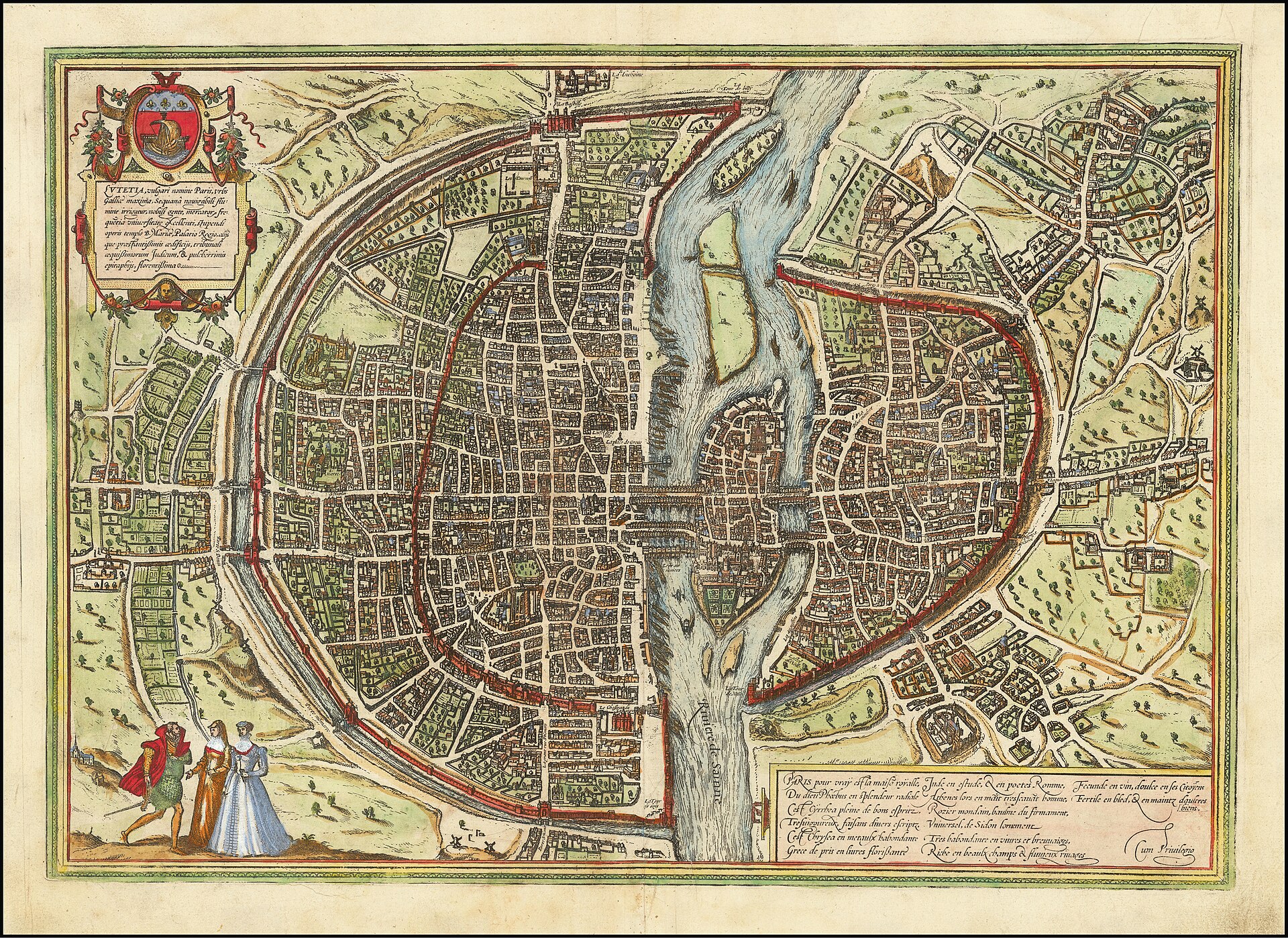
Plan of Paris (Lutetia), from Braun & Hogenberg's Civitates Orbis Terrarum
Shows the walled medieval city with the Seine and Île de la Cité, bridges, defensive walls, detailed street blocks and churches.
1572 · Georg Braun & Frans Hogenberg · Wikimedia Commons
Public domain (plate dated 1572)
In this city
Landmarks of Paris, see each in its prime


Castles of Paris


More cities to explore
 FranceRouenExplore it in 1431 · 1540 · 1876
 FranceReimsExplore it in 1429 · 1900
 FranceLyonExplore it in AD 100 · 1500 · 1835
 FranceStrasbourgExplore it in 1440 · 1770 · 1900
Castles of Europe · Landmarks of Europe · create your own reconstruction.