Historic Cities · France
Lyon through the ages
Lyon is a city in France. It is located at the confluence of the rivers Rhône and Saône, to the northwest of the French Alps, 391 km (243 mi) southeast of Paris, 278 km (173 mi) north of Marseille, and 113 km (70 mi) southwest of Geneva, Switzerland.

Lyon in AD 100
Roman Lugdunum
This is Lugdunum at the height of its early imperial prosperity: a provincial capital straddling the Saône and Rhône with temples, theatres on Fourvière, aqueducts, busy river quays and an imperial mint. The walk moves from the hilltop sanctuaries and theatres down to the rivers and market quays, passing workshops, the forum and the civic monuments that mark Roman civic life.
Stone and tile dominate the skyline: terracotta roofs and pale limestone walls climbing the Fourvière heights above the brown rivers. Broad arched aqueducts stride across lower slopes, while temples and the curved mass of the theatre stand out against sky. Street-level scenes are shaded porticoes, sunlit open markets, packed river-wharves with amphorae and wooden masts, and compact blocks of two- and three-storey stone houses along paved Roman streets.
The route: 21 streets, squares and views
Approach on Via Agrippa → Monts d'Or Aqueduct → Fourvière Hill → Great Theatre of Fourvière → Odeon of Fourvière → Sanctuary of the Three Gauls → The Confluence (Confluens) → Saône Right-Bank Wharves → Riverside Warehouses → Vaise District Workshops → …
Step inside, 12 interiors
Atrium of a Patrician Domus · Scaenae Frons and Stage House · Small Covered Concert Hall · Regional Council Curia · Wharfside Merchants' Counting Room · Granary and Riverside Warehouse · Bronze Smith's Workshop · Amphitheatre's Central Arena · Basilica's Public Hall · Coining Hall of the Mint · Caldarium Hot Bath Chamber · Timbered Cargo Shed
Planned from the Wikipedia record: Lugdunum.
Lyon in 1500
Renaissance Lyon
Lyon in 1500 is a dense, prosperous Renaissance entrepôt where four yearly international fairs and a rising printing trade bring merchants, books and bankers from across Europe. The walk moves from the Roman heights of Fourvière down through Vieux Lyon's narrow streets and traboules, across the busy Presqu'île of printers and loggias, and out toward the Guillotière fairs at the Rhône bridge.
A compact city of steep stone hills and narrow, tiled roofs, Lyon in 1500 shows ochre and pink plaster beside dark timber framing, high medieval gables and the squat mass of Saint-Jean cathedral. Stone bridges cross the brown Rhône and Saône, quays and narrow streets teem with packhorses, carts and hawkers, and the peninsula around rue Mercière is a tight spine of timber-fronted houses, signboards and printing banners where smoke and ink hang in the air.
The route: 22 streets, squares and views
Fourvière Hill Approach → Roman Theatre, Fourvière → Montée du Gourguillon → Porte Saint-Jean → Place Saint-Jean → Cathédrale Saint-Jean → Rue Saint-Jean → Tour Rose Traboule → Rue du Bœuf → Place Saint-Paul → …
Step inside, 13 interiors
Odeon Stage Chamber · Cooper's Workshop · Cathedral Sacristy · Astronomical Clock Chamber · Traboule Court and Stair · Merchant's Courtyard · Wool Merchants' Hall · Customs Toll Chamber · Printing Press Workshop · Moneychangers' Exchange Hall · Florentine Bankers' Counting House · Fishmongers' Covered Stalls · Hôtel-Dieu Infirmary Ward
Planned from the Wikipedia record: History of Lyon.
Lyon in 1835
Silk-weavers' Lyon
Lyon in 1835 is a city shaped by silk: the Croix‑Rousse slopes are a forest of tall canut houses and workshop windows, and the two rivers carry raw silk and finished cloth to markets. The walk moves from the city's high terraces and Roman ruins down through Vieux Lyon and the Presqu'île to the canuts' streets and the Rhône quays.
The skyline is a staccato of rooflines: low Renaissance houses along the Saône, the cathedral's towers, the odd classical hospital façade on the Rhône and the steep ribs of Croix‑Rousse rising like a fabric mill. Buildings are mostly pale stone and ochre plaster; shutters and loom‑windows punctuate brickwork. Narrow streets open to a few wide squares; smoke from dyehouses and steamboat funnels hangs over river quays.
The route: 22 streets, squares and views
Fourvière Slope View → Roman Theatre of Fourvière → Cathédrale Saint-Jean → Rue Saint-Jean → Traboule at Rue du Bœuf → Pont du Change → Quai Saint-Antoine → Place Bellecour → Rue Mercière → Place des Terreaux → …
Step inside, 13 interiors
Vaulted Theatre Passage · Saint-Jean Nave · Tight Bouchon Common Room · Covered Traboule Gallery · Drapery Sample Hall · Town Hall Council Chamber · Hôtel-Dieu Infirmary Ward · La Guillotière Market Hall · Steamboat Lower Saloon · Gareur's Workbench · Ourdisseuse's Warping Loft · Upper Canut Workshop · Bon‑Pasteur Arsenal Room
Planned from the Wikipedia record: Canut revolts.
Its story
The story of Lyon.
Lugdunum: Capital of the Gauls, 43 BC–AD 197
Long before Rome arrived, Stone Age traces suggest that trade routes from the Mediterranean to northern Europe may already have passed through the confluence of the Rhône and the Saône, and the Segusiavi, Aedui and Allobroges were already in contact across it. There is little evidence of extensive settlement, but the top of Fourvière has yielded thousands of amphorae and animal bones, the debris of groups meeting and feasting there. According to Dio Cassius, in 43 BC the Roman Senate ordered a settlement built for Roman refugees of the war with the Allobroges, who had been expelled from Vienne and were encamped at the confluence. Lucius Munatius Plancus, a former officer under Caesar and later proconsul of Gallia Comata, is credited with the founding, though the true date is debated. The colony was small and lightly defended, raised ground behind wooden palisades, and its founder named it Colonia Copia Felix Munatia.
Three things turned that modest colony, capital of the Roman province of Gallia Lugdunensis, into a great city. Augustus's campaign to conquer Germania from 20 BC made it the operations centre for the northern territories, since the Roman road network traced directly to its centre. The administrative organisation of Gaul was still incomplete, so governors supervised the whole region from there. And from 12 BC the annual assembly of Gallic notables met at the confluence, the same year the Sanctuary of the Three Gauls was inaugurated. In 15 BC Augustus installed a mint to finance his German campaigns, promoted to imperial rank, a privilege unique in the empire, which struck until AD 78, reappeared briefly in 196–197 and was recreated by Aurelian in 274 against the devalued and imitated coinage then circulating; downgraded in 294 when the Trier mint opened, it kept working until 413.
The wealth showed. Aqueducts were probably built between 20 and 10 BC; a theatre of about 4,500 seats opened between 16 and 14 BC by decree of Augustus and was enlarged under Hadrian to hold some 10,700; the Amphitheatre of the Three Gauls was inaugurated in AD 19 and extended around 130–136; Antoninus Pius added an odeon of 3,000 seats about AD 160. The population rose towards 70,000, with trade communities of sailors, vintners, plasterers and potters each organised under a board of dignitaries. Amable Audin reckoned that over a quarter of the inhabitants bore Greek names. Two emperors were born there: Claudius in 10 BC, whose speech arguing for the admission of Gauls to the Senate survives on the Lyon Tablet, and Caracalla. For three hundred years after its foundation it was the most important city in north-western Europe. Seneca the Younger records a fire that destroyed and razed the city under Nero, a disaster attested by that text alone and never corroborated archaeologically. After the Battle of Lugdunum in 197 the city never fully recovered.
The Martyrs of 177 and the Primate of the Gauls
Christianity reached Lugdunum early, brought by Greeks from Asia Minor who had settled there in numbers. In AD 177 the city's duumvirs questioned the Christians, and the community wrote to their co-religionists in Asia Minor naming forty-eight of their number who had been martyred in the Croix-Rousse amphitheatre, among them Pothinus, the first Bishop of Lyon. Blandina and Epipodius were among the local saints of persecutions under emperors including Marcus Aurelius and Septimius Severus. The church recovered quickly: Pothinus's successor Irenaeus, a Greek, wrote at such length and depth that he ranks among the major early Christian theologians, and in the fifth century Sidonius Apollinaris continued that intellectual line.
The see outlasted the empire that had persecuted it. Monastic communities were established between the fourth and sixth centuries at Île Barbe and Saint-Martin d'Ainay, and in 1078 Pope Gregory VII conferred the title of Primate of the Gauls on the Archbishopric of Lyon, a title its holder still bears. Military monastic orders settled in the twelfth century, and the city became a comfortable stopover and temporary residence for the papacy: both Clement V, at the Basilica of Saint Justus, and his aged successor John XXII were crowned in Lyon.
Burgundian Capital, Imperial Fief, French Only in the 14th Century
Burgundians fleeing the destruction of Worms by the Huns in 437 were resettled in eastern Gaul, the Romans established the Kingdom of the Burgundians in 443, and Lugdunum became its capital in 461. In 843 the Treaty of Verdun assigned Lyon to Lothair I; it later formed part of the Kingdom of Arles, which was absorbed into the Holy Roman Empire in 1033. When Frederick Barbarossa married Béatrice, heiress of the counts of Burgundy, he formally recognised the archbishopric's de facto control of the city in the Golden Bull of 1157. Lyon did not come under French control until the fourteenth century.
Peace brought newcomers, among them a large Jewish community trading in precious stones, metals, jewellery and fabrics. Money-lending helped underpin the city's prosperity, financing trade with the East and business at the Chalon and Champagne fairs, and it was tolerated in Lyon so long as it was conducted by Jews in the twelfth and thirteenth centuries, or afterwards by Lombard bankers. The change of hands followed the expulsion of the Jews from France by the edict of 17 September 1394, after which the Lyon community relocated to Trévoux, Saint-Symphorien-d'Ozon and Vienne.
Fairs, Florentines, Printing and Silk, 1436–1601
A century of warfare, the écorcheurs loosed on the Lyonnais countryside by the peace of Arras, and Charles VII's increases to both the taille and the gabelle produced an urban revolt in 1436 that ran from April to 6 June. The crowd went after two targets: royal commissioners with their bureaucrats, and taxpayers in arrears. Barbers and beltmakers, small tradesmen, were the most heavily represented among the rebels. Charles VII arrived on 20 December 1436 and ordered an investigation still pending the following 19 January; by Steyert's account three inhabitants were sentenced to death, a barber was maimed and a hundred and twenty citizens were banished.
Under Louis XI four annual fairs were established, drawing merchants from across Europe and above all from Italy, Florence in particular. Lyon became a major centre of the spice trade and then, more consequentially, of silk, after François I granted weaving privileges that had until then been an Italian monopoly. The Florentine immigrants who came through the fairs turned the city into a centre of banking and insurance; when international banking moved on to Genoa and then Amsterdam, Lyon remained the financial counting house of France.
The printing press reached Lyon by 1473, its workshops clustering on the rue Mercière on the peninsula between the rivers, and through the Renaissance the city published in many languages: editions of Erasmus, Rabelais, Étienne Dolet and Thomas More, many issued by the Württemberger Sebastian Gryphius, the first Lyon printer to publish work entirely in Greek. Maurice Scève and Louise Labé wrote there alongside Italian exiles such as Luigi Alamanni. The peace did not hold: Protestant troops seized the city in 1562, and in 1572 Lyon saw mass violence by Catholics against Protestant Huguenots in the St Bartholomew's Day Massacre. The Treaty of Lyon of 1601 ended a war and added large parts of the Duchy of Savoy to the French kingdom; the city lost the considerable autonomy it had enjoyed, though its commerce and industry went on undiminished.
"Lyon No Longer Exists": Revolt, Siege and Terror, 1793–1797
Through the seventeenth and eighteenth centuries Lyon's pre-eminence in silk production went unchallenged, with Vaucanson and Jacquard making far-reaching contributions to the industry, and the prosperity of the 1700s showed the need for systematic town planning, carried out by de Cotte, Soufflot, Morand and Antoine-Michel Perrache. The Revolution ended that. In 1793 Lyon backed the Girondins against the National Convention and was judged too royalist for it; the revolt drew a siege by Revolutionary armies lasting over two months, and the city surrendered in October 1793.
Jean-Marie Collot d'Herbois and Joseph Fouché then administered the execution of more than two thousand people, shot or decapitated. Buildings were destroyed, particularly around the Place Bellecour, and architectural work stopped. By a decree of the Convention of 12 October 1793 the city was renamed Commune-Affranchie, the Emancipated Commune, and a plaque was erected proclaiming that Lyon had made war on Liberty and that Lyon no longer existed. The name was resumed in 1794 after the end of the Terror, and a decade later Napoleon ordered the reconstruction of everything demolished. The reprisals did not stop with the Convention: days after the Coup of 18 Fructidor on 4 September 1797, a commissioner of the Directory was assassinated in Lyon.
Canuts, 210,000 Silk Workers and the Anarchist Decades, 1831–1894
Development revived under the Napoleonic Empire and Lyon became an industrial city. In 1831 and again in 1834 the canuts, the silk weavers, staged major uprisings for better pay and working conditions. The first of the city's extensive network of funicular railways began operating in 1862, and the traboules (covered passages cutting through buildings, the earliest of them thought to date from the fourth century) carried the canuts from their workshops on the slopes of the Croix-Rousse down to the textile merchants at the foot of the hill. By the end of the nineteenth century Lyon had 310 silk factories employing 210,000 workers and 320 silk traders, exporting mainly to North America and England but also to India and China.
The same decades made the city one of the recognised capitals of the anarchist movement, with a run of closely related newspapers succeeding one another as each was banned. Relations with the state hardened through the early 1880s. On 23 October 1882 Fanny Madignier and other anarchists bombed the Assommoir restaurant in revenge on the Lyonnais bourgeoisie for the repression of the movement, which stood accused of links with the Montceau-les-Mines troubles and the Black Band; one person was killed, the first lethal act of propaganda by the deed in French history, and the attack served as the pretext for the Trial of the 66 in January 1883. Police raids on the city's anarchists in January and February 1894 achieved little; in June that year Sante Caserio assassinated President Sadi Carnot, who had been responsible for the repression, as he travelled to the Exposition universelle, internationale et coloniale at the Parc de la Tête d'Or.
Occupation, Liberation and the Modern Metropolis
During the Second World War Lyon was a centre for the occupying German forces, among them Klaus Barbie, the "Butcher of Lyon", who tortured prisoners and was ultimately convicted of crimes against humanity. It was at the same time a stronghold of the French Resistance, and the traboules let people escape Gestapo raids through the buildings. The 1st Free French Division and the Forces Françaises de l'Intérieur liberated the city on 3 September 1944. A Resistance museum now stands in the city.
The post-war decades pushed Lyon towards a European role through its transport links and cultural institutions, and the Part-Dieu business quarter was created in 1960. In 1998 the historic site was inscribed on the UNESCO World Heritage List for what the citation called an "exceptional testimony to the continuity of urban settlement over more than two millennia on a site of great commercial and strategic significance": the Roman district and Fourvière, the Renaissance quarter of Vieux Lyon, the silk district on the slopes of the Croix-Rousse, and the Presqu'île. Lyon is the prefecture of the Auvergne-Rhône-Alpes region and the third-largest city in France, with 519,127 people inside its 48 square kilometres in 2023, 1,436,354 in the Metropolis of Lyon formed with 58 suburban municipalities in 2015, and 2,339,329 in the wider metropolitan area. As of 2011, 14 per cent of its population was born outside metropolitan France. Auguste and Louis Lumière invented the cinematograph in the city, and it hosts the international headquarters of Interpol.
From the archive
Lyon on paper: the old town as it was mapped.
A period plan or bird's-eye view of the old town, drawn between 1500 and 1850, the streets this page's reconstructions walk. Public domain, with its source named.
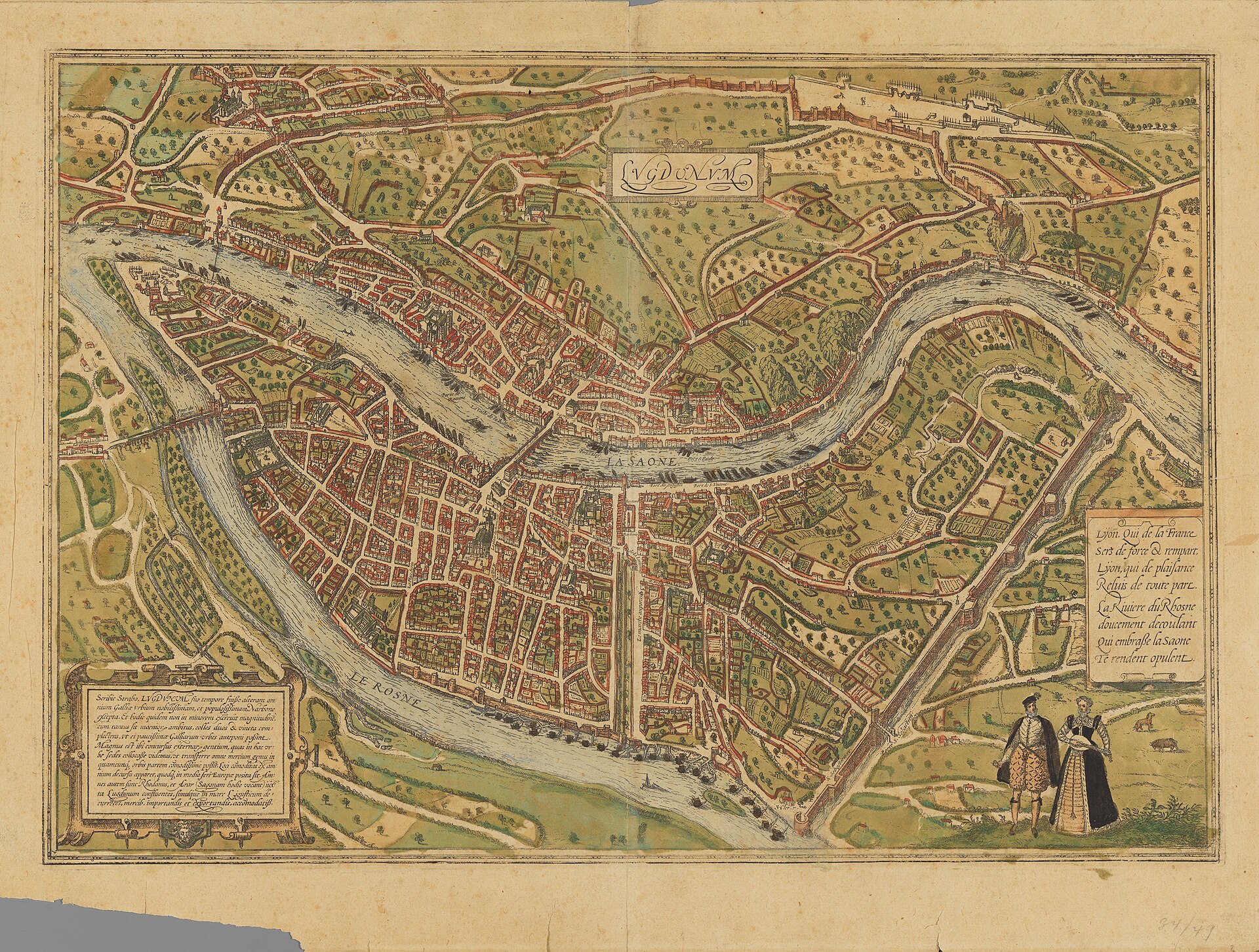
Bird's-eye view of Lyon (Lugdunum), drawn by Joris Hoefnagel for Braun & Hogenberg's Civitates
Depicts the walled old town on the Presqu'île with gates and bridges, the Saône and Rhône rivers, street blocks and prominent church spires.
1575 · Hoefnagel, Joris · Wikimedia Commons
Public domain (plate dated 1575)

More cities to explore
 FranceAnnecyExplore it in 1610
 FranceDijonExplore it in 1450
 FranceParisExplore it in 1250 · 1670 · 1789 · 1889
 FranceRouenExplore it in 1431 · 1540 · 1876
Castles of Europe · Landmarks of Europe · create your own reconstruction.