Historic Cities · France
Annecy through the ages
Annecy is the prefecture and largest city of the Haute-Savoie department in the Auvergne-Rhône-Alpes region of Southeastern France. It lies on the northern tip of Lake Annecy, 35 kilometres (22 mi) south of Geneva, Switzerland.

Annecy in 1610
The Savoy Lake Town
Annecy in 1610 is the small Savoyard capital of the Genevois, a lakeside clerical centre of the Counter‑Reformation where the bishop's voice threads through the town's canals. Visitors will see the Palais de l'Île slicing the Thiou, arcaded streets and market stalls, tanners and millers working the sluices, and the castle of the Genevois‑Nemours dukes above the roofs.
Stone houses with steep slate roofs cluster between the glass‑green lake and the low hill of the château; the narrow streets are a mix of ochre lime‑wash and exposed timber, pierced by arcades and small bridges. The Palais de l'Île sits like a ship's prow in the Thiou, while the canals (Vassé, Saint‑Dominique and the Thiou) carry wooden mills, sluices, washing steps and the pale reflections of Semnoz and La Tournette.
The route: 15 streets, squares and views
Lac d'Annecy: North Shore → Quai Sainte‑Claire → Porte Sainte‑Claire → Rue Sainte‑Claire → Place Sainte‑Claire → Palais de l'Île → Thiou at the Palais → Canal du Vassé and Mills → Canal de Saint‑Dominique → Tanners' Washing Steps → …
Step inside, 9 interiors
Common Room of the Lakeside Inn · Island Courthouse Chamber · Boatwright's Workshop · Stone Mill Wheel Chamber · Tannery Loft over the Thiou · Arcaded Market Hall · Nave of Saint‑Maurice Cathedral · Cloister Refectory · Genevois‑Nemours Great Chamber
Planned from the Wikipedia record: Annecy.
Its story
The story of Annecy.
From Boutae to Anesciacum: the Plain Abandoned, 121 BC–867
Rome beat the Allobroges in 121 BC and again, decisively, in 62 BC, then laid roads and staging inns across the district, among them a secondary route from Turin to Geneva. On the site of an earlier Allobrogian village in the plaine des Fins a Gallo-Roman settlement grew from the second half of the 1st century BC, recorded on the Antonine Itinerary as Ad Bautas, Boutae. It covered some 26 hectares and prospered from the 1st century into the first half of the 3rd, acquiring a public space comparable to a forum together with a basilica, temples, baths and a theatre; the pottery and amphorae found there came from Baetica, from elsewhere in Spain and from Mauretania.
Boutae was raided by the Alamanni in 259 and 278 and by the Bagaudae, and burnt more than once in the 3rd century. Occupation appears to have continued into the 5th, after which the settlement drifted off the plain. Around 443 the Roman general Aetius granted the Sapaudia to the Burgundians (a short 5th-century notice records that "Sapaudia is given to the remnants of the Burgundian people to be shared with the inhabitants"), and growing insecurity drove people from the flat land up onto the neighbouring hills. An agricultural estate on the slope of Annecy-le-Vieux is attested for the 7th and 8th centuries; it entered the royal domain in the century after, and appears as Anesciacum in the 9th. The name is first attested in 867, in the charter by which Lothar II endowed his wife Theutberge. Its ending descends from the Gallo-Roman suffix -(i)acum, "property of"; whose property is disputed, one reading deriving the stem from a Roman Anicius and another from the Germanic personal name Anerīk.
Annecy-le-Neuf and the Counts of Geneva, 1107–1394
The town as it now stands began in the 11th century at the foot of a defensive tower on the last spur of the Semnoz. A text of 1107 confirms the existence of Annecy-le-Neuf on the banks of the Thiou and gives the first mention of a church of Saint-Maurice below the castle. Under Count Amédée I of Geneva it grew as a large village with numerous byres, and in 1132 a fortified house was built on the island in the Thiou, the building later known as the Palais de l'Isle. Locked in a long quarrel with the bishops of Geneva, the counts of Geneva ended the 12th century by withdrawing to Annecy: first to the manor of Novel out in the plaine des Fins, then to the castle, which they enlarged in the 13th century. The town became the capital of their county.
Amédée III ruled from 1320 to 1367, the year Annecy's franchises were confirmed. His wife, Countess Mahaut de Boulogne, gave birth at the castle to Robert, the last count of Geneva, who set off the Great Western Schism by becoming Pope Clement VII in residence at Avignon. In 1394 Robert raised the church of Notre-Dame-de-Liesse, burial place of the counts of Geneva, to collegiate status, and it became a popular centre of pilgrimage.
Capital of the Apanage: Savoy Takes the Genevois, 1401–1659
Clement VII died in 1394, and in 1401 Amédée VIII, count of Savoy, acquired the county of Geneva. It was broken in two: the county of Geneva proper, the city and its surroundings, which kept a large measure of autonomy, and the county of Genevois, with Annecy as its capital. To win over inhabitants who did not welcome attachment to the House of Savoy, the duke created the apanage of Genevois and Faucigny in 1434 for his younger son Philippe of Savoy. It lapsed when Philippe died without issue in 1444, and was reconstituted from 1460 to 1491 for Janus of Savoy (count of Genevois, baron of Faucigny, lord of Beaufort, Ugine, Faverges and Gourdans), who made Annecy his official residence. Under Janus the county's organs of government were established in the town: the comital council, the chamber of accounts, the fiscal procurator and the juge mage.
Annecy reverted to Savoy from 1491 until 1514, when Charles II enfeoffed the Genevois and the baronies of Faucigny and Beaufort to his brother Philippe, made duke of Nemours in France in 1528 and the first prince of the Genevois-Nemours line. Emmanuel-Philibert erected the county into a duchy in 1564, the better to bind and watch Jacques de Savoie-Nemours, whom he judged too French for comfort. The line ran until the death of Henri II, last duke of Genevois-Nemours, on 14 January 1659. The town itself was run by a general council of its burgesses, who elected syndics for three-year terms; from 1491 a narrow council known as the Twelve, made up of the syndics and a body of councillors, took charge of its affairs.
The Rome of the Alps: Geneva's Bishops in Exile, 1536–1648
When the Calvinist reform triumphed at Geneva, the canons of the cathedral of Saint-Pierre moved to Annecy from 1536, and Catholic orders such as the Poor Clares came with them. From 1560 northern Savoy and Annecy, sitting on the dividing line between the confessions, became a forward citadel of the Counter-Reformation. The bishop of Geneva was habitually resident from 1568, the first to live there permanently being Ange Giustiniani, bishop from 1568 to 1578; the Catholic reform in the diocese effectively dates from his successor Claude de Granier, bishop from 1578 to 1602. On 5 October 1600, at the close of the Franco-Savoyard war, Henri IV entered Annecy having invaded and conquered Savoy, accompanied by Henri I of Savoy-Nemours, who had come over to him in 1594; he stayed three days.
Francis de Sales (born at Sales in 1567 and sent as a boy to the college at Annecy that Eustace Chapuys had founded in 1549) was bishop of Geneva in residence at Annecy from 1602 to 1622. He preached himself, then laid the basis of a reform of the clergy and of a change in manners and habits of mind across his diocese, and the success of his Introduction to the Devout Life carried his name across Catholic Europe. His relics are kept in the cathedral; he was canonised in 1666. In 1606, twenty-eight years before the founding of the Académie française, he and Antoine Favre, president of the Senate of Savoy, created the Académie florimontane on the Italian model. In 1610 he and Jeanne de Chantal founded the order of the Visitation in the town.
The orders arrived in numbers: Capuchins in 1592, Visitandines in 1610, Barnabites in 1614, the Annonciades of Saint-Claude in 1638, the reformed Bernardines in 1639, the Lazarists in 1641, the Cistercians of Bonlieu in 1648. Annecy held thirteen religious houses for 5,000 inhabitants, and half the town belonged to the orders, not only churches and convents but workshops, mills and wide holdings of land and forest. They ran the schools and the hospitals and gave the local artisans and traders their work. It was in these years that Annecy became known as the "Rome of the Alps".
Invasion, the Mont-Blanc Department and the Treaty of Turin, 1792–1860
Revolutionary ideas reached the Annecy bourgeoisie through Savoyards living in Paris, through the Encyclopédie and through the writings of Voltaire and of the Genevan Jean-Jacques Rousseau, which stood in the private libraries of the town's notables. On the night of 21–22 September 1792 French troops under General Montesquiou invaded the Duchy of Savoy by surprise, and the Sardinian army under the elderly General Lazary, along with officials and clergy, fled to Turin, capital of the Savoyard states since 1562. At the end of October the Assembly of the Allobroges, meeting in Chambéry cathedral, declared an end to despotism and abolished the sovereign rights of the House of Savoy, the nobility, seigneurial dues and rights, and the militia. It created the department of Mont-Blanc, in which Annecy was no more than the chief town of a district.
A republican municipality was elected under the lawyer Jean-François Favre, but real power lay with the Jacobin society of the Friends of Liberty and Equality, 110 members drawn from the whole bourgeoisie of the town. The French troops had at first been received with some enthusiasm, the senior officials having fled and the inhabitants feeling themselves genuinely liberated. Mass conscription, requisitions paid in devalued assignats, higher taxes, the economic crisis that followed the exile of the nobles and the refractory priests, and the expropriation of church property turned that welcome. The diocese was suppressed in 1801.
After the Bourbon restoration in 1815 Annecy was returned to the King of Sardinia and the diocese was restored in 1822; the town hall was completed in 1851. When Savoy was annexed to France by the Treaty of Turin on 24 March 1860, Annecy became the capital of the new department of Haute-Savoie.
Canals, Bearings and the Film Festival, 1860–2025
The canals of the Vassé and Saint-Dominique and the river Thiou had served to defend the town until the 19th century; industry then turned them to hydraulic power for textile work, paper making and the trades that followed. Nineteenth-century Annecy manufactured silk, linen and cotton goods, glass, cutlery, earthenware and leather, bleached linen and mined iron. By the First World War it was joined by rail to Aix-les-Bains and had factories for linen and cotton goods, felt hats and paper, with a bell foundry at Annecy-le-Vieux. The Palais de l'Isle, prison and courthouse until the Revolution, was classified a historic monument in 1900 and was used as a prison again during the Second World War; it now holds a local history museum.
Annecy hosted the second round of the General Agreement on Tariffs and Trade talks in 1949. The castle was restored and a fine art museum opened in it in 1956, and from 1960 the town built its tourism on the lake, on the ski resorts within reach and on culture, taking the international animated film festival and, from 1965, the fête du lac, each drawing around 100,000 visitors a year. An institute of technology opened in 1973, merged with the Savoy university centre in 1979 and became part of the université Savoie-Mont-Blanc in 2015. Manufacturing stayed: SNR bearings, Salomon, Fusalp, Mavic and Entremont all had their headquarters in the town in 2025.
Hemmed in between the lake and the protected Semnoz, with little land left to build on, the town proper held a population of around 50,000 from 1950. On 1 January 2017 it merged with the former communes of Annecy-le-Vieux, Cran-Gevrier, Meythet, Pringy and Seynod, giving a city of 128,199 people and an urban area of 177,622. It is the prefecture of Haute-Savoie.
From the archive
Annecy on paper: the old town as it was mapped.
A period plan or bird's-eye view of the old town, drawn between 1500 and 1850, the streets this page's reconstructions walk. Public domain, with its source named.
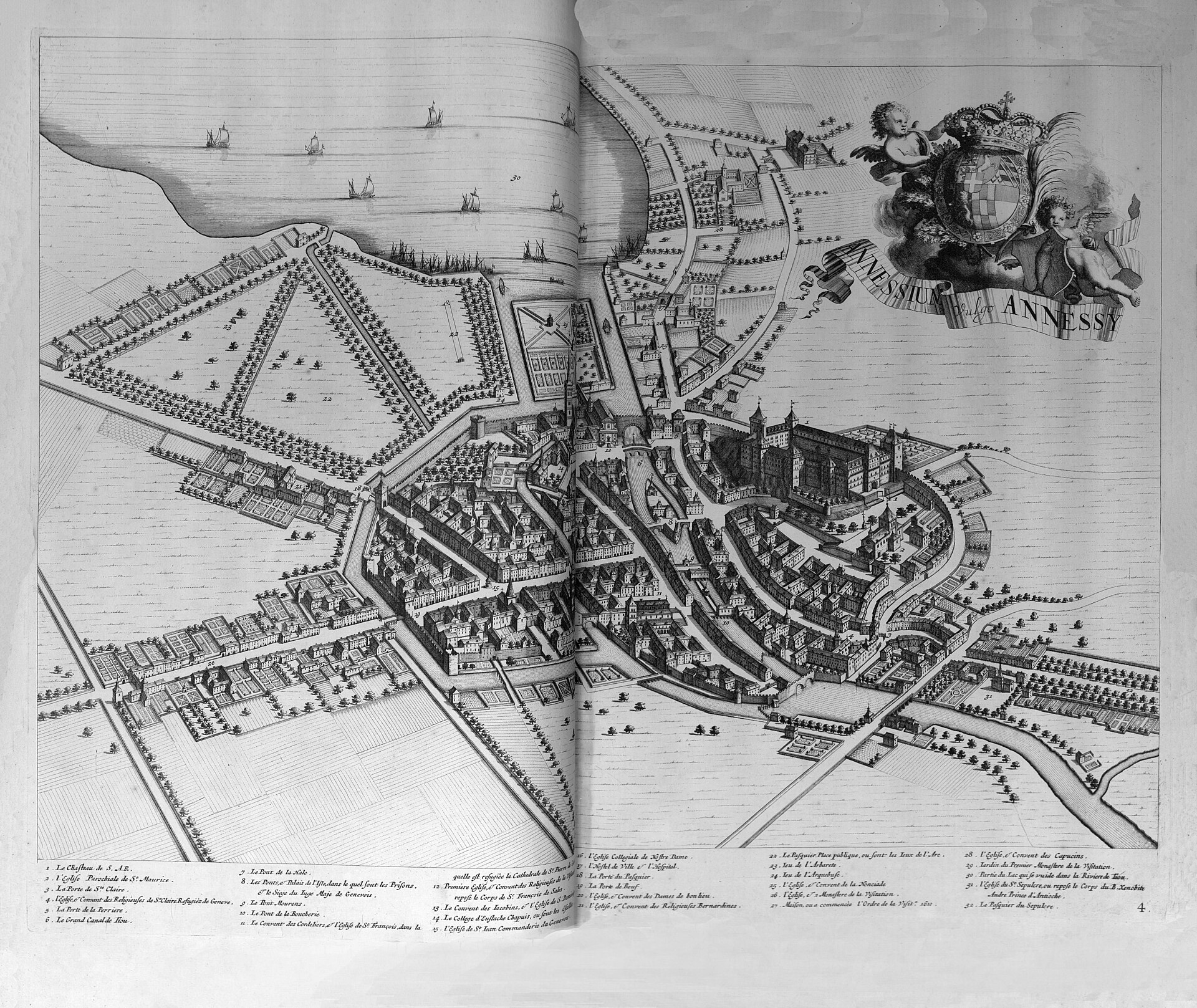
Bird's-eye view of Annecy, from Nouum Theatrum Pedemonti et Sabaudiae (1651)
Engraved bird's-eye of the walled old town showing streets and gates, the château on its promontory and the Lac d'Annecy shoreline.
1651 · Fondo Antiguo de la Biblioteca de la Universidad de Sevilla · Wikimedia Commons
Public domain (plate dated 1651)
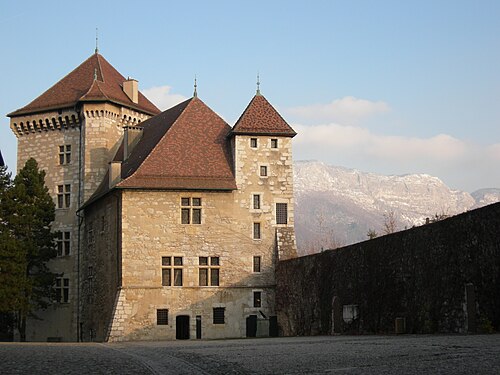
Castles of Annecy

More cities to explore
 FranceLyonExplore it in AD 100 · 1500 · 1835
 SwitzerlandBernExplore it in 1500 · 1750
 FranceParisExplore it in 1250 · 1670 · 1789 · 1889
 FranceRouenExplore it in 1431 · 1540 · 1876
Castles of Europe · Landmarks of Europe · create your own reconstruction.