
France · Restored
Château de Menthon-Saint-Bernard
The Château de Menthon is a medieval castle on a high rocky promontory above Lake Annecy in Haute-Savoie, France, occupied by the Menthon family since the 12th century and remodelled across the centuries. The present appearance largely reflects 19th-century restorations that unified the medieval towers with added turrets and a half-timbered gallery; it is a privately owned, visitable monument historique with furnished rooms, a large library and medieval kitchens.
First raised
1000
Its prime
1880
Today
Restored
As it stood in 1880
What Château de Menthon-Saint-Bernard looked like in its prime.
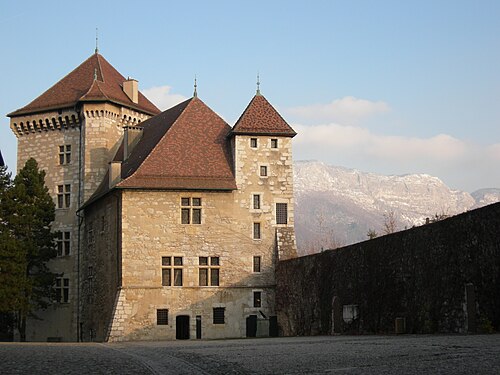
Perched on a roughly 200 m high limestone rock, the château reads as a compact cluster of grey-beige stone buildings dominated by three large square medieval towers, several smaller cylindrical turrets with conical red-brown roofs, and raised curtain walls. A lower outer wall encloses a courtyard; steep pitched roofs and added decorative turrets puncture the skyline. The side facing the lake has a suite of large windows and a terrace; stone walls show coursed masonry and medieval arrow-slit openings.
Its story
The story of Château de Menthon-Saint-Bernard.
The Guard Post of c.923 and Bernard of Menthon
The first fortress on the rock went up in the 10th century, about 923: a simple wooden guard post on a promontory above the old Roman road and Lake Annecy, set on a spur 600 metres above sea level and watching the road from Bluffy to Menthon. Bernard of Menthon, founder of the hospice at the Great St Bernard pass, is said to have been born in that first fortress in 1008.
The Menthons, Their Three Square Towers and the Tour des Armes
The origin of the Menthon family is uncertain, though they are held to have come from Burgundy, and the lords of Menthon are documented from the end of the 12th century; the family holds the château still. They built the three great square towers soon after they arrived, and from the 13th century acquired a degree of feudal power. The castle itself is first mentioned in 1249, and in 1261 Thomas de Menthon received the investiture of the annual fair, held on the first Sunday after All Saints, from the bishop of Geneva.
The present buildings were raised between the 13th and the 19th centuries. On the highest ground to the north-east, facing the attack, stands the keep called the tour des armes, an irregular quadrangular block some eight metres to a side, flanked by a circular stair turret carried up above it as a lookout; a second tower, nine metres by twelve, commands the entrance to the south-west. The enceinte, pierced with arrow slits, is tied to the keep by curtain walls, and the gate is covered by a machicolation. The whole was heavily remodelled in the 14th and 15th centuries, but masonry of the 13th century survives, and some of it perhaps of the 12th.
Nicod de Menthon and the Renaissance Barony
In the 15th century Nicod de Menthon served Duke Amédée de Savoie as ambassador to France, then as governor of Nice, and commanded as admiral the fleet the church council sent to Constantinople. At the Renaissance the medieval fortress was turned into a sumptuous residence and the seat of the barony of Menthon: apartments took the place of the wall-walks between the towers, and the family bought furniture in quantity.
Comfort, Insurgents and Viollet-le-Duc, 1740–1890
The castle's general appearance held until 1740, when alterations were made for comfort: a suite of spacious, well-lit rooms was added on the lake side, among them the dining room and a hall of 100 square metres with four windows over the water. The one notable incident the château's history records came on 7 May 1793, when a band of insurgents led by Maurice Genand came down from the Thônes valley to take arms and ammunition from it, including two small cannon known as campagnardes. In 1809 it was bought by François Ruphy de Menthon de Lornay. Between 1860 and 1890 Count René de Menthon, a fervent disciple of Viollet-le-Duc, consolidated and heightened the walls, added the turrets and made the half-timbered gallery of the inner courtyard, giving the building the outline it carries now.
François de Menthon at Nuremberg, and the Listed Château
François de Menthon, of the same family, was a lawyer and a member of the Resistance who appeared as a prosecutor for France at the Nuremberg trials; he worked for the creation of a united Europe and was Minister of Justice under de Gaulle.
The château was listed as a monument historique by an order of 21 February 1989 and remains in Menthon hands. It opens from May to September, with a company of actors reviving its past in summer, and takes some 40,000 visitors a year; its library holds more than 12,000 works from before 1800, among them incunabula, manuscripts on parchment illuminated by medieval monks, and one of the rare complete editions of Diderot's Encyclopédie. The château is sometimes named as the inspiration for Walt Disney's Sleeping Beauty castle, as is Neuschwanstein.
Step inside
9 places to explore in 1880.
The record describes 9 distinct spots at Château de Menthon-Saint-Bernard, including 4 interiors: great hall (grand hall), countess's bedroom, 13th-century kitchens and more. Create your own photoreal reconstruction and explore every one, more scenes means more rooms, more angles, and more of the place to stand in.
Build Your Own Castle
Recreate Château de Menthon-Saint-Bernard with AI to explore it.
The artist rebuilds it as it stood in 1880, a photoreal reconstruction that belongs to you alone. Pay with coins, no subscription needed.
Recreate this castle →Defend this castle →Whose castle
Clans who held Château de Menthon-Saint-Bernard.
The families that held Château de Menthon-Saint-Bernard for a decade or more across its history, follow a name to its clan.
Menthon
Occupied by the Menthon family from 1180 to the present day.

Questions about Château de Menthon-Saint-Bernard
What is the history of Château de Menthon-Saint-Bernard?
What is inside Château de Menthon-Saint-Bernard?
Who owns Château de Menthon-Saint-Bernard now?
Why was Château de Menthon-Saint-Bernard built, and what was it used for?
Does anyone live in Château de Menthon-Saint-Bernard now?
Where is Château de Menthon-Saint-Bernard?
When was Château de Menthon-Saint-Bernard built?
Which family or clan held Château de Menthon-Saint-Bernard?
What did Château de Menthon-Saint-Bernard look like in its prime?
Is Château de Menthon-Saint-Bernard still standing, or is it a ruin?
Can you visit Château de Menthon-Saint-Bernard?
More castles of France


Explore the city


