Historic Cities · France
Rouen through the ages
Rouen is a city on the River Seine, in northwestern France. It is in the prefecture of region of Normandy and the department of Seine-Maritime. Formerly one of the largest and most prosperous cities of medieval Europe, the population of the metropolitan area is 712,886 (2022). People from Rouen are known as Rouennais.

Rouen in 1431
Joan of Arc's Rouen
Rouen in 1431 is the English-occupied Norman capital and a great medieval entrepôt of cloth and river trade, where Joan of Arc was tried and burned after an English tribunal. The walk moves from the Seine and quays through timbered lanes, market squares and the cathedral precinct to the castle keep and city ramparts, showing everyday work, worship and commerce under occupation.
A compact medieval city pressed to the Seine, Rouen in 1431 shows dense rows of dark half‑timber houses, steep gables and overhanging upper stories above narrow, muddy lanes. Lead and slate roofs crowd a skyline of unfinished Gothic pinnacles and squat bell towers; the cathedral's western face rises in dressed stone but lacks later spires. Barges and roped boats line the busy quays, while the castle keep and city walls loom in stone above timbered suburbs.
The route: 23 streets, squares and views
Seine bank at Petit‑Quevilly → Quays of the Seine → Medieval bridge approach → Western city gate → Grande Rue → The Gros Horloge → Rue du Gros‑Horloge → Place du Vieux‑Marché → Halle aux Draps (cloth hall) → Rue du Change → …
Step inside, 13 interiors
Riverside Dyehouse · Clock Mechanism Room · Merchant's Timber Hall · Great Cloth Hall · Tannery Pit Room · Covered Fishmarket Hall · Nave of Notre‑Dame · Choir and High Altar · Aître Charnel House · Bouvreuil Great Hall · Keep Trial Chamber · Prisoner's Cell · Parlement Chamber
Planned from the Wikipedia record: Rouen.
Rouen in 1540
Renaissance Rouen
Rouen in 1540 is a wealthy Norman river city at the height of its Renaissance commerce, where textile manufacture and the Seine's trade in salted cod and overseas goods shape daily life. The walk moves from the busy river approaches into the medieval streets to the Gros-Horloge, the new Bureau des Finances, the flamboyant Palais de Justice and the parish churches and workshops that connect them.
The skyline is a chorus of stone church towers and slim spires rising above dense tiers of timber-framed houses with jettied upper floors and steep, slate or tile roofs. Narrow cobbled streets thread between ochre plaster and dark oak, while riverside quays are lined with masts and ramps; smoke and the smell of dyers, tanners and cooking mingle with salt air, and the gilded face of the Gros-Horloge punctuates the urban profile.
The route: 22 streets, squares and views
Grand Pont Approach → Grand Pont → Rue du Gros-Horloge → Le Gros-Horloge → Place du Vieux-Marché → Rue Saint-Romain → Les Halles → Quai de Paris → River Wharves → Bureau des Finances → …
Step inside, 14 interiors
Goldsmith's Workshop · Clockkeeper's Workshop · Les Halles Fish Hall · Salted Cod Warehouse · Wharf Cooperage · Chamber of Finances · Grand Hall of Justice · Parlement Chamber · Tower Guardroom · Dyers' Vat House · Charnel Gallery · Carved West Porch Vault · Saint‑Maclou Nave · Cathedral Choir
Planned from the Wikipedia record: Rouen.
Rouen in 1876
Impressionists' Rouen
Rouen in 1876 is a busy river city where a newly rebuilt cast‑iron spire crowns the cathedral and steamers tie up along the Seine beneath warehouses stacked with cotton bales. The walk moves from the river approach, along the active quays and through the bourgeois streets and medieval lanes that artists and writers of the era knew well.
Low Norman light, often cool and silvery, falls across a dense townscape of stone Gothic towers, timber‑framed houses, slate roofs and ironwork. The cathedral's ornate west façade and its recent iron spire rise above a compressed jumble of narrow streets; the Seine cuts a broad, working channel lined with quays, steamers, warehouses and piles of cotton. Horse traffic, river smoke and the flutter of laundry animate the scale between cathedral and port.
The route: 22 streets, squares and views
View from Grand‑Quevilly → Pont Corneille → Quai de Paris → Quai de la Bourse → Lower Quays and Warehouses → Place du Vieux‑Marché → Rue du Gros‑Horloge → Gros‑Horloge Belfry → Rue Saint‑Romain → Rue des Carmes → …
Step inside, 13 interiors
Steamer Agents' Office · Cotton Exchange Counting Room · Warehouse Loft with Bales · Covered Butchers' Hall · Clockmakers' Workshop · Clockroom of the Gros‑Horloge · Saint‑Maclou Nave · Great Hall of the Palais · Renaissance Ballroom · Cathedral Ambulatory · Palm Greenhouse · Grand Salon of the Musée · Iron Arrival Hall
Planned from the Wikipedia record: Rouen.
Its story
The story of Rouen.
From Rotomagus to Rollo's Rouen
The town was founded by the Veliocasses, the Gaulish tribe of the lower Seine valley whose name survives in the Vexin; they called it Ratumacos and the Romans Rotomagus. It ranked as the second city of Gallia Lugdunensis after Lyon, and after Diocletian's reorganisation of the empire it became the chief city of Lugdunensis secunda, reaching the height of its Roman development with an amphitheatre and thermae whose foundations remain. In the fifth century Rouen became the seat of a bishopric and later a capital of Merovingian Neustria.
Vikings raided the lower Seine from 841; the Chronicle of Fontenelle records that they burned Rouen on 14 May of that year. By the treaty of Saint-Clair-sur-Epte in 911 Charles III granted Rollo the land between the Epte and the Dives, and Rollo was made count of Rouen. The city became the capital of the Duchy of Normandy and the residence of its dukes until William the Conqueror developed Caen; it remained the duchy's economic and religious capital, and William died there on 9 September 1087 of wounds taken in the attack on Mantes. From the Viking period the town was a trading port linked to the Paris region and a slave market. It received the charter that permitted self-government in 1150, and under Henry II the Établissement de Rouen put the city in the hands of a hundred peers, who submitted three names from which the king chose the mayor.
The Jewry of Rouen and the Expulsion of 1306
A Jewish community settled at Rotomagus at the time of the Roman colonisation, in the terra judaeorum, a quarter of three hectares around what is now the Rue aux Juifs; the settlement was encouraged by a Roman power that wanted the military conquest of Gaul reinforced by population. It held together for a thousand years despite repeated massacres. A pogrom in 1007 destroyed part of it, and on 26 January 1096 the Jews of Rouen, then the largest community north of the Loire, were massacred in the hostility raised by Urban II's call to the First Crusade; those who remained were driven out of France by Philip Augustus in 1182.
In the twelfth century Rouen was probably the site of a yeshiva, known as La Maison Sublime; about 6,000 Jews lived in the town, roughly a fifth of the population, and the well-preserved remains of a medieval Jewish building that could be that yeshiva were found in 1976 beneath the law courts. In 1306 Philip IV expelled the Jewish community of France, and Rouen lost five or six thousand inhabitants, marked out by the rouelle. By a document issued at Pacy in February 1307 the king made over to the mayor, jurors and commune the lands, houses, gardens and property that had belonged to the Jews of the town, including their cemetery.
Cloth, the Seine Monopoly and the Commune, 1150–1415
Rouen's prosperity rested on river traffic: since Henry II its merchants had held the monopoly of navigation on the Seine downstream of Paris, shipping wine and wheat to England and bringing back wool and tin. On that English wool a textile industry grew up in the city and the towns around it, competing with Flanders and Brabant and finding its market at the Champagne fairs. The population reached 30,000 in the early twelfth century, and in the thirteenth the walls were pushed out twice to take in the growth.
On 24 June 1204, after a siege of forty days, Philip Augustus entered Rouen; the governor Pierre de Préaux capitulated when relief from John failed to arrive, and Normandy was annexed to the royal demesne. The king demolished the ducal castle and built his own, the Château Bouvreuil, on the site of the Gallo-Roman amphitheatre, and in 1207 granted the city trading advantages to help it absorb the loss of its English links. In 1292 Philip IV founded the Clos aux Galées on the left bank, the first arsenal in France.
Urban strife followed. In 1291 the mayor was assassinated and noble houses were pillaged; Philip IV restored order by suppressing the charter and the river monopoly, then let the Rouennais buy their liberties back in 1294. A later revolt of the urban underclass, the Harelle, was put down with the withdrawal of both once again. The Black Death entered Normandy about June 1348 and struck Rouen in July, killing a third of the population within a month. After 1350 the older walls were replaced by a far wider circuit, whose line the inner boulevards still follow, though the work dragged for want of royal money until the defeat at Agincourt in 1415 brought levies in money and forced labour that finished it in haste.
English Rouen and the Trial of Joan of Arc, 1419–1449
On 19 January 1419 Rouen, with a population of 70,000, surrendered after a long siege to Henry V, who annexed Normandy once more to the Plantagenet domains. Alain Blanchard, who had hanged English prisoners from the walls during the siege, was beheaded after the city fell; Robert de Livet, canon and vicar general of Rouen, excommunicated Henry V and was imprisoned in England for five years. Rouen became the capital of English power in France.
The Duke of Bedford bought Joan of Arc from the Duke of Burgundy, who had held her since May 1430, and she was sent to Rouen for trial at Christmas 1430. A church court sentenced her to be burned, and the sentence was carried out on 30 May 1431; most of the city's inhabitants supported Burgundy, the French king's enemy. In the same year the young Henry VI, crowned king of England and France in Paris, came on to Rouen and was acclaimed there. Charles VII recaptured the town in 1449, after thirty years of English rule.
Alum, Brazil Dyes and the Wars of Religion, 1485–1592
The upturn at the end of the fifteenth century rested mainly on cloth, with silk and metallurgy behind it: Rouen's fishermen went as far as the Baltic for herring, salt came from Portugal and Guérande, cloth went to Spain, which supplied the wool in return, and the Medici made Rouen the chief port for the resale of Roman alum. At the beginning of the sixteenth century it became the main French port for trade with Brazil, principally for the import of cloth dyes. Printing arrived in 1485 and ten presses were at work by 1500. The permanent Exchequer of Normandy, installed in 1499 and turned into a regional administrative assembly by Francis I in 1515, held judicial, legislative and executive power in Norman affairs and authority over French Canada. By the 1550s the city held about 75,000 people.
From 1531 part of the population embraced Calvinism, and the Reformed Church came to represent between a quarter and a third of the town. The Massacre of Vassy set off the first of the Wars of Religion. On 15 April 1562 the Protestants entered the town hall and ejected the king's personal representative; iconoclasm broke out in May, the Catholic members of the council fled, and the Catholics seized the Fort of Saint Catherine above the town. Both sides used terror. The Protestant authorities appealed to Elizabeth I, and under the Treaty of Hampton Court signed with Condé on 20 September 1562 English troops were sent to support them; on 26 October royalist troops retook Rouen and pillaged it for three days.
News of the Massacre of St Bartholomew's Day reached Rouen at the end of August 1572. Hennequier tried to prevent a massacre by shutting the Protestants in the town's prisons, but between 17 and 20 September crowds forced the gates and murdered those they found inside. Henry IV attacked the city several times without taking it, notably in the siege that ran from December 1591 to May 1592, which Rouen withstood with the help of the Spanish army under the Duke of Parma.
Wool, Faience and the Parlement, 1703–1894
Textiles and the port carried the city through the seventeenth and eighteenth centuries. The Norman Chamber of Commerce was formed in 1703. Rouen was known for wool, which was its main source of wealth, and for faience, the glazed ceramic ware for which it was renowned from the sixteenth century to the eighteenth. It had no university, but its schools of higher learning gave it standing: a school of surgery was founded in 1734, second only to that of Paris founded in 1724, and a new hospital opened west of the town in 1758 to replace the medieval one, which had grown too small. The Palais de Justice housed the Parlement of Normandy, and the Hôtel de Ville was completed in 1825.
The Prussians occupied Rouen during the war of 1870–71. In January and February 1894 the police raided the anarchists living in the city, without much success, and the Paris–Rouen motor race of the same year, Le Petit Journal's horseless carriage contest, finished at the Champs de Mars.
From Supply Base to HAROPA Port, 1914 Onwards
In the First World War the British used Rouen as a supply base, with many military hospitals in the city. Germany occupied the town from 1940 to 1944, and roughly 45 per cent of it was destroyed during the war. In June 1940 the area between the cathedral and the Seine burned for forty-eight hours because the Germans would not let the fire brigade through, and further destruction came between March and August 1944, before and during the Battle of Normandy; the cathedral and other monuments were damaged by Allied bombing.
The SS ran a subcamp of the V SS construction brigade in the city. Around 500 prisoners, most of them Polish and Soviet, were used as slave labour to build launching bases for the V-1 and V-2 rockets. Several died because they were made to work through air raids, and others were executed for attempting to escape or for no longer being considered fit for work. In August 1944, with the Allies advancing, the Germans dissolved the subcamp and deported the surviving prisoners to Mittelbau-Dora. Canadian troops liberated Rouen on 30 August 1944.
The city recovered its industry and its port after the war. Rouen is the prefecture of the Normandy region and of the Seine-Maritime department, and the Métropole Rouen Normandie had 500,703 inhabitants in 2022. In 2021 the port merged with those of Le Havre and Paris to form HAROPA Port.
From the archive
Rouen on paper: the old town as it was mapped.
A period plan or bird's-eye view of the old town, drawn between 1500 and 1850, the streets this page's reconstructions walk. Public domain, with its source named.
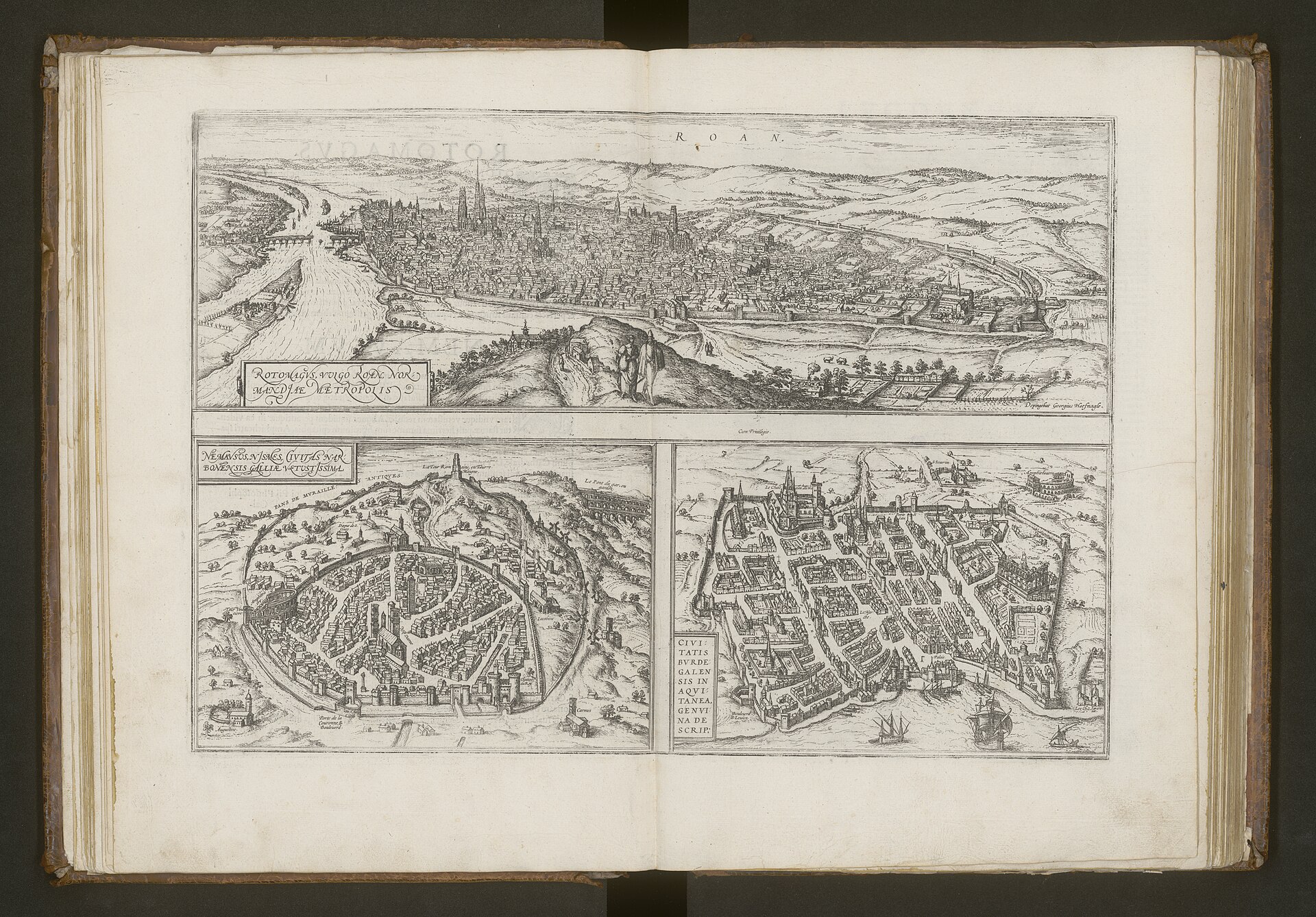
Bird's-eye view of Rouen (Rotomagus), from Braun & Hogenberg's Civitates Orbis Terrarum
Depicts the walled old town with gates, the Seine and bridges, and prominent church spires including Rouen Cathedral.
1577 · Georg Braun · Wikimedia Commons
Public domain (plate dated 1577)

Ships tied to Rouen
- Nautilus: Built at the Perrier boatyard in Rouen; first dives in the Seine there in 1800
Castles of Rouen

More cities to explore
 FranceParisExplore it in 1250 · 1670 · 1789 · 1889
 BelgiumYpresExplore it in 1300 · 1910
 FranceLyonExplore it in AD 100 · 1500 · 1835
 FranceStrasbourgExplore it in 1440 · 1770 · 1900
Castles of Europe · Landmarks of Europe · create your own reconstruction.