Historic Cities · France
Strasbourg through the ages
Strasbourg is a prefecture and commune, and the largest city of the Grand Est region of northeastern France, in the historic region of Alsace. It is the prefecture of the Bas-Rhin department and the official seat of the European Parliament.

Strasbourg in 1440
Gutenberg's Strasbourg
Strassburg in 1440 is a compact free imperial city crowned by its newly completed cathedral spire, the tallest building in Christendom. The walk moves from the approaches and river quays into the cathedral precinct, guild streets, and the tanners' canals, passing workshops where a goldsmith-printer is beginning to test movable types across the river.
A dense island of steep-roofed timber-framed houses, narrow lanes and canals sits within defensive walls and low bastions. Stone and red tile predominate; timber framing shows dark beams against white wattle-and-daub. The cathedral's openwork spire rises above everything as a dark lace pinnacle. The Ill's quays and wooden bridges, clusters of guildhalls and tannery lofts give the island a close, bustling harbour town feel under a cool northern light.
The route: 22 streets, squares and views
Route des Romains → Koenigshoffen Suburb → Ponts Couverts → Porte du Pont → Quai des Bateliers → Parvis de la Cathédrale → Maison Kammerzell → Rue Mercière → Marché aux Poissons → Rue du Dôme → …
Step inside, 13 interiors
Bridge Tower Toll Chamber · High Nave of the Cathedral · Clockmaker's Chamber and Machine · Kammerzell Merchant's Hall · Booksellers' Workshop and Stall · Covered Fishmongers' Hall · Goldsmiths' Guild Hall · Council Chamber of the Magistrates · Tannery Drying Loft · Riverside Soakhouse · Mill Wheelhouse Interior · Goldsmith-Printer's Workshop · Butchers' Great Hall
Planned from the Wikipedia record: History of Strasbourg.
Strasbourg in 1770
Goethe's Strasbourg
Strasbourg in 1770 is a walled, river‑braided provincial capital recently annexed to France, where a tall Gothic Münster overlooks timber‑framed lanes, canals and star‑shaped bastions. The walk follows the Ill and the Grande Île from the Rhenish approach through the Ponts Couverts and La Petite France to the cathedral forecourt and the riverside mansions of the Rohan quarter.
A single stone spire, the Cathedral of Our Lady, dominates a compact island of steep half‑timbered houses, red‑tiled roofs and narrow alleys, threaded by the Ill's slow canals. Stone bridges, millwheels and varnished barges pick out the water; pale limestone façades of recent 18th‑century houses and the low classical mass of Palais Rohan sit beside older medieval frames. Outside the walls, star‑shaped bastions and parade grounds carry the visible presence of a French garrison.
The route: 23 streets, squares and views
Kehl riverbank view → Bridge to Kehl → Barrage Vauban → Ponts Couverts → La Petite France → Petite France mills → Quai des Bateliers → Vieux Marché aux Poissons → Cathedral forecourt → Maison Kammerzell → …
Step inside, 12 interiors
Bridge Tower Guardroom · Tanner Quarter Winstub · Miller's Canal House · Fishmarket Hall · North Tower Platform · Merchant's Parlor · Printer's Workshop · Grand Appartement d'État · Ceremonial Stair Hall · Philosophy Lecture Hall · Civil Hospital Ward · Garrison Officers' Mess
Planned from the Wikipedia record: History of Strasbourg.
Strasbourg in 1900
Imperial Strasbourg
Straßburg in 1900 is a city split and remade; the dense, timbered Grande Île retains medieval streets and the cathedral, while across new avenues the German Empire has carved the Neustadt with monumental sandstone public buildings. This walk follows the new imperial axis and the older island alike: tramlines, university halls, palace façades and canal-side workshops reveal how two city-centres meet in daily life.
The skyline is a sharp meeting of eras: the lacework spire of Notre‑Dame rises above dark timber roofs on the Grande Île, while across broad avenues towers and domes of pale Alsatian sandstone and brick announce the German-built Neustadt. Plane trees and wide sidewalks shade tram rails and horse-drawn carriages; shopfronts alternate carved stone and half-timbering. Colours are brick-red, honey sandstone and blackened timber, with gleams of ironwork on bridges and station canopies.
The route: 22 streets, squares and views
Gare de Strasbourg approach → Bahnhofsplatz → Avenue de la Liberté → Place de la République → Palais du Rhin → Allée de la Robertsau → Palais Universitaire → National & University Library → Saint‑Paul Church → Villa Schutzenberger → …
Step inside, 14 interiors
Iron Concourse and Ticket Hall · Imperial Reception Hall · University Ceremonial Hall · Domed Reading Room · Villa Schutzenberger Salon · Dining Salon · Great Concert Hall · Grand Courtroom · Main Auditorium · Brasserie Parlor · Cathedral Nave and Choir · Bargemen's Warehouse · Tanners' Dye House · Covered Bridge Tower Chamber
Planned from the Wikipedia record: Neustadt, Strasbourg.
Its story
The story of Strasbourg.
Argentoratum, a Legionary Camp on the Rhine
The site was permanently settled by proto-Celts around 1300 BC, and by the end of the 3rd century BC was a Celtic township with a market called Argentorate. The Romans under Nero Claudius Drusus put a military outpost of the province of Germania Superior on the spot and Latinised the name to Argentoratum, first recorded in 12 BC, the date from which the city counted its 2,000th birthday in 1988. From the year 90 the Legio VIII Augusta was permanently stationed there, in a camp of about 20 hectares that burned and was rebuilt six times between the 1st and 5th centuries.
From the 4th century the city was the seat of the Bishopric of Strasbourg; excavations beneath the Église Saint-Étienne found the apse of a church of the late 4th or early 5th century, taken to be the oldest in Alsace. In 357 the Alemanni fought the Battle of Argentoratum against Rome and were defeated by Julian, later emperor, taking their king Chonodomarius prisoner, and early in the 5th century they appear to have crossed the Rhine for good and settled what is now Alsace. Through that century the town was occupied in turn by Alemanni, Huns and Franks.
The Oaths of 842, the Free City of 1262, and the Massacre of 1349
In 842 the Oaths of Strasbourg recorded the town under its local name, Strazburg. That trilingual text carries, beside Latin and Old High German, the oldest written variety of Gallo-Romance clearly distinct from Latin, the ancestor of Old French, and the division of the Carolingian Empire it sealed is taken to mark the birth of France and Germany. In 923 it came under the Holy Roman Empire through the homage the Duke of Lorraine paid to the German king Henry I.
Its early history is a long quarrel between its bishop and its citizens, who had been governed by the bishops since the 4th century. The citizens won it at the Battle of Hausbergen in 1262, after which Strasbourg held the status of a free imperial city, and a revolution in 1332 produced a broad city government with the guilds taking part, the city declaring itself a free republic. The cathedral, begun in the 12th century, was finished in 1439 with only the north tower of the intended pair built, and became the tallest building in the world. A census of 1444 put the population at about 20,000, only a third fewer than Cologne.
The bubonic plague of 1348 was followed on 14 February 1349 by one of the first and worst pogroms in pre-modern history: several thousand Jews were publicly burnt to death. Until the end of the 18th century Jews were forbidden to remain in the town after ten at night, the hour announced by a municipal herald blowing the Grüselhorn, and a special tax, the Pflastergeld or pavement money, was charged on any horse a Jew rode into the city during the hours they were admitted.
Printing, the Reformation and the Dancing Plague of 1518
Johannes Gutenberg is credited with making the first European movable-type printing press in Strasbourg, and from about 1460 the first printing offices outside his home town of Mainz were set up here by Johannes Mentelin and Heinrich Eggestein. In 1605 Johann Carolus obtained the city's permission to print a weekly journal in German written by reporters in several central European cities, the first modern newspaper. In July 1518 the dancing plague struck: around 400 people danced constantly for weeks, most of them eventually dying of heart attack, stroke or exhaustion.
The theses of Martin Luther were fixed to the cathedral door in 1519, and through the 1520s the city took up his teaching under the political guidance of Jacob Sturm von Sturmeck and the spiritual guidance of Martin Bucer, with Protestant iconoclasm doing much damage to churches and cloisters. Sturm and the guildmaster Matthias represented the city at the Imperial Diet of Speyer in 1529, where their protest led to the schism with the Catholic Church; at the Diet of Augsburg in 1530 Strasbourg presented the confessio tetrapolitana with four other free cities, later following the Augsburg Confession instead.
The reformers founded a Gymnasium under Johannes Sturm, dated to 1538 and raised to a university in 1567. John Calvin arrived in 1538 after being expelled from Geneva and served as a minister until he returned there in 1541, working here on the second edition of the Institutes.
Annexed by Louis XIV, 30 September 1681
The Free City of Strasbourg stayed neutral through the Thirty Years' War of 1618 to 1648 and kept its imperial status. Louis XIV's advisers held that an independent Strasbourg endangered his newly annexed territories in Alsace: its bridge over the Rhine had been used repeatedly by Imperial forces, and three times during the Franco-Dutch War the city had served as the gateway for invasions of Alsace. In September 1681 French forces surrounded it with overwhelming strength and without a clear pretext for war; after some negotiation Louis marched in unopposed on 30 September and proclaimed the annexation, one of the direct causes of the War of the Reunions, which left the French in possession. The Treaty of Ryswick recognised it in 1697.
The policy of religious intolerance that drove most Protestants out of France after the revocation of the Edict of Nantes in 1685 was not applied in Strasbourg or Alsace, which held a special status as a kind of foreign province of the king. The cathedral was taken from the Lutherans and returned to the Catholics, though other historic churches stayed in Protestant hands. The language of the city remained overwhelmingly German (contemporary observers reckoned only one per cent of the population spoke French), and the German Lutheran university lasted until the Revolution, with Goethe and Herder among its students.
Revolution, La Marseillaise, and the Bombardment of 1870
On 21 July 1789, after news of the storming of the Bastille, the city hall was sacked; the clergy's property was seized in 1790 and the then Lutheran university lost most of its revenues. At a dinner given by Mayor Frédéric de Dietrich on 25 April 1792, after France had gone to war with Prussia and Austria, Claude Joseph Rouget de Lisle composed the War Song for the Army of the Rhine, later renamed La Marseillaise. Dietrich himself was guillotined in December 1793. The city's free status was revoked, Enragés such as Eulogius Schneider ran it, Christian worship was forbidden and many churches and monasteries were destroyed or badly damaged; in April 1794 there was talk of pulling down the cathedral spire as an offence against equality, until in May the citizens saved it by crowning it with a giant tin Phrygian cap. Proponents of the Revolution demanded that Alsatians profess French over their native German, which was disparaged as the language of the enemy, of feudalism and of slaves.
Under Napoleon the city was given a commodity market and a chamber of commerce in 1801, a new bridge over the Rhine and repaired roads; with industry and trade the population tripled over the 19th century to 150,000.
During the Franco-Prussian War the Prussian army bombarded Strasbourg heavily, the shelling intended to break the morale of the inhabitants. On 24 and 26 August 1870 fire destroyed the Museum of Fine Arts and the Municipal Library in the former Dominican church, with its collection of medieval manuscripts, among them the Hortus deliciarum, and the cathedral, the theatre and many houses were damaged. By the end of the siege over 600 people had died, 261 of them civilians, 3,200 were injured, 1,100 of them civilians, and 10,000 inhabitants were left without shelter.
Four Changes of Nationality, 1871–1944
Under the Treaty of Frankfurt the city passed in 1871 to the new German Empire as the capital of the Reichsland Elsass-Lothringen. It was rebuilt and extended on a grand scale (the Neue Stadt around the present Place de la République), and the university, suppressed at the Revolution as a stronghold of German sentiment, reopened in 1872 as the Kaiser-Wilhelms-Universität. A belt of heavy forts was thrown around the city; most still stand, renamed after French generals, and were later used as prisoner-of-war camps in 1918 and 1945.
On 11 November 1918 communist insurgents proclaimed a soviet government in Strasbourg; French troops under General Henri Gouraud entered the city on 22 November. In 1919, under the Treaty of Versailles, the city was annexed by France without a referendum, the transfer backdated to Armistice Day, Germans were expelled and imperial monuments destroyed, among them the statue of Emperor William I. Ninety per cent of the population spoke the Alsatian dialect and wished to keep their local laws, and central government control from Paris fed the rise of communist and autonomist movements. In 1920 the Central Commission for Navigation on the Rhine moved here from Mannheim, and river traffic, the port and the rail links brought back a prosperity that cushioned the crisis of the 1930s. In the same decade the population swelled with the arrival of Central European Jews, accompanied by a rise in antisemitism.
Between the German invasion of Poland on 1 September 1939 and the Anglo-French declaration of war two days later the entire city, 120,000 people, was evacuated and stood empty for ten months but for its garrison, the Jews of Strasbourg having been sent to Périgueux and Limoges and the university to Clermont-Ferrand. After the fall of France in 1940 Alsace was annexed by Germany and a rigorous Germanisation imposed by the Gauleiter Robert Heinrich Wagner; when the first evacuees were allowed back in July 1940, only residents of Alsatian origin were admitted. The last Jews were deported on 15 July 1940, and the main synagogue, completed in 1898 with a 54-metre dome, was set ablaze and then razed. In September 1940 Marcel Weinum founded the first Alsatian resistance movement, La Main Noire, twenty-five young men aged fourteen to eighteen whose attacks culminated in one on Wagner himself; Weinum was beheaded at Stuttgart in April 1942, aged eighteen. Many men of Strasbourg were conscripted into the German army against their will and sent to the Eastern Front, the malgré-nous, and those who did not answer at once were pressured to volunteer for the SS by direct threats to their families; the few who survived were often accused after the war of treason or collaboration, because what had happened to them was not known in the rest of France. Allied aircraft bombed the city from 1943, damaging the Palais Rohan and the cathedral in August 1944, and the 2nd French Armoured Division under General Leclerc liberated Strasbourg on 23 November 1944.
Francisation and the European Seat, 1945 Onwards
After 1945 Alsace was subjected to policies of Francisation and the use of German or Alsatian was banned in schools. German-speakers were not generally expelled, unlike in Bohemia, Pomerania, East Prussia and Silesia, but many families switched to French at home, in reaction to the Nazi Germanisation policies and out of a felt guilt towards mainland France, so that their children did not learn the dialect, which came to be seen as a mark of backwardness.
In 1949 Strasbourg was chosen as the seat of the Council of Europe, with its European Court of Human Rights and European Pharmacopoeia. The European Parliament has met here since 1952, and was formally given the city as its seat at the European Council meeting in Edinburgh in December 1992, a position written into treaty in 1997; its monthly four-day plenary sessions have sat since 1999 in the Immeuble Louise Weiss, all other business being conducted in Brussels and Luxembourg. New residential districts were built in the 1950s and 1960s against both war damage and a population growing with the baby boom and immigration from North Africa.
On 11 December 2018 Chériff Chekatt, who had pledged allegiance to the Islamic State of Iraq and the Levant, attacked civilians near the Christmas market, killing five and injuring eleven; he was shot dead by police two days later. Strasbourg is the prefecture of the Bas-Rhin department and, since 2016, the capital of the Grand Est region, with about three hundred thousand inhabitants. The Grande Île, the historic centre, was made a UNESCO World Heritage Site in 1988, and the Neustadt was added to it in 2017.
From the archive
Strasbourg on paper: the old town as it was mapped.
A period plan or bird's-eye view of the old town, drawn between 1500 and 1850, the streets this page's reconstructions walk. Public domain, with its source named.
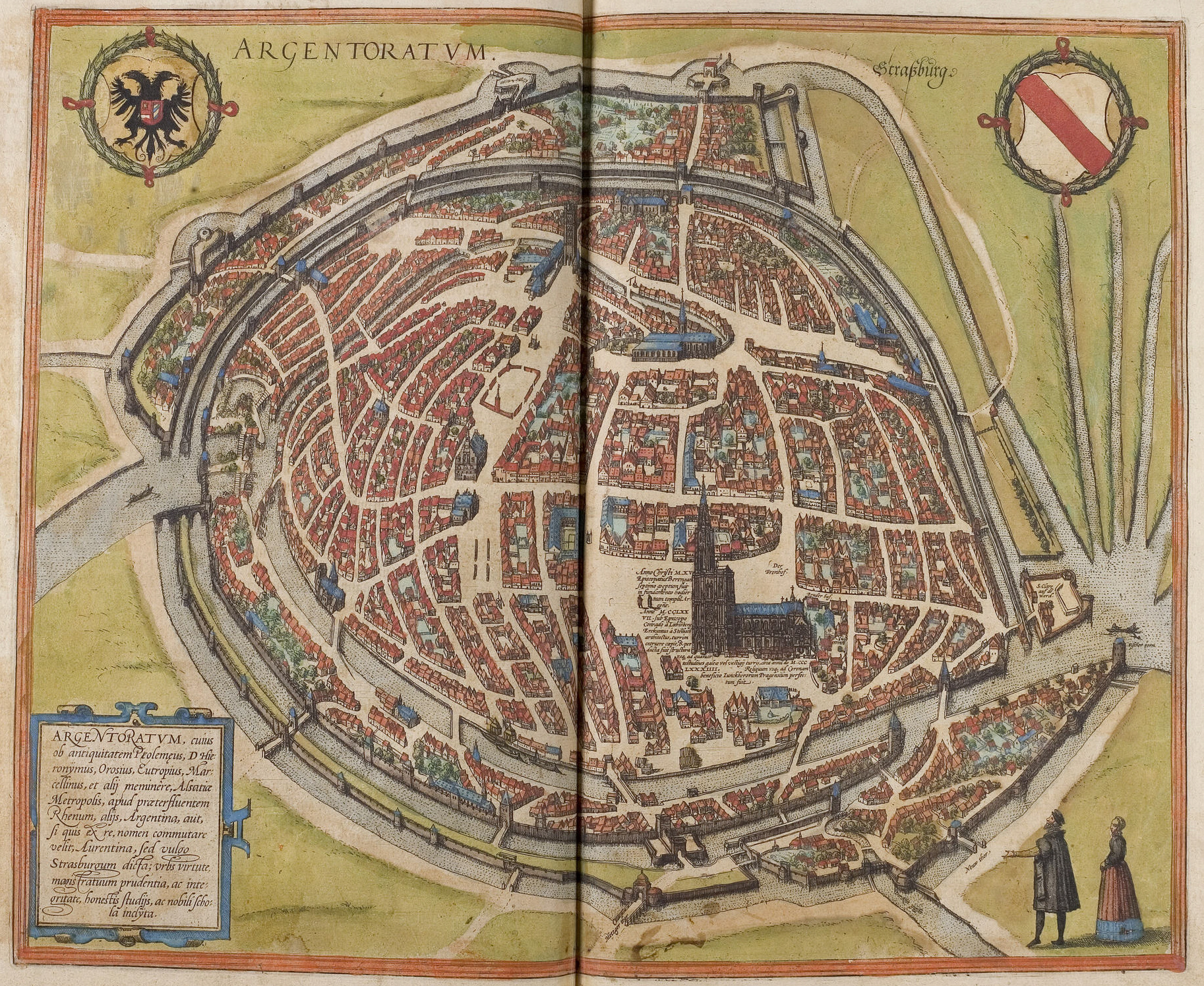
Bird's-eye view of Strasbourg (Argentoratum), from Braun & Hogenberg's Civitates Orbis Terrarum
Walled circular town of Strasbourg showing ramparts and bastions, gates and bridges, dense street grid centred on the cathedral (Notre‑Dame) and river channels.
1572 · Georg Braun; Frans Hogenberg · Wikimedia Commons
Public domain (plate dated 1572)
In this city
Landmarks of Strasbourg, see each in its prime


More cities to explore
 FranceColmarExplore it in 1615
 GermanyFreiburgExplore it in 1530
 FranceParisExplore it in 1250 · 1670 · 1789 · 1889
 FranceRouenExplore it in 1431 · 1540 · 1876
Castles of Europe · Landmarks of Europe · create your own reconstruction.