Historic Cities · Germany
Freiburg through the ages
Freiburg im Breisgau, or simply Freiburg, is the fourth-largest city in the German state of Baden-Württemberg after Stuttgart, Mannheim and Karlsruhe. Its built-up area has a population of about 355,000 (2021), while the greater Freiburg metropolitan area has about 660,000 (2018).

Freiburg in 1530
Minster and Market
Freiburg stands as a bustling Breisgau market town at the edge of the Black Forest, its lace-like Minster tower long finished and its new choir recently consecrated. Visitors will find water running through every street in the narrow Bächle, market stalls crowded beneath the spire, the new Kaufhaus with its arcades and oriels, and workshops and tanneries working along the town's channels.
The city is a compact knot of red-tiled roofs and timber‑framed houses punctured by the fretted stone of the Freiburger Münster's filigree west tower. Streets are narrow and paved, their edges lined with Bächle runnels; arcaded civic buildings and the new painted Kaufhaus stand by open market squares. Colourful market canopies and drying hides in the Gerberau give spots of hue against warm sandstone; carts and laden packhorses arrive from the forest roads.
The route: 14 streets, squares and views
Schlossberg Vineyards → Dreisam River Approach → Martinstor Gate → Gerberau Tanners' Quarter → Gewerbebach Channel → Augustinerstraße → Kaufhaus Arcades → Münsterplatz Market → Freiburger Münster → Market Bächle Runnel → …
Step inside, 8 interiors
Gatehouse Wine Tavern · Tanners' Over-Channel Workshop · Augustinian Refectory · Upper Merchants' Hall · Goldsmith's Shop and Forge · Choir of the New High Altar · Tower Star Gallery · Town Hall Council Chamber
Planned from the Wikipedia record: Freiburg Minster.
Its story
The story of Freiburg.
Castle, Market and Black Forest Silver, 1091–1218
A trade route ran near the Dreisam, with an imperial road striking west towards Breisach and Colmar, and habitation on the site was documented in 1008. In about 1091 Berthold II of Zähringen built a castle, the Castrum de Friburch, on the Schlossberg to control that traffic, and a settlement of servants and craftsmen grew below it. In 1120 Konrad, brother of Duke Berthold III, granted that settlement a market and extensive privileges, including relief from farmstead taxes and the free election of its pastor. The name translates as the free or independent town, and it stood where routes between the Mediterranean and the North Sea crossed those between the Rhine and the Danube.
Silver found at the end of the tenth century west of the Black Forest made the place rich; the Zähringer held the mining rights from the Bishops of Basel, who had received the mining regale from Emperor Konrad II in 1028. By 1200 about 6,000 people lived there, and the last Zähringer duke, Berthold V, began replacing the parish church where Bernard of Clairvaux had preached the Second Crusade in 1146. He was buried in its successor, the Freiburg Minster, in 1218.
Buying Freedom from the Counts, 1218–1368
The Zähringer inheritance passed to Berthold's nephew Egino, first Count of Urach, whose house took the title Counts of Freiburg. Distrusting the new lords, the citizens wrote their old rights into a council constitution, the Stadtrodel of 1218, and by the end of the thirteenth century craftsmen were entering the council through the guilds. The quarrels between town and counts were usually about money. In 1299 the citizens refused Count Egino II's new demands and shot his castle to pieces with catapults; the count called in his brother-in-law Conrad of Lichtenberg, Bishop of Strasbourg, who was killed in the fighting (a citizen named Hauri is said to have stabbed him), and the town won, but had to pay an annual reparation for the bishop's death. In 1368 the citizens bought themselves free for 20,000 marks of silver and put themselves under the protection of the House of Habsburg, becoming part of Further Austria and sharing Habsburg fortunes until 1805.
The Jewish Community: Burnings, Ban and Return, 1230–1836
Jews are said to have lived in Freiburg before 1230, and after that year to have founded a community in the Webergasse. The counts of Freiburg bought the profitable right of Jewish protection, and on 12 October 1338 Konrad II and his co-reigning son Friedrich issued a letter promising safety and liberty to the town's Jews. It was worthless by 1 January 1349. Although the plague had not yet reached the town, its Jews were accused of spreading it and taken into custody; on 31 January 1349 all of them except pregnant women were burned alive, and the surviving children were forcibly baptised.
Few returned after that. In 1401 the city council decreed that no Jew should ever again live in Freiburg, and King Sigismund confirmed the expulsion for all time in 1424. Permanent Jewish residence was not permitted again until 1809, and a community was refounded in 1836.
The University, the Peasants' War and the Witch Trials, 1386–1628
The silver veins were dwindling by the end of the fourteenth century, and a town that had held 8,000 to 9,000 people was down to about 6,000 inside its walls by 1460. Its living changed with it: in 1448 Archduke Albrecht, lord of the Habsburg forelands, established a school of learning that became the University of Freiburg under its founding charter of 1457. The guilds had taken over the council after most of the town's nobility fell with Duke Leopold III at Sempach in 1386.
Rebellion came from the countryside. In 1513 the Bundschuh peasants gathered in Freiburg under Joß Fritz, were betrayed before they could act, and were punished as an example. On 23 May 1525, during the German Peasants' War, 18,000 peasants under Hans Müller took the town and forced the council into an evangelical Christian association pledged to end the grievances of the common poor. Once the rising was beaten, Freiburg assured the Habsburgs of its Catholic loyalty; it had declined the Reformation in 1520 and became a Catholic centre on the Upper Rhine, taking in Erasmus of Rotterdam and the cathedral chapter of Basel when iconoclasm turned that city Protestant in 1529.
Plague killed about 2,000 people in 1564, a quarter of the population, as recorded by the town doctor Johannes Schenck; the search for someone to blame for such calamities drove on the witch trials that had begun in 1536. Between 1550 and 1628, 131 of 302 people convicted of witchcraft were executed, far more women than men. On 24 March 1599 Catharina Stadellmenin, Anna Wolffartin and Margaretha Mößmerin were among those beheaded and burned outside the walls; thirty-seven women and two men were executed that year.
Five Sieges and Vauban's Fortress, 1632–1754
Freiburg surrendered to the Swedish general Gustav Horn on 30 December 1632 and changed hands repeatedly thereafter; in 1638 Bernhard of Saxe-Weimar, financed by France, took it after an eleven-day siege. An imperial Bavarian army under Franz von Mercy and Johann von Werth recovered it in the summer of 1644, bringing on the Battle of Freiburg against the French and Weimarian forces of Turenne and Enghien, said to be the war's bloodiest in proportion to the numbers engaged. The town had held between 10,000 and 14,000 people in 1618; accounts of what survived five sieges differ, putting the remnant at two or three thousand.
The Peace of Westphalia gave Alsace and the Sundgau to France and left Freiburg, in place of Ensisheim, as both the capital of Further Austria and a front-line town. It surrendered to Louis XIV's marshal François de Créquy in late 1677 after the first bombardment, and at Nijmegen in 1679 the emperor gave it up to keep Philippsburg. Louis XIV had Sébastien Le Prestre de Vauban rebuild the town as a modern fortress, clearing the surviving suburbs for a field of fire. The French marched out on 11 June 1698, besieged the place again under Villars in 1713, and came back in 1744 with Louis XV directing the bombardment in person from the Lorettoberg. When the Treaty of Füssen restored Freiburg to the Habsburgs, the departing French blew up Vauban's fortifications and wrecked the houses nearest them; only the Breisacher Tor survived, and in 1754 the town held 1,627 men and 2,028 women.
From Further Austria to Baden: Revolution, Railway and Silk, 1805–1918
Napoleon ended the Habsburg centuries. Austria's defeat at Austerlitz put the Breisgau under Baden, and in 1806 Freiburg went from a Habsburg outpost on the Upper Rhine to a provincial town of the new Grand Duchy. Many in Freiburg wanted Vienna back, but the Congress of Vienna settled the matter for Baden, and the town became the seat of the new Archdiocese of Freiburg in 1827. The Karlsruhe government closed the university on 12 September 1832 over its political direction, forced the liberal professors Karl von Rotteck and Carl Theodor Welcker into early retirement, and in 1833 refused to confirm Rotteck as the town's elected mayor. The railway from the north reached Freiburg in 1845. Three years later Baden became the centre of German revolution: some 1,500 irregulars barricaded Freiburg at Easter 1848 and were beaten in street fighting by government troops brought up on that new railway, and citizens loyal to the Grand Duke handed the town to Prussian troops on 7 July 1849. Friedrich Neff and Gebhard Kromer were shot in the cemetery at the Wiehre.
Carl Mez's firm, in Freiburg from 1828, was the largest silk-weaving business in Germany during the nineteenth century and employed about 1,200 people by its close, before the Scottish company Coats took it over from 1920. Under Mayor Otto Winterer, called the second founder of the city when he retired in 1913, the number of houses and inhabitants doubled, electric trams replaced horse traction from 1891, and in 1899 the university enrolled a woman, the first in Germany to do so. Wealthy incomers made up a fifth of households and earned the town the nickname Alldeutsches Pensionopolis, while the growing working class lived in Stühlinger, the divide Rosa Luxemburg attacked in a packed hall in April 1914, after which 280 residents joined the Social Democrats. In the First World War the town lay close enough to the Alsace front to be bombed twenty-five times, more often than any other German city, and 444 people died of Spanish influenza in 1918. On 9 November 1918 more than 9,000 soldiers gathered at Karlsplatz wearing red cockades, and soldiers' and workers' councils took over.
Persecution, Bombing and Reconstruction, 1933–2002
The Nazi takeover ran through the spring of 1933. The swastika went up on the city hall on 6 March without the consent of Mayor Karl Bender; the Reich commissioner for Baden, Robert Heinrich Wagner, banned SPD and KPD assemblies on 10 March, and on 18 March all local organisations of both parties were dissolved; and Bender resigned on 9 April after a campaign against him in the Nazi paper Der Alemanne, his post going to that paper's editor. At the university the new rector, Martin Heidegger, proclaimed the greatness of the National Socialist movement.
The synagogue built in 1870 was burned on 9 November 1938 during Kristallnacht, Jewish shops and homes were plundered without police or fire brigade intervening, and Jewish men were taken to Buchenwald and Dachau. On 22 October 1940 Wagner ordered the deportation of Baden's Jews, 350 of them from Freiburg, to the camp at Gurs in southern France, where many died; those still alive were sent on to Auschwitz on 18 July 1942 and almost all were murdered. There was a camp in the city for Sinti and Roma. Josef Mengele, later the camp doctor at Auschwitz, kept an apartment with his wife Irene in the Sonnhalde in Herdern from the summer of 1940 until November 1944. Stolpersteine set in the pavements name individual victims outside their former homes.
On 10 May 1940 German aircraft bombed the town by mistake, killing 57 people including 22 children in a playground; the official news agency blamed the Western Allies and threatened reprisals, and although the police commander established from the fragments that the bombs were German, that was not published for years. On 27 November 1944 more than 300 aircraft of RAF Bomber Command destroyed much of the centre in Operation Tigerfish, killing nearly 3,000 people and injuring some 9,600. The Minster took no direct hit and was reroofed with tiles given by the city of Basel by January 1945.
French troops entered the ruined old town on 21 April 1945, and the rubble was carried out to the Flückiger lake by a dedicated railway between 1947 and 1949. Freiburg was the seat of government of the state of Baden until 1952 and the centre of opposition, led by Minister-President Leo Wohleb, to merging it into Baden-Württemberg; South Baden voted against, and the merger went ahead with Stuttgart as capital. The inner city was rebuilt on its old street lines, and the French garrison stayed until 1991. Opposition to the planned nuclear power station at Wyhl in the 1970s drew Freiburg groups in, and its defeat made the town a base for the environmental movement and a stronghold of the Green Party; the barracks the French left in 1992 became the Vauban district, built to ecological standards. The population passed 200,000 in 1996, and in 2002 Dieter Salomon became the first Green politician elected mayor of a German city.
From the archive
Freiburg on paper: the old town as it was mapped.
A period plan or bird's-eye view of the old town, drawn between 1500 and 1850, the streets this page's reconstructions walk. Public domain, with its source named.
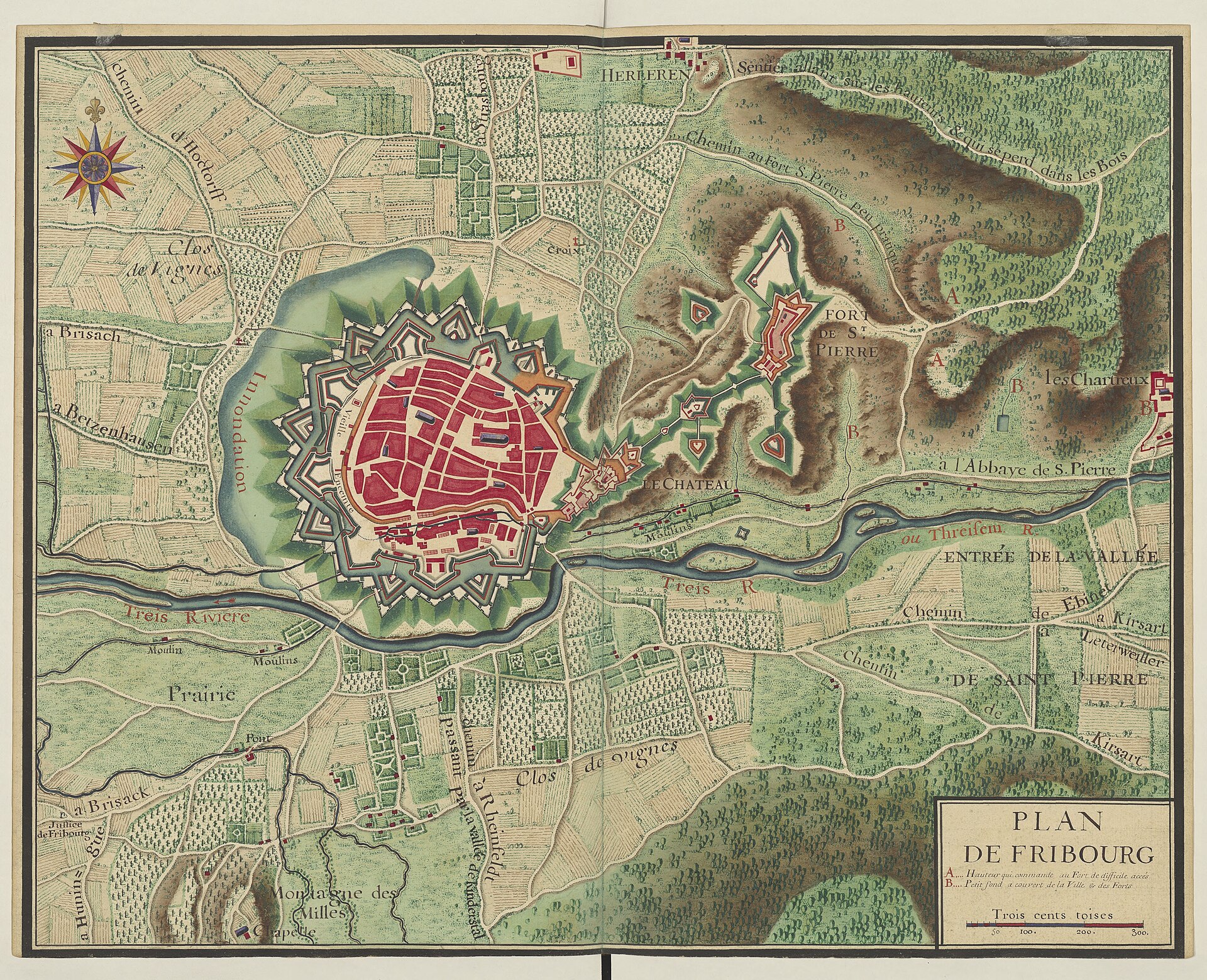
Plan de Fribourg, from Carte des environs de Fribourg en Breisgau
Walled town with bastioned fortifications, internal street grid, city gates, river channel and the Fort de Saint-Pierre and château on the adjacent heights.
1700 · Wikimedia Commons
Public domain (plate dated 1700)

Castles of Freiburg


More cities to explore
 FranceColmarExplore it in 1615
 FranceStrasbourgExplore it in 1440 · 1770 · 1900
 GermanyBerlinExplore it in 1750 · 1871 · 1928
 GermanyMunichExplore it in 1500 · 1700 · 1900
Castles of Europe · Landmarks of Europe · create your own reconstruction.