Historic Cities · Germany
Munich through the ages
Munich is the capital and most populous city of Bavaria, Germany. As of 30 November 2024, its population was 1,604,384, making it the third-largest city in Germany after Berlin and Hamburg. Munich is the largest city in Germany that is not a state of its own, and it ranks as the 11th-largest city in the European Union (EU).

Munich in 1500
Late Gothic Munich
Munich at the turn of the 16th century is the growing ducal capital of Upper Bavaria, its skyline already defined by the twin brick towers and onion domes of the new Frauenkirche and the compact rhythm of guild houses and church spires. This walk moves from the Isar approach through the city gates and markets, past the Alter Hof and the Old Town Hall, to a final lookout over the fortified town and river mills.
A compact medieval town of reddish brick and dark timber, Munich's skyline in 1500 is dominated by the twin, onion‑capped towers of the Frauenkirche rising above steep gabled roofs and slender stone spires. Narrow, cobbled lanes thread between close‑set houses with overhanging upper floors; the Isar runs brown and swift with saw‑and‑millworks on its banks, wooden bridges and fortified gates for salt wagons and ducal processions.
The route: 20 streets, squares and views
Isar Meadows → Isar Bridge → Isartor Gate → Salzstraße at Isartor → Tal Street → Kaufingerstraße → Marienplatz → Frauenkirche → Old Town Hall → St. Peter's (Peterskirche) → …
Step inside, 13 interiors
Vaulted Gate Guardroom · Carters' Inn Common Room · Clothier's Shop and Counting House · White Nave · Great Dance Hall · Old Parish Choir · Great Butchers' Hall · Hospital Nave · Ducal Audience Chamber · Courtyard Service Chambers · Great Ducal Stables · Millworks Hall · Crystal Store Hall
Planned from the Wikipedia record: History of Munich.
Munich in 1700
Electoral Munich
Munich in 1700 is an elector's city swelling with Italianate baroque: new façades and palaces are rising alongside medieval towers and market streets. The walk moves from the low meadow of Nymphenburg into the walled old town, passing the Theatinerkirche's yellow façade, the Residenz courts, the Marian column on Marienplatz and the riverbanks where carts and barges keep the city's life flowing.
The skyline is a compact cluster of red tile roofs, brick church towers and newly stuccoed baroque domes; ochre and pale yellow facades of Italian influence stand beside older dark brick gables. Streets are narrow and paved with cobbles, market stalls and timber-framed houses crowd the squares, while the Isar and the low meadows beyond frame the town with willows, mills and distant blue Alpine ridges.
The route: 21 streets, squares and views
Nymphenburg Meadows → Nymphenburg Forecourt → Nymphenburger Approach → Neuhauser Gate → Kaufingergasse → Marienplatz → Frauenkirche Exterior → Old Town Hall → Rindermarkt → Hofbräuhaus at the Platzl → …
Step inside, 12 interiors
Stone Hall · Palace Chapel · Cathedral Nave · Council Chamber · Butchers' Hall · Court Brewery Taproom · Antiquarium Barrel-Vaulted Gallery · Hofgarten Pavilion Room · Theatinerkirche Central Nave · Royal Stables · Jesuit Church Interior · Hospital Refectory
Planned from the Wikipedia record: History of Munich.
Munich in 1900
Prince Regent's Munich
Munich in 1900 is the Prinzregentenzeit: a prosperous capital of the Kingdom of Bavaria where new museums and boulevards meet lively beer-houses and emerging modern art. Walk through the old town and the new cultural avenues to see Schwabing’s artists, the new civic monuments and the Frauenkirche towers above café terraces and tramlines.
The skyline is dominated by the twin brick towers of the Frauenkirche, low red-tiled roofs, church spires and the occasional neoclassical colonnade around Königsplatz. Streets are paved with cobbles and threaded by tramlines; horse-drawn carts share space with early motor cars. Stone façades, stuccoed villas and Jugendstil details appear alongside traditional timber-framed houses. Beer palaces glow warmly, tree-lined avenues and the Isar’s green floodplains give the city a compact, human scale.
The route: 22 streets, squares and views
Isar Meadows (South Approach) → München Hauptbahnhof Forecourt → Theresienwiese → Karlsplatz (Stachus) → Neuhauser Straße → Marienplatz → Frauenkirche Forecourt → Viktualienmarkt → Hofbräuhaus Forecourt → Residenz Paradehof → …
Step inside, 14 interiors
Main Station Arrival Hall · Theresienwiese Fest Hall · Cathedral Nave · Viktualienmarkt Covered Row · Vaulted Hofbräuhaus Hall · Antiquarium · Cuvilliés Theatre · Theatinerkirche Nave · Leopoldstraße Café Salon · Schwabing Artist Atelier · Villa Stuck Studio · Maximilianeum Assembly Chamber · Glyptothek Marble Halls · Ruhmeshalle Colonnade
Planned from the Wikipedia record: History of Munich.
Its story
The story of Munich.
Henry the Lion's Bridge and the Salt Monopoly
The Isar was a prehistoric trade route, and in the Bronze Age the site was among the largest raft ports in Europe. The Roman road from Augsburg to Salzburg crossed the river south of the modern city, and from the sixth century the Baiuvarii settled the area. The city's name comes from a tiny tenth-century monastic settlement called zu den Munchen, to the monks.
Munich was made by force over a river crossing. Henry the Lion, Duke of Saxony and Bavaria, burned down the town of Föhring and its bridges over the Isar to control the salt trade, then built a new toll bridge, customs house and coin market upstream. Otto of Freising, the bishop who had lost his bridge, protested to his nephew Emperor Frederick Barbarossa, but the conflict was settled at Augsburg on 14 June 1158 in the duke's favour, Henry being ordered only to pay the bishop a third of his income. That date is taken as the city's founding day, though shards of eleventh-century vessels dug up at Marienhof in 2012 show the settlement was older.
Munich received city status and fortification in 1175. After the trial of Henry the Lion in 1180 the town was handed to the bishop of Freising, passed to Otto II Wittelsbach in 1240, and in 1255, when the duchy was split in two, became the ducal residence of Upper Bavaria; the Wittelsbachs would rule Bavaria until 1918. Duke Louis IV, elected German king in 1314 and crowned Holy Roman Emperor in 1328, granted the town the salt monopoly, and having outmanoeuvred Freising it held the principal crossing on the route from the Salzburg salt sources to Augsburg. Ruin came repeatedly: a fire on 13 February 1327 destroyed about a third of the town, the Black Death ravaged Munich and Bavaria in 1349, and a guild uprising in 1397 was put down in 1403.
Counter-Reformation Capital, Swedish and Habsburg Occupations
When the Landshut line of the Wittelsbachs died out in 1503, the resulting war of succession was settled in 1505 by the Cologne arbitration of Emperor Maximilian I, which reunited the Bavarian duchies as one and made Munich the capital. Through the sixteenth century the city was a centre of the German Counter-Reformation, and its politics and arts increasingly ran through the court: Duke Albrecht V built the Antiquarium in 1568 for the Wittelsbach collection of antiquities and made Orlando di Lasso director of the court orchestra, and under Duke William V, who commissioned the Jesuit Michaelskirche, the city began to be called the German Rome. William V had the Hofbräuhaus built in 1589, the prototype for the city's beer halls.
The Catholic League was founded in Munich in 1609. Duke Maximilian I was invested with the electoral dignity in 1623, making the city an electoral residence, but in 1632, during the Thirty Years' War, it was occupied by Gustavus Adolphus of Sweden, and Swedish and Spanish troops advanced on it again in 1634. Maximilian issued a plague ordinance, but bubonic plague ravaged Munich and the countryside around it in 1634 and 1635.
Munich fell under Habsburg control after Maximilian II Emanuel made a pact with France in 1705 during the War of the Spanish Succession. The occupation provoked risings against the Austrian imperial troops and a massacre of rioting farmers remembered as the Sendlinger Mordweihnacht. A second Habsburg occupation followed the coronation of his son as Emperor Charles VII in 1742, after which Maximilian III Joseph gave up the imperial ambition and made peace. Karl Theodor, who inherited the Bavarian lands in 1777, invited Count Rumford to Munich in 1785 to carry out social reforms including workhouses for the poor; from 1791 the city removed its fortifications, and citizens built outside the old walls.
Braurecht: Secularisation, Beer and the Kingdom of 1806
After an alliance with Napoleonic France, Munich became in 1806 the capital of the new Kingdom of Bavaria under Maximilian IV Joseph, gaining the Landtag and a new archdiocese, and the Ludwig-Maximilians-Universität was moved there from Landshut twenty years later. One of the king's first acts was secularisation: all monasteries had been dissolved in 1802, and once crowned he raised revenue by selling church lands. He also took the right to brew, handing the monopoly to the city's wealthiest brewers, who paid heavy taxes on their production, and in 1807 abolished the limits on how many apprentices and journeymen a brewery could employ.
The state then taxed beer and the taverns that sold it, and from 1831 paid a cost-of-living allowance on beer to lower-ranking civil servants and soldiers. Beer had long been regarded in Bavaria as liquid bread, and in a city with poor water sanitation it did real work: by the mid-1840s the police estimated that at least 40,000 residents relied on it primarily for their nutrition. The festival held on the meadows outside the city in October 1810 for the wedding of the crown prince and Princess Therese of Saxe-Hildburghausen, with parades in the regional dress of the kingdom, grew into the annual Oktoberfest.
Isar-Athen: Ludwig I, the Railway and the Laboratories
King Ludwig I rebuilt the capital in neoclassical stone, the Ludwigstraße and the Königsplatz raised by Leo von Klenze and Friedrich von Gärtner, and the works earned the city the names Isar-Athen and Monaco di Bavaria. The old walls came down as the population expanded: about 100,000 people in 1846, about 500,000 by 1901.
The first Munich station opened in 1839 with a line west to Augsburg, and by 1849 the Hauptbahnhof carried a line north to Landshut and Regensburg; trams followed in 1876 and electric lighting in 1882. The Technical University was founded in 1868, the Deutsches Museum in 1903. Wilhelm Röntgen came as professor of physics in 1900 and was awarded the Nobel Prize the following year; Justus von Liebig, Georg Ohm, Carl von Linde and Rudolf Diesel also worked in the city. The Jugendstil movement took its name from the Munich magazine Die Jugend, and the expressionist group Der Blaue Reiter was founded there in 1911.
Revolution, White Terror and the Beer Hall Putsch
The Allied blockade brought food and coal shortages, and three bombs fell on Munich in French air raids in 1916. On 12 November 1918 mass demonstrations and a revolutionary workers' and soldiers' council drove Ludwig III of Bavaria from the city, and he abdicated. On 21 February 1919 a far-right Bavarian nationalist, Anton Graf von Arco auf Valley, assassinated Kurt Eisner, the minister-president put in office by the councils. In April the councils proclaimed the Bavarian Soviet Republic. On 30 April, with some 35,000 government and Freikorps troops encircling the city, members of the Red Army killed ten hostages they were holding; reacting to exaggerated reports of a massacre, Freikorps units ignored their orders and unleashed a white terror. By the republic's defeat on 3 May, 606 dead had been counted, 335 of them civilians.
Munich then became a centre of right-wing politics. Hitler described his actions there after November 1918 as the beginning of his political activity and called the Bavarian Soviet Republic the rule of the Jews. In 1923 Gustav von Kahr, chosen prime minister by the Bavarian parliament, at once planned the expulsion of all Jews who did not hold German citizenship; the Munich chief of police Ernst Pöhner and Wilhelm Frick, head of its political division, were openly antisemitic, and Bavarian judges praised men of the political right as patriotic for their crimes and passed mild sentences. That year Hitler and his supporters staged the Beer Hall Putsch in an attempt to overthrow the Weimar Republic; it failed, sixteen Nazis and four policemen died at the end of the Residenzstrasse, and Hitler was arrested.
Capital of the Movement, Dachau and the Bombing
When the Nazis took power in 1933 the city became a stronghold again, called by them the Hauptstadt der Bewegung, the Capital of the Movement; the party headquarters stood there and Führerbauten were built around the Königsplatz. The first concentration camp was set up at Dachau, sixteen kilometres to the north-west. During the Night of the Long Knives in 1934 Ernst Röhm was killed in Munich's Stadelheim Prison. The Munich Agreement, ceding the mostly German-speaking Sudetenland of Czechoslovakia to Germany, was signed in the city in 1938 by representatives of Germany, Italy, France and Britain, and on 8 November 1939 Georg Elser planted a bomb in the Bürgerbräukeller to kill Hitler, who had left minutes earlier.
The city held multiple forced labour camps during the war, among them two Polenlager camps for Polish youth and 40 subcamps of Dachau holding men and women of various nationalities; the largest, Munich-Allach, held up to 17,000 prisoners in 1945. By mid-1942 the majority of Jews living in Munich and its suburbs had been deported. Munich was the base of the White Rose student resistance, whose members stencilled slogans such as Down with Hitler on public buildings after the Battle of Stalingrad and whose core members were arrested and executed after Sophie Scholl and her brother Hans were caught distributing leaflets on the university campus. The city was hit by 71 air raids over six years, and by May 1945 337,000 people, 41 per cent of the population, had left. American divisions assaulted the outskirts on 29 April 1945, liberating Dachau as they came, and took the city the next day against light resistance.
Refugee Camps, the Olympics of 1972 and the High-Tech Region
Under American occupation, and with Germans expelled from the annexed eastern territories and from across Eastern Europe, Munich was running over a thousand refugee camps for 151,113 people in October 1946. Rebuilding followed a deliberately conservative plan that kept the pre-war street grid, and the Residenz, the Hofbräuhaus, the Frauenkirche and the Peterskirche were reconstructed to look as they had before 1933. The population passed a million in 1957.
Munich hosted the 1972 Summer Olympics, and after the bid was won in 1966 Mayor Hans-Jochen Vogel accelerated construction of the U-Bahn and S-Bahn. During the Olympics eleven Israeli athletes were murdered by gunmen of the Palestinian Black September group, who had taken members of the Israeli team hostage. The Oktoberfest bombing, later blamed on militant neo-Nazism, was the deadliest militant attack the Federal Republic has seen; in 2016 a gunman carried out a hate crime in the city targeting people of Turkish and Arab descent.
The city and its surroundings became Germany's leading high-technology region during the 1980s and 1990s, and the new airport opened in 1992. Munich is the capital of Bavaria and the seat of the Upper Bavarian administrative region, with 1,604,384 inhabitants as of 30 November 2024, the third-largest city in Germany after Berlin and Hamburg.
From the archive
Munich on paper: the old town as it was mapped.
A period plan or bird's-eye view of the old town, drawn between 1500 and 1850, the streets this page's reconstructions walk. Public domain, with its source named.
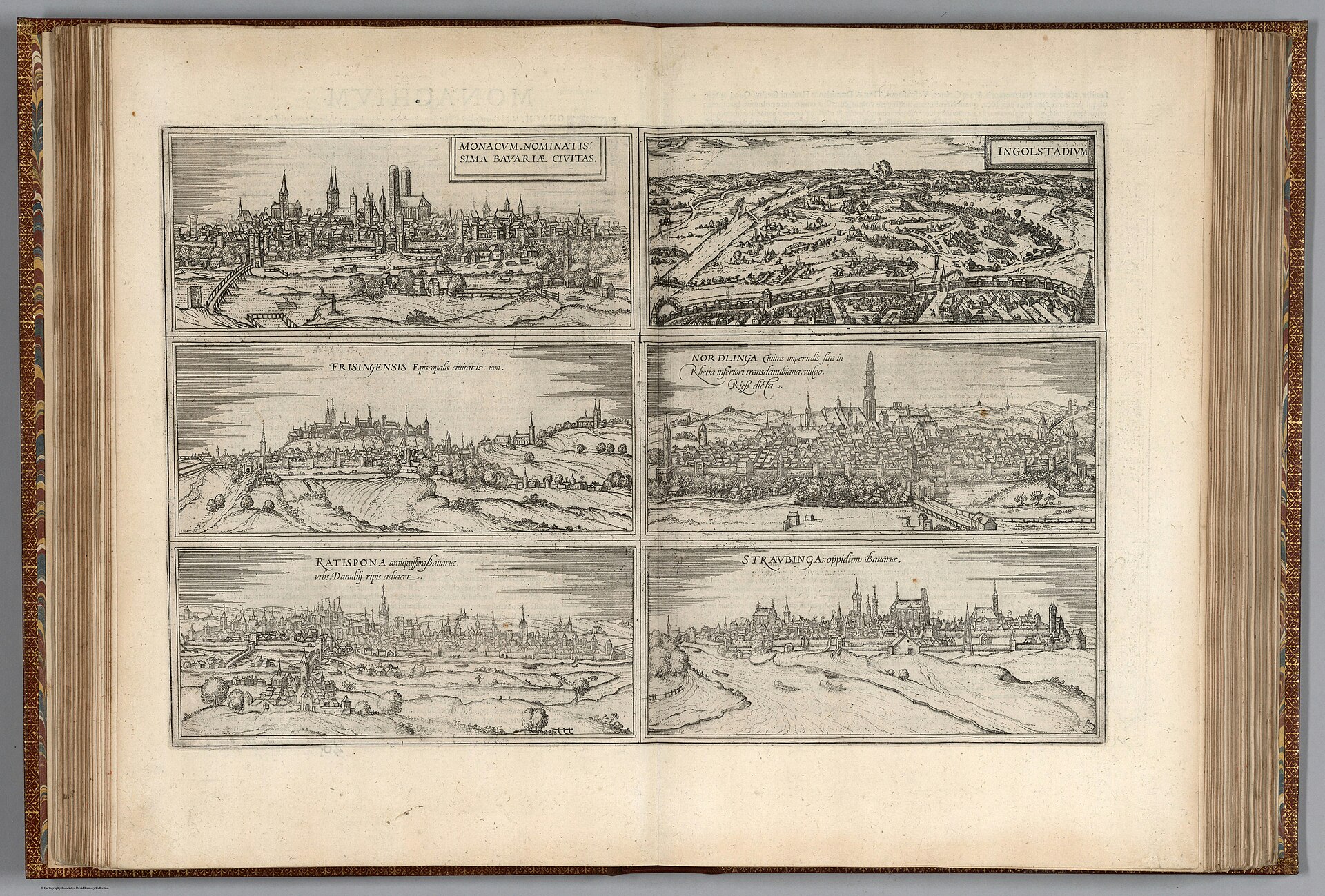
Engraved prospect of Monacum (Munich), from Braun & Hogenberg's Civitates Orbis Terrarum (1640)
Prospect showing Munich's riverfront with bridges, city walls and gates, and prominent church spires including the Frauenkirche twin towers.
Public domain (plate dated 1640)
In this city
Landmarks of Munich, see each in its prime


Castles of Munich


More cities to explore
 AustriaInnsbruckExplore it in 1500
 GermanyRegensburgExplore it in 1250 · 1750
 GermanyBerlinExplore it in 1750 · 1871 · 1928
 GermanyCologneExplore it in AD 150 · 1250 · 1880
Castles of Europe · Landmarks of Europe · create your own reconstruction.