Stadium · Germany · Still standing
Grünwalder Stadion & Allianz Arena
Allianz Arena is a modern football stadium on the Fröttmaning Heath at the northern edge of Munich. Designed by Herzog & de Meuron and opened in 2005, it is famed for its inflated ETFE-foil panel facade that can be lit in different colours. It serves as Bayern Munich's home stadium and contains spectator tiers, concourses, locker rooms, hospitality boxes and a club museum.
Its prime
2012
Today
Still standing
As it stood in 2012
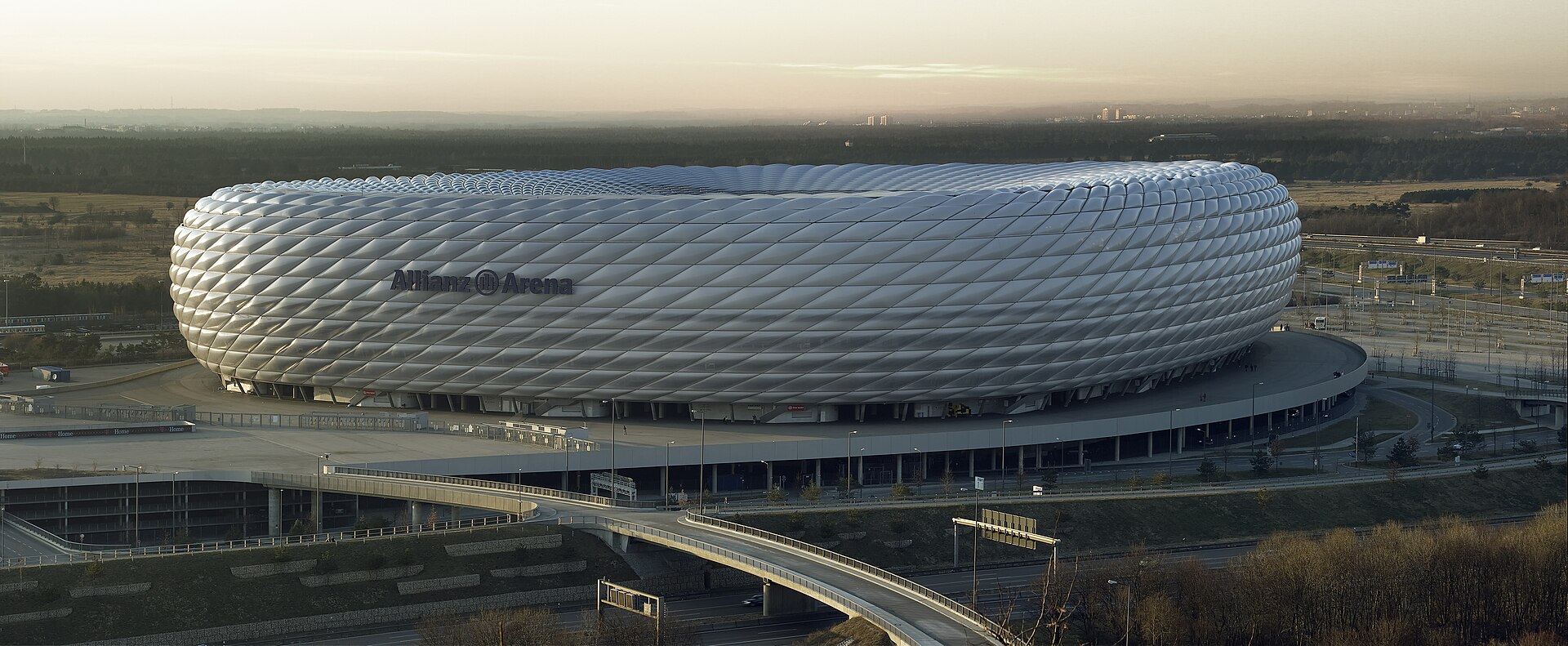
What Allianz Arena looked like in its prime.
An enormous oval bowl sitting on a low circular plinth, the stadium is wrapped in thousands of slightly translucent, quilted ETFE inflated panels forming a continuous diamond-like pattern around the rim. From ground level an elevated esplanade leads to recessed entry portals; a broad partial roof shelters the seating tiers while the playing field sits in a deep sunken bowl. Surrounding infrastructure includes multi-storey parking and a motorway visible nearby; the exterior reads as smooth, silvery-white when unlit.
Its story
The story of Allianz Arena.
A Referendum on Fröttmaning Heath, 2001–2005
The alternative to a new ground had been a major reconstruction of Munich's Olympic Stadium, an option refused by its architect Günther Behnisch. Munich's voters were asked instead whether a stadium should be built on the Fröttmaning Heath at the northern edge of the city and whether the city should provide the infrastructure; about two-thirds voted in favour. The Allianz Arena München Stadion GmbH, founded in 2001, commissioned the work, and was owned in equal parts by the two clubs that would play there, Bayern Munich and 1860 Munich.
The Swiss firm Herzog & de Meuron designed a stadium wrapped in self-cleaning ETFE foil cushions, 0.2 mm thick, those on the facade individually lit. Building began in late 2002 and was finished by the end of April 2005. Construction cost €286 million, rising to €340 million once financing was counted, with a further €210 million or so spent by the city and the state on infrastructure, including U-Bahn work that shifted the Fröttmaning platforms south and widened them from two tracks to four.
The Wildmoser Corruption Case, 2004–2006
On 9 March 2004 Karl-Heinz Wildmoser Sr., president of 1860 Munich, his son Karl-Heinz Wildmoser Jr., chief executive of the arena company, and two others were charged with corruption over the award of construction contracts and taken into custody. The father struck a plea bargain on 12 March, was released, gave up the club presidency three days later, and had the investigation into his conduct closed on 18 May. His son stayed in custody; bail was refused on 29 June on grounds of flight risk and obstruction of justice. Prosecutors charged him on 23 August 2004 with fraud, corruption and tax evasion, alleging that he had awarded the construction contract at an inflated price and given the Austrian builder Alpine inside information that let it win the work, taking €2.8 million in return. He was convicted on 13 May 2005 and sentenced to four and a half years; the Federal Court of Justice rejected his appeal in August 2006.
Opening Weekend and First Goals, 2005
The arena opened on 30 May 2005 with 1860 Munich beating 1. FC Nürnberg 3–2, Patrick Milchraum scoring the first official goal; Bayern Munich played the Germany national team the following day. On 2 June the two tenants met in the first "arena derby", won by 1860 with a goal from Paul Agostino. Bayern, who had played at the Olympic Stadium since 1972, took the first competitive goal at the ground through Roy Makaay in a DFL-Ligapokal semi-final on 26 July 2005, and Owen Hargreaves scored the first league goal on 5 August in a 3–0 win over Borussia Mönchengladbach.
Bayern Buys Out 1860 and Allianz Buys the Name, 2006–2024
In April 2006 Bayern bought 1860 Munich's 50 per cent share of the arena for a reported €11 million; 1860's managing director Stefan Ziffzer said the deal prevented the club's insolvency. 1860 went on playing at the arena until the end of the 2016–17 season, when Bayern terminated their rental contract in July 2017 and became sole tenants as well as sole owner. The locally based financial services group Allianz bought the naming rights for thirty years, but the name cannot be used at FIFA and UEFA events: the ground was FIFA WM-Stadion München at the 2006 World Cup, is the Fußball Arena München for UEFA matches, and the sponsor's logo was removed for the 2006 World Cup and Euro 2024.
Tournaments, Capacity and the Beckenbauer Address, 2006–2025
The stadium was a 2006 World Cup venue and has since held the 2012 and 2025 Champions League finals, matches at Euro 2020 and at Euro 2024 (four group games including the opening match, a round-of-16 tie and a semi-final), and the 2025 Nations League finals, during whose final a spectator died after falling from an overhead level onto a media area below. It also staged the first regular-season NFL game played in Germany in 2022, Tampa Bay beating Seattle 21–16 before 69,811, and a second on 10 November 2024, Carolina beating the New York Giants 20–17 before 70,132.
Capacity has been raised repeatedly; an expansion cleared in January 2015 brought the ground to 75,024 for Bundesliga and cup matches and 69,344 for international games. It is the second-largest stadium in Germany, behind Dortmund's Westfalenstadion. The facade was rebuilt in LED from October 2014 and switched on for the 2015–16 season, replacing panels that could show only white, red or blue with more than 300,000 individually controlled lights. Bayern's museum, the FC Bayern Erlebniswelt, has been inside the arena since 2012. On 1 May 2025 the arena's address became Franz-Beckenbauer-Platz 5, the square dedicated four days later by the mayor, Dieter Reiter.
Step inside
12 places to explore in 2012.
The record describes 12 distinct spots at Allianz Arena, including 7 interiors: pitch and seating bowl, lower, middle and upper seating tiers, südkurve (south curve) supporters stand and more. Create your own photoreal reconstruction and explore every one, more scenes means more photos, more angles and more of the immersive experience.
Build Your Own Castle
Recreate Grünwalder Stadion with AI to explore it.
Rebuilds stop at 1945, so the artist raises Grünwalder Stadion, the historic ground that came before it, as a photoreal reconstruction that belongs to you alone. Pay with coins, no subscription needed.
Recreate Stadium to Explore →Nearby
Castles within reach of Allianz Arena.


Landmarks within reach of Allianz Arena.


More landmarks of Germany


Explore the city