Historic Cities · Austria
Innsbruck through the ages
Innsbruck is the capital of the Austrian state of Tyrol and the fifth-largest city in Austria. It is located on the River Inn, at its junction with the Wipp Valley, which provides access to the Brenner Pass 30 km (19 mi) to the south. The city had a population of 132,188 in 2024.

Innsbruck in 1500
Maximilian's Innsbruck
Innsbruck in 1500 is the Habsburg court’s lively alpine residence, a walled market town folded beneath the Nordkette where imperial pageantry and skilled armourers share the streets. The walk follows the river and the old town from the bridge and Ottoburg, through the newly gilded Golden Roof square and arcaded Lauben, to a high viewpoint above the roofs and saw-toothed mountains.
The town sits low and dense along the Inn: steep red-tiled roofs, pale plaster and dark timber-framed gables, stone towers and church spires puncturing a compact skyline. Arcaded streets (Lauben) line the market thoroughfare; the Golden Roof’s newly gilded loggia flashes above the square. The Inn carries timber rafts and flat boats past quay workshops, while the Nordkette rises as a sheer, snow-bright wall behind the roofs.
The route: 15 streets, squares and views
Wilten Riverbank View → Ottoburg Bridgehead → Old Inn Bridge → Riverside Toll House → Inn Quay and Rafts → Golden Roof → Hofburg Towers → Court Garden (Hofgarten) → Herzog-Friedrich-Strasse → Old Town Hall and Stadtturm → …
Step inside, 9 interiors
Ottoburg Tower Chamber · Riverside Toll Chamber · Raftmen's Riverside Tavern · Golden Roof Loggia · Hofburg Great Hall · Imperial Spiral Stair · Clothiers' Vaulted Hall · Master Armourer's Workshop · St James Nave
Planned from the Wikipedia record: Innsbruck.
Its story
The story of Innsbruck.
Veldidena, the Bridge Over the Inn and the Brenner Toll, to 1300
Innsbruck is a crossing point that turned into a town. The Romans planted the army station Veldidena (the name survives in the district of Wilten) to protect the commercial road running from Verona over the Brenner to Augsburg in their province of Raetia; accounts date its founding to about 15 BC under Augustus and to the 4th century AD, and it lasted into late antiquity before being destroyed around 600. Pre-Roman place names, urn cemeteries at Wilten, Amras, Hötting and Mühlau and La Tène finds in the inner city indicate the basin has been settled continuously for more than three thousand years.
In 1133 the Counts of Andechs laid out a market on the left bank of the Inn, at today's St Nikolaus, and in the 1170s Count Berchtold V connected it to the far bank by the old Inn bridge. An exchange with Wilten Abbey in 1180 brought the counts ground on the southern bank; the fortified market and trading place that grew there appears in the records that year as Insprugk and received market rights in 1187. The Latin name Oeni Pons, bridge over the Inn, describes exactly what the place was for.
Between 1187 and 1205 the market obtained town rights, and with them the toll income that made it wealthy: all east-Alpine trade heading over the Brenner into Italy now went through Innsbruck and across its bridge. The town rights were confirmed and extended in 1239. When Otto VIII, last of the Andechs counts, died in 1248 the territory passed to the Counts of Tyrol, raised to ducal rank by Rudolf of Habsburg in 1286. A further exchange with Wilten Abbey allowed the new town to be laid out in 1281, and by about 1300 the Brenner route was made up and largely passable by wagon while other Alpine crossings still took pack animals only. The town seal, in use from 1267, shows the Inn bridge from above.
The Habsburg Takeover of 1363 and the Court of Maximilian I
In 1363 Margarete Maultasch, the last Countess of Tyrol, handed the country to the Habsburgs. Innsbruck became capital of the whole of Tyrol in 1429, and in 1420 Duke Friedrich IV, known as Frederick of the Empty Purse, had already made it his residence city and laid out the arcades and the court garden. The city tower was added between 1442 and 1450 to the old town hall of 1358, the Hofburg followed in 1456, the Ottoburg in 1495 and the Golden Roof in 1497–1500.
In 1485 witch trials were held in the city at the instigation of the inquisitor Heinrich Institoris, later author of the Malleus Maleficarum. They were abandoned the same year because of serious procedural defects.
Under Maximilian I, who kept his court in the city through the 1490s, Innsbruck rose to be a political and artistic centre of the Empire. The arsenal built around 1500 was one of the most significant arms stores in Europe at the time, and a regular postal service between Innsbruck and Mechelen was set up in 1490 by the Thurn und Taxis post. Maximilian's grandson Ferdinand I built the court church between 1553 and 1563 to hold the emperor's cenotaph, surrounded by the bronze figures of his real and mythical ancestors cast between 1509 and 1550; the emperor is not buried in it.
Ambras, the Jesuits, and the University That Replaced the Court, 1564–1826
Ferdinand II took over the rule of Tyrol and other Further Austrian possessions in 1564, administered from Innsbruck into the 18th century. He built Schloss Ambras and arranged his Renaissance collections there, now held mainly in Vienna's Kunsthistorisches Museum. As part of the Counter-Reformation, Jesuits under Petrus Canisius founded a college and Latin school in 1562, the ancestor of the present Akademisches Gymnasium. In 1629–30 Leopold V had the Dogana built as the first permanent opera and theatre house in the German-speaking lands.
The Tyrolean line of the Habsburgs ended in 1665 with Archduke Sigmund Franz. Innsbruck ceased to be a residence city (which is why its Gothic old town survived largely unaltered), and rule passed back to Vienna under governors. Partly in compensation, Leopold I founded the University of Innsbruck on 15 October 1669 with four faculties; it was dissolved and reopened twice before Franz I definitively restored the philosophical and juridical faculties in 1826.
Bavarian Rule and the Bergisel Risings, 1805–1849
Marshal Ney marched into Innsbruck on 5 November 1805. Under the Treaty of Pressburg, Tyrol was ceded to Bavaria, France's ally, and from 1806 Innsbruck served for eight years as capital of the Bavarian Innkreis. During the Tyrolean rising of 1809 there was heavy fighting around the city on 11 and 12 April, and Andreas Hofer led a peasant army to victory in the battles of Bergisel before making Innsbruck the seat of his administration. Immediately after the first Bergisel battle there were attacks on the city's Jewish population. The combined Bavarian and French forces later overran the Tyrolean militia; Hofer was shot for his part in the rising and became a martyr locally, his remains brought back to Innsbruck in 1823 and interred in the Franciscan church.
The Congress of Vienna restored Austrian rule. In May 1848 riots in Vienna led Emperor Ferdinand to move the seat of government temporarily to Innsbruck, and in 1849 the city formally took over from Meran as capital of Tyrol, four centuries after the princes had begun residing there.
From the Brenner Railway to the Italian Occupation, 1858–1932
The railway reached Munich by way of Kufstein and Rosenheim in 1858, crossed the Brenner to Bozen in 1867 and the Arlberg in 1884, and tourism grew quickly afterwards. Two more lines built to plans by Josef Riehl followed, to Fulpmes in 1904 and to Garmisch-Partenkirchen in 1912. A traditional local industry was the manufacture of loden, the weatherproof cloth used for coats and clothing; Franz Baur's Söhne, imperial and royal court and army supplier, had its seat in the city at the end of the 19th century.
The only recorded wartime action in Innsbruck came near the end of the First World War, when Allied aircraft flying from Italy raided the city on 20 February 1918, causing casualties among the Austrian troops stationed there without recorded damage to the town. After the armistice with Italy took effect on 4 November 1918, Bavarian troops occupied Innsbruck on 7 November to forestall an Italian occupation and withdrew once the German armistice was signed; an Italian advance guard arrived on 17 November and the main contingent on 23 November. The occupation, at times 20,000 to 22,000 strong, lasted until 1 December 1920. The partition of Tyrol that followed the war also ended the city's ecclesiastical attachment to the diocese of Brixen, which had lasted more than a thousand years. Interwar politics were violent here as elsewhere: an SA man was stabbed to death in the Hötting hall battle of 27 May 1932.
Reichsgau Capital: the November Pogrom of 1938 to the Surrender of 1945
After the Anschluss of 1938 Innsbruck became capital of the newly formed Reichsgau Tirol-Vorarlberg. In the November pogrom of 1938 the homes and businesses of Jews were destroyed and the interior of the synagogue was wrecked. Four Jews were murdered or later died of their injuries and many others were severely wounded. Almost all the Jews of Tyrol were then expelled to Vienna. Under the South Tyrol Option of 1939–43 numerous South Tyroleans moved into housing estates built for them in the city, particularly in the Pradl district.
Innsbruck held two subcamps of Dachau concentration camp, one of them a special camp for prominent people from sixteen countries and their families, held as hostages; among them were the former French prime minister Léon Blum, the former regent of Hungary Miklós Horthy, the former Austrian chancellor Kurt Schuschnigg, the Italian general Giuseppe Garibaldi II and a nephew of Winston Churchill.
Between 1943 and April 1945 the city was bombed twenty-two times and heavily damaged. The cathedral was badly hit on 16 December 1944, and the raids of December 1944 and April 1945 wrecked most of the medical and surgical university clinic in the Anichstraße. The twenty-two attacks killed 495 people. On 3 May 1945 Innsbruck was handed over to American troops without a fight, Gauleiter Franz Hofer having forbidden all resistance in a radio address beforehand.
Olympic City and Tyrolean Capital, 1948–2024
Innsbruck fell into the French occupation zone, and the military administration set up a camp for displaced persons on the site of a former military camp. Reconstruction from 1948 and preparation for the Winter Olympic Games of 1964 and 1976 produced whole new districts, among them the Reichenau and the Olympic Village. The 1976 games came to Innsbruck after Colorado voters rejected a bond referendum in 1972 to finance the Denver games awarded in 1970. The city also hosted the Winter Paralympics of 1984 and 1988 and the first Winter Youth Olympic Games in 2012. Initiatives in the mid-1990s to bring the Winter Olympics back a third time were dropped in 2006 after a referendum in which every Tyrolean district was in favour but the people of Innsbruck were against. The Bergisel stadium and ski jump were rebuilt after a crush at the Air & Style snowboard contest in 1999 in which six young people died, the jump to a design by Zaha Hadid completed in 2001.
Innsbruck was the base for South Tyrol activists in the 1960s and 1970s who sought to separate South Tyrol from Italy and reunite it with North and East Tyrol; in 1996 the European Union recognised the Euroregion Tyrol-South Tyrol-Trentino, linking the Austrian state with the Italian autonomous provinces of South Tyrol and Trentino. The interurban tramway to Hall was closed in 1974, a decision the former mayor Alois Lugger later called the greatest mistake of his time in office.
The capital of Tyrol and a statutory city ranking as a district in its own right, Innsbruck had 132,188 inhabitants in 2024, making it the fifth-largest city in Austria. Roughly a third of its residents were born outside Austria, Germany supplying the largest share of foreign nationals, and around 35,000 people commute in each day. It records more than a million overnight stays a year.
From the archive
Innsbruck on paper: the old town as it was mapped.
A period plan or bird's-eye view of the old town, drawn between 1500 and 1850, the streets this page's reconstructions walk. Public domain, with its source named.
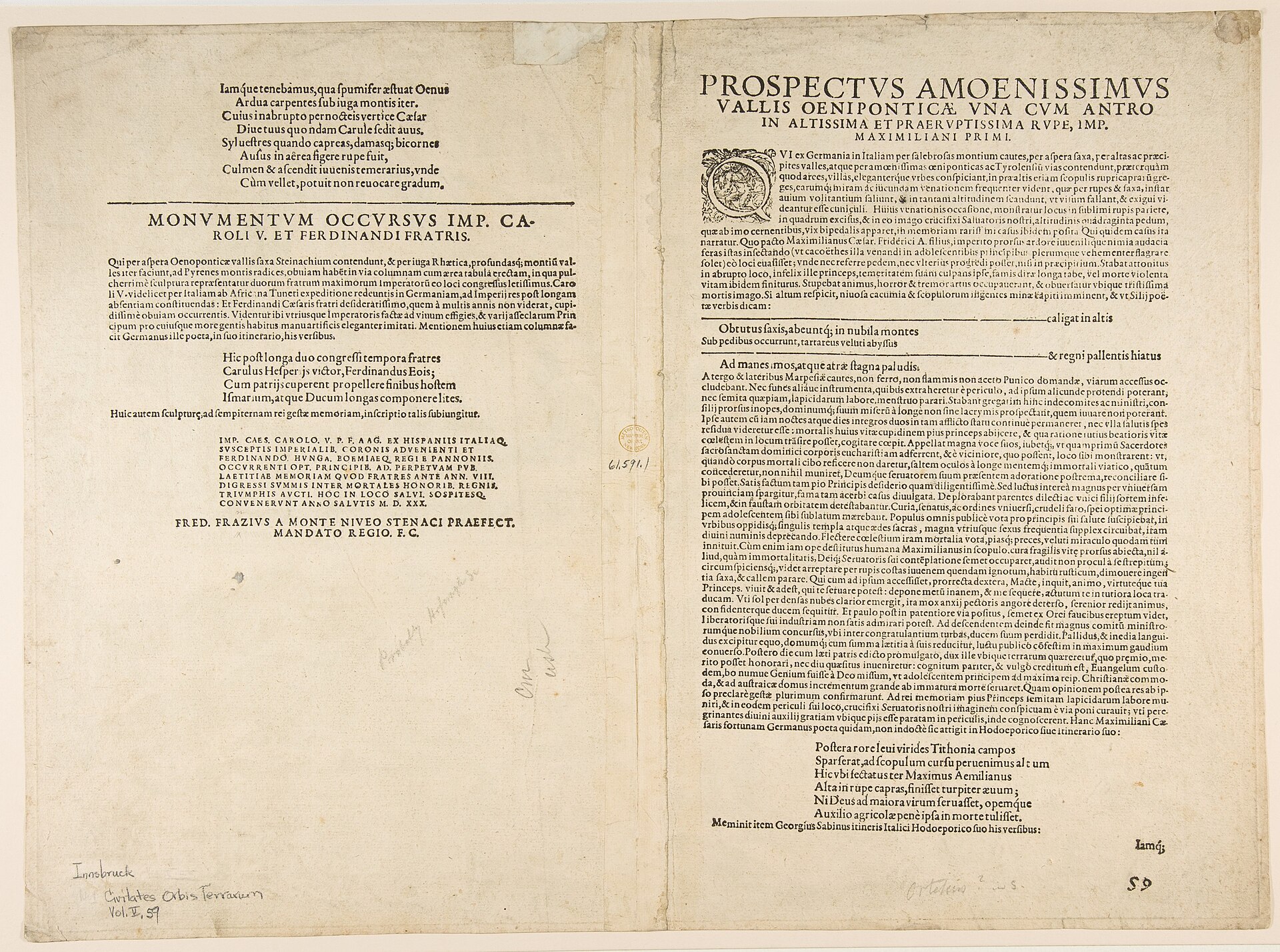
Bird's‑eye view of Innsbruck, from Civitates Orbis Terrarum (Braun & Hogenberg)
Depicts Innsbruck's walled old town with gates and riverside defences, the Inn river and bridge, multiple church spires and surrounding Tyrolean mountains.
1590 · Joris Hoefnagel / Simon Novellanus · Wikimedia Commons
CC0 (plate dated 1590)
Castles of Innsbruck

More cities to explore
 GermanyMunichExplore it in 1500 · 1700 · 1900
 AustriaSalzburgExplore it in 1620 · 1780
 AustriaViennaExplore it in 1490 · 1690 · 1780 · 1900
 AustriaGrazExplore it in 1650
Castles of Europe · Landmarks of Europe · create your own reconstruction.