Historic Cities · Austria
Vienna through the ages
Vienna is the capital, most populous city, and one of the nine states of Austria. It is Austria's primate city, with just over two million inhabitants. Its larger metropolitan area has a population of nearly 2.9 million, representing nearly one-third of the country's population.

Vienna in 1490
Late Gothic Vienna
Vienna in 1490 sits at the end of a turbulent decade: Matthias Corvinus's Hungarian occupation has just ended and the old Habsburg order is reasserting itself. Walk through a dense medieval centre of stone towers and timber houses to see the completed south tower and patterned roof of Stephansdom, the compact Hofburg courts, riverside harbours on a Danube arm, and the ubiquitous cellar doors that open onto wine beneath the streets.
A compact medieval skyline of steep gables, pinnacled church spires and the tall, slender south tower of Stephansdom rises above narrow streets; encaustic tile and coloured slate flash on the cathedral roof. Walls of pale limestone and dark timber-framed houses crowd cobbled lanes, cellar doors and barrel vents at pavement level, while small craft and wooden quays cluster along one of the Danube’s many arms. Narrow light, smoke, and rain-darkened cobbles give the city a close, tactile scale.
The route: 22 streets, squares and views
Danube Bank at Nußdorf → Rossau Harbour → Wien River Mouth → Stubentor Gate → Rotenturmstraße → Stephansplatz and Cathedral → Stock‑im‑Eisen → Neuer Markt → The Graben → Stock‑im‑Eisen Corner → …
Step inside, 13 interiors
Boatmen's Wine Tavern · Harbour Cooperage · River Customs Hall · Stubentor Guardroom · New Vaulted Nave · Neuer Markt Exchange · Graben Market Hall · Butchers' Hall · Abbey Chapter House · Hofburg Chapel · Ducal Great Hall · Augustinian Choir Stalls · Communal Wine Cellar
Planned from the Wikipedia record: History of Vienna.
Vienna in 1690
Post-siege Vienna
Seven years after the Ottoman siege was broken, Vienna stands as a fortified, repaired city with its glacis cleared and the first baroque palaces beginning to rise inside the bastions. This walk moves from the meadowed approaches and the city gates into the tight medieval streets, past the plague column on the Graben and the Hofburg courts, finishing at a high vantage over the red roofs and church spires.
The skyline is dominated by the needle of St. Stephen's and a scattering of church domes above a carpet of red‑tiled roofs and pale stucco façades. Thick medieval curtain walls, eleven bastions and a broad cleared glacis still frame the centre; within them baroque ornament and scaffolding pierce older masonry. Streets are narrow and cobbled, squares lined with market stalls and inns, while the Wienfluss and Donaukanal carry small barges and the first fashionable coffee houses open to the street.
The route: 21 streets, squares and views
Prater Meadows Approach → Stubentor Gate → Rotenturmstraße → Stephansplatz and St. Stephen's → Graben with Plague Column → Kohlmarkt → Kärntner Straße → Kärntnertor Gate → Am Hof Square → Hofburg Outer Court → …
Step inside, 12 interiors
Prater Hunting Pavilion · Stubentor Guardroom · Türkenbefreiung Chapel · Blue Bottle Coffee Room · Imperial Frescoed Stair · Michaelerkirche Nave · Schottenstift Chapter House · Rupert's Nave · Butchers' Market Hall · Draper's Counting Hall · Wienfluss Tannery Loft · Bastion Casemate Vault
Planned from the Wikipedia record: History of Vienna.
Vienna in 1780
Mozart's Vienna
This is Vienna under Emperor Joseph II, a capital of enlightened reform where court ritual and new public pleasures coexist. The walk moves from the wooded hills above the city through Augarten and the newly public Prater into the dense streets of the Innere Stadt, passing theatres, salons and masked redoutes where music, promenading and commerce meet.
In 1780 Vienna's skyline is a low, compact lattice of church spires, palace roofs and clipped garden axes seen against the distant Wienerwald. Buildings are stuccoed and pale, palace façades carved in baroque profiles; streets are narrow, cobbled and lined with wooden carts, carriages and iron-posted signs. Along the Donaukanal and riverbanks lie mills and warehouses; parks and avenues (Augarten and the Prater) cut formal green ribbons through the dense city fabric.
The route: 22 streets, squares and views
Kahlenberg Panorama → Nussdorf Road → Augarten → Donaukanal at Augarten → Praterstern → Prater Hauptallee → The Lusthaus → Taborstraße Approach → Stubentor Gate → Wien River Bridge → …
Step inside, 12 interiors
Augarten Concert Pavilion · Prater Tea Pavilion · Lusthaus Great Room · Tailor's Workshop · Cathedral Nave · Billiard Café Room · Court Theatre Auditorium · Ornate Foyer and Stair · Courtier's Salon · Winter Riding Hall · Redoutensaal Ballroom · Fortepiano Salon
Planned from the Wikipedia record: History of Vienna.
Vienna in 1900
Secession Vienna
Vienna in 1900 stands at the height of its Ringstrasse splendour while a new Secession of artists reshapes visual culture. The walk follows the Ring and its adjacent streets: imperial palaces, Otto Wagner's Stadtbahn pavilions and Majolica façades, Klimt's Secession hall, crowded markets and cafés where composers, critics and early modern thinkers meet.
The skyline balances nineteenth-century Neo‑Renaissance and Neo‑Baroque palaces along the broad Ringstrasse with the squat white cube and gilded laurel dome of the Secession building. Cast‑iron Stadtbahn pavilions and enamelled tiles flash near low to mid‑rise apartment façades; the Majolikahaus shows bright ceramic florals. Overhead tram wires and the clatter of electric trams cross avenues shaded by lime trees; horse‑drawn cabs and market stalls add close, human scale.
The route: 22 streets, squares and views
Donaukanal at Schwedenbrücke → Schottentor Gate → Universität Wien → Rathausplatz → Austrian Parliament → Volksgarten → Heldenplatz → Burgtheater → Albertina and Boulevard → Wiener Staatsoper → …
Step inside, 13 interiors
University Great Hall (Aula) · Rathaus Festival Hall · Chamber of Deputies · Staatsoper Auditorium · Karlsplatz Stadtbahn Waiting Hall · Beethoven Frieze Gallery · Fishmonger's Interior Stall · Majolikahaus Stair Hall · Parlor with Medallioned Walls · Great Golden Hall · Main Salon at Café Central · Freud's Consulting Room · Nave of St. Stephen's
Planned from the Wikipedia record: Vienna Secession.
Its story
The story of Vienna.
From the Camp of Vindobona to the Staple Right of 1221
Construction of a Roman legionary camp began around AD 97 on the ground now covered by Vienna's city centre, in the province of Pannonia, to secure the empire's Danube border; a civilian town adjoined it and the Legio X Gemina was quartered there. Vindobona held some 15,000 people at its height, and in 212 it was raised to a municipium with Roman city rights. Its name is Celtic, meaning either "white place" or "place of Vindos", which suggests the region was inhabited before the Romans came. How the Roman town ended is told two ways: one account has the population fleeing the Hunnic invasion of Pannonia in the fifth century and the site abandoned for centuries, another finds the camp never wholly deserted, its streets still following the Roman walls closely enough to suggest parts of the fortification stood.
The German name Wien is unrelated to Vindobona and derives from the River Wien; it first appears in the Salzburg Annals, which note a battle fought at a place called Wenia against the Magyars in 881, though whether that means the settlement or the river is unclear. In 976 the Margraviate of Ostarrîchi was granted to the Babenberg family, and Vienna lay on its border with Hungary. It was already an important site of trade in the eleventh century, and the Exchange of Mautern, between the Bishop of Passau and Margrave Leopold IV, calls it a civitas for the first time. Henry II moved the Babenberg residence to Vienna in 1155 and made it his capital, and the ransom taken for King Richard the Lionheart, seized by Duke Leopold V near Vienna two days before Christmas in 1192, paid for a mint and for city walls raised around 1200. In 1221 Vienna received city rights and the staple right, which obliged every trader passing through to offer his goods for sale in the city; the Viennese became middlemen and built trade connections along the Danube basin and south to Venice.
Habsburg Rule, the University of 1365 and the Expulsion of 1421
Rudolf I took the Austrian lands in 1278 after defeating Ottokar II of Bohemia, but Habsburg authority settled slowly over Vienna, where Ottokar's partisans stayed strong and there were several risings against Albert I. Under the Luxembourg emperors Prague became the imperial residence and Vienna stood in its shadow, the early Habsburgs building to keep pace. Rudolf IV was called the Founder for two things: the University of Vienna, established in 1365, and the gothic nave of the Stephansdom, begun with a metropolitan chapter that stood as a symbolic substitute for the bishop the city still lacked.
Inheritance disputes among the Habsburgs brought economic decline and unrest between the parties of the patricians and the artisans; the mayor Konrad Vorlauf, a leading patrician, was executed in 1408. When Duke Albert V was elected German king as Albert II, Vienna became the capital of the Holy Roman Empire; his name is also remembered for the expulsion of the city's Jewish population in 1421 and 1422. Vienna was given its own bishop only in 1469, when the Stephansdom became a cathedral. Matthias Corvinus and the Black Army of Hungary took the city in 1485, and it served as the Hungarian king's seat and capital until 1490.
Imperial Seat, the Ottoman Sieges and the Baroque City, 1522–1790
In 1522, under Ferdinand I, the Blood Judgment of Wiener Neustadt had leading members of the city's opposition executed, and from then on Vienna stood under direct imperial control; Bohemia was added to the Habsburg realm in 1526 and in 1556 Vienna became the seat of the Holy Roman Emperor. The city had turned Protestant quickly and was then recatholicised, the Jesuits arriving in 1551. The Ottomans besieged Vienna in 1529 and failed: the medieval walls barely held, and epidemics and an early winter forced the besiegers to withdraw. In 1548 the city was rebuilt as a fortress on plans by Sebastian Schrantz, with eleven bastions, a moat and a glacis kept clear of buildings so defenders could fire freely; that work proved decisive in the second siege of 1683, when the city held for two months until the Ottoman army was defeated by the force led by the Polish king John III Sobieski, the turning point of the Turkish Wars.
Reconstruction turned Vienna largely into a baroque city under Johann Bernhard Fischer von Erlach and Johann Lukas von Hildebrandt, most of the building falling in the suburbs, the Vorstädte, where the nobility laid out garden palaces including the Belvedere, built for Prince Eugene of Savoy. The Great Plague of 1679 is estimated to have killed nearly a third of the inhabitants and a further epidemic followed in 1713; afterwards the population grew steadily, put at 150,000 by 1724 and 200,000 by 1790. The first factories were built in Leopoldstadt, which also became a district where many Jews lived after they had been driven out of their fifty-year-old ghetto in 1670.
Napoleon, the Congress of Vienna and the Ringstraße, 1805–1873
The French took Vienna twice. In 1805 they took it without a battle: three marshals crossed the strongly defended Taborbrücke, then the only Danube bridge, and convinced the Austrian commander that the war was already over. The second occupation, in 1809, came only after heavy fire; shortly afterwards Napoleon suffered his first large defeat at Aspern nearby, then recrossed the Danube less than two months later and won the Battle of Wagram, ending the War of the Fifth Coalition. Salomon Mayer Rothschild arrived from Frankfurt in 1810 and set up a bank in the city, and the five Rothschild brothers were made barons in 1823. The Congress of Vienna sat from 18 September 1814 to 9 June 1815 and redrew the political map of Europe, at heavy cost to Austria, which paid for its round of social events.
Intensive industrialisation followed, with Vienna the centre of the railway network after 1837, and the French revolution of February 1848 reached the city as the March Revolution of the thirteenth, which forced the long-serving chancellor Metternich to resign. In 1850 the city was extended to the line of the Linienwall, the Vorstädte becoming the 2nd to 9th districts and the old city the 1st. The fortifications were demolished in 1858 and the Ringstraße boulevard built in their place, lined with monumental buildings in the historicist style that has marked Viennese architecture since; the period peaked in the World Exhibition of 1873, immediately before the stock market crash that ended the Gründerzeit.
Two Million People: Migration, Lueger and Red Vienna, 1869–1934
Censuses taken regularly from 1869 recorded a population climbing steeply, mostly through migration, to an all-time high of 2,031,000 in 1910, then the third largest city in Europe after London and Paris, and the city with the second largest Czech population in the world after Prague. Vienna, with Budapest, also became one of the main centres of the Aromanian diaspora during the nineteenth century. Karl Lueger led city politics through those years; his dedication to social policy and municipal works, among them the Hochquellwasserleitung bringing fresh water down from the mountains, went together with an intense anti-Semitism that enjoyed popular support at the time.
The First World War brought no immediate threat to the city but severe shortage, the Entente embargo cutting supplies of food and clothing while the cost of the war, financed largely by borrowing, produced inflation that wiped out the savings of many middle-class Viennese. The food shortages set off the Austro-Hungarian January Strike of 1918, which began in Vienna. The war ended Austria-Hungary, and on 12 November 1918 the Republic of German-Austria was proclaimed in front of the parliament; many Czechs and Hungarians then returned to their ancestral countries and the population fell.
Vienna was separated from Lower Austria in 1921 and became a state in its own right. The Social Democrats, who had taken an absolute majority in the municipal election of May 1919 and appointed Jakob Reumann mayor, ran the city through the period known as Red Vienna; more than 60,000 flats were built in the municipal Gemeindebauten between 1925 and 1934, allotted on a points system favouring families and less affluent citizens. In July 1927, after three far-right paramilitaries were acquitted of killing two members of the Social Democrats' Republikanischer Schutzbund, rioters set the Palace of Justice ablaze and the police killed at least 84 of them. Chancellor Engelbert Dollfuss dissolved parliament in 1933, banned the Nazi Party, the Communist Party and the Schutzbund, and after the February Uprising of 1934 banned the Social Democrats too. The civil war of February 1934 spread from Linz to Vienna, where Schutzbund members barricaded themselves in the housing estates until the army shelled the Karl-Marx-Hof.
Anschluss and the Destruction of Jewish Vienna, 1938–1945
German troops entered Austria on 12 March 1938 and Hitler reached Vienna three days later, greeted by 200,000 people at the Heldenplatz, where he announced from a balcony of the Neue Burg that Austria would be absorbed into Nazi Germany. Persecution of Jews began almost immediately: Viennese Jews were harassed and hounded, their homes and businesses plundered, and some were forced to scrub pro-independence slogans off the streets. In August the Central Office for Jewish Emigration was created under Adolf Eichmann, who held office in the expropriated Palais Rothschild and organised the expropriation and persecution of the city's Jews. During Kristallnacht on 9 November 1938 every synagogue and prayer house in Vienna was destroyed except the Stadttempel, spared because of its closeness to residential buildings. Of the almost 200,000 Jews in Vienna, around 120,000 were driven to emigrate and approximately 65,000 were killed; after the war the city's Jewish population was about 5,000. Vienna lost its status as a capital to Berlin, Austria having ceased to exist, and the few who resisted were arrested.
Twelve sub-camps of the Mauthausen-Gusen concentration camp were housed in various parts of the city. The first air raid, by the Soviet air force, came in 1942, and sustained bombing began once the Allies had taken Italy: from 17 March 1944 there were 51 raids, aimed chiefly at the oil refineries but destroying around a third of the centre and burning the State Opera and the Burgtheater. Large flak towers built against the bombers remain in place, too thick and too deeply founded to remove without damaging the buildings around them. The Red Army entered Vienna on 6 April 1945 by the eastern and southern suburbs and took the centre after several more days of fighting.
Four-Power Vienna, the State Treaty of 1955 and the Refugee City
On 29 April 1945, days after the fighting ended, the parliament building passed from the occupation force to a new Austrian government, and Karl Renner announced the reinstitution of the democratic Republic of Austria. From September the city was divided into sectors between the Soviet Union, the United States, the United Kingdom and France, the first district forming an international zone in which the four powers alternated control month by month. At the first municipal elections in November 1945 the Social Democrats took 58 of the 100 council seats, the Austrian People's Party 36 and the Communists 6. The Soviets used force to repatriate key workers of Czech, Slovak and Hungarian origin to their ethnic homelands.
Four-power control ended with the Austrian State Treaty, signed in May 1955 and in force from 27 July; all soldiers had left by October. Parliament immediately amended it to establish Austria's neutrality and non-alignment, and it was called a state treaty rather than a peace treaty because Austria had temporarily ceased to exist in 1938. In the autumn of 1956 the city took in many Hungarians fleeing after the attempted revolution, with further waves of refugees after the Prague Spring of 1968 and the collapse of Yugoslavia in 1991. During the 1970s, under Chancellor Bruno Kreisky, the Vienna International Centre was built and the city became the third official seat of the United Nations. The city centre was designated a UNESCO World Heritage Site in 2001. Vienna is the capital of Austria and one of its nine states, with just over two million inhabitants.
From the archive
Vienna on paper: the old town as it was mapped.
A period plan or bird's-eye view of the old town, drawn between 1500 and 1850, the streets this page's reconstructions walk. Public domain, with its source named.
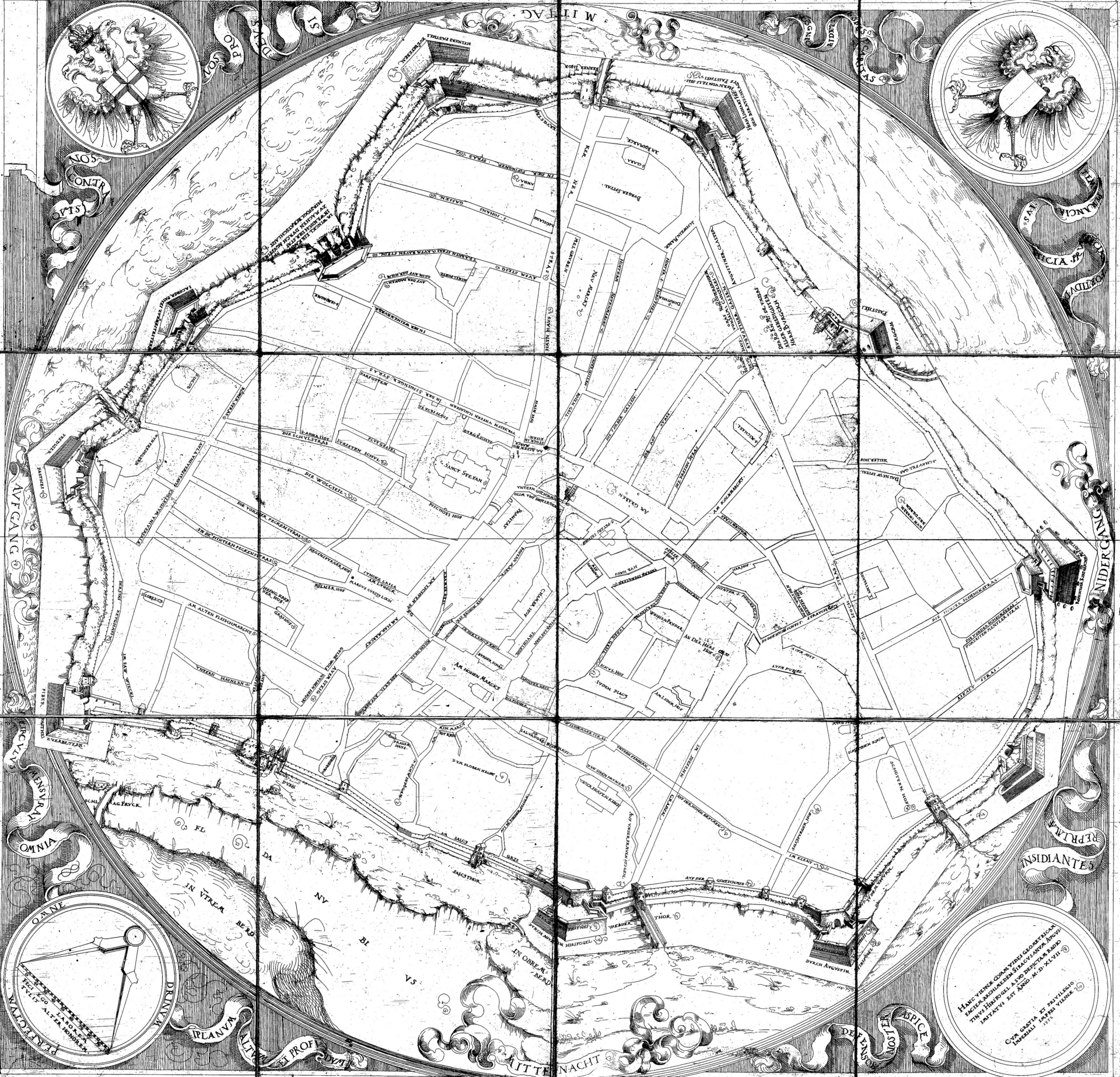
Plan of Vienna, by Augustin Hirschvogel (1547)
Detailed town plan showing Vienna’s enclosing walls and bastions, named streets and gates, with St Stephen’s church marked in the urban grid.
1547 · Augustin Hirschvogel · Wikimedia Commons
Public domain (plate dated 1547)
In this city
Landmarks of Vienna, see each in its prime


Ships tied to Vienna
- SMS Viribus Unitis: A six-metre cutaway model stands in the Museum of Military History, Vienna
Castles of Vienna


More cities to explore
 SlovakiaBratislavaExplore it in 1740 · 1900
 AustriaGrazExplore it in 1650
 AustriaSalzburgExplore it in 1620 · 1780
 AustriaInnsbruckExplore it in 1500
Castles of Europe · Landmarks of Europe · create your own reconstruction.