Historic Cities · Slovakia
Bratislava through the ages
Bratislava is the capital and largest city of Slovakia and the fourth largest of all cities on the river Danube. Officially, the population of the city proper is about 479,000, with the wider Bratislava Region exceeding 732,000 inhabitants. The metropolitan area has a population of approximately 1.3 million.

Bratislava in 1740
Coronation Pressburg
Pressburg in 1740 stands as the ceremonial coronation city of the Hungarian kingdom, its cathedral and castle the visible signs of royal ritual and noble power. The walk follows the Danube approach, a floating bridge and the procession route through Michael's Gate to Saint Martin's crowned spire, passing magnates' palaces, market squares, riverside quays and the vineyards rising onto the Little Carpathians.
A compact Baroque town clasped beneath a broad, four‑towered castle atop a wooded rock, rooflines dominated by steep red tile and dark timber, with the tall spire of Saint Martin's Cathedral punctured by a small coronation crown. White and ochre stucco palaces press the inner ring of medieval walls and towers, narrow cobbled lanes slope down to a busy timber quay and a long wooden pontoon bridge across the Danube, while vineyard terraces climb the green Little Carpathian slopes above.
The route: 21 streets, squares and views
Devín Approach → Danube Approach → Pontoon Bridge → Riverside Quay → Michael's Gate → Michalská Street → Main Square (Hauptplatz) → Old Town Hall → Approach to St Martin's → St. Martin's Cathedral → …
Step inside, 14 interiors
Pontoon Toll House · Customs Counting Room · Gate Guardroom Beneath Tower · Main Square Merchant Hall · Council Chamber of the Old Hall · Nave Prepared for Coronation · Cathedral Sacristy · Coach Stable and Workshop · Palffy Palace Ballroom · Magnate Dining Saloon · Vintner's Stone Cellar · Covered Fish Market Hall · State Audience Chamber · Castle Private Chapel
Planned from the Wikipedia record: History of Bratislava.
Bratislava in 1900
Pressburg of the Empire
Pressburg in 1900 is a provincial Habsburg river town on the eve of modern change: trilingual streets sit beneath the castle while steamers and an iron bridge keep it linked to Vienna. The walk passes river quays and horse‑tram lines into the medieval core, through the new city theatre and the Jewish quarter, and out to the factories and suburbs where chimneys mark the town’s industrial edge.
The skyline is ruled by the squat rectangle of the castle and a scattering of church spires, with red clay roofs and pale stucco façades stepping down to the Danube. Narrow cobbled streets and low market squares open between four‑storey bourgeois houses; horse trams run on iron rails, steamers puff at wooden landings, and smoky factory chimneys puncture the low hills beyond the town ring. Colours are muted earth tones with blacks and brass from ironwork and river craft.
The route: 21 streets, squares and views
Engerau Riverside → Pressburg Railway Station → Franz Joseph Bridge → Danube Quay → Steamboat Landing → Pálffy Palace → St. Martin's Cathedral → Michael's Gate → Michalská Street → Main Square → …
Step inside, 15 interiors
Station Waiting Room · Bridge Toll House · River Customs Office · Shipping Agent's Office · Pálffy Ballroom · Cathedral Nave · Gate Tower Chamber · Kaffeehaus Reading Salon · Vaulted Wine Tavern · Hall of Mirrors · Grand Auditorium · Confectioner's Parlour · Laurinska Music Salon · Tailor's Workshop · Chocolate Works Packing Room
Planned from the Wikipedia record: History of Bratislava.
Its story
The story of Bratislava.
The Frontier Fortress Above the Danube, to 1291
The Danube here was the edge of the Roman world: from the first to the fourth century the Limes Romanus ran along the river, with the Roman border town of Gerulata, excavated under the suburb of Rusovce, on the southern bank and Germanic Barbaricum on the northern. Slavs arrived between the fifth and sixth centuries, and after a rising against Avar rule Samo was made king of the Slavs in 623, founding a political entity that lasted until 658. The castles at Bratislava and at Devín (the Dowina first named in the Annals of Fulda in 864) were centres of the Principality of Nitra and of Great Moravia, though scholars have questioned that identification for want of archaeological evidence. The name Brezalauspurc first appears in 907, in connection with the battle in which a Bavarian army was defeated by the Hungarians; the exact site of the battle is unknown, and whose castle the name refers to is still argued over.
The territory passed to Hungary in the tenth century and became a frontier administrative and economic centre, with a county founded around 1000. Its position made it worth attacking: the Czech duke Břetislav I struck at the castle in 1030 and took the town with German help twelve years later, the German king Henry III besieged it for two months in 1052 without success after the Hungarians sank his supply ships on the Danube, and Boris, a claimant to the Hungarian throne, took the castle in 1146 and had to be bought out. A market settlement grew below the walls from about 1000, and Hungarians settled among its largely Slovak inhabitants in waves through the twelfth and thirteenth centuries. The Mongols failed to take the castle or the town in 1241–42 but devastated the settlements around it; German colonists arrived after 1242 and grew into the largest ethnic group in the town, which they remained until the late nineteenth century. King Andrew III granted its first known town privileges in 1291.
Free Royal Town, Hussite Wars and the Turkish Threat, 1291–1536
The town changed hands repeatedly in the decades either side of 1291: Ottokar II of Bohemia held it in the 1270s, the palatine Nicholas Kőszegi burned the castle in 1286, Andrew III's widow handed it to the Habsburgs in 1301, and it returned to Hungary in 1338. Sigismund of Luxembourg declared it a free royal town in 1405 and granted it its own coat of arms in 1436. The Hussites burned the suburbs in 1428, negotiations with them in the town failed the following year, and their attacks between 1432 and 1434 were beaten off. The first bridge over the Danube was built in 1434 and swept away by floods the next year; a second stood from 1439 until a flood took it in 1486.
From 1465 to 1490 the town was the seat of the Universitas Istropolitana, founded by Matthias Corvinus and the first university in what is now Slovakia. The Treaty of Pressburg of 7 November 1491 settled Maximilian I's claims with Ladislaus II: Hungary renounced Lower Austria, and Maximilian was to succeed if Ladislaus left no legitimate male heir. After the Kingdom of Hungary was defeated by the Ottomans at Mohács in 1526 the Turks besieged the town in 1529 and failed to take it; churches and hospitals outside the walls were pulled down two years later so that besiegers could not see over them, and in 1532 thousands of soldiers were quartered there, which turned the town into a military camp and helped divert the Ottoman advance on Vienna. In this period the town became the refuge of the Holy Crown of Hungary.
Capital and Coronation Town of Royal Hungary, 1536–1783
With Buda in Ottoman hands, Pressburg was designated capital of Royal Hungary in 1536. It became the meeting place of the Hungarian Diet from 1542 to 1848, with interruptions, the seat of the archbishop from 1543, and the coronation town: eleven kings and eight queens were crowned in St Martin's Cathedral between 1536 and 1830, the first Maximilian of Habsburg and the last Ferdinand V. Maria Theresa was crowned there on 25 June 1741, and in 1775 had a coronation hill raised from soil brought from Hungary's sixty-four counties, up which each new monarch rode to cut the air towards the four cardinal points.
The seventeenth century was the town's worst. Bocskai's troops occupied its surroundings in 1606, Gabriel Bethlen took it in 1619 and besieged it in 1621–22 until the Peace of Pressburg of 1626 ended his uprising, and from 1671 to 1677 it was the seat of extraordinary courts against Protestants and participants in the anti-Habsburg risings. It was the only town in present-day Slovakia that refused to capitulate to Thököly in 1682–83; the town below the castle gave in that July and was retaken only after the Turks were beaten near Vienna in September. Prince Eugene of Savoy held it against Rákóczi's troops in 1704, though its surroundings were destroyed. Plague came repeatedly: an outbreak in 1678–81 killed about 11,000 of roughly 30,000 residents, and the epidemic of 1710–11 another 3,800, after which the Holy Trinity column was raised in thanksgiving for its end.
The eighteenth century reversed the decline. The first factory opened in 1728, the town wall was pulled down in 1775 to let the town expand and the first theatre opened in 1776; the population rose by 200 per cent between 1720 and 1780 and reached 33,000 by 1782, making Pressburg the largest town in the Kingdom of Hungary. It was also where the region's presses started: the first journal in Hungary, Mercurius Veridicus ex Hungaria, in 1705, the first regular newspaper, the Latin Nova Posoniensia, in 1721, the German Pressburger Zeitung in 1764, the first Hungarian-language newspaper, Magyar hírmondó, on 1 January 1780, and the first in Slovak, Presspurske Nowiny, in 1783, the same year as the first Slovak novel, Jozef Ignác Bajza's René. Then in 1783 Joseph II had the crown jewels taken to Vienna and moved many central offices to Buda; much of the nobility followed, the population fell and the town's economy did not recover until 1811.
The Lutheran Lyceum, Napoleon and Industry, 1784–1918
The town became a centre of the Slovak national revival. Anton Bernolák, a student at the General Seminary in the castle, published the first Slovak language standard in 1787; a department of Czechoslovak speech and literature was created at the Evangelical Lutheran Lyceum in 1803, and students there founded the Czech-Slav Society in 1829. Ľudovít Štúr spent twenty years at the Lyceum, first as student and then as professor, sat as a deputy in the Diet, and codified the present-day Slovak language standard in 1843. In the same years the Diet moved the other way: Hungarian was proclaimed the official language of legislation, administration and teaching in 1843–44.
The town also caught the century's wars. The fourth and best-known Treaty of Pressburg was signed there in 1805 by Austria and France after Austerlitz; Napoleon's army besieged and bombarded the town in 1809 and ruined Devín Castle, and the castle above the town burned by accident in 1811 and stood in ruins until the 1950s. In 1848 the monarch signed at the Primate's Palace the laws abolishing serfdom, then dissolved the Diet, which moved to Budapest and never sat in Pressburg again. The city took the revolutionary Hungarian side; its citizens destroyed the pontoon bridge to stop Jelačić crossing the Danube in October, but the Austrians entered without a fight on 18 December 1848, and the tribunal that followed under Haynau sentenced 149 people to prison and fourteen to death.
Industry then made the modern city. The first horse-drawn railway in the Kingdom of Hungary ran from Pressburg to Svätý Jur in 1840, a steam line to Vienna opened in 1848 and one to Pest in 1850; the first bank in present-day Slovakia was founded in 1842, sewerage and gasworks arrived in 1856, the first permanent Danube bridge in 1891, trams in 1895 and public electricity in 1902. A chemical works was founded in 1873 and an oil refinery in 1895, and in the last decades of Austria-Hungary Pressburg was the second most industrialised town of the Kingdom of Hungary. The 1910 census, taken after decades of magyarisation, returned a population of 78,223 that was about 42 per cent German, 41 per cent Hungarian and 15 per cent Slovak.
Becoming Bratislava, 1918–1945
Czechoslovakia was proclaimed on 28 October 1918 with its borders unsettled. The city's dominant German and Hungarian population tried to prevent annexation and declared it a free city, while the Slovak National Assembly described the arriving legionaries as a defensive action by Slovaks themselves. The Allies drew a provisional line, given to the Hungarian government on 23 December in the Vix Note; the legion advanced from 30 December and by 2 January 1919 held every important civil and military building. The city became the seat of Slovakia's political institutions on 4 February. On 12 February Czechoslovak soldiers fired on demonstrators: the historian Attila Simon puts the toll at eight dead and fourteen injured, Marián Hronský at six dead and several injured, including the wounded Czechoslovak commander, and the accounts disagree over whether the crowd was peaceful. The name Bratislava was adopted on 27 March 1919 in place of Prešporok, Pressburg and Pozsony. On the night of 14 August 1919 Czechoslovak soldiers crossed the Old Bridge barefoot, captured the guards and took Petržalka without a fight, a bridgehead the Paris Peace Conference then assigned to Czechoslovakia. Many Hungarians were expelled or fled, teaching in Hungarian and German was radically reduced, and by the 1930 census the Hungarian share of the population had fallen to 15.8 per cent.
In October 1938 Nazi Germany annexed Petržalka and Devín, then still separate from the city, renaming them Engerau and Theben an der March, and the Old Bridge became a state frontier. Bratislava was declared capital of the first independent Slovak Republic on 14 March 1939, and the new state quickly fell under German influence. In 1941–42 and 1944–45 the Slovak government cooperated in deporting most of the city's roughly 15,000 Jews to concentration camps, where most were killed or died before the end of the war. American bombers struck the city and its Apollo refinery on 16 June 1944, killing 181 people. The Red Army took Bratislava on 4 April 1945.
Expulsion, Demolition and the Capital of Independent Slovakia
Most of the city's ethnic Germans were evacuated by the German authorities at the end of the war; the few who returned were expelled without their property under the Beneš decrees. In 1946 Jews living in the city were attacked during the Partisan Congress riots. The city absorbed seven neighbouring villages in 1946, and the 1947 Paris peace treaty transferred three Hungarian villages south of the Danube to Czechoslovakia to give it room to grow. After the Communist seizure of power in February 1948 the population rose sharply and became about ninety per cent Slovak. Prefabricated panel estates went up from the 1960s, and a quarter of the Old Town was demolished in the late 1960s for a single project, the bridge of the Slovak National Uprising: the ground cleared for it included much of the centuries-old Jewish quarter and the nineteenth-century Moorish-style Neolog Synagogue.
The city was occupied by Warsaw Pact troops in 1968 after the failed attempt to liberalise the regime, and shortly afterwards became capital of the Slovak Socialist Republic within a federalised Czechoslovakia, the Law of Federation being signed at Bratislava Castle. The candle demonstration of 1988 was broken up by police. In November 1989 the city was one of the centres of the Velvet Revolution: Slovak students rallied on 16 November, a day before the Prague demonstrations, Alexander Dubček spoke there for the first time since 1970, and the first non-Communist party, Public Against Violence, was founded on 21 November. The Declaration of Independence of the Slovak Nation was adopted on 17 July 1992 and the constitution signed at the castle on 3 September, and in 1993 Bratislava became capital of an independent Slovakia. It is the seat of the president, the parliament and the supreme courts, with a population of about 479,000 in a region of more than 732,000.
From the archive
Bratislava on paper: the old town as it was mapped.
A period plan or bird's-eye view of the old town, drawn between 1500 and 1850, the streets this page's reconstructions walk. Public domain, with its source named.
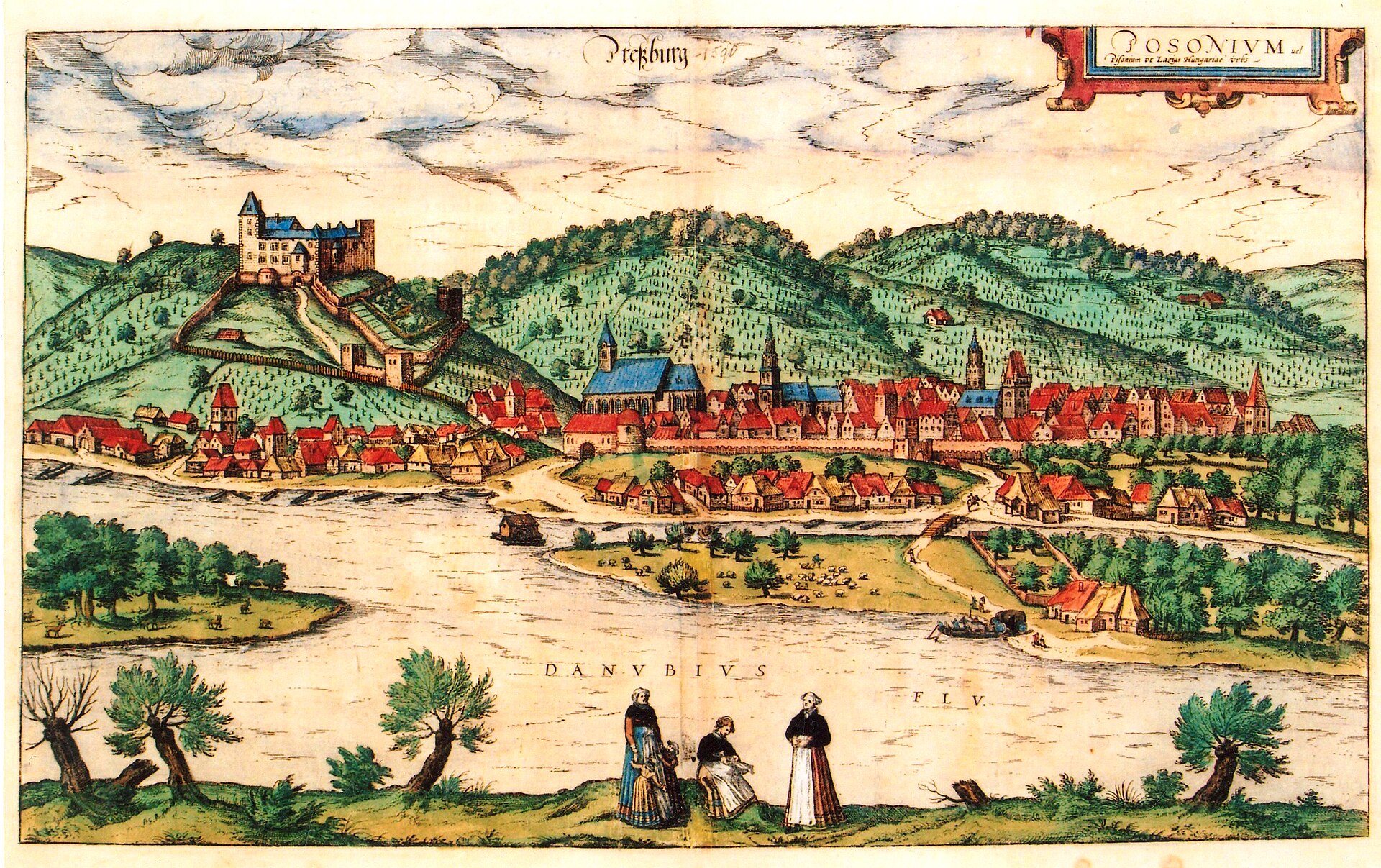
Engraved view of Posonium (Bratislava), from Braun & Hogenberg's Civitates Orbis Terrarum
Riverside prospect showing the Danube, the town's medieval walls and gates, multiple church spires and the hilltop Bratislava Castle.
1588 · Wolfgang Lazius · Wikimedia Commons
Public domain (plate dated 1588)
Castles of Bratislava


More cities to explore
 AustriaViennaExplore it in 1490 · 1690 · 1780 · 1900
 HungaryBudapestExplore it in 1470 · 1560 · 1896
 NetherlandsUtrechtExplore it in 1400 · 1700
 EnglandLondonExplore it in AD 200 · 1390 · 1600 · 1885
Castles of Europe · Landmarks of Europe · create your own reconstruction.