Historic Cities · Hungary
Budapest through the ages
Budapest is the capital and most populous city of Hungary. It is Hungary's primate city with 1.7 million inhabitants and its greater metro area has a population of about 3.3 million, representing one-third of the country's population and producing more than 40% of the country's economic output.

Budapest in 1470
Corvinus's Buda
Buda in 1470 is the royal seat newly embellished under King Matthias Corvinus, its castle quarter crowned by a renovated palace and a great ducal library. The walk shows the castle on the hill, the Church of Our Lady's tall tower, German and Hungarian merchant streets, vineyards sloping to the Danube and the low town of Pest across the river.
Castle Hill rises in compact stone and timber volumes, crowned by a royal palace with white marble detail and steep tiled roofs. Matthias’s Gothic church tower pierces the skyline. Below the walls, dense rows of merchants’ houses, workshop yards and crenellated ramparts give way to terraced vineyards and wooden quays on the Danube. Colours are muted ochres, grey stone and dark red tiles under a clear central-European sky, with figures in woolen cloaks, hoods and embroidered noble garments.
The route: 22 streets, squares and views
Danube Approach from Pest → Buda Ferry Landing → Buda Quays and Vineyards → Watertown (Víziváros) → Vienna Gate (Bécsi Kapu) → Castle Hill Ramparts → Main Castle Street → Royal Palace of Buda → Corvinus Palace Façade → Palace Terrace and Gardens → …
Step inside, 12 interiors
Fishmongers' Hall · Marble Audience Chamber · Corvina Library Hall · Renaissance Loggia · Church Choir · Saint Emeric Chapel · Vaulted Merchant Cellar · Great Butchers' Hall · Monastic Refectory · Scribe's Study · Coopers' Workshop · Riverside Counting House
Planned from the Wikipedia record: Buda.
Budapest in 1560
Ottoman Buda
In 1560 Buda sits as the Ottoman provincial capital of Budin, a fortified river town where a pasha's administration, janissary garrisons and caravan trade shape everyday life. Walkers will encounter Gothic church towers reworked with minarets, steaming Turkish baths on the Danube, crowded quays with ferries and caravans, and soldiers posted along the castle walls.
The skyline is a compact mass of the castle on the hill, clustered stone and timber houses with red clay tiles, and the tall vertical punctuation of Gothic spires retrofitted with slim minarets. Rounded domes and low, vaulting bathhouses send white steam toward the Danube, where flat-bottomed barges and ferries crowd the shore; stout stone fortifications and wooden palisades punctuate the hills, and narrow lanes thread steep slopes down to the river.
The route: 22 streets, squares and views
Pest Riverside Approach → Ferry Crossing at Buda → Víziváros Quay → Rudas Bath Exterior → Sokollu Mustafa Bath → Castle Garden Approach → Lower Castle Gate → Royal Palace Approach → Szent György Square → Matthias Church (Mosque) → …
Step inside, 12 interiors
Riverside Warehouse Storage Hall · Octagonal Marble Pool Chamber · Main Hot Room and Vaults · Gatehouse Guardroom and Armoury · Palace Stone Stair Antechamber · Converted Nave Prayer Hall · Pasha's Divan Chamber · Janissary Mess Hall · Covered Meat Market Hall · Caravanserai Central Courtyard · Tannery Vat Workshop · River Customhouse Hall
Planned from the Wikipedia record: Ottoman Hungary.
Budapest in 1896
Millennium Budapest
Budapest in 1896 is at the peak of its fin-de-siècle transformation: the millennium celebrations have driven a string of grand public works, the new Heroes' Square and Vajdahunyad Castle anchor a reimagined park, and the continent's first underground railway opens beneath Andrássy Avenue. This walk follows the river and the new boulevards, from the Buda hills across the Chain Bridge into Pest's glittering cafés, busy shopping streets and the Parliament's rising dome.
A broad, newly ordered city of pale stone and brick, Budapest in 1896 reads as an urban pageant of neo-Renaissance and eclectic façades, tree-lined boulevards and monumental domes. The Danube splits packed quays and promenades; Buda's steep, older roofs climb the hills while Pest displays long, even cornices of multi-storey palaces. Gas and early electric lamps edge the streets; horse-drawn cabs, omnibuses and brass-trimmed trams share busy carriageways beneath a haze of coal smoke and late-summer light.
The route: 24 streets, squares and views
Gellért Hill View → Citadella Esplanade → Buda Castle Forecourt → Fisherman's Bastion → Matthias Church Forecourt → Clark Ádám tér → Chain Bridge Mid-span → Vigadó / Dunakorzó → Parliament Riverside → Kossuth Lajos tér → …
Step inside, 14 interiors
Royal Audience Chamber · Matthias Church Nave · Vigadó Concert Auditorium · Dome Hall of Representatives · Gilded Ceremonial Stair · Great Synagogue Prayer Hall · Gerbeaud Confectionery Salon · Central Coffee House Salon · Oktogon Tile Ticket Hall · Opera House Auditorium · Museum Grand Exhibition Hall · Vajdahunyad Great Hall · Marble Spiral Staircase · Nyugati Train Shed Concourse
Planned from the Wikipedia record: History of Budapest.
Its story
The story of Budapest.
From Aquincum, Capital of Pannonia Inferior, to the Árpád Dynasty
A Celtic town of about thirty hectares stood on the slopes of Gellért Hill in the first century BC, with what may have been a district of craftsmen, and coins from several regions that point to trade. The Romans occupied the town at the beginning of the Christian era and its people moved down to the Danube plains, to a city that kept the Celtic name: Aquincum. In AD 106 it became the capital of the province of Pannonia Inferior, with the governor's headquarters, a garrison and a population of about 20,000, and the river beside it was the imperial frontier.
The Romans pulled out in the fifth century, and after the Huns and Germanic tribes the Avar Khaganate dominated Pannonia between the sixth and ninth centuries. From 829 Pannonia belonged to Bulgaria, and the Bulgarians built two frontier fortresses on opposite banks: Buda and Pest. The Magyar tribes led by Árpád settled the territory at the end of the ninth century, displacing those settlers, and under the Árpád dynasty Hungary became a Christian state, ruled first from Esztergom and later from Székesfehérvár.
Ofen and Pest: The Mongol Ruin of 1241 and the Royal Seat to 1500
Buda and Pest began to grow in the twelfth century, largely through French, Walloon and German settlers who worked and traded under royal protection along the banks of the Danube. Both were devastated in the Mongol invasion of 1241–42. King Béla IV, having seen how hard a plain was to defend, ordered stone walls and set his royal palace on the hills of Buda; German colonists were invited in to rebuild and inhabit both towns, and renamed Buda Ofen, furnace, after its lime kilns; the name Pest, of Slavic origin, also means furnace.
In 1361 Buda became the capital of Hungary. The Angevin kings, who were of French origin, made it the seat of centralised power and built a succession of palaces on the Várhegy. Under Matthias Corvinus, who reigned from 1458 to 1490, and his Italian-born queen Beatrice of Naples, the court became a centre of Renaissance patronage, and his library, the Bibliotheca Corviniana, was second in size only to the Vatican Library. The first Hungarian book was printed in Buda in 1473, and around 1500 the town had about 5,000 inhabitants.
Ottoman Buda, 1541–1686, and Rule from Vienna
Hungary's defeat at Mohács in 1526, against the Turks under Suleiman the Magnificent, opened the way to the Ottoman occupation of the country. The Ottomans took Buda in 1526 and again in 1529, and occupied it finally in 1541, in a siege that formed part of the Little War in Hungary. Their rule lasted more than 150 years, and the unoccupied west became Habsburg territory as Royal Hungary. The Turks built bathing facilities here, among them the Rudas and Király baths, still in use. The Christian population fell to about a thousand by 1547 and to about seventy by 1647.
In 1686, two years after a failed attempt, a Holy League army of more than 74,000 men drawn from across Europe besieged Buda Castle for six weeks and took it at the twelfth attempt. The Treaty of Karlowitz recognised the recovered territory in 1699, and in 1718 the whole kingdom passed out of Ottoman rule. Through the eighteenth century Buda and Pest were insignificant provincial towns: Vienna controlled the kingdom's foreign affairs, defence and tariffs, and a largely formal Diet met every three years at Pozsony, now Bratislava.
Széchenyi's Chain Bridge, the Revolution of 1848 and the Merger of 1873
In the early nineteenth century Pest became the centre of the Reform movement led by Count Széchenyi, whose idea of progress took physical form in the Lánchíd, the Chain Bridge. Opened in 1849, it was the first permanent bridge between Buda and Pest, which until then had depended on pontoon bridges, barges and ferries.
In the Hungarian Revolution of 1848, part of that year's revolutions in the Habsburg lands, Lajos Kossuth led the parliamentary liberals while the poet Sándor Petőfi and his fellow revolutionaries plotted the downfall of the Habsburgs at the Café Pilvax in central Pest and led crowds to the steps of the National Museum, where Petőfi recited his National Poem. The insurrection began in the capital and was defeated a year and a half later with the help of the Russian Empire; Habsburg repression took the form of the newly built Citadella on Gellért Hill, its cannons and garrison overlooking the city.
The Compromise of 1867 created the dual monarchy of Austria-Hungary and made Budapest a twin capital. On 17 November 1873 Pest, Buda and Óbuda were formally merged into one city.
The Boulevard Capital, 1870–1910
In 1870, under Prime Minister Gyula Andrássy, a Metropolitan Board of Public Works was created. Andrássy and Baron Frigyes Podmaniczky laid out the inner city with large ring roads and boulevards and separated business, residential and industrial districts; Pest was rebuilt on the Paris model, with the Nagykörút as its main artery and Andrássy Avenue running out to Heroes' Square. Competing with Vienna, the country concentrated its resources on the capital, partly through tax breaks, and a radial road and rail network reinforced its position. The millennial celebrations of 1896 brought the first line of the Budapest Metro, beneath Andrássy Avenue: the first underground transit line on the European continent, still in service as the M1.
Migration from the overpopulated countryside of Transdanubia and the Great Plain raised the proportion of Hungarians from 35.6 per cent in 1851 to 85.9 per cent by 1910, and German was crowded out as the dominant language. The Jewish share peaked in 1900 at 23.6 per cent, and the city, prosperous and with a large Jewish community, was commonly called the Jewish Mecca, or Judapest. It was also, with Vienna, one of the most important centres of the Aromanian diaspora.
Trianon, the Arrow Cross and the Budapest Ghetto, 1918–1945
Austria-Hungary collapsed in 1918. Two revolutions followed in 1918–19: the Aster Revolution, which brought the Hungarian Democratic Republic, and the short-lived Hungarian Soviet Republic under Béla Kun, after which came two years of White Terror. The Romanian Army occupied the city on 4 August 1919, ending the Hungarian–Romanian War, and Miklós Horthy became regent for the exiled King Karl IV. The Treaty of Trianon partitioned the country in 1920: Hungary lost over two-thirds of its territory and about two-thirds of its inhabitants, among them 3.3 million of its 15 million ethnic Hungarians, who found themselves in surrounding states. Horthy's regency was marked by nationalism and antisemitism, though he was considered a moderate beside the fascist Arrow Cross Party, whose power grew as the war spread.
About 200,000 Jews lived in Budapest before the war, making it the centre of Hungarian Jewish cultural life, and in the late 1930s and early 1940s it was a haven for refugees: some 5,000 arrived before the war, primarily from Germany and Austria, and as many as 8,000 Slovak Jews settled there after deportations from Slovakia began in March 1942. Hungary was allied with Nazi Germany, and despite discriminatory legislation and widespread antisemitism the community remained relatively secure until the German occupation of March 1944. The Germans then ordered a Jewish council established, restricted Jewish life severely and confiscated apartments occupied by Jews, and hundreds were interned in the Kistarcsa transit camp north-east of the city. Between April and July 1944 the Germans and Hungarians deported the Jews of the Hungarian provinces, and by the end of July those in Budapest were virtually the only Jews left in the country. In June Hungarian authorities ordered them into more than 2,000 designated buildings across the city, marked with Stars of David; about 25,000 from the suburbs were rounded up and transported to the Auschwitz-Birkenau extermination camp. The deportations were suspended in July 1944.
In October 1944, knowing of Horthy's contacts with the Allies, the Germans staged a coup against him and installed an Arrow Cross government under Ferenc Szálasi. Hundreds of Jews were shot and others drafted into forced labour. On 8 November 1944 Arrow Cross militia concentrated more than 70,000 Jews, men, women and children, in the Újlaki brickyards in Óbuda and forced them to march on foot to camps in Austria; thousands were shot and thousands more died of starvation or cold, and the survivors were taken on to Dachau and Mauthausen and to Vienna to build fortifications. In November the remaining Jews were ordered into a closed ghetto, those without protective papers from a neutral power to move in by early December. Between December 1944 and the end of January 1945 the militia took Jews from the ghetto in nightly raids, along with army deserters and political enemies, shot them on the banks of the Danube and threw the bodies in. Foreign diplomats worked against it: the nuncio Angelo Rotta, Raoul Wallenberg, Giorgio Perlasca, Carl Lutz, Friedrich Born, Harald Feller, Ángel Sanz Briz and George Mandel-Mantello organised false papers and safe houses, saving tens of thousands, and about 3,000 people sheltered in the Glass House at Vadász Street 29 and a neighbouring building, declared Swiss protected territory by Lutz. Wallenberg was abducted by the Russians on 17 January 1945 and never regained his freedom. Soviet forces captured Budapest on 13 February 1945, with more than 100,000 Jews still in the city. Between 20 and 40 per cent of Greater Budapest's 250,000 Jewish inhabitants died under the German occupation and the Arrow Cross.
The Siege, the 1956 Uprising and the System-Change
British and American air raids partly destroyed the city from 4 April 1944, and from 24 December 1944 to 13 February 1945 Soviet and Romanian troops fought German and Hungarian ones through its streets in the Battle of Budapest. More than 38,000 civilians died. The retreating Germans blew up every bridge over the Danube to slow the Red Army, and the Castle District was reduced to rubble; Erzsébet Bridge, the last rebuilt, was finished only in 1964. In 1950 the smaller outlying towns were amalgamated into Greater Budapest.
Free elections were held after 1945, but Soviet pressure brought the small Communist Party into the governing coalition, and in the election of 1949 it used a flaw in the so-called blue-ticket system to have its voters trucked to polling stations away from their home districts. The Communists gained power, Hungary was declared a People's Republic that year, arrests, beatings and summary executions became standard tools of the secret police, and Buda Castle, regarded as a symbol of the old regime, was gutted during the 1950s. On 23 October 1956 citizens held a large peaceful demonstration demanding democratic reform; when the crowd went to the radio station the regime ordered troops to fire on it, Hungarian soldiers handed rifles to the demonstrators, and the Hungarian Revolution of 1956 began. Imre Nagy was appointed prime minister, declared Hungary neutral and announced its departure from the Warsaw Pact. Warsaw Pact forces attacked on 4 November; fighting ran to mid-November and left more than 3,000 dead. Nagy fled to the Yugoslav embassy, was arrested by Soviet troops despite a promise of free passage and was later tried in secret.
János Kádár, installed after the revolt was crushed, embarked on cautious reforms sustained by large Western loans, and much of the war damage was repaired. Buda Castle and the banks of the Danube were added to the UNESCO World Heritage list in 1987, Andrássy Avenue and Heroes' Square in 2002. Through the 1980s the city was the centre of opposition activity, unauthorised printing and the Round Table Consultations between government and opposition. The borders were opened in the first official break in the Iron Curtain, Hungary was declared a Republic on 23 October 1989, and at the free elections that followed the ruling party was voted out rather than toppled. Soviet military occupation ended in 1991. The population reached 2.1 million in the 1980s and then fell as residents moved out to the agglomeration in Pest county. Budapest is the capital of Hungary, with about 1.7 million inhabitants and a metropolitan area of some 3.3 million, a third of the country's population.
From the archive
Budapest on paper: the old town as it was mapped.
A period plan or bird's-eye view of the old town, drawn between 1500 and 1850, the streets this page's reconstructions walk. Public domain, with its source named.
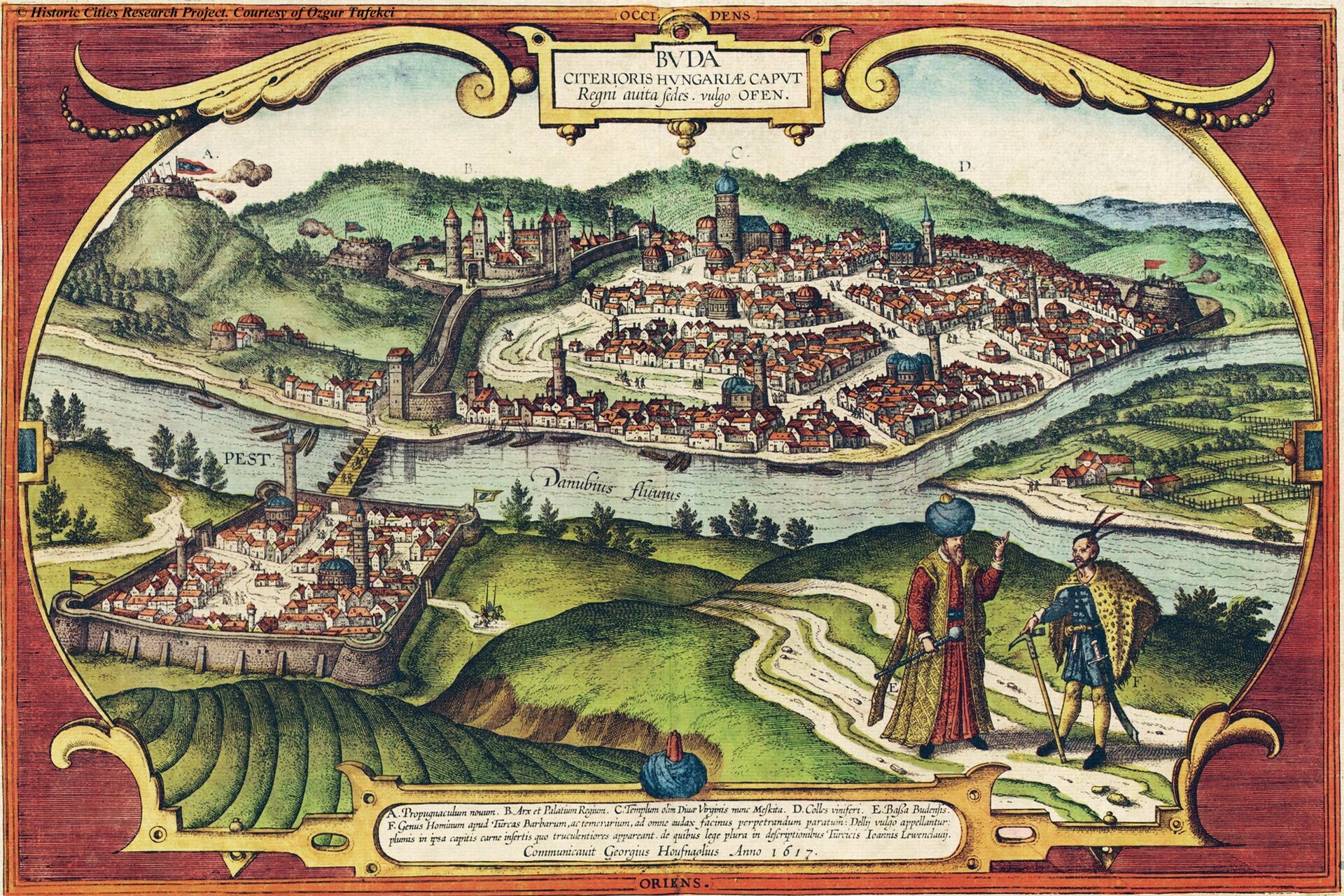
Bird's-eye view of Buda and Pest, from Braun & Hogenberg's Civitates Orbis Terrarum (after Georg Hoefnagel)
Shows Buda's castle and fortified walls, the Danubius (Danube), the walled town of Pest, a bridge and street blocks of the old town.
1617 · Braun and Hogenberg, based on the etching of Georg Hoefnagel · Wikimedia Commons
Public domain (plate dated 1617)
In this city
Landmarks of Budapest, see each in its prime


Castles of Budapest


More cities to explore
 SlovakiaBratislavaExplore it in 1740 · 1900
 AustriaViennaExplore it in 1490 · 1690 · 1780 · 1900
 NetherlandsUtrechtExplore it in 1400 · 1700
 EnglandLondonExplore it in AD 200 · 1390 · 1600 · 1885
Castles of Europe · Landmarks of Europe · create your own reconstruction.