Historic Cities · Austria
Salzburg through the ages
Salzburg is the fourth-largest city in Austria. In 2026 its population was 157,994. The city lies on the Salzach River, near the border with Germany and at the foot of the Alps mountains.

Salzburg in 1620
Prince-archbishops' Salzburg
Salzburg in 1620 is the prince-archbishop's Alpine city midway through a Baroque remaking: the new cathedral rises where a medieval quarter once stood, the Residenz fronts an enlarged square, and Hohensalzburg sits white and commanding on its rock. Walk through river quays crowded with salt barges, narrow merchant streets hung with wrought-iron signs, the green refuge of Mirabell, and beyond the walls the playful waterworks of Hellbrunn.
From the Salzach the city reads as pale stone and red tile beneath the white bulk of Hohensalzburg on the rock; narrow lanes open into broad cleared squares around the Residenz and the cathedral site with scaffolds and cranes. The riverbanks show timber salt-boats and low warehouses; shopfronts on the Getreidegasse carry blacksmith-forged, curving iron signs. Rooflines are steep and compact, plastered facades burnished by alpine light, and garden terraces and parkland lie just beyond the packed urban ring.
The route: 22 streets, squares and views
View from Gaisberg → Linzertor Gate → Linzer Gasse → Salzach Quay (East Bank) → Salt Warehouses → Salt Barges on the Salzach → Salzach Bridge → Mirabell Palace (Altenau) → North Salzach Quay → Getreidegasse → …
Step inside, 12 interiors
Riverside Inn Common Room · Salt Merchant's Counting Room · Mirabell Banqueting Hall · Goldsmith's Shop and Forge · Woodcarver's Workshop · Butchers' Market Hall · Prince-Archbishop's Audience Chamber · Cathedral Nave Beneath Scaffolding · Canons' Chapter House · Monastic Refectory · Castle Great Hall · Grotto of Water Automata
Planned from the Wikipedia record: Prince-Archbishopric of Salzburg.
Salzburg in 1780
Mozart's Salzburg
A compact princely court town whose wealth and identity revolve around the archbishop's rule and an unusually large musical establishment. The walk follows streets, quays and garden parterres where court musicians, shopkeepers and Salzburg families, among them the Mozarts, move between cathedral, Residenz and concerting rooms beneath the fortress.
White and pale‑pastel Baroque façades cluster beneath the high medieval fortress, red clay roofs and dark wooden shutters puncturing narrow alleys. The Salzach cuts the town in silver, crossed by an old stone bridge, while copper domes and the cathedral's great leaded dome rise above the Residenzplatz. Shop signs hang from iron brackets on Getreidegasse, Mirabell's parterres form clipped geometry, and steep wooded slopes (Kapuzinerberg and Gaisberg) frame the town against the Alps.
The route: 21 streets, squares and views
Gaisberg Ridge View → Kapuzinerberg Path → Nonntal Approach → Mülln Quay → Steinerne Brücke → Linzergasse Riverfront → House near the Market Square → Getreidegasse → Mozart Birth House → Alter Markt → …
Step inside, 14 interiors
Mülln Refectory · Mozart Family Music Room · Getreidegasse Coffee House · Birth Parlor · Butchers' Guild Hall · Residenz Grand Staircase · Residenz Concert Hall · Cathedral Organ Loft · Chapter House · Franciscan Church Nave · Violin Maker's Workshop · Mirabell Marble Hall · Court Chapel · Prince's Great Hall
Planned from the Wikipedia record: Prince-Archbishopric of Salzburg.
Its story
The story of Salzburg.
Iuvavum: Celts, Romans and the Name Salzburg, 15 BC–c. 800
The Salzburg basin has been settled without a break since the Neolithic. In the La Tène period it was an administrative centre of the Celtic Taurisci within the kingdom of Noricum, though no pre-Roman settlement can be shown on the ground of the present old town. After the Roman conquest of Noricum in 15 BC the settlements on the hills were abandoned and a valley town was laid out beside the Salzach. It was given Roman municipal rights under Claudius and, as Municipium Claudium Iuvavum, became one of the most important cities of the province. The name was not Latin: the Romans, like the Celts before them, took over an older name thought to derive from the river, Ivarus, meaning roughly water mixed with sand. When the province of Noricum collapsed in 488, at the start of the migration period, part of the Romano-Celtic population stayed on, and in the sixth century came under the rule of the Baiuvarii.
The German name arrived with them. It first appears in 765, in the phrase in oppido qui dicitur Salzburch, and the second element carries the old sense of a fortified height or town rather than a castle. The first element is argued over. Most take it from the salt whose extraction and trade made the place economically important, which is odd, because Salzburg was neither a salt deposit nor a transhipment point for salt: the workings that mattered to it were at Bad Reichenhall, and Hallein became significant only long after the name was in use. The competing derivation is from the Salzach itself, whose name enters the records at about the same time. In favour of salt is Saint Rupert, the refoundation's father figure, whose emblem is a salt cellar and who is the patron of salt workers. A charter of Charlemagne and two papal letters of about 800 give an older name for the place, Petena, which has never been explained.
Rupert's Refoundation and the Archbishops' Market, 696–1287
The Life of Saint Rupert credits him with the city's rebirth. Around 696 Bishop Rupert received from Duke Theodo II of Bavaria the remains of the Roman town, together with an upper castle on the Nonnberg terrace, on condition that he evangelise the east and south-east of Bavaria. He surveyed the river for a site for his basilica and settled on Iuvavum, ordained priests and annexed the manor of Piding. He built a church at St Peter on the site of the present cathedral, and probably founded both the monastery attached to it and the Benedictine nunnery on the Nonnberg for his kinswoman Erentrude. Salzburg has been the seat of a bishop since 739 and of an archbishop since 798; the first cathedral was raised under Archbishop Virgil.
Salt mining and the reach of the missionary effort pushed the territory and its counties steadily up the order of power within Bavaria. In 996 the Emperor Otto III granted Archbishop Hartwig the market and minting rights, and probably the right of toll; the salt barges on the Salzach had been paying a toll since the eighth century. The first part of Hohensalzburg was built in 1077 by Archbishop Gebhard, on the site of a Roman fort, as his residence; it was expanded heavily over the centuries that followed, and is one of the largest medieval fortresses in Europe. A city judge is recorded in 1120 or 1130. The left bank held an extensive ecclesiastical quarter (cathedral, bishop's residence, cathedral monastery, St Peter's), and only in the twelfth century did lay settlement spread into the Getreidegasse and along the quay. The first city fortifications went up around 1280; the oldest known city law dates from 1287.
The Prince-Archbishops' State, 1322–1732
From the battle of Mühldorf in 1322 the archbishopric was at odds with its Bavarian motherland, and it went on to become a territory in its own right within the Holy Roman Empire; independence from Bavaria was secured in the late fourteenth century. After the Imperial reform of 1500 Salzburg was grouped into the Bavarian Circle for governance, defence and taxation. Gold had been mined in the Tauern since 1300, and with salt it made the archbishopric one of the richest principalities in the Empire by about 1600. Prosperity in the fifteenth century also produced a confident burgher class with growing rights, which Archbishop Leonhard von Keutschach (himself a very successful manager of the territory's wealth) put down by force. In 1525, during the German Peasants' War, rebel miners and peasants besieged Hohensalzburg for three months with Archbishop Matthäus Lang von Wellenburg shut inside it; they were forced to withdraw only when troops of the Swabian League were bought in.
Within a few years of Luther's theses the majority of the city's population leaned towards Protestantism. Those who would not bend had all been expelled from the territory by 1590. Wolf Dietrich von Raitenau then remade the centre of the old town: the great late Romanesque cathedral was pulled down, and Markus Sittikus rebuilt it in the early Baroque. Paris Lodron kept Salzburg out of the Thirty Years' War by a careful neutrality and turned it into one of the best-fortified cities in Europe. It became a centre of the Counter-Reformation, with monasteries, a seminary and a great many Baroque churches; most of the inhabitants belonged to lay brotherhoods. Between 1675 and 1690 the city held the trials known as the Zauberbubenprozesse, after which more than 150 people were executed for alleged witchcraft. A large proportion of them were children and adolescents.
On 31 October 1731, the 214th anniversary of the 95 Theses, Archbishop Count Leopold Anton von Firmian signed an edict of expulsion, the Emigrationspatent, ordering every Protestant citizen to recant. 21,475 refused and were expelled from Salzburg. Most accepted an offer from King Friedrich Wilhelm I of Prussia and travelled the length and breadth of Germany to new homes in East Prussia; the rest settled in other Protestant states in Europe and in the British colonies in America. The bulk of the Protestants still left in the wider territory were forced out the following year.
Mozart, Colloredo and the End of the Archbishopric, 1756–1816
Wolfgang Amadeus Mozart was born in the city in 1756. Under Archbishop Hieronymus Graf von Colloredo, from 1772, Salzburg was a centre of the late Enlightenment in which the sciences and arts flourished. Colloredo was also one of Mozart's principal employers, and argued with him often; he dismissed him with the line Soll er doch gehen, ich brauche ihn nicht, 'he should go; I don't need him'. Mozart left for Vienna with his family in 1781, though his father Leopold stayed behind, being on close terms with Colloredo.
Napoleonic troops occupied and plundered Salzburg in 1800, in 1805 and again in 1809. In 1803 Napoleon secularised the archbishopric and handed the territory to Ferdinando III, the former Grand Duke of Tuscany, as the Electorate of Salzburg. In 1805 it was annexed to the Austrian Empire along with the Berchtesgaden Provostry, and after Austria's defeat at Wagram it passed to the Kingdom of Bavaria. The Treaty of Munich of 1816 returned it to Austria for good, but without Rupertigau and Berchtesgaden, which stayed Bavarian. Salzburg was folded into the Province of Salzach and governed from Linz.
Crown Land, Tourists and the Festival, 1816–1935
For a time after 1816 Salzburg was a district town of little consequence, reached by a few spa guests and by painters and writers who strayed there, and who were taken enough with the place that their accounts began to bring visitors. In 1850 its status was restored as capital of the Duchy of Salzburg, a crown land of the Austrian Empire. The nostalgia of the Romantic era drove tourism up further, and in 1892 a funicular was installed to carry visitors to Hohensalzburg.
After the First World War and the dissolution of Austria-Hungary, Salzburg, capital of one of its territories, became part of the new German Austria, which the Treaty of Saint-Germain-en-Laye replaced with the First Austrian Republic in 1919. The city has been known internationally for its festival since 1920. Its official population rose sharply in 1935, when it absorbed the adjacent municipalities.
Anschluss, the Maxglan Camp and the Bombing, 1938–1945
The Anschluss took place on 12 March 1938, one day before a scheduled referendum on Austrian independence, and German troops moved into the city. Political opponents, Jewish citizens and other minorities were arrested and deported to concentration camps. The synagogue was destroyed.
After Germany invaded the Soviet Union, several camps for prisoners of war from the Soviet Union and other enemy nations were set up in the city. A Romani camp was built at Salzburg-Maxglan: an Arbeitserziehungslager, a work 'education' camp, which supplied slave labour to local industry and also served as a transit camp, holding Roma before their deportation to German camps or to ghettos in German-occupied eastern Europe. Salzburg was also the site of five subcamps of Dachau.
Fifteen air strikes destroyed 46 per cent of the city's buildings, above all around the railway station. Allied bombing destroyed 7,600 houses and killed 550 inhabitants. The bridges and the dome of the cathedral were among the losses, but much of the Baroque architecture came through intact. American troops entered the city on 5 May 1945.
American Zone to World Heritage, 1945–2026
Salzburg became the centre of the American-occupied area in Austria, and several camps for displaced persons were established there, among them Riedenburg, Camp Herzl in the Franz-Josefs-Kaserne, Camp Mülln, Bet Bialik, Bet Trumpeldor and New Palestine. Many refugees settled permanently; housing built for American soldiers passed to them when the soldiers left, which they did after Austria signed the treaty of 1955 re-establishing it as a democratic and independent state and then declared its perpetual neutrality. The city became the capital of the federal state of Salzburg. Its population passed 100,000 around 1950 and 150,000 in 2016, and stood at 157,994 in 2026, making it the fourth-largest city in Austria.
The old town, whose Baroque core survived the war, is regarded as one of the best-preserved city centres north of the Alps, and was listed as a UNESCO World Heritage Site in 1996. The city was the shooting location and setting of The Sound of Music in the 1960s, and on 27 January 2006, the 250th anniversary of Mozart's birth, all 35 of its churches rang their bells after eight in the evening. Alongside Vienna and the Tyrol it is one of Austria's most visited destinations, and it has three universities and a large student population; its GDP per head in 2017, at €46,100, was above the Austrian average.
From the archive
Salzburg on paper: the old town as it was mapped.
A period plan or bird's-eye view of the old town, drawn between 1500 and 1850, the streets this page's reconstructions walk. Public domain, with its source named.
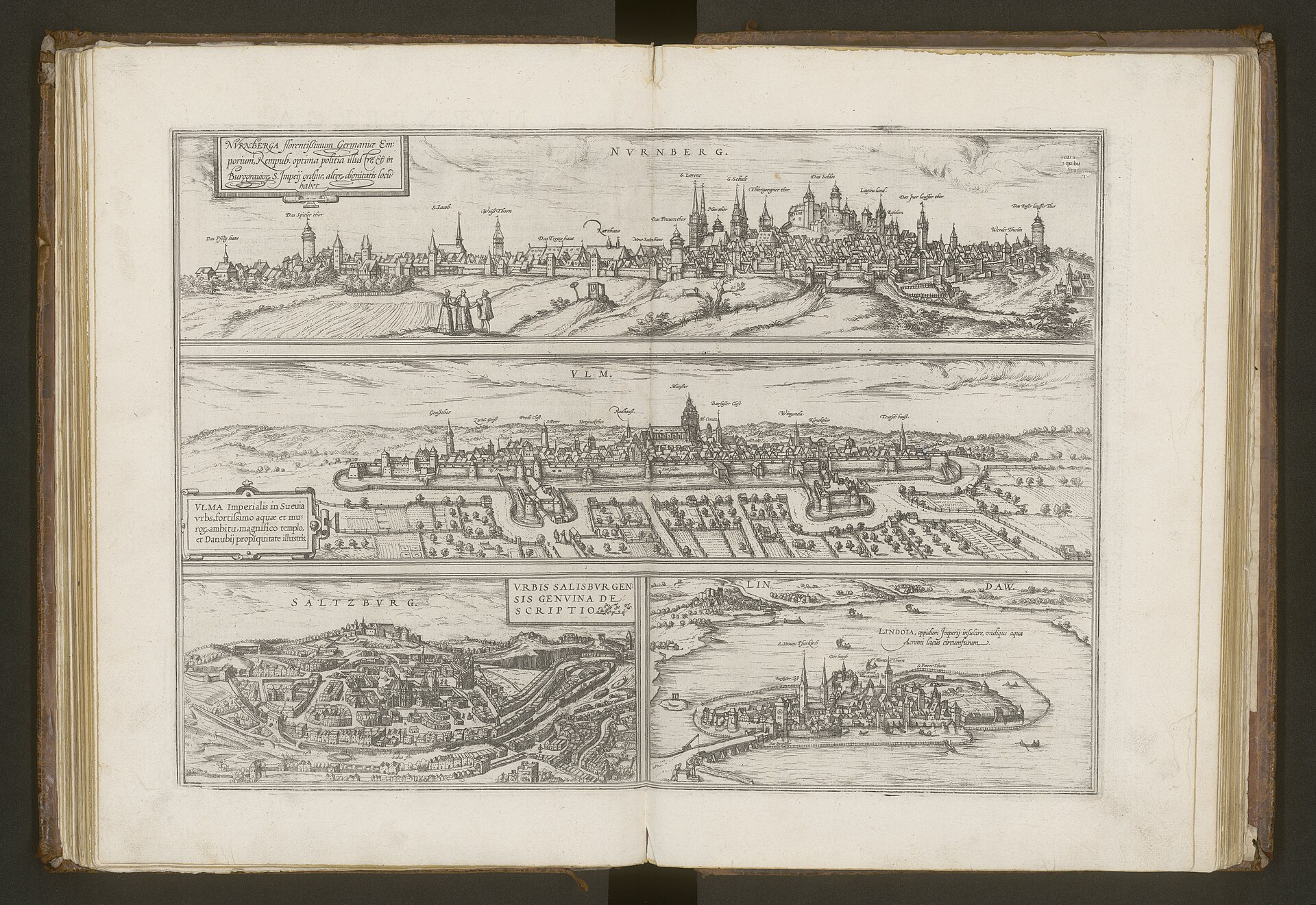
Bird's-eye view of Salzburg, from Braun & Hogenberg's Civitates Orbis Terrarum
Walled old town of Salzburg with the Hohensalzburg fortress on the hill, streets and blocks within the city, gates in the walls and the river flowing beside the town.
1577 · Georg Braun · Wikimedia Commons
Public domain (plate dated 1577)

Castles of Salzburg


More cities to explore
 AustriaHallstattExplore it in 1850
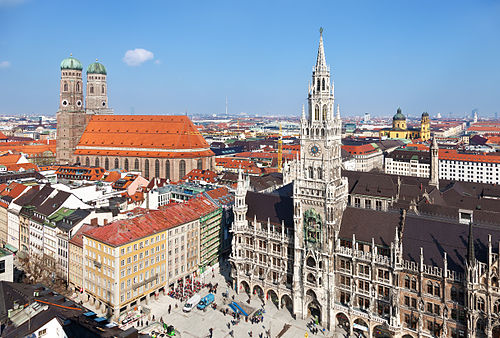 GermanyMunichExplore it in 1500 · 1700 · 1900
 AustriaViennaExplore it in 1490 · 1690 · 1780 · 1900
 AustriaInnsbruckExplore it in 1500
Castles of Europe · Landmarks of Europe · create your own reconstruction.