Historic Cities · Austria
Hallstatt through the ages
Hallstatt is a small town in the Gmunden District of the Austrian state of Upper Austria. Situated between the southwestern shore of Hallstätter See and the steep slopes of the Dachstein massif, the town lies in the Salzkammergut region, on the national road linking Salzburg and Graz.

Hallstatt in 1850
Salt and Painters
Hallstatt in 1850 is a narrow salt village pressed between the Dachstein limestone and the Hallstätter See, still reachable only by boat or the high attic-path. The walk shows the working fabric of the place: stacked lakeside houses and boathouses, the market triangle and the parish church on its terrace, the wooden brine flume above the roofs, timbered mine mouths high on the Salzberg and the mills fed by the Mühlbach.
A single tight ribbon of roofs and timber façades sits between dark water and pale cliff: brown oaken balconies, whitewashed gables, boathouses with painted planks and moored flat Fuhr boats. Above the houses a wooden brine conduit runs on trestles; the steep slope is crisscrossed by narrow paths, waterfalls and the black mouth of the salt stollen. Church stonework, wooden mine timbers and slate roofs punctuate the slope against the high grey of the Dachstein.
The route: 9 streets, squares and views
Hallstätter See Approach → Lakeside Boathouses → Marktplatz (Market Triangle) → Mühlbach Waterfall → Soleleitung (Brine Flume) → Pfarrkirche Maria Himmelfahrt → Beinhaus (Karner) → Salzberg Mine Mouth → Rudolfsturm View
Step inside, 5 interiors
Fisher Family Boathouse · Lakeside Inn Parlour · Winged Altar · Painted Ossuary Chapel · Salzberg Mine Gallery
Planned from the Wikipedia record: Hallstatt.
Its story
The story of Hallstatt.
Salt Mined Before Writing, and the Silence After 500 BC
Hallstatt exists because of salt. The mountainside above the lake holds rich natural deposits worked for thousands of years, and by the Bronze Age salt production here was a day-to-day commercial business, carried out in quantity under evidently highly organised arrangements with specialist workers supporting the mining. The wealth it generated shows in the prehistoric cemeteries above the village.
The people who worked the mines between the 8th and 5th centuries BC left grave goods distinctive enough in style and decoration that the whole early European Iron Age took the village's name: the Hallstatt culture, dated to roughly 800–450 BC and linked to Proto-Celtic and early Celtic populations. The site sits where the western and eastern zones of that culture meet, and the finds reflect it. Major activity appears to have finished about 500 BC, for reasons that are unclear. Many graves were robbed, probably at that time; there was widespread disruption across the western Hallstatt zone, and the workings had by then become very deep. No documentary record survives from the early Middle Ages, and settlement continuity through those centuries has not been demonstrated archaeologically.
Ramsauer Opens the Cemetery, 1846, and What the Salt Kept
In 1846 Johann Georg Ramsauer, a mine official born in Hallstatt in 1795, found a large prehistoric cemetery high on the Salzberg beside the mines and excavated it through the second half of the century. His work eventually yielded 1,045 burials; the prehistorian Josef Szombathy directed excavations at the cemetery after him, and some 1,300 graves have been found in all, containing around 2,000 individuals, with women and children present but few infants. No associated settlement has been located, and it may lie under the village itself, which has long occupied the entire narrow strip between hillside and water. Much of the material from the earliest excavations was dispersed.
Inside the workings the salt preserved what soil would have destroyed: textiles, wood and leather, along with abandoned shoes, cloth, tools and miners' backpacks in good condition. In 1734 miners found the body since known as the Man in the Salt, dried and preserved after he was killed in a mining accident in the 4th century BC. From March 2016 long-disused galleries were made safe so archaeological digging could resume. Excavation for a new funicular station in 2025 turned up a Roman cameo of Medusa dated to the 2nd century AD, thought to have been carved at Aquileia on the Adriatic.
Habsburg Salt: Rudolfsturm 1282 to the Ebensee Brine Line
Between 1282 and 1284 Duke Albrecht I of Austria built the Rudolfsturm on the mountain above the mines, naming it for his father Rudolf I. It served as a defensive work in the salt war against Archbishop Konrad IV of Salzburg, and from 1313 until the middle of the 20th century it housed the mine master. Elisabeth of Görz and Tyrol founded the Hallstatt saltworks in about 1305, and in 1311 the settlement obtained the market right, a sign that it counted economically. The place name is one of the typical Hall- names of salt-getting.
In 1494 the future Emperor Maximilian I granted the market its arms: a silver bar on red, and beside it a gold steering oar upright on blue, the oar for the lake shipping the inhabitants depended on, the red-white-red for Habsburg territorial lordship over a saltworks town. The late Gothic parish church of the Assumption was completed on the rock above the roofs in 1505, its massive tower the only surviving part of a predecessor of 1320, and the miners' altar in its right-hand aisle came from the workshop of the Gmunden carver Leonhard Astl around 1515.
Hallstatt had salt but was running short of the firewood needed to boil it. From 1607 a gravity-fed pipeline has carried brine north to the boiling house at Ebensee on the Traunsee, where fuel was more plentiful. Built originally from bored-out conifer trunks and now of iron and plastic, it is reckoned the oldest industrial pipeline still in operation. The mine still raises about 1.25 million cubic metres of brine a year for the Ebensee saltworks, which also processes comparable volumes from Altaussee and Bad Ischl. Salt mining remains the most significant part of the local economy after tourism.
Lutheran Miners, the Transylvania Deportations and the Painted Skulls
As in many Austrian mining communities, Lutheran teaching took hold in Hallstatt after it reached the Salzkammergut with German miners from 1520. Recatholicisation gathered pace around 1600 and measures were taken against the Protestants. Under Rudolf II there was unrest: the Catholic salt-office administrator Veit Spindler was seized in Hallstatt and mocked by miners in a kind of procession from Hallstatt to Ischl, and the Catholic priests were driven out. Troops of the Salzburg prince-archbishop Wolf Dietrich von Raitenau secured the Counter-Reformation's victory here at the beginning of the 17th century, and since 1623 the Corpus Christi procession has been held each year across the lake in the flat-bottomed local boats.
As late as the middle of the 18th century hundreds of Protestants were expelled from Hallstatt and deported to Transylvania, among the Austrians resettled there who became known as Landler. Joseph II's Patent of Toleration in 1781 partly restored the right of Protestants around the Dachstein to practise their religion, and Franz Joseph's Protestant Patent placed them largely on an equal footing with Catholics; the neo-Gothic Protestant church was built near the shore in 1863. At the 2001 census 63 per cent of the population declared themselves Catholic and 26 per cent Protestant.
Burial ground was as scarce as building ground. Bones were exhumed after some twenty to thirty years, bleached and stacked in the charnel house of the 16th century that stands in the churchyard north of the parish church, the skulls painted with the name of the dead person, their dates, and wreaths of oak leaves, ivy or flowers.
The Fire of 20 September 1750, and the Flood of 2013
During the night of 20 September 1750 fire broke out at the house of the Keferbäck at Marktplatz 61, where the master baker's wife had tried to warm an attic room with glowing wood bedded in ash and neglected the necessary precautions. Most of the Markt quarter burned. Every state-owned building went (the court chapel, the hospital church, the boiling house and its outbuildings) along with nine salt-shippers' houses and numerous private ones, 35 houses in all, and four people died.
Water has been the other recurring danger. On 18 June 2013 the Mühlbach, in flood and blocked by debris, forced a way through the centre of the village, and the lake rose into some houses because the 500-year-old listed outlet weir at Steeg has no bypass.
Only by Boat: the Road, the Railway and Austria's First Referendum
Until the end of the 19th century Hallstatt could be reached only by boat, from Obertraun or from the lower lake, or on foot along narrow mule tracks; the houses standing on the shore were connected only by boat or by the upper way, a narrow passage running through attics. A road was blasted in part out of the rock from Gosaumühle to the north-west, dated in different accounts to 1875 and to 1890. In 1877 the Salzkammergut railway opened a halt about a kilometre away on the opposite, eastern shore, a route along the extremely steep western side having been rejected on geological and topographic grounds; a boat service carried passengers and the post across, and in very cold winters a motor sledge ran over the ice instead.
Residents then turned against the road. Protests against continuing it south along the shore led in 1958 to the first referendum held in Austria, at which the population rejected a lakeside road through the village. The through route was driven into the mountain west of the town instead, as a double tunnel opened in 1966. From December 2020 the station gained a direct InterCity service from Vienna at weekends and on public holidays; the express now runs daily, a little over three hours to and from Wien Westbahnhof.
World Heritage 1997 to the Selfie Fences of 2023
In 1997 UNESCO inscribed the Hallstatt-Dachstein/Salzkammergut cultural landscape, with the town at its core, as a World Heritage Site. Tourism had begun here in the 19th century but rose steeply afterwards. Hallstatt was a location for the South Korean television series Spring Waltz in 2006, which made it known across East and South-East Asia, and a rumour reported in China in 2013 that the village was the model for Arendelle in Frozen increased day-visitor numbers further, although the filmmakers said their research had been done in Norway and Canada. In 2011 the Chinese mining company China Minmetals began building a full-scale replica of parts of the town at Huizhou in Guangdong, opened as a residential development in June 2012.
Before the COVID-19 pandemic some 600,000 to 700,000 visitors came each year, by one 2018 estimate as many as 900,000, most of them from Asia and particularly China, arriving by coach and staying a few hours in a market municipality whose resident population was 741 at the start of 2026. By 2017 local churches were employing door staff to stop services being disrupted. Since autumn 2020 coaches must take a time slot allocated in advance by the tourist office, pay an 80-euro fee and stay at least two and a half hours, with arrivals capped at 54 a day, about half the number on peak days in 2018. In May 2023 two fences were put up to stop visitors stopping for selfies and taken down again after a backlash; that August protesters blocked the tunnel through which the coaches enter, and the mayor announced plans to cut bus numbers by a further third.
From the archive
Hallstatt on paper: the old town as it was mapped.
A period plan or bird's-eye view of the old town, drawn between 1500 and 1850, the streets this page's reconstructions walk. Public domain, with its source named.
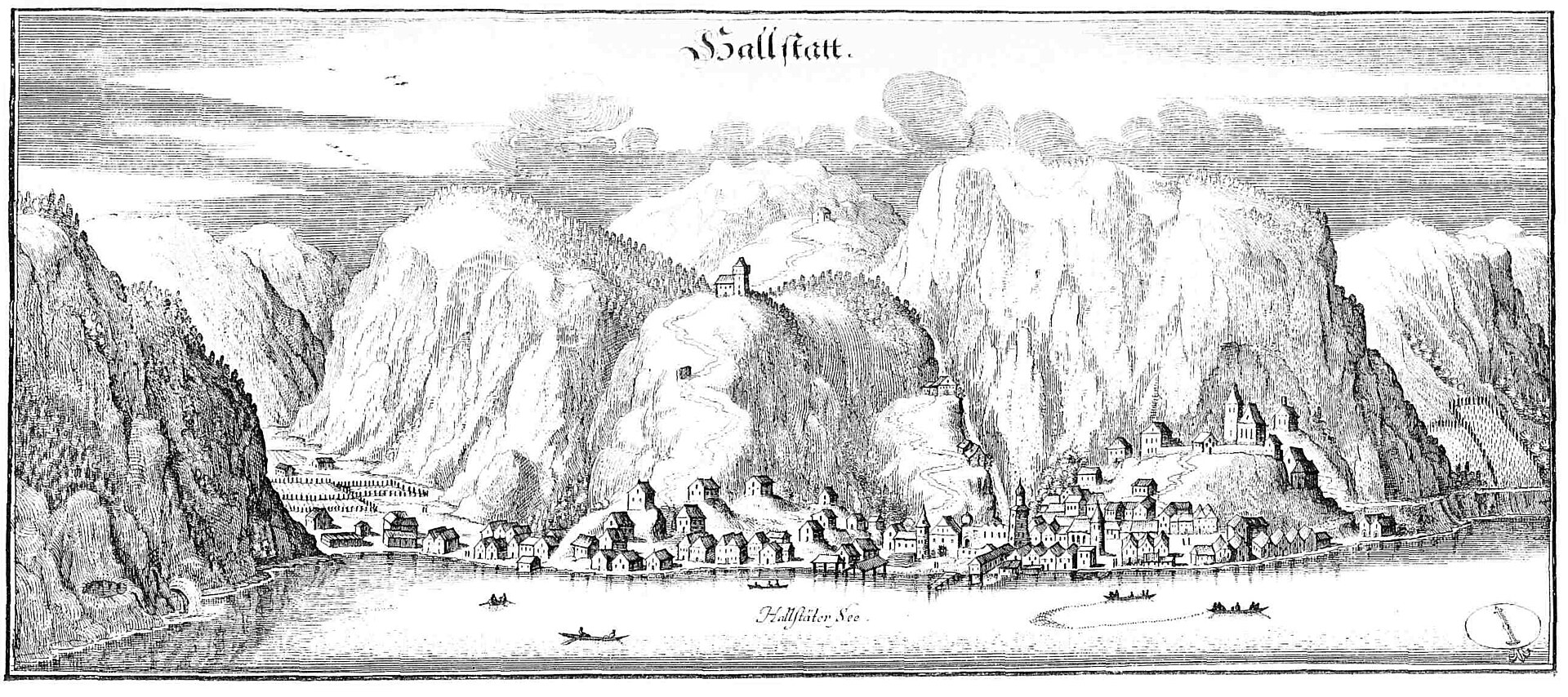
Engraved view of Hallstatt, from Matthaeus Merian (1656)
Lake-front settlement on the Hallstätter See with rows of houses along the shore, a prominent church tower, steep surrounding cliffs and a hillside track to a hilltop chapel.
1656 · Matthaeus Merian · Wikimedia Commons
Public domain (plate dated 1656)
More cities to explore
 AustriaSalzburgExplore it in 1620 · 1780
 AustriaGrazExplore it in 1650
 AustriaViennaExplore it in 1490 · 1690 · 1780 · 1900
 AustriaInnsbruckExplore it in 1500
Castles of Europe · Landmarks of Europe · create your own reconstruction.