Historic Cities · Austria
Graz through the ages
Graz is the capital of the Austrian state of Styria and the second-largest city in Austria, after Vienna. On 1 January 2026, Graz had a population of 307,912, or 345,391 including residents with a secondary residence. In 2023, the population of the Graz functional urban area was 660,238.

Graz in 1650
The Styrian Capital
Graz in 1650 sits beneath its fortified Schlossberg as the administrative heart of Inner Austria, where Habsburg power, Italian Renaissance taste and local German building traditions meet. The walk passes the clock and bell towers on the hill, the busy Hauptplatz market, the Landhaus's tiered courtyard and the great provincial armoury beside the river, with watermills and painted merchant houses along the Mur.
A compact, hilly town dominated by the Schlossberg’s stone ramparts, the Uhrturm clock and the Glockenturm bell tower; red clay tile roofs and steep gables step down towards the Mur. Narrow streets open into Renaissance arcaded courtyards and painted merchant façades, Italianate motifs set behind German timber gables. Stone and plaster predominate, timber wharves and waterwheels line the river, and the new armoury’s long stone block punctuates the riverside skyline.
The route: 16 streets, squares and views
Murbank at Gries → Murbrücke → Timber Wharves and Watermills → Hauptplatz Market → Rathaus Front → Cathedral and Mausoleum → Landhaus Courtyard → Landhaus Facade → Herrengasse Painted Façades → Schmiedgasse Workshops → …
Step inside, 9 interiors
Miller's Wheelroom · Vaulted Wine‑Cellar Inn · Gothic Nave with Frescoes · Ferdinand's Marble Mausoleum · Arcaded Assembly Hall · Guildsmith's Smoke‑Filled Forge · Armour Galleries · Arsenal Gallery · Castle's Grand Stair
Planned from the Wikipedia record: Graz.
Its story
The story of Graz.
The Small Castle on the Mur, 1128–1281
The name most likely comes from Slavic. Gradec means 'small castle', and still does in Slovene, and some archaeological finds point to a small castle raised here by Alpine Slavic settlers who moved into the region after the Celts and the Romans had been driven out. The town itself was founded by Bavarian settlers who arrived shortly after the Slavs and intermixed with them, and who called it Bayrischgraz, Bavarian Graz, to distinguish it from the older Windischgraz, the Slovene one. The Bavarian town soon eclipsed its namesake, and Graz came to mean only this one. People had been on the ground since the Copper Age, but no settlement ran unbroken from then into the Middle Ages.
The name appears in the records in 1128; a record of Grez from 1091 is disputed, and the earliest mention generally treated as secure dates from 1140, when Udalrich von Graz witnessed a donation. Around 1160 the great Graz market was established on the ground of what is now the Hauptplatz, and under the dukes of the Babenberg line the town grew into a commercial centre of real weight. It received its civic arms in 1245, and in 1281 King Rudolph I granted it special privileges.
Residence of Inner Austria, 1379–1619
Graz became a Habsburg residence in 1379, and it housed the Inner Austrian line of the dynasty. From the castle on the Schlossberg they ruled Styria, Carinthia, most of present-day Slovenia and parts of Italy: Carniola, Gorizia and Gradisca, and Trieste. Frederick III found the old hill castle too small and uncomfortable and built a new Burg down in the town between 1438 and 1453; it remained the residence of the Inner Austrian court until 1619. Sixteenth-century building was largely in the hands of Italian Renaissance architects and artists: the Landhaus, raised by Domenico dell'Allio between 1557 and 1565, served the local rulers as their seat of government.
At the head of the open and fertile Mur valley, the city was a standing target for invaders. The year 1480 brought locusts, pestilence and a Turkish invasion together; all three were painted in 1485 on the cathedral's outer wall in the Landplagenbild, presumably by Thomas von Villach, which also carries the oldest painted view of Graz. Matthias Corvinus and the Hungarians came in 1481, the Ottomans in 1529 and again in 1532. Apart from Riegersburg Castle, the Schlossberg was the only fortification in the region that never fell to the Ottomans, and new works were built on it at the end of the sixteenth century. The provincial armoury, preserved in the city since 1551, holds the world's largest historical collection of late medieval and Renaissance weaponry, with over 30,000 items on display.
The court left when its head was promoted. Ferdinand II, of the younger Habsburg branch resident in Graz, succeeded to the imperial throne in 1619 and moved the capital to Vienna; the entire Habsburg household transferred to the Hofburg that year. Graz remained the chief town of the Duchy, later crown land, of Styria, and Ferdinand's mausoleum was built beside the cathedral.
A University Founded, Closed and Restored, 1585–1938
Archduke Karl II founded the University of Graz in 1585. He also had 20,000 Protestant books burned in a city square, and succeeded in returning Styria to the authority of the Holy See. The Protestant preachers were driven out in 1598 and the Protestant schools closed in 1599. Johannes Kepler had come to Graz in 1594 as district mathematician, teaching at the Lutheran school and studying astronomy in the time that left him; he departed for Prague in 1600, when Protestants were banned from the city.
For most of its existence the university was controlled by the Catholic Church, and in 1782 Joseph II closed it in an attempt to bring educational institutions under state control, converting it into a lyceum that trained civil servants and medical personnel. Emperor Franz I re-established it as a university in 1827 under the name Karl-Franzens. Ludwig Boltzmann held the chair of mathematical physics from 1869 to 1890; Nikola Tesla studied electrical engineering at the Polytechnic in 1875; the Nobel laureate Otto Loewi taught at the university from 1909 until 1938; Ivo Andrić took his doctorate there, and Erwin Schrödinger was briefly its chancellor in 1936.
Slovene Graz, 1574–1919
As the capital of the then multiethnic Duchy of Styria, Graz was also a centre of Slovene culture, above all in the centuries between the founding of its university and the establishment of the University of Ljubljana in 1919. The first Slovene Catholic book was published here in 1574, and in 1592 Hieronymus Megiser published in Graz his Dictionarium quatuor linguarum, the first multilingual dictionary of Slovene. The first chair of Slovene was established at the Graz lyceum in July 1811, on the initiative of Janez Nepomuk Primic.
In the nineteenth century the student associations of Graz were a crucible of Slovene nationalism, and some Slovene students there were more nationally aware than Slovenes elsewhere. This drew fierce anti-Slovene efforts from the German supermajority in the city, before and during the Second World War. Slovenes only ever formed a tiny minority of the population.
Eight Assaults on the Schlossberg and the Gründerzeit, 1797–1918
Napoleon's army occupied Graz in 1797, and the city was taken by the French more than once over the course of the wars. In 1809 it withstood a further assault. The officer commanding the fortress was ordered to hold it with about 900 men against a French force of roughly 3,000, and beat off eight attacks; the defence ended only when the Grande Armée occupied Vienna and the Emperor ordered a surrender.
Austria's defeat at Wagram later that year settled the fate of the works. Under the Peace of Schönbrunn the fortifications on the Schlossberg were demolished with explosives. The bell tower and the civic clock tower were spared only because the citizens of Graz paid a ransom for their preservation.
After the French withdrew, cultural life, commercial initiative and new technology drove the city's growth until the monarchy ended in 1918. Graz became a statutory city around 1850, and its population passed 100,000 in about 1870, during the Gründerzeit. Industrialisation and urban expansion through the nineteenth and twentieth centuries made it an industrial, educational and cultural centre for southern Austria. Archduke Franz Ferdinand was born here, in the building that now houses the city museum.
Border City, Anschluss and the Wetzelsdorf Massacre, 1919–1955
The Treaty of Saint-Germain-en-Laye demoted Graz in fact if not in name: from an interior city of a large state to a border city of a small one. On 7 June 1920 a hunger revolt known as the Kirschenrummel broke out. At the Anschluss of 1938 the local National Socialists took control of the city before the German troops arrived, and the whole outer ring of suburban communities was converted into city districts the same year, forming 'Greater Graz' and raising the population accordingly.
Of all Austrian cities, Graz recorded the most air raids of the Second World War: 56 in all. On 2 April 1945, during the heaviest Allied raid on the city, the Gestapo and the Waffen-SS committed a massacre at the SS barracks at Graz-Wetzelsdorf, killing resistance fighters, Hungarian-Jewish forced labourers and prisoners of war. Soviet troops entered Graz in 1945 and were followed by British troops, who stayed until the conclusion of the State Treaty in 1955.
World Heritage and a Communist Mayor, 1999–2026
Graz is the capital of Styria and the second-largest city in Austria, with 307,912 residents at 1 January 2026: 70 per cent of them Austrian citizens, 14 per cent citizens of other EU states and 16 per cent nationals of countries outside the Union. Four universities and four other higher-education institutions had more than 63,000 students between them as of June 2023. The historic centre was added to the UNESCO World Heritage list in 1999, for the co-existence of buildings of different periods and styles in a single townscape, and in 2010 the inscription was extended to Eggenberg Palace on the western edge of the city. Graz was European Capital of Culture in 2003 and is recognised as a City of Design within UNESCO's Creative Cities Network.
Its politics have gone their own way. A Social Democratic stronghold for much of the post-war period, the city was overtaken by the People's Party in 2003: the same election in which the Communist Party of Austria, negligible nationally, took third place with 20.8 per cent under the local leader Ernest Kaltenegger. The Communist vote fell to 11.2 per cent in 2008, recovered under Elke Kahr to 19.9 per cent in 2012 and 20.3 per cent in 2017, and carried the party into the Styrian provincial parliament in 2005, its first seats in an Austrian provincial parliament in 35 years. In 2021 the People's Party vote collapsed, the Communists took 29 per cent, and Kahr was elected mayor that November at the head of a coalition with the Greens and the Social Democrats. At the municipal election of 28 June 2026 the party won almost 36 per cent of the vote.
From the archive
Graz on paper: the old town as it was mapped.
A period plan or bird's-eye view of the old town, drawn between 1500 and 1850, the streets this page's reconstructions walk. Public domain, with its source named.
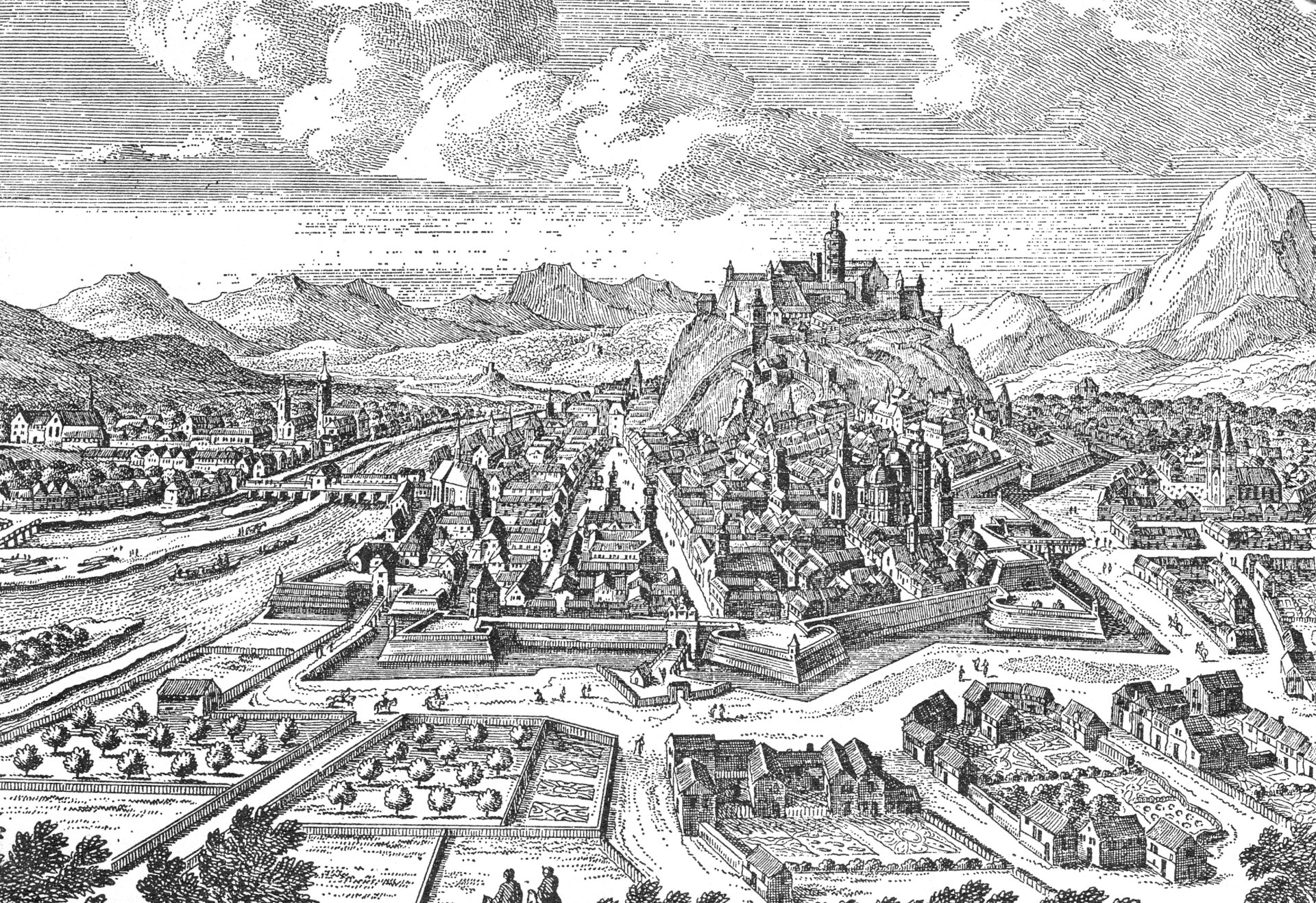
Bird's-eye view of Graz, from Matthäus Merian's engraving (1650)
Shows Graz's walled old town with bastioned ramparts, gates, the main street grid, the Schlossberg with castle, river Mur and several church towers.
1650 · Matthäus Merian · Wikimedia Commons
Public domain (plate dated 1650)
Ships tied to Graz
- SMS Tegetthoff: Her bell is on display in Graz
More cities to explore
 SloveniaLjubljanaExplore it in AD 200 · 1910
 AustriaViennaExplore it in 1490 · 1690 · 1780 · 1900
 AustriaSalzburgExplore it in 1620 · 1780
 AustriaInnsbruckExplore it in 1500
Castles of Europe · Landmarks of Europe · create your own reconstruction.