Historic Cities · Slovenia
Ljubljana through the ages
Ljubljana is the capital and largest city of Slovenia, located along a trade route between the northern Adriatic Sea and the Danube region, north of the country's largest marsh, it has been inhabited since prehistoric times. It is the country's cultural, educational, economic, political and administrative centre and the seat of the Urban Municipality of Ljubljana.

Ljubljana in AD 200
Roman Emona
This is Emona at its height as a compact Roman colonia on the route from Aquileia to the Danube, a walled grid of insulae, a forum and riverside trade. The walk follows the main gates and streets, timber quays on the Ljubljanica, suburbs of potters and kilns, and finishes on Castle Hill with marsh and Alpine ridges beyond.
A low, rectilinear Roman town of stone walls and red clay roofs sits beside a narrow, timber‑lined river. Streets run in a tidy grid between insulae of two‑storey houses, workshops and drainage gutters. The forum’s porticoes and the baths rise in limestone and plaster, while smoke and kiln glow come from pottery yards beyond the western gate; distant marshes and the Alps frame the skyline.
The route: 22 streets, squares and views
Approach across the Marsh → Aquileia Road Outside Walls → Porta ad Aquileiam → Decumanus Maximus → Cardo Maximus → Forum of Aemona → Basilica at the Forum → Timber Quays of the Ljubljanica → Bridge over the Ljubljanica → Riverside Warehouses and Barges → …
Step inside, 13 interiors
Gatehouse Inner Chamber · Decumanus Oil and Wine Shop · Bakers' Oven Hall and Counter · Porticoed Market Hall Interior · House Church Meeting Hall · Riverside Timber Warehouse · Bridge Gate Guardroom Chamber · Long Cargo Warehouse Hall · Mosaic Atrium and Hypocaust · Potter's Wheel and Kiln Room · Smith's Forge and Anvil Hall · Caldarium and Tepidarium Halls · Kiln and Drying Shed Interior
Planned from the Wikipedia record: Emona.
Ljubljana in 1910
Ljubljana Rebuilt
This city shows the immediate aftermath of the 1895 earthquake transformed into a provincial capital remade in Vienna Secession dress. The walk follows new bridges, banks, schools and market embankments along the Ljubljanica, passes the pink Franciscan church and Hauptmann House’s glazed tiles, and finishes with the castle on its wooded hill.
A compact, low skyline capped by the stone bulk of Ljubljana Castle on a wooded hill; narrow river embankments lined with wooden market stalls and stuccoed Secession facades. Streets are paved and narrow, shopfronts display hand-lettered signs, and iron balustrades and glazed tile accents add bright points against pale plaster. The Dragon Bridge’s four green, patinated bronze dragons mark the river, while new banks and school buildings show measured civic scale rather than grand imperial height.
The route: 21 streets, squares and views
Railway Approach → Main Railway Station → Dunajska cesta → Kongresni trg → Tivoli Park → Miklošičeva Cesta → Prešernov Trg → Franciscan Church → Hauptmann House → Prešeren Embankment → …
Step inside, 12 interiors
Main Station Waiting Hall · Opera House Auditorium · Hotel Union Ballroom · Secession Stairwell of Iron · Riverside Coffeehouse Parlor · Covered Meat Hall · Market Bakers' Vaulted Hall · Town Hall Council Chamber · Savings Bank Marble Hall · Cathedral Nave under Dome · Seismological Observatory Office · Castle Great Hall
Planned from the Wikipedia record: 1895 Ljubljana earthquake.
Its story
The story of Ljubljana.
Pile Dwellings, the Oldest Wheel and the Roman Town of Emona
Around 2000 BC people were living in pile dwellings on the Ljubljana Marsh, moving through the wetland in dugout canoes and surviving by hunting, fishing and primitive agriculture. Among the finds recovered there is the oldest wooden wheel in the world; the remains, in what is now the Municipality of Ig, have been a UNESCO World Heritage Site since June 2011 under a joint nomination by six Alpine states. The basin itself stayed a transit point rather than a settled heartland, crossed in turn by Illyrians, by the mixed Celtic–Illyrian Iapodes, and from the 3rd century BC by the Celtic Taurisci; before the Roman occupation it lay within the kingdom of Noricum.
Around 50 BC the Romans built a military encampment here, held by the Legio XV Apollinaris, which grew into the permanent settlement of Iulia Aemona. It housed between 5,000 and 6,000 people (largely merchants and craftsmen, with state officials and army veterans among them), and its paved streets, drainage system and aqueducts served a town that mattered strategically in a succession of wars. Emona became an early Christian centre with a bishopric of its own.
In 452 it was destroyed by the Huns on Attila's orders, and afterwards by the Ostrogoths and the Lombards. The ancestors of the Slovenes moved into the area in the 6th century; by the 9th they had fallen under Frankish domination while enduring frequent Magyar raids. Little is known of the place between the fall of Emona and the early Middle Ages.
Three Squares, the Capital of Carniola, and the Expulsion of 1515
The earliest surviving notice of Ljubljana is indirect. A parchment sheet titled Nomina defunctorum, most probably written in the second half of 1161, records that Rudolf of Tarcento, a lawyer of the Patriarchate of Aquileia, had granted a canon twenty farmsteads beside the castle of Ljubljana, castrum Leibach; the historian Peter Štih dates the grant itself to between 1112 and 1125. The German name is documented from 1144 and a Slovene form appears in records by 1146. The land south of the Sava where the town developed passed by degrees to the Carinthian Dukes of the House of Sponheim, and urban settlement began in the second half of the 12th century. Around 1200 market rights were granted to Old Square, one of three original districts alongside the Town quarter beside the predecessor of the cathedral and New Square across the Ljubljanica.
Town privileges followed at some point between 1220 and 1243, bringing with them the right to strike coin at the castle, and Ljubljana in time took precedence over Kranj and Kamnik. Artisans organised into craft guilds; the Teutonic Knights, the Conventual Franciscans and the Franciscans all settled there, and seven fires broke out over the medieval centuries. In 1256, when the Carinthian duke Ulrich III of Spanheim became lord of Carniola, the provincial capital moved from Kamnik to Ljubljana. In the late 1270s King Ottokar II of Bohemia took the town; after his defeat it passed in 1278, with the rest of Carniola, to Rudolph of Habsburg. The Counts of Gorizia administered it from 1279 until 1335, when it became the capital town of Carniola. Renamed Laibach, it remained Habsburg property until 1797, and the Habsburgs granted it thirty-nine trading and other privileges. In 1382 a peace treaty between the Republic of Venice and Leopold III of Habsburg was signed in front of St Bartholomew's Church at Šiška, then a village outside the town.
A Jewish quarter with a synagogue was established in 1327. It lasted until 1515, when Emperor Maximilian I expelled the Jews from Ljubljana at the request of its citizens, and demanded a payment from the town in return for doing so. Of the quarter only the street name Židovska ulica survives.
Slovene Books, the Estates' School and the Counter-Reformation, 1461–1703
A bishopric was established in 1461 and the Church of St Nicholas became its cathedral, making Ljubljana a see as well as a provincial capital. After the Idrija earthquake of 1511 the town was rebuilt in the Renaissance style and given a new wall, and after a large fire at New Square in 1524 wooden buildings were forbidden outright. By the 16th century the population stood at about 5,000, of whom some 70 per cent spoke Slovene as their first language and most of the rest German.
Ljubljana became the centre of Slovene Protestantism and, with it, of Slovene letters, acquiring its first secondary school, its first public library and its first printing house. On a proposal by Primož Trubar the Carniolan Estates' School was founded in 1563, teaching mainly Latin and Greek but also German and Slovene, and open to both sexes and all social strata; Trubar established the Carniolan Estates' Library in 1569. Soon after his first printed Slovene books of 1550, Jurij Dalmatin translated the Bible, printed at Wittenberg, and Adam Bohorič published several Slovene grammars.
An active Slovene Protestant community had existed in the town from 1529. Its members were expelled in 1598, the Estates' School closed the same year, and Bishop Thomas Chrön ordered the public burning of eight cartloads of Protestant books. The Jesuits arrived in 1597 and the Capuchins in 1606, sent to eradicate Protestantism; only 5 per cent of the town's residents were then Catholic, but the orders eventually re-Catholicised it. The Jesuits founded a college, staged the first theatre productions, fostered Baroque music and established Catholic schools. In 1702 the Ursulines settled in the town and the following year opened the first public school for girls in the Slovene Lands, which remained for some 170 years the only public girls' school in Carniola.
Academies, the Illyrian Provinces and the Congress of Laibach, 1688–1849
The first society of leading scholars and public men in Carniola, the Dismas Fraternity, was formed in Ljubljana in 1688, and the Academia Operosorum Labacensium followed in 1693, lasting with an interruption until the end of the 18th century; it drew foreign builders and sculptors to the town, among them Francesco Robba. The Academia philharmonicorum was founded in 1701, one of the first such musical associations outside Italy; Haydn, Beethoven, Brahms and the violinist Paganini were honorary members of the Philharmonic Society that succeeded it, and Gustav Mahler was among its conductors. Manufactories multiplied through the 18th century, but the town's economic weight still rested on transit. In 1775 the Empress Maria Theresa made elementary education compulsory and Ljubljana received a normal school to train teachers.
From 1809 to 1813 Ljubljana, as Laybach, was the capital of Napoleon's Illyrian Provinces. Slovene became an official language, a four-year elementary programme with greater emphasis on Slovene was introduced, and in 1810–11 higher schools opened teaching general medicine, surgery, architecture, law and theology. The city returned to Austria in 1813 and from 1815 to 1849 served as the administrative centre of the Kingdom of Illyria. In 1821 it hosted the Congress of Laibach, which fixed European political borders for that period; Congress Square is named after the meeting. The poet France Prešeren was working in the city in these decades, and the first train arrived from Vienna in 1849.
The Trieste Railway, the Earthquake of 1895 and the University of 1919
In 1857 the railway was extended to Trieste, tying Ljubljana into the route between the Adriatic and the interior that had always been its reason for being. Through the second half of the 19th century the city established itself as the political and cultural centre of the Slovenes, and Slovenska matica was founded in the 1860s.
In 1895 the city, then holding some 31,000 people, was struck by an earthquake of moment magnitude 6.1 and a maximum EMS intensity of VIII–IX, rated heavily damaging to destructive. Twenty-one people died and about 10 per cent of the city's 1,400 buildings were destroyed. Reconstruction, carried out largely by Austrian and Czech architects, rebuilt whole districts in the Vienna Secession style. A water supply had arrived in 1890; public electric lighting and a modern sewerage network followed in 1898, a tramway in 1901 and the first cinema in 1907. The years from 1896 to 1910 are called the revival of Ljubljana, for the rebuilding and for the reform of municipal administration, health, education and tourism driven by the mayor Ivan Hribar.
Austria-Hungary never permitted the Slovenes a university of their own. After the empire dissolved in 1918 the region joined the Kingdom of Serbs, Croats and Slovenes; the National Gallery was founded that year and the University of Ljubljana in 1919, with faculties of law, philosophy, technology, theology and medicine, seated at Congress Square in the building that had served as the State Mansion of Carniola from 1902 to 1918. Ljubljana became the capital of the Drava Banovina in 1929, and the Slovenian Academy of Sciences and Arts was established in 1938. Between the wars the architect Jože Plečnik reshaped the city so thoroughly that the period carries his name; by 1935, after Spodnja Šiška, Zgornja Šiška, Moste and Vič had been annexed, a greater Ljubljana had taken form.
Occupation, the Wire and the Province of Ljubljana, 1941–1945
Fascist Italy occupied the city in 1941 and on 3 May made Lubiana the capital of the Italian Province of Ljubljana, with the former Yugoslav general Leon Rupnik as mayor. The Axis established strongholds and command centres for the Quisling organisations, the Anti-Communist Volunteer Militia under Italy and the Home Guard under German control. From February 1942 the Italian occupiers ringed the city with some 30 kilometres of barbed wire, later fortified with bunkers, to prevent cooperation between the resistance movements operating inside and outside the fence. At Gramozna jama the Italian occupiers shot more than a hundred hostages in reprisal.
After the Italian capitulation, Nazi Germany took control in 1943 under the SS general Erwin Rösener and Friedrich Rainer, though the city formally remained the capital of an Italian province until 9 May 1945. Postwar reprisals filled mass graves. Since 1985 a commemorative trail has followed the line where the wire once ran.
From Yugoslav Republic to Capital of an Independent Slovenia, 1945–2024
After the Second World War Ljubljana became the capital of the Socialist Republic of Slovenia within the Socialist Federal Republic of Yugoslavia. Migrants moved in for the better economic prospects, and the city answered with new housing estates. Slovene independence was declared in Ljubljana on 25 June 1991, and Article 10 of the new constitution names the city as capital; Slovenia joined the European Union in 2004.
The city proper recorded 293,218 inhabitants at the 2022 census and about 300,000 as of 2024, roughly 91 per cent of them speaking Slovene as their first language, with Bosnian the second most spoken and Serbo-Croatian the third. Industry remains the largest employer, chiefly pharmaceuticals, petrochemicals and food processing, alongside banking, finance, transport, construction and tourism. The university the Habsburgs would not allow counted more than 63,000 students in 2011, roughly one in seven of the city's population.
From the archive
Ljubljana on paper: the old town as it was mapped.
A period plan or bird's-eye view of the old town, drawn between 1500 and 1850, the streets this page's reconstructions walk. Public domain, with its source named.
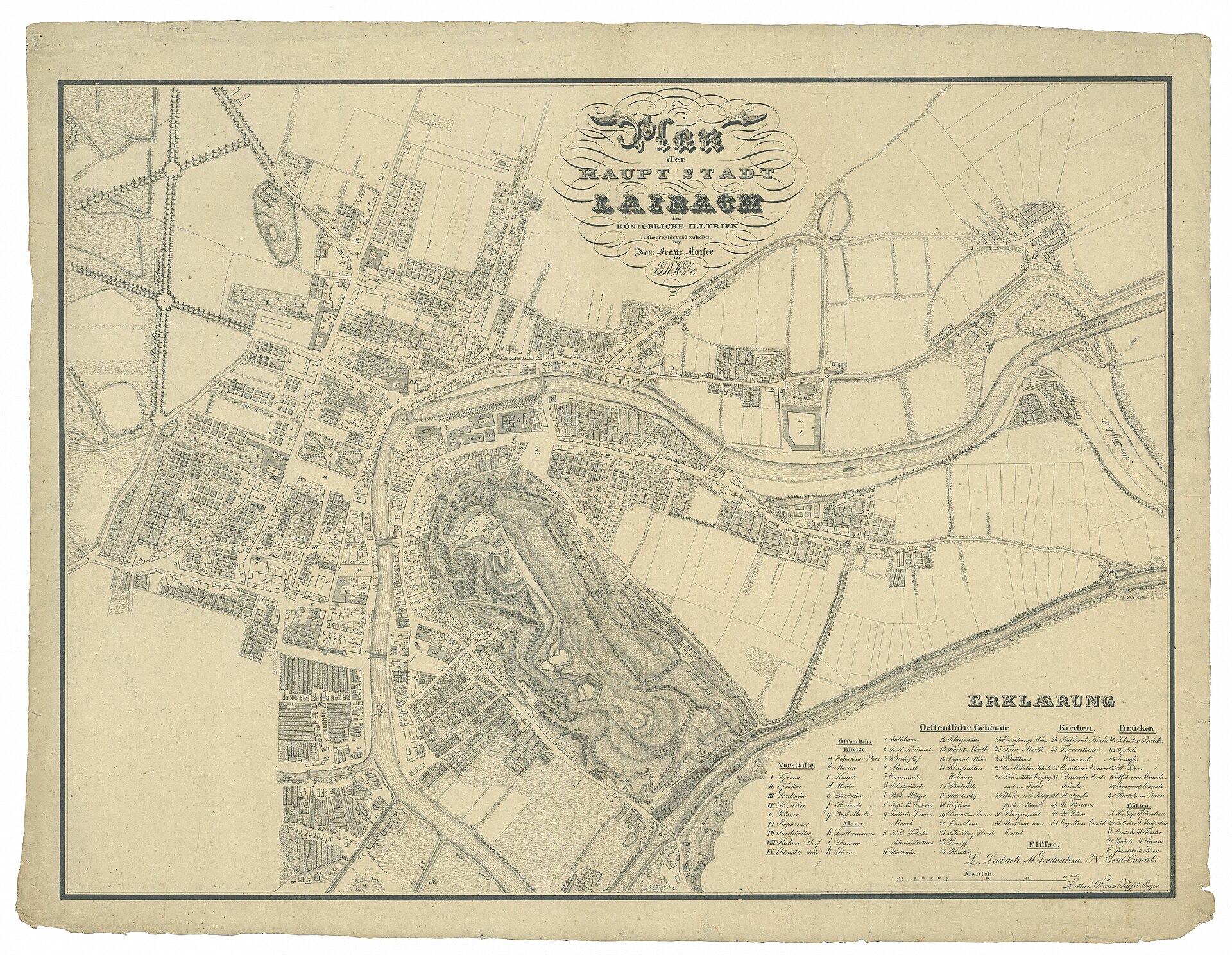
Plan der Haupt Stadt Laibach im Königreiche Illyrien (Plan of Laibach / Ljubljana): Franz‑Joseph Kaiser
Engraved plan showing the castle‑topped hill, enclosing walls and gates, street layout and blocks, and bridges across the Ljubljanica river.
1830 · Franz-Joseph Kaiser · Wikimedia Commons
Public domain (plate dated 1830)
Castles of Ljubljana

More cities to explore
 AustriaGrazExplore it in 1650
 AustriaHallstattExplore it in 1850
 NetherlandsUtrechtExplore it in 1400 · 1700
 EnglandLondonExplore it in AD 200 · 1390 · 1600 · 1885
Castles of Europe · Landmarks of Europe · create your own reconstruction.