
Austria · Restored
Liechtenstein Castle
Burg Liechtenstein
Liechtenstein Castle is a medieval hill castle near Maria Enzersdorf on the edge of the Wienerwald in Lower Austria and the ancestral seat of the House of Liechtenstein. Built in the 12th century beginning with a tower and later expanded into a larger palace complex, it was destroyed in Ottoman sieges and rebuilt in the 19th century; it remains privately owned by the princely family and is open to the public.
First raised
1136
Its prime
1500
Today
Restored
As it stood in 1500
What Liechtenstein Castle looked like in its prime.
Perched on the wooded edge of the Vienna Woods, the castle began as a single stone tower and grew into a compact palace complex of connected stone ranges. The silhouette is dominated by the original vertical keep at one end and lower multi-level residential ranges with a continuous stone masonry exterior and intact pitched roofs. In its prime the complex appears fully roofed and occupied, sitting above steep wooded slopes with the built mass tightly grouped on the ridge.
Its story
The story of Liechtenstein Castle.
Hugo and the Bright Stone, c. 1122–1136
The man who built the castle came to Austria as a free retainer of Diepold III, Margrave of Vohburg, who enfeoffed him with Petronell on the Danube near the Hungarian border, lands King Conrad III converted to his outright property in 1142. From the Babenberg margraves of Austria he received further fiefs at Leesdorf and Weikersdorf near Baden, and finally the ground at the edge of the Wienerwald where, between about 1122 and 1136, he raised a stone tower house with a chapel on a narrow limestone ridge. The rock's pale colouring gave the place its name, the "bright stone", and in 1136 the builder first signed himself after it, as "huc de lihtensteine". Hugo of Liechtenstein, who died in 1156, is counted the progenitor of the house that would one day give its name to a principality.
The tower was probably expanded into a larger, multi-part complex within the twelfth century. It was no ornament: the castle formed part of a belt of fortifications along the eastern rim of the Wienerwald, built to meet attacks from the east, and it watched the road that ran from Vienna over Heiligenkreuz into the Triesting valley.
Out of Liechtenstein Hands, 1249–1799
In January 1249 Heinrich of Liechtenstein received the lordship of Nikolsburg from Ottokar II of Bohemia, and the family's interests shifted towards southern Moravia; whether they lost or sold their ancestral castle is not recorded. The marriage of Dietmut of Liechtenstein-Rohrau to Leutold of Stadeck may have carried the castle to the lords of Stadeck by inheritance, and they extended it before pledging it in 1384 to the counts Hermann and Wilhelm of Cilli. Under Duke Albert IV it reverted to the sovereign as a lapsed fief, and on his orders the mercenary captain Jan Holuberzi occupied the castle, married the widow of its former warden and took over its keeping.
Around 1480 the army of the Hungarian king Matthias Corvinus damaged the castle. Ottoman raiding parties took it in 1529 during the first Turkish siege of Vienna, and in 1533 the fief passed to Georg Freisleben on the condition that he rebuild it. A sketch in a letter of December 1569, likely the oldest known depiction, shows the fortress restored to defensibility. Damaged again by Transylvanian forces under Stefan Bocskay and patched only makeshift, it was still called a defensible place of refuge in 1683, when the second Turkish siege of Vienna brought its near-final destruction. The Ottomans left a ruin, which passed through the Waffenberg, Penkler and Poniatowski families over the following century.
The Ancestral Seat Bought Back and Rebuilt, 1807–1903
On 22 December 1807 Prince Johann I of Liechtenstein purchased the long-alienated seat of his ancestors together with Mödling castle. From 1808 to 1816 the architect Joseph Hardtmuth carried out the first restorations: a knights' hall, a dungeon, the chapel made usable again. The prince built a new Schloss below the crag in 1820–21, and in the years that followed laid out a romantic landscape garden around the ruin, dotted with artificial ruins.
The full rebuilding waited until 1884, when Johann II entrusted the ruin to the Viennese architect Carl Gangolf Kayser, then also rebuilding Burg Kreuzenstein. Kayser worked to spare the surviving medieval fabric, but died mid-project in 1895; Humbert Walcher von Moltheim carried the work on, with Egon Rheinberger joining for the interiors from 1899, and the restoration was completed in 1903. The keep was rebuilt from the second floor up in historicist style, noticeably taller than the medieval original. The finished castle was never meant to be lived in again; it was conceived as a built document of the Middle Ages.
Front Line to Festival Stage, 1945–2012
In 1945 the castle lay on the main battle line of the Second World War and was badly damaged then and during the Soviet occupation, its furnishings and archive plundered. Restored between 1949 and 1953, it was handed to the scouts as a youth centre, managed by the market town of Maria Enzersdorf from 1960, and housed a viticulture museum from 1995. When the municipality could no longer fund its upkeep the lease was dissolved in 2007, and structural faults kept the castle closed until a renovation and new roof in 2008–09; it reopened to the public in spring 2010; since 2007 it has been administered by the Prince of Liechtenstein Foundation's estate office. From 1983 to 2012 the courtyard hosted the annual Nestroy theatre festival under Elfriede Ott, and the castle appeared in films from A Walk with Love and Death (1969) to The Three Musketeers (1993).
Step inside
5 places to explore in 1500.
The record describes 5 distinct spots at Liechtenstein Castle, including 1 interior: inner courtyard. Create your own photoreal reconstruction and explore every one, more scenes means more rooms, more angles, and more of the place to stand in.
Build Your Own Castle
Recreate Liechtenstein Castle with AI to explore it.
The artist rebuilds it as it stood in 1500, a photoreal reconstruction that belongs to you alone. Pay with coins, no subscription needed.
Recreate this castle →Defend this castle →Whose castle
Clans who held Liechtenstein Castle.
The families that held Liechtenstein Castle for a decade or more across its history, follow a name to its clan.
Liechtenstein
Ancestral seat and place of origin of the House of Liechtenstein; held from the mid-12th century until the 13th, and again from 1808 to the present.
Stadeck
Came to the Stadeck family through Dietmut of Liechtenstein's marriage to Leutold of Stadeck in the late 13th century.
From the archive
Liechtenstein Castle on paper: the measured plan and period views.
The survey plan and photographs below are the ground truth this page's reconstructions are checked against, drawn and photographed while the castle was still a working garrison. Every image is public-domain or openly licensed, with its source named.
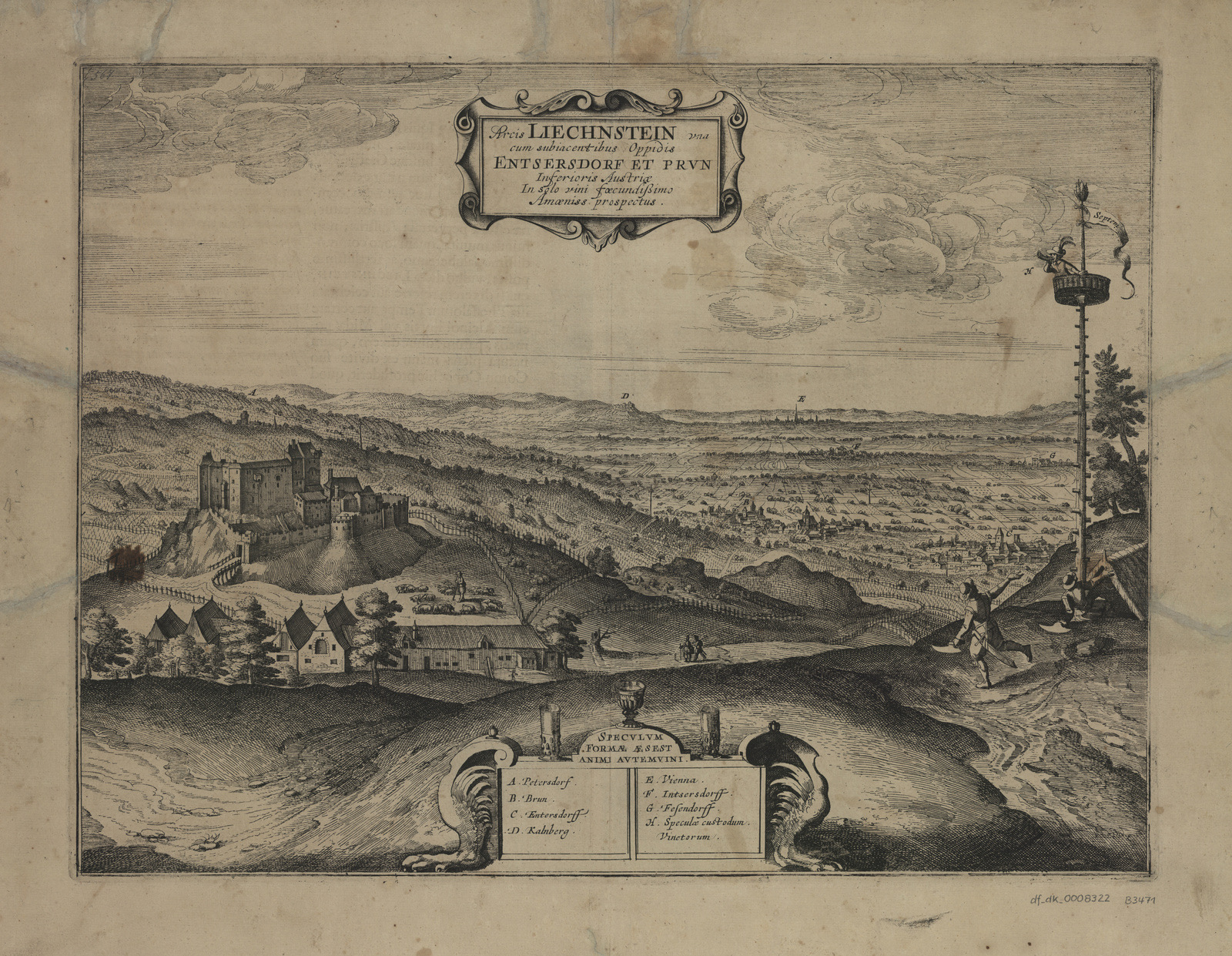
Bird’s show of Liechtenstein Castle near Maria Enzersdorf, etching, 1657
· Deutsche Fotothek (via Europeana)
CC BY-SA
Nearby
Landmarks within reach of Liechtenstein Castle.


Questions about Liechtenstein Castle
What is the history of Liechtenstein Castle?
Why was Liechtenstein Castle built, and what was it used for?
Who owns Liechtenstein Castle now?
Where is Liechtenstein Castle?
When was Liechtenstein Castle built?
Was Liechtenstein Castle ever attacked or besieged?
Which family or clan held Liechtenstein Castle?
What did Liechtenstein Castle look like in its prime?
Is Liechtenstein Castle still standing or is it a ruin?
Can you visit Liechtenstein Castle?
More castles of Austria


Explore the city


