
Cathedral · Austria · Restored
St. Stephen's Cathedral
Stephansdom
St. Stephen's Cathedral (Stephansdom) in Vienna is the Roman Catholic mother church of the Archdiocese of Vienna and the city's principal Gothic landmark. Built of limestone, it combines Romanesque west towers with an elaborately carved Gothic south tower and a large steep roof covered in patterned glazed tiles. The building contains multiple naves, a Gothic choir, bell belfries and interior tombs and pulpits.
First raised
1137
Its prime
1474
Today
Restored
As it stood in 1474
What St. Stephen's Cathedral looked like in its prime.
A large limestone Gothic cathedral with a very tall, open-traceried south spire and an asymmetrical shorter north tower capped in a Renaissance roof. The steep, long roof is covered in multicoloured glazed tiles arranged in bold chevron patterns and a mosaic double-headed eagle above the choir. Pointed-arch windows, flying buttresses, carved portals and clustered pinnacles puncture the façades; the west face retains older square Romanesque towers. Scale dominates the surrounding square.
Its story
The story of St. Stephen's Cathedral.
From the Treaty of Mautern to the Second Consecration, 1137–1263
The Treaty of Mautern, signed in 1137 by Bishop Reginmar of Passau and Margrave Leopold IV, called Vienna a civitas for the first time and set aside land beyond the walls for a new parish church dedicated to Saint Stephen, patron of the bishop's own cathedral at Passau. Excavations in 2000 found graves 2.5 metres beneath it, carbon-dated to the fourth century, pointing to a cemetery already on the site in Roman times.
The partly built Romanesque church was dedicated in 1147 before Conrad III of Germany and German nobles about to leave on the Second Crusade. Fire destroyed much of it in 1258; the larger replacement, again Romanesque and reusing the two towers, was consecrated on 23 April 1263, an anniversary still marked each year by ringing the Pummerin for three minutes. The two Romanesque towers, raised with the present west wall between 1230 and 1245, and the Giant's Door are the oldest parts of the church.
The Gothic Rebuilding and the Unfinished North Tower, 1304–1578
In 1304 King Albert I ordered a Gothic three-nave choir built east of the church, and the Albertine choir, continued under his son Albert II, was consecrated in 1340. Duke Rudolf IV laid the cornerstone of a westward Gothic extension on 7 April 1359, a scheme that enclosed the old church altogether: in 1430 its fabric was taken down from inside as the new walls rose around it. The south tower was completed in 1433 and the nave vaulted between 1446 and 1474.
Rudolf IV had already, in 1365, installed a chapter of canons in what was still formally a parish church. Emperor Frederick III prevailed on Pope Paul II to grant the city its own bishop, and the diocese was canonically erected on 18 January 1469; the see was raised to an archbishopric in 1722. Frederick had laid the north tower's foundation in 1450 and Laurenz Spenning built on it, but work stopped early in the 1510s. In 1578 the stump was given a Renaissance cap, leaving it roughly half the height of its neighbour.
Preaching a Crusade and Casting a Bell from Ottoman Cannon, 1456–1705
From what was then the cathedral's main pulpit, John Capistrano and the Hungarian general John Hunyadi preached a crusade in 1456 to repel Muslim invasions of Christian Europe. During the siege of 1529 and again in 1683 the south tower served as the main observation and command post for the defence of the walled city, and Turkish cannonballs damaged the building in the second of those sieges. The great bell cast in 1705 under Johann Achamer used metal from nearly 300 cannon taken from the Ottoman army.
Mozart's Wedding and the Habsburg Funerals, 1515–2019
Louis II of Hungary married Mary of Austria in the cathedral in 1515, Joseph Haydn married Maria Anna Theresia Keller here in 1760 and Wolfgang Amadeus Mozart married Constanze Weber here in 1782. Mozart was appointed an adjunct music director shortly before his death, and his funeral was held in the Chapel of the Cross on 6 December 1791. The cathedral has also held the funerals of Antonio Vivaldi in 1741, of Emperor Franz Joseph I in 1916, of Zita of Bourbon-Parma, the last Empress of Austria, in 1989, of Otto von Habsburg in 2011 and of Niki Lauda in 2019.
The Roof Fire of April 1945 and the Cathedral Workshop Since
The cathedral came through the bombing and street fighting of the Second World War with little structural damage. On 10 April 1945 the Wehrmacht captain Gerhard Klinkicht refused the city commandant Sepp Dietrich's order to lay it in rubble with a hundred shells; a tablet on the building records the refusal. In the night of 12 April, fire set by looters in surrounding buildings reached the cathedral: the larch roof frame burned out, the roof collapsed and the old bourdon bell fell and shattered. The Rollinger choir stalls of 1487 were lost, though brick shells around the pulpit and Frederick III's tomb limited the damage to the most valuable works.
Rebuilding began immediately, with a partial reopening on 12 December 1948 and a full one on 23 April 1952; the roof was rebuilt on more than 600 tonnes of steel bracing instead of timber. A new Pummerin, cast in 1951 at St Florian in Upper Austria from metal salvaged from the shattered bell, entered service in 1957.
St Stephen's is a listed monument, the mother church of the Archdiocese of Vienna and the seat of its archbishop. A laser survey of the building guides the nine full-time stonemasons of its permanent Dombauhütte, who cut replacement stone in workshops by the north wall; the Manner company pays one mason's wages in return for permission to use the cathedral as its logo. The catacombs below, which may be toured, hold the remains of more than 11,000 people, among them the bones from eight adjoining cemeteries closed in the 1735 plague outbreak.
Step inside
10 places to explore in 1474.
The record describes 10 distinct spots at St. Stephen's Cathedral, including 6 interiors: central nave (middle nave), north nave and side aisles, albertine choir (east choir) and more. Create your own photoreal reconstruction and explore every one, more scenes means more photos, more angles and more of the immersive experience.
Build Your Own Castle
Recreate St. Stephen's Cathedral with AI to explore it.
The artist rebuilds it as it stood in 1474, a photoreal reconstruction that belongs to you alone. Pay with coins, no subscription needed.
Recreate Cathedral to Explore →Nearby
Castles within reach of St. Stephen's Cathedral.
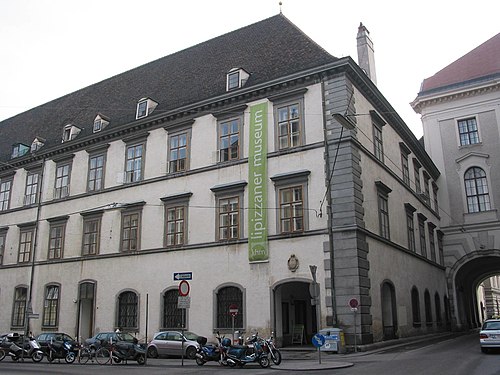


Landmarks within reach of St. Stephen's Cathedral.


More landmarks of Austria


Explore the city


