Historic Cities · Germany
Regensburg through the ages
Regensburg is a city in eastern Bavaria, at the confluence of the rivers Danube, Naab and Regen, Danube's northernmost point. It is the capital of the Upper Palatinate subregion of the state. With more than 150,000 inhabitants, Regensburg is the fourth-largest city in the State of Bavaria after Munich, Nuremberg and Augsburg and the eighth-largest of all cities on the river Danube.

Regensburg in 1250
Imperial Regensburg
Regensburg is at the height of its medieval prosperity in 1250, the richest city on the northern Danube where the Stone Bridge carries the great road east to Bohemia. Visitors will see the Roman Porta Praetoria and castra remains, compact patrician tower-houses, busy salt and iron wharves along the river, and merchants loading boats bound for Venice, Kyiv and towns of the Rhine.
The skyline is a dense comb of steep gables, squat stone towers and church spires rising from a tight knot of red-tiled roofs and pale limewashed façades. Streets are narrow and paved with cobble or packed earth, the Danube slips past sandstone quays where riverboats and barges are stacked with salt and iron. Light is sharp in clear weather, turning the stone bridge’s arches and timber facades golden in the afternoon.
The route: 22 streets, squares and views
Stadtamhof riverside → Steinerne Brücke east arch → Wurstkuchl by the bridge → Brückturm bridge tower → Porta Praetoria → Castra Regina remains → Obere Bachgasse → Untere Bachgasse → Schwanenplatz → Alte Kapelle → …
Step inside, 14 interiors
Boatmen's Hall · Bridge Tower Gate Chamber · Goldsmith's Workshop · Dyers' Yard and Loft · Chapel of the Virgin · Cathedral Nave · Council Chamber · Bishop's Audience Hall · Kaufhaus Trading Hall · Tower Great Hall · Monastic Scriptorium · Niedermünster Choir · Great Salt Vault · Wharfside Smithy Workshop
Planned from the Wikipedia record: Regensburg.
Regensburg in 1750
Regensburg of the Perpetual Diet
Regensburg in 1750 is the permanent seat of the Holy Roman Empire’s Diet, a small medieval town crowded by envoys, post riders and river traffic. The walk follows the old Roman walls and the Danube quays into the town: you will see the Stone Bridge, the Old Town Hall where delegates dispute precedence, Thurn und Taxis’s post yards, the cathedral with its unfinished towers and the everyday markets and workshops that supply the assembly.
A low medieval skyline of red tile roofs and timber‑framed houses, pierced by the choir of the Gothic cathedral whose twin towers remain truncated stumps. Narrow, stone‑paved streets open into small market squares; Baroque plaster and painted façades mask older Gothic gables. The Danube runs busy with rafts and barges beneath the broad arch of the Stone Bridge. Uniformed post riders, powdered envoys and tradesmen populate bridges, quays and coffee‑house fronts under often clear, crisp Bavarian light.
The route: 22 streets, squares and views
Prüfening Hill View → Porta Praetoria → St. Emmeram's Abbey → Steinerne Brücke → Brückturm (Bridge Tower) → Wurstkuchl Sausage Kitchen → Donauufer Quay → Schwanenplatz → Obere Bachgasse → Untere Bachgasse → …
Step inside, 12 interiors
Abbey Chapter Hall · Bridge Chapel of the Holy Cross · Bridge Tower Guardroom · Sausage Kitchen Hall · Timber Raftmen's Warehouse · Nave of St. Peter's Cathedral · Bishop's Audience Chamber · Reichssaal of the Imperial Diet · Thurn und Taxis State Room · Posthof Sorting Room · Weavers' Workshop · Envoys' Coffee House
Planned from the Wikipedia record: Perpetual Diet of Regensburg.
Its story
The story of Regensburg.
Castra Regina: the Legionary Fortress of AD 179
The Danube turns north here and takes in the Naab and the Regen, and the Romans fortified the bend. A cohort fort went up at Kumpfmühl in about AD 79 to watch the two river mouths, and was destroyed in the Marcomannic wars of the 160s. From about 175, on the orders of Marcus Aurelius, a legionary fortress called Castra Regina, the camp on the Regen, was built for the Third Italic Legion and its roughly 6,000 men. Its dedication stone of 179, once set above the east gate, survives and is taken as the town's founding document, and the fortress outline still governs the plan of the old town. It was the main military base of the province of Raetia, unusual in standing away from the provincial capital at Augsburg, and the place is believed to have been a bishop's seat as early as the late Roman period.
Ducal Capital and Mother Church of Prague, 530–911
From the early sixth century Regensburg was the seat of the Agilolfings, and from about 530 until the first half of the thirteenth century the capital of Bavaria. The bishopric the Romans had established was refounded by Boniface in 739, when Duke Odilo settled the Bavarian dioceses. Charlemagne wintered here in 791–793 to secure the absorption of Bavaria into the Frankish realm, and in 792 the town hosted the bishops of his general assembly, who condemned the adoptionism taught by Elipandus of Toledo and Felix of Urgell.
After the Carolingian empire was partitioned in 843 the city became the seat of the East Frankish ruler Louis the German. Two years later fourteen Bohemian princes came to Regensburg to be baptised, the beginning of the Christianisation of the Czechs, which made the diocese of Regensburg the mother church of that of Prague and placed the Czech lands in the Roman Catholic rather than the Slavic-Orthodox world. Arnulf of Carinthia died in the town on 8 December 899 and was buried, like his son Louis the Child, in the abbey of St Emmeram.
Long-Distance Trade and the Stone Bridge, 1000–1189
Trade reaching Paris, Venice and Kiev made Regensburg rich: its population grew from about 23,000 in 800 to some 40,000 by the year 1000, and around 1050 it is reckoned to have been the largest city in the empire. Part of that trade was in people: Ibrahim ibn Yaqub, an envoy of the Caliph of Córdoba, described the town as a centre of the medieval slave trade, through which Slavs and Balts taken in war were sold into the Muslim world. In 1096, on the way to the First Crusade, Peter the Hermit led a mob that tried to force the mass conversion of the town's Jews and killed those who refused.
The Stone Bridge across the Danube, built between 1135 and 1146, opened trade routes between northern Europe and Venice and became the model for other bridges, among them the Judith Bridge in Prague. It also marked the rise of civic self-government: Barbarossa's bridge privilege of 26 September 1182 names the bridge-master Herbord, the first municipal officer known by name. Crusading armies left from the crossing in May 1147 under Conrad III and in May 1189 under Barbarossa himself.
Free Imperial City, Then Bankruptcy, 1245–1496
In 1245 Frederick II confirmed the citizens' right to appoint their own mayor and council, and Regensburg became a free imperial city. Some 20,000 people lived there, and government lay with a patriciate of fifty or sixty families. The Wittelsbach dukes moved their residence to Landshut in 1259 but kept the rights they had held since 1185 (the mint, escort and jurisdiction), and spent the next four centuries trying to undermine the town's independence and win their lost capital back.
The decline set in early in the fourteenth century as the eastern trade shifted to Augsburg, Nuremberg and Vienna, whose populations rose while Regensburg's fell. The plague of 1347–53, Bavarian blockades, and the Hussite wars from 1419, which closed the Bohemian markets, ate into what remained; the town had lived on transit trade and had never built up crafts and consumer manufacture as Nuremberg had. Capital and rich families left, the eastern route was finally shut by the fall of Constantinople in 1453, and the population fell to about 12,000. Emperor Frederick III had fined the town 8,000 gulden in 1476 for the long unlawful imprisonment of seventeen prominent Jews, and in 1483 threatened it with the imperial ban to extract 6,000 gulden more. Bankrupt and taxed into revolt, the citizens preferred a duke (the watchword ran that a duke makes you rich and the empire makes you poor), and in July 1486 the council agreed the town's incorporation into the Duchy of Bavaria. The emperor answered with the imperial ban and the military weight of the Swabian League; Albrecht IV gave way, and the treaties of 1496 restored the town to the empire but placed it under imperial commissioners.
The Expulsion of 1519
Emperor Maximilian I, who had protected the town's Jews, died in January 1519, and his successor Charles V was not elected until June. The council used the gap. Acting on a demand from Christian craftsmen recorded on 21 February, and citing economic grievances and long-standing religious hostility, it expelled one of the largest Jewish communities in Germany: about 500 people were driven out and their property confiscated, the synagogue and much of the Jewish quarter on what is now the Neupfarrplatz were pulled down, and the medieval cemetery outside the Peterstor was destroyed, its gravestones broken or reused in buildings around the town.
An accident during the demolition was proclaimed a miracle and produced the pilgrimage of the Beautiful Mary, which for a few years brought the town and the bishop a large income. A pilgrimage church was begun with that money and built partly of Jewish gravestones; when the pilgrimage fell away only the choir had been finished, and the shell became the Protestant city church in 1542. Jews were not permitted to settle in Regensburg again for centuries.
Lutheran Council, Catholic Bishop, Perpetual Diet, 1541–1810
The colloquy of 1541 in the Neue Waag on the Haidplatz, between Philipp Melanchthon and Johannes Eck, failed to bridge the confessional split. On 15 October 1542 the council introduced the Reformation with a communion service in the Neupfarrkirche, and it remained entirely Lutheran thereafter; Catholics were denied civic rights. The bishopric, the abbey of St Emmeram and the convents of Obermünster and Niedermünster stayed Catholic and held their own seats and votes at the Imperial Diet, so that the town contained five independent states of the empire at once. From the late sixteenth century it was also a refuge, reachable up the Danube, for Protestants driven out of Austria, with a second wave of Salzburg exiles arriving in the winter of 1731–32.
The Thirty Years' War left the town fought over rather than spared: Bavarian troops seized it in April 1632, Swedish forces under Bernhard of Saxe-Weimar stormed it in November 1633, expelled the Catholic clergy and held Protestant services in the cathedral, and imperial and Bavarian troops under Archduke Ferdinand retook it in July 1634 after a three-month siege. Plague returned in 1713–14 and killed about 8,000 people; the envoys and some 7,000 residents left, and Bavarian hussars sealed the town while a plague hospital and mass graves were set up on the Unterer Wöhrd.
The imperial diet that reconvened in 1663 never dispersed, and as the Perpetual Diet of Regensburg it sat until 1806, making the town a working second capital of the empire after the emperor's court at Vienna. Envoys settled with their households, and from 1748 the emperor's principal commissary was the Prince of Thurn and Taxis. In 1803 Regensburg lost its imperial-city status and was handed to Carl von Dalberg, Archbishop-Elector of Mainz, as compensation for Mainz territory annexed by France; Dalberg merged bishopric, monasteries and town into the Principality of Regensburg and gave Protestants and Catholics equal rights. Between 19 and 23 April 1809 the town was the scene of the Battle of Ratisbon between Napoleon's forces and the retreating Austrians, and was overrun once its supplies and ammunition ran out, with about 150 houses burnt and others looted. Dalberg ceded Regensburg to the Kingdom of Bavaria in 1810.
Deportation, Bombing and the Displaced Persons Camp, 1933–2006
The Jewish community was persecuted after the Nazi Party took power in 1933; many Jews fled and some were expelled to Poland, though a German-Polish agreement allowed them to return. On 9 November 1938, during Kristallnacht, the synagogue and several Jewish homes and shops were destroyed and around 220 Jews were arrested, some of them deported to Dachau. In 1942 more than 200 Jews were deported to Piaski in German-occupied Poland or to the Theresienstadt ghetto. In March and April 1945 a subcamp of Flossenbürg concentration camp operated in the town, holding 460 forced labourers of various nationalities, forty of whom died. Stolpersteine in the pavements name the deported.
Regensburg held a Messerschmitt Bf 109 aircraft works and an oil refinery, bombed by the Allies on 17 August 1943 in the Schweinfurt–Regensburg mission and again on 5 February 1945. Both targets were severely damaged but the town itself came through the strategic bombing campaign with little harm; the Romanesque church of Obermünster, destroyed in a raid in March 1945 and never rebuilt apart from its belfry, was the heaviest cultural loss. Slow economic recovery afterwards meant historic buildings were not cleared away, and by the time restoration money reached the town in the late 1960s the argument had turned in favour of preservation.
Between 1945 and 1949 Regensburg held the largest displaced persons camp in Germany: at its peak in 1946–47 the workers' district of Ganghofersiedlung housed almost 5,000 Ukrainian and 1,000 other displaced persons, who ran their own camp postal service from 11 December 1946. The population passed 100,000 in 1945 with the arrival of Germans expelled from Eastern and Central Europe. From the early 1960s the city spent heavily on infrastructure to attract industry; Siemens came first, the University of Regensburg was founded in 1965, BMW built a large plant in 1986, and Infineon and OSRAM followed in the 1990s. In July 2006 the World Heritage Committee listed the old town, the largest medieval city site north of the Alps, as a UNESCO World Heritage Site. The city has more than 150,000 inhabitants and is the capital of the Upper Palatinate.
From the archive
Regensburg on paper: the old town as it was mapped.
A period plan or bird's-eye view of the old town, drawn between 1500 and 1850, the streets this page's reconstructions walk. Public domain, with its source named.
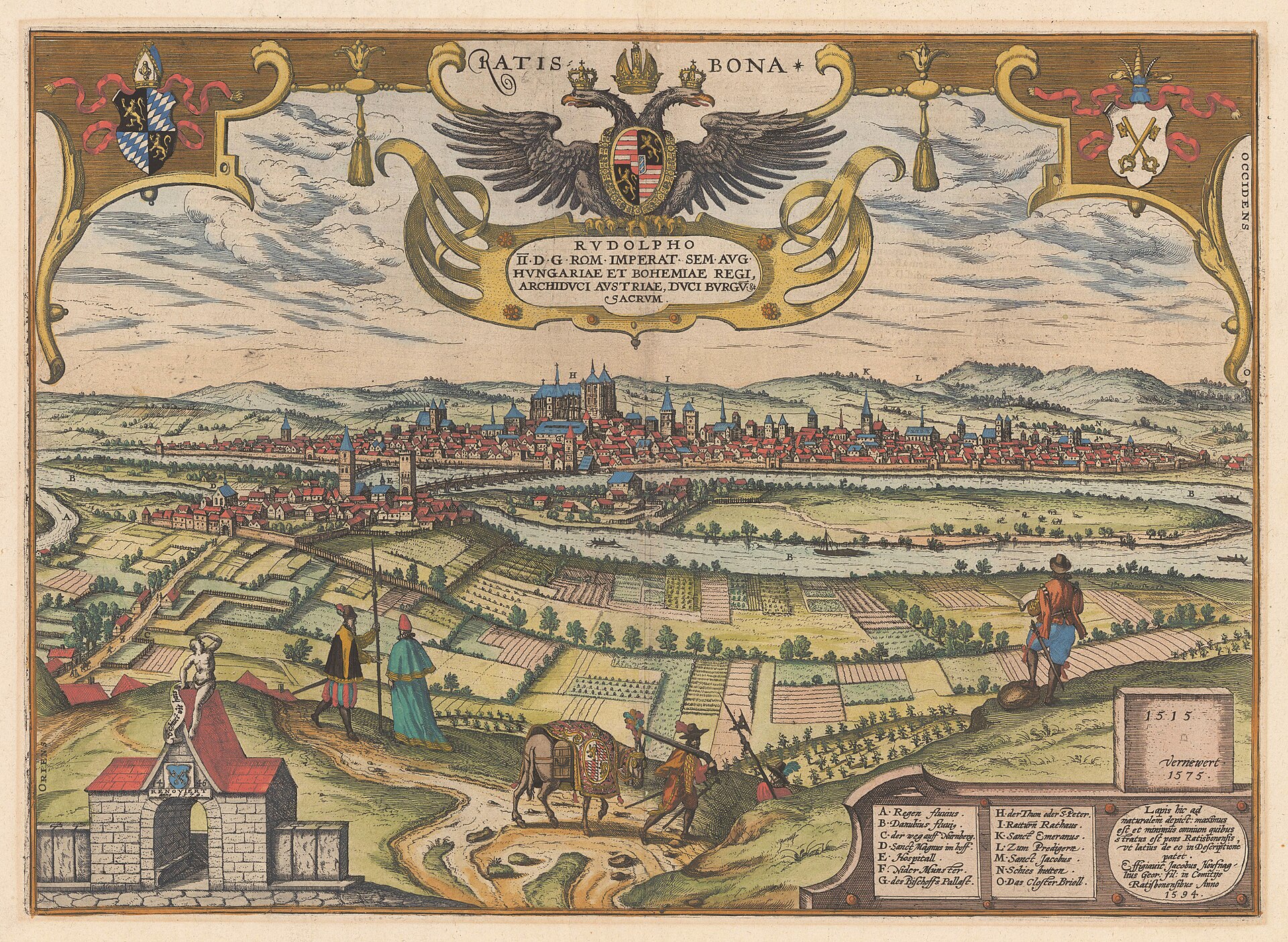
Bird's‑eye view of Regensburg, from Braun & Hogenberg
Shows the Danube with islands and the Stone Bridge, city walls and gates, the cathedral towers and dense medieval street blocks of Regensburg’s old town.
1575 · Werner / Ringle · Wikimedia Commons
Public domain (plate dated 1575)
Castles of Regensburg

More cities to explore
 GermanyNurembergExplore it in 1350 · 1500 · 1835
 GermanyMunichExplore it in 1500 · 1700 · 1900
 GermanyBerlinExplore it in 1750 · 1871 · 1928
 GermanyCologneExplore it in AD 150 · 1250 · 1880
Castles of Europe · Landmarks of Europe · create your own reconstruction.