Historic Cities · France
Colmar through the ages
Colmar is a city and commune in the Haut-Rhin department and Alsace region of north-eastern France. The third-largest commune in Alsace, it is the seat of the prefecture of the Haut-Rhin department and of the subprefecture of the Colmar-Ribeauvillé arrondissement.

Colmar in 1615
Merchants of the Wine Road
Colmar in 1615 stands at its commercial height as a prosperous imperial free city on the Alsatian wine road. The walk follows merchants, bargemen and craftsmen through timbered streets, canal quays and the trading house where last autumn's vintage is stored.
A compact medieval town hemmed by the Vosges foothills, Colmar's skyline is a patchwork of steep timber-framed houses, carved stone gables and slate or glazed-tile roofs punctured by church towers. Narrow cobbled streets slope to sinuous canals of the Lauch where barges lie level with low quays. Facades favour ochres, pink Vosges sandstone and timber darkened by age; the scale is human and densely built, with oriels and painted galleries overhanging cellar doors and workshops.
The route: 15 streets, squares and views
Vineyards above Colmar → Koïfhus (Ancienne Douane) → Grand'Rue → Maison Pfister → Maison des Têtes → Maison des Chevaliers → Place Saint-Martin → Église Saint-Martin → Quays of Petite Venise → Tanners' Gables on the Lauch → …
Step inside, 8 interiors
Upper Trading Hall · Cellar of the Great Tuns · Painted Gallery · Merchant's Counting Room · Choir and Ambulatory · Tanners' Workshop · Madonna Chapel · Cloister Walk
Planned from the Wikipedia record: Colmar.
Its story
The story of Colmar.
Columbarium: From Carolingian Fisc to Imperial City, 823–1295
The first firm record of the place is a donation charter of Louis the Pious, drawn up at Frankfurt on 12 June 823, giving the abbey of Munster part of the forest of the fisc of Columbarium: a scatter of farm holdings on a Carolingian crown estate whose name, attested as Columbrensi in the eighth century, points to a dovecote. Charles the Fat held an assembly there in 883 and again in 884, attended by dignitaries of the Empire from between the Meuse and the Elbe and from beyond the Alps.
Around 965 the royal domain was divided between the Cluniac monastery of Payerne and the bishop of Constance, and a church went up around the year 1000 on the site of the later collegiate church of Saint-Martin. Fire destroyed Colmar in 1106. It grew again under the Hohenstaufen, who held the duchy of Swabia and Alsace before taking the imperial throne, and Frederick Barbarossa broke his journey there four times between 1153 and 1186. A text of 1226 calls the place a civitas under the suzerainty of Frederick II of Hohenstaufen, who granted it the standing of a free imperial city; he came in person in 1235, and in these years the Franciscans, Dominicans and Augustinians began to settle.
In 1261 the Schultheiss Jean Roesselmann freed the townsmen from the domination of the prince-bishop of Strasbourg, and in 1262 threw back a second attack by him at the cost of his own life. Rudolf I of Habsburg, count and landgrave of Upper Alsace, put the liberties in writing on 29 December 1278: a Freiheitsbrief of forty-four provisions in German covering criminal law, private law and procedure, among them that a murder within the commune's bounds was punished by beheading and the demolition of the killer's house. The charter confirmed Colmar as a city of the Empire, an imperial estate in its own right. A rising against Adolf of Nassau in 1293 failed; the first town hall was built two years later.
The Ladhof, the Décapole and the Koïfhus, 1337–1480
Colmar's first port, the Ladhof, the place where goods are loaded, opened in 1337 where the Thur meets the Lauch, and cargo went from there to Strasbourg and into the Rhineland. In 1342, with Charles IV's agreement, seven imperial cities of the Alsatian plain bound themselves to mutual defence; Colmar joined on 28 August 1354, making the confederation of ten known as the Décapole, which sent its own deputies to the imperial diet. A stable constitution in 1360 placed the government in the hands of the burghers and the guilds; the town won the right to strike coin in 1376 and entered the Rappenmünzbund monetary alliance in 1403. Bubonic plague struck in 1418.
In 1469 Archduke Sigismund, the emperor's representative in Alsace and badly short of money, took a loan from Charles the Bold of Burgundy and pledged part of the province as security. The bailiff Charles sent in, Peter von Hagenbach, was so cruel that the Alsatian towns hurried to repay the duke, and Hagenbach refused to give up the place. Beaten and taken prisoner, he was condemned to lose his head, and the execution fell to the executioner of Colmar in 1474. The Koïfhus was finished in 1480 and served at once as warehouse, customs office and meeting place for the deputies of the Décapole. The same decades made the town a centre of painting through Caspar Isenmann, Martin Schongauer and Matthias Grünewald.
Excluded in 1512: Colmar's Jewish Community
A Jewish community had lived in Colmar since the thirteenth century. In 1512 it was excluded from the town, and had no right of residence there again until the Revolution. In a climate of anti-Judaism shared by part of the population and part of the elite, the Jewish merchant Hirtzel Lévy of Wettolsheim was condemned to death by the Sovereign Council of Alsace and broken alive on the cattle-market square on 31 December 1754. The King's privy council at Versailles quashed the judgment, and the Parlement of Metz rehabilitated him the following September and acquitted his co-accused.
A synagogue was built in 1843. Twenty years after that the Colmar Treasure came to light, a hoard of precious objects hidden by Jews during the Black Death, discovered in 1863. A section of the Bartholdi Museum is given over to the local Jewish community's heritage.
Lutheran Presses, the Swedish Garrison and the French Lilies, 1522–1698
Between 1522 and 1525 the printer Farckall's books made Colmar a centre of Lutheran propaganda, and the first groups sympathetic to reform gathered after the Peasants' War, whose violence the town escaped narrowly. Even so the Reformation failed to establish itself for another half-century. Plague in 1541 killed 1,560 people and decimated the Franciscans. Only on 14 May 1575, long after Strasbourg and Basel, did the council under the Obristmeister Michel Buob authorise Protestant worship alongside Catholic, and the first Protestant service was held the next day in the Franciscan church. New fortifications, by the Strasbourg architect Daniel Specklin, followed in 1580.
The Swedish army took Colmar in 1632 and held it two years; the Schoeman family arrived in 1634 and started the first town library. In 1635 Imperialist forces spoiled the harvest while the inhabitants shot at them from the walls, and on 1 August that year the town placed itself by treaty under the protection of Louis XIII, without abandoning its standing as a city of the Empire. Government posts were divided equally between Catholics and Protestants, although Protestants were two-thirds of the population. Imperial troops besieged the town in 1636 until French regiments got supplies in. At the end of the Thirty Years' War the Treaty of Münster handed France the Habsburg possessions, including the Grand Bailiwick that covered the ten towns of the Décapole.
In the spring of 1673, during the Dutch War, it was decided to seize the town: Louvois and the marquis de Coulanges appeared at the gates with 500 cavalry on 28 August, and the townsmen were disarmed next day. Four thousand men were set to pulling down the fortifications, and a hospital was built from what was left of them; Louis XIV came on 30 August to see the demolition, and remarked that the gentlemen of Colmar were no longer as proud as they had been. Imperial armies invaded Alsace again in the autumn of 1674, but Turenne beat them at Turckheim on 5 January 1675, and the fear of suffering the same treatment pushed Colmar to submit. The Treaty of Nijmegen of 5 February 1679 ended the war, and the free imperial city became a French royal town. In 1698 the Sovereign Council of Alsace was moved there from Ensisheim, making Colmar the judicial capital of the province.
Prefecture, Cholera and the Riots, 1790–1855
The Revolution made Colmar the chef-lieu of the Haut-Rhin in 1790, when it held more than 13,000 people. In 1791 it became the seat of the department's constitutional bishopric and the collegiate church of Saint-Martin was raised to a cathedral, which it remained until the concordat of 1802. Hérault de Séchelles converted the criminal court of the Haut-Rhin into a revolutionary tribunal in 1793, and thirteen executions were pronounced within a few months. The first prefect arrived in 1800 and an appeal tribunal became a court of appeal in 1804. The dissolution of the local monasteries and convents and the gift of their collections to the town is why the municipal library holds more than 2,300 incunabula, unusual for a town with neither a university nor a college.
Four riots mark the middle decades. In 1833 the tax administration proposed to tax a small local wine, the Bubberi, at the rate charged on fine wines; labourers joined the market gardeners and vine-growers, barricades went up, and the measure was withdrawn under the threat that the piquette would be tipped into the Sinn stream. In 1842, the year after the Basel–Colmar–Strasbourg railway was inaugurated, the council taxed firewood, demonstrators occupied the town hall and a squadron of lancers was called in from Sélestat. Cholera reached the town in 1854 and 349 of the 505 who fell ill died, the state of the streets and houses blamed; when the administration banned foods held to be risky, cucumbers among them, market gardeners pelted a sergeant and his squad with vegetables. A fourth riot in 1855, over the transfer of funerals to an undertaking firm, cost Mayor Chappuis his post.
Reichsland, the Colmar Trial and the Pocket of 1945, 1870–1945
The Franco-German war began on 19 July 1870, and on 14 September the inhabitants resisted at the Horbourg bridge, an episode in which Auguste Bartholdi (born in the town, later the sculptor of Liberty Enlightening the World) took part. France signed the Treaty of Frankfurt on 10 May 1871 and gave up Alsace and the Moselle. Colmar became chef-lieu of the district of Upper Alsace in the Reichsland of Alsace-Lorraine; the municipal council stayed in place, and a liberal clause of the treaty allowed more than 3,000 inhabitants to take French nationality. French was banned from official texts in 1883. By 1910 the town had 43,800 inhabitants, 4,000 of them soldiers.
French mounted patrols rode in on 23 August 1914, suggesting a quick conquest, before the army fell back on the Vosges. Four people were killed by bombing on 8 August 1917. The Treaty of Versailles of 28 June 1919 returned Alsace and Lorraine to France, and Colmar was decorated with the croix de guerre 1914–1918 on 6 October 1922. Unease followed. After Édouard Herriot's declaration of 17 June 1924 that the whole body of republican legislation should be introduced in the region, and the clashes of the 'bloody Sunday' of 22 August 1926 between Alsatian autonomists and pro-French Alsatians, the autonomist leaders were tried at Colmar in 1928.
German troops entered on 17 June 1940 and Alsace was annexed in fact, though in law it remained under French sovereignty. A brutal Germanisation and Nazification followed: the monuments to Admiral Bruat and General Rapp were wrecked, and about a fifth of the street names, those that could recall France, were changed, the avenue de la République becoming Adolf-Hitler-Straße. In 1942 the Germans broke up the Colmar resistance network, active since 1940, and imprisoned its leaders. An ordinance of 25 August that year made military service compulsory, and 123,000 young men of the annexed region were forced into the uniform of the Wehrmacht or the Waffen-SS; 40,000 did not return. A munitions train exploded in the goods station on 18 September 1944. In late January 1945 the town was the objective of the pincer attack mounted by General de Lattre de Tassigny to reduce the pocket the German army still held in Alsace. American infantry of the 21st Corps broke the German lines north of Colmar on 1 February and, on General Milburn's order, gave the lead into the town to General Schlesser's tanks of the French First Army, which took it intact on the afternoon of 2 February.
Wine Fair, Industrial Zone and Protected Old Town: Colmar since 1948
Colmar received the croix de guerre 1939–1945 with palm on 30 June 1948, the citation recording that its people had supported thousands of French prisoners of war in June 1940 and kept faith through four years of occupation. The first regional Alsace wine fair was held the same year, growing into the Foire aux vins d'Alsace. Under the future mayor Joseph Rey 5,000 municipal dwellings went up between 1945 and 1963, mostly in the western districts, about a third of the commune's housing stock. Industrial reconversion began in 1958 with a large industrial zone north of the town, where the American firm Timken settled in 1959.
The old town had come through the Revolution and the wars of 1870–1871, 1914–1918 and 1939–1945 largely undamaged, and the council, faced with a commune spreading outward, restored the historic core and had it made a protected sector of 35 hectares, approved in 2002. Conservative parties have governed without a break since 1947, with only three mayors in that time. Colmar is the prefecture of the Haut-Rhin, seat of the Colmar-Ribeauvillé subprefecture and seat of a court of appeal, as it has been since 1804. Its population in 2022 was 67,360, the third-largest commune in Alsace after Strasbourg and Mulhouse. Tourism is its main economic strength, and it sits on the Alsatian wine route, calling itself the capital of Alsatian wine.
From the archive
Colmar on paper: the old town as it was mapped.
A period plan or bird's-eye view of the old town, drawn between 1500 and 1850, the streets this page's reconstructions walk. Public domain, with its source named.
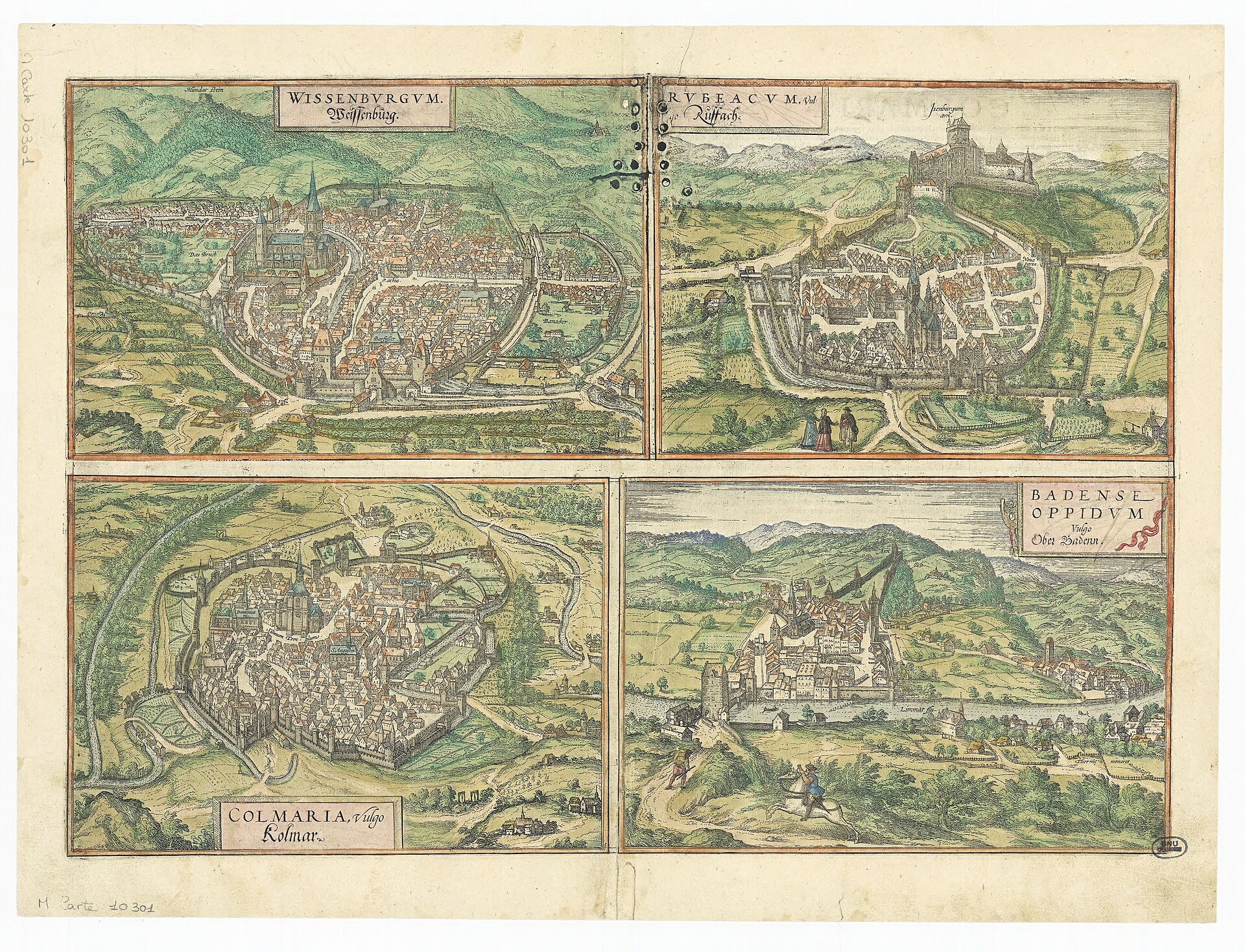
Bird's-eye view of Colmar, from Braun & Hogenberg's Civitates Orbis Terrarum
Walled medieval Colmar with curtain walls and gates, dense street blocks, a prominent central church spire and surrounding river/moat are visible.
1572 · Braun, Georg (1541-1622). Cartographe Hogenberg, Frans (1535-1590). Cartographe · Wikimedia Commons
Public domain (plate dated 1572)
Castles of Colmar


More cities to explore
 GermanyFreiburgExplore it in 1530
 FranceStrasbourgExplore it in 1440 · 1770 · 1900
 FranceParisExplore it in 1250 · 1670 · 1789 · 1889
 FranceRouenExplore it in 1431 · 1540 · 1876
Castles of Europe · Landmarks of Europe · create your own reconstruction.