Historic Cities · Switzerland
Bern through the ages
Bern, or Berne, is the de facto capital of Switzerland, referred to as the "federal city". With a population of about 146,000, Bern is the fifth-most populous city in Switzerland, behind Zurich, Geneva, Basel and Lausanne. The Bern agglomeration, which includes 36 municipalities, had a population of 406,900 in 2014. The metropolitan area had a population of 660,000 in 2000.
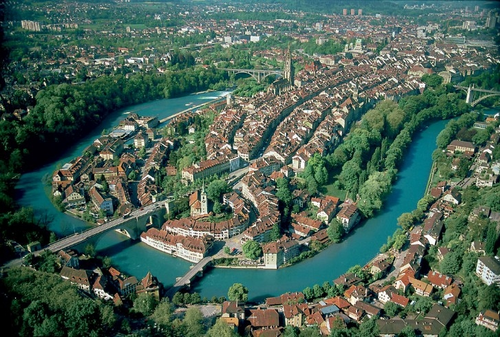
Bern in 1500
Bern of the Confederates
Bern in 1500 is a compact town-looped by the green Aare, a city-state of guilds and granaries newly refashioned in grey‑green sandstone after the great fires of the fifteenth century. This walk traces the peninsula’s arcades, market streets, the Zytglogge’s painted clock, the rising Münster and the bear enclosures beside the river, following the lanes that lead traders and packhorses toward the alpine passes.
From the Aare’s rim the old town reads as a tight ribbon of stone: low rooflines of grey‑green sandstone, continuous covered arcades shielding shopfronts, and a handful of tall civic towers, Zytglogge and the unfinished Münster choir, piercing the skyline. Streets run long and narrow along the ridge; wooden trough‑fountains mark crossings; the river’s green loop, timber quays and riverside workshops set a constant, working foreground to the compact masonry town.
The route: 22 streets, squares and views
Bremgarten View → Matte Quay → Nydegg Bridge → Nydegg → Bärengraben → Nydeggstalden → Münsterplatz → Berner Münster → Spitalgasse → Kramgasse → …
Step inside, 12 interiors
Tannery Loft · Bridge Guardroom · Bear House Chamber · Masons' Lodge Hall · Nave beneath Scaffolds · Clothier's Shop under Lauben · Upper Granary Floor · Council Hall · Tower Prison Cell · Clock Loft and Wheels · Jack Figures Workshop · Guildhall Dining Hall
Planned from the Wikipedia record: History of Bern.
Bern in 1750
Patrician Bern
Bern in 1750 is a compact, patrician-run republic whose authority is written into carved stone, painted fountains and the sober fronts of town palaces. The walk moves from the river's horseshoe bend into the arcaded main streets, past the truncated Munster tower, the granary and the corn market, and finishes on a nearby hill that looks back over the orderly rows of shutters and cobbles.
The Old City sits on a narrow Aare peninsula of warm sandstone buildings and continuous arcades whose allegorical fountains are painted bright above their columns. Rooflines are low and steep; wooden shutters hang in regular ranks; the Minster's tower remains a truncated stump. Streets are cobbled and narrow, pierced by prominent clock and gate towers. Goods arrive by boat on the river; bears live in a small pit below the eastern bridge, a civic emblem in stone and life.
The route: 22 streets, squares and views
Engehalbinsel Approach → Nydeggbrücke → Nydegg Quarter → Bärengraben (Bear Pit) → Nydeggstalden → Marktgasse → Kramgasse → Zytglogge → Käfigturm → Gerechtigkeitsgasse → …
Step inside, 13 interiors
Nydegg Church Nave · Bear-Keeper's Shelter · Great Butchers' Hall · Arcade Cellar Shop · Zytglogge Clockroom · Käfigturm Guardroom · Carved Choir Stalls · West Vestibule Beneath Tympanum · Council Chamber · Granary Hall · Corn Market Exchange · Erlacherhof Salon · Infirmary Ward
Planned from the Wikipedia record: History of Bern.
Its story
The story of Bern.
A Zähringer Town Between Two Languages, 1191
The Aare loop was not the first ground settled here. A late La Tène settlement stood on the Engehalbinsel, the peninsula north of the later city, founded around 300 to 200 BCE and fortified in the second century BCE; it is thought to have been one of the twelve oppida of the Helvetii that Caesar mentions. After the Roman conquest a small Gallo-Roman vicus was re-founded on the same site and abandoned between 165 and 211 CE. The Bern zinc tablet, found in the 1980s, carries the name Brenodor, indicating that the oppidum's possible Celtic name was still known in Roman times. No archaeological evidence has yet been found for any settlement on the site of today's old town before the 12th century.
The city proper was founded by the Zähringen family, who held authority over much of what is now western Switzerland, then reckoned part of southern Burgundy. Possessing no duchy of their own, the Zähringer leaders were styled dukes by decree of the German king and exercised imperial power south of the Rhine, and to secure that position they founded or enlarged settlements including Fribourg in 1157, Burgdorf and Morat. In the second half of the 12th century Berchtold V built a small castle at Nydegg on the eastern part of the peninsula to guard the Aare; it stood on the border between the German-speaking Alamannians and the French-speaking Burgundians. Fourteenth-century historiography, the Cronica de Berno of 1309, gives 1191 as the year Berthold V founded the town, though whether a settlement already stood beside the castle, and how far the first town extended, are both debated. Its population is estimated at 400 to 600 at the founding, and had reached about 3,000 by 1300.
The Goldene Handfeste, a Forgery That Held
After Berchtold V died without an heir, Bern gained its town privileges and the standing of an Imperial Free City through the Goldene Handfeste, traditionally dated to 1218. The document presents itself as a grant of Emperor Frederick II, but most scholars now hold it to be a Bernese forgery made in the middle of the 13th century. Its terms held anyway: on 16 January 1274 King Rudolph I of Germany confirmed the traditional rights it set out, and in 1293 King Adolf of Germany confirmed all the privileges Bern had acquired during the interregnum of 1291 to 1293. Those grants still fell short of imperial immediacy in law, but from about 1300 the city acted confidently as an imperial city and pursued a policy of sovereign territorial expansion.
Bern was governed at first by a mayor drawn from the noble families that held citizenship, appointed by the Zähringens and afterwards by the Holy Roman Emperor or his representative; by the late 13th century the town council elected him itself, and the city was a de facto independent city-state within the Empire. The constitution established in 1294 (a Grand Council of two hundred members and a Small Council of twenty-seven headed by the Schultheiss) remained largely unchanged until 1798.
Laupen 1339 and the Eighth Canton
In 1323 Bern entered an alliance with the forest cantons of Uri, Schwyz and Unterwalden. Its continued expansion brought it into conflict with feudal lords backed by Burgundy and the Habsburgs and with the neighbouring city of Fribourg. In 1339 those lords, in league with Fribourg, put a combined force of 17,000 men into the field, including a thousand feudal heavy cavalry under Rudolf von Nidau and Gérard de Valengin. Bern called on its confederate allies and raised 6,000 men. When the Fribourg forces laid siege to the Bernese border town of Laupen, the Bernese army marched out to raise it and, outnumbered two to one, formed pike blocks that destroyed both the Fribourg infantry and the heavy cavalry.
The victory allowed Bern to consolidate its power and drew it closer to the forest cantons. In 1353 the city upgraded its pact with them into an eternal alliance and became a permanent member of the Old Swiss Confederacy, which thereby reached the count of the Acht Orte, the eight cantons, concluding its formative period. Bern became a leading member and did much to encourage the expansionist policy the confederacy followed through the later 14th and 15th centuries.
Aargau 1415, Vaud 1536, and the Oberland Revolts
Bern invaded and conquered Aargau in 1415 and Vaud in 1536, along with smaller territories, becoming the largest city-state north of the Alps and, by the 18th century, holding most of what are now the cantons of Bern and Vaud. Between 1323 and 1400 it acquired the majority of the Bernese Oberland from indebted local barons by conquest, purchase, mortgage and marriage politics. Under Bernese control the five valleys kept extensive rights and far-reaching autonomy through their Bäuerten, the farming cooperative municipalities, and their Talverbände. They also rose against Bernese authority repeatedly: the Böser Bund, the Evil League, fought Bernese military service and taxes in 1445 following the Old Zürich War; in 1528 the Oberland rose in resistance to the Reformation; and Thun revolted in 1641.
The Reformation was settled in the city by argument. Between 6 and 26 January 1528, after three weeks of debate known as the Bern Disputation, Bern converted to Protestantism, and with the acquisition of Vaud eight years later it became the most powerful city-republic north of the Alps and one of the leading Protestant cities of early modern Switzerland.
Leather, Guilds and the Gnädige Herren
Bern lay on none of the major trading routes, so agriculture quickly became its principal economic activity and remained so throughout Bernese history. Tanning grew into an important industry and leather goods into one of the city's main exports. In the 14th century, as European commerce rose in importance, wealthy trading families emerged as the city's aristocracy; in the 15th they turned instead to government and mercenary service, and trade stagnated as the city's autocratic rule over the countryside strengthened. Bernese commerce and crafts, organised in guilds, flourished again in the 16th and 17th centuries, with Bernese glass paintings especially sought after across Europe. After a major blaze in 1405 the original wooden buildings were gradually replaced by half-timbered houses and later by sandstone, and despite the waves of pestilence that struck Europe in the 14th century the population kept growing, mainly through immigration from the surrounding countryside.
Political power narrowed as the territory widened. Upward mobility and access to public office had been relatively easy for successful traders and craftsmen in the Middle Ages, but by the 17th century citizenship had become an inherited prerogative, the political bodies elected one another, and officials were elected for life. Bern now styled itself a republic (Stadt und Republik Bern) on the model of the Italian city republics rather than a Reichsstadt. Office became the exclusive preserve of the gnädige Herren, the merciful lords, as the ruling families were called: 152 families qualified to rule in 1605, 104 by 1691, and only 69 towards the end of the 18th century, while the territory they governed had grown to 52 bailiwicks. Patrician Landvögte ruled a politically powerless countryside, often using armed force to put down peasant revolts. At one point during the 18th century the city was the largest shareholder in the South Sea Company, the British joint-stock company involved in the Atlantic slave trade.
French Occupation, the Federal City, and Bern Today
French troops occupied Bern in 1798 during the French Revolutionary Wars, and the city was stripped of parts of its territories. The Bernese Oberland was detached to become a canton of its own, drawn without regard to historic borders or traditional rights; there had been no previous separatist feeling among its conservative population and little enthusiasm for the new order. The Malmaison Constitution of 1801 proposed reuniting the Oberland with Bern, but the two were not rejoined until the Act of Mediation two years later abolished the Helvetic Republic and partly restored the ancien régime. Following the Congress of Vienna of 1814 Bern newly acquired the Bernese Jura and became once again the largest canton of the confederacy as it stood during the Restoration, a position it held until the canton of Jura seceded in 1979.
On 28 November 1848, during the revolutions of that year, a majority of the deputies of the new Swiss Federal Assembly chose Bern as the Federal City, the seat of government of the newly created Swiss federal state, ahead of Zurich and Lucerne. The choice was political: it avoided concentrating all power in Zurich, the country's economic powerhouse, while Catholic and conservative Lucerne had been part of the Sonderbund in the war of the previous year. Bern was also more centrally placed and was supported by the French-speaking cantons on account of its proximity to them. The constitution does not define Bern as the official capital of Switzerland, only as the seat of government. During the First World War, with Switzerland neutral, the city hosted a number of congresses of the socialist First and Second Internationals.
The population rose from about 5,000 in the 15th century to about 12,000 by 1800 and above 60,000 by 1900, passing 100,000 during the 1920s; it peaked during the 1960s at 165,000 and has since fallen back somewhat. Albert Einstein lived in a flat at Kramgasse 49 from 1903 to 1905, employed as an examiner at the patent office, and worked out his theory of relativity while living in the city. In 1983 the historic old town was inscribed as a UNESCO World Heritage Site. The Universal Postal Union and the University of Bern both have their seats here, and Bern remains the capital of its canton as well as the federal city of Switzerland.
From the archive
Bern on paper: the old town as it was mapped.
A period plan or bird's-eye view of the old town, drawn between 1500 and 1850, the streets this page's reconstructions walk. Public domain, with its source named.
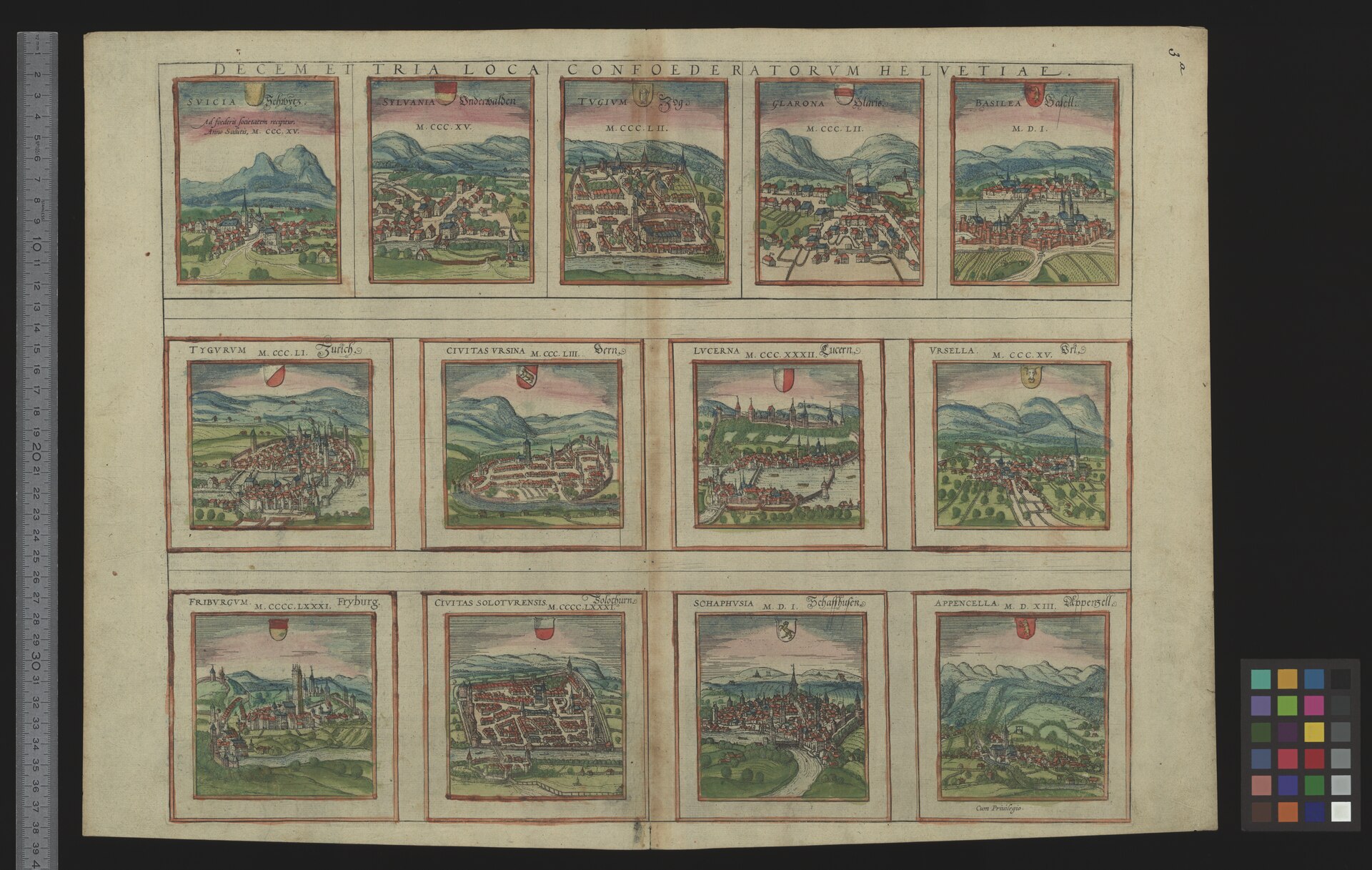
Bird's-eye view of Bern (Civitas Ursina), from Georg Braun's Decem et tria loca Confoederatorum Helvetiae
Peninsular walled old town bordered by the Aare, showing gates, street blocks and several church spires.
1572 · Georg Braun · Wikimedia Commons
Public domain (plate dated 1572)


Castles of Bern

More cities to explore
 SwitzerlandLucerneExplore it in 1615
 GermanyFreiburgExplore it in 1530
 NetherlandsUtrechtExplore it in 1400 · 1700
 EnglandLondonExplore it in AD 200 · 1390 · 1600 · 1885
Castles of Europe · Landmarks of Europe · create your own reconstruction.