Historic Cities · Switzerland
Lucerne through the ages
Lucerne or Luzern is a city and a municipality in central Switzerland, in the German-speaking portion of the country. Lucerne is the capital of the canton of Lucerne and part of the district of the same name. With a population of approximately 82,000 people, Lucerne is the most populous city in Central Switzerland, and a nexus of economics, transport, culture, and media in the region.

Lucerne in 1615
City of the Wooden Bridges
A compact Catholic market republic straddling the outflow of Lake Lucerne, its streets threaded by the great roofed wooden bridges and ringed by the Musegg fortifications. This walk crosses both covered bridges, moves through the busy river quays and market squares, and climbs to the town wall and nearby heights beneath Pilatus's snow-capped ridge.
Stone towers and timber frames crowd a narrow riverside town where two long, roofed wooden bridges span the Reuss; the Kapellbrücke leans diagonally with its round stone Wasserturm, the Spreuerbrücke sits nearer the upstream mills. Roofs are steep and clay-tiled, façades often oiled or painted with heraldry, market stalls cluster by the quays, small barques tack on the lake, and the Musegg wall's nine towers punctuate the northern skyline below snowy Pilatus.
The route: 16 streets, squares and views
Luzerner Bucht → Seebrücke Pier → Kapellbrücke and Wasserturm → St Peter Chapel Bridgehead → Reussquai Fish Stalls → Weinmarkt Fountain → Kornmarkt and Town Hall → Rathaussteg Crossing → Spreuerbrücke and Mills → Mill Quarter and Mühlenplatz → …
Step inside, 9 interiors
Chapel Bridge Painted Gallery · Bridge Painter's Workshop · St Peter Chapel Interior · Fishmongers' Backroom · Town Hall Council Chamber · Spreuer Bridge Painted Corridor · Watchtower Guardroom · Hofkirche Nave · Guild Tavern Panelled Room
Planned from the Wikipedia record: Lucerne.
Its story
The story of Lucerne.
Luciaria: the Abbey, the Gotthard Road and an Undated Founding
Definite traces of pile dwellings were found in the Lucerne lake basin only in 2020, when a floating excavator cutting a trench for a lake-water pipe turned up wooden piles and potsherds; radiocarbon dating of the timber and analysis of the sherds placed settlement here in the late Bronze Age, around 1000 BC. The meaning of the town's name remains unclear. Derivations from Latin lucerna, 'lantern', from the Celtic god Lugus and from the personal name Luz have all been rejected, though the lantern reading attached itself to the place early and stuck. A possible root remains Latin lucius, 'pike', with a suffix of abundance, giving a name meaning a place where pike gather in quantity.
After the collapse of Roman authority, Alemannic settlement spread through the district from the seventh century and Alemannic speech gradually replaced Latin. The Benedictine monastery of St Leodegar was founded here in the eighth century and passed in the middle of the ninth to the Alsatian abbey of Murbach; by then the area was known as Luciaria. From 1135 the advocacy over Murbach, and so over Lucerne, lay with the Habsburgs.
The town's founding is not securely dated. One account puts it in 1178, when Lucerne obtained independence from Murbach's jurisdiction; another places it between 1180 and 1200 and credits the brothers von Eschenbach, who at the end of the twelfth century held the abbacy of Murbach and of Lucerne at the same time. What made the place matter was traffic: it stood at the gateway of the growing Gotthard trade route and served as an administrative centre. By 1250 Lucerne had reached the size it would keep until the nineteenth century, and by 1290 it held some 3,000 inhabitants. Thirteenth-century politics were shaped by faction fighting between supporters of the emperor and of the pope, and the town appears already to have had a council and a citizens' assembly.
The Habsburg Question and the Battle of Sempach, 1291–1386
In 1291 Rudolf I of Habsburg, German king, bought up Murbach Abbey's rights of lordship over Lucerne, having already worked through the surrounding territories. The disputed royal succession of 1314–25 brought hostilities to the lands around the Vierwaldstättersee, and in 1332 Lucerne entered a pact with the three neighbouring forest districts of Uri, Schwyz and Unterwalden, concluded on 7 November. What that pact was for is told two ways: it has been read as a bid by a populace discontented with growing Habsburg influence to be free of Austrian rule, but its own terms expressly reserved Lucerne's obligations to the House of Austria, and it was not framed against the Habsburgs as such.
From the second half of the fourteenth century Lucerne set about extending its influence over the rural districts around it and binding their lordship rights to itself. That territorial policy, pursued by other confederate towns such as Zurich as well, brought conflict with Austria to a head at the battle of Sempach in 1386. Victory allowed Lucerne to consolidate a territory already close to the extent of the present canton, and the town promptly granted itself rights the Habsburgs had withheld.
Imperial Freedom, Scythe Smiths and the Trials
In 1415 King Sigismund granted Lucerne Reichsfreiheit, making it an imperial city, a standing it held until the Peace of Westphalia in 1648. The town built out its territorial lordship, levied taxes and installed salaried bailiffs. Its population of 3,000 fell by about 40 per cent, to plague arriving from around 1350 in several waves and to the wars of the period, among them the campaigns south of the Alps.
One of the first export trades here was scythe-making, from the fourteenth century onwards. Lucerne imported iron and steel, and its blacksmiths turned out scythes sold into western Switzerland and northern Italy. The workshops were kept on the edge of the town because of the fire risk, those on the Krienbach working hammers driven by watermills.
Prosecutions ran alongside the trade. Witch persecution had spread first through francophone territory; the word Hexereye appears in 1419 in a sorcery trial against a man in Lucerne, its first recorded use in the German-speaking lands. In 1471 the town passed a law to persecute Roma.
Why Lucerne Stayed Catholic, 1522–1712
The Reformation reached Lucerne and very nearly took it. After a sermon by the visiting preacher Konrad Schmid at the Musegg procession on 24 March 1522, and the work of the local reformer Oswald Myconius, more than half the town's clergy were of evangelical mind. The decisive turn came in 1524 among the leading patricians, and the reason recorded for it is money: fear that the Reformation would abolish the lucrative mercenary trade. Lucerne remained Catholic. From 1525 to about 1530 the Franciscan Thomas Murner, who had fled to Lucerne from Strasbourg, served as lector and wrote and printed polemics against Luther and the Swiss Protestants. The town staged its own annual passion play from 1453 to 1616, two days long at twelve hours a day.
After the Catholic victory over the Reformed at Kappel in 1531, the Catholic towns dominated the confederacy, and Lucerne was among its influential urban cantons. The Jesuits arrived in 1567 with strong backing from Cardinal Carlo Borromeo, Archbishop of Milan; from 1577 to 1773 their college occupied the Ritter palace, a Renaissance house begun in 1556 for the Schultheiss Lux Ritter, which has served as the cantonal government building since 1804. Their church is described as the earliest large baroque church in Switzerland.
The advantage did not hold. In 1653 a peasant army besieged Lucerne and the town quickly signed a peace with the rebels. Despite a military win in the First Villmergen War of 1656, weight shifted to the Reformed cities of Zurich, Bern and Basel, which defeated the Catholic side in the second war of 1712, and Lucerne's leading position in the confederacy was gone. Through the sixteenth and seventeenth centuries wars and epidemics grew less frequent and population rose strongly, but the growth was in the countryside; inside the walls the town barely expanded.
Mercenary Money, the Tuileries and the French Army, 1792–1860
The mercenary service the patricians had protected has its memorial in a small park just off the Löwenplatz. Bertel Thorvaldsen's carving of a dying lion, made in 1819, commemorates the hundreds of Swiss Guards killed in 1792 when an armed mob stormed the Tuileries Palace in Paris during the French Revolution.
Nine years after that revolution began, in 1798, the French army marched into Switzerland. The Old Confederacy collapsed and patrician rule gave way to the Helvetic Republic, of which Lucerne was briefly the capital. Non-Catholic worship became legal here for the first time, though the first Protestant church, the Matthäuskirche on the Hertensteinstrasse, was not built until 1860, on ground made available by the Reformed Hauser family of the Hotel Schweizerhof.
Hotels, Queen Victoria and a Late Industrial Revolution, 1804–1914
Friedrich Schiller's play William Tell of 1804 did much for the reputation of Lucerne and its district. Schiller had never been there; he was moved to write it by his wife Lotte and by Goethe, both of whom had visited, Goethe lodging on the Hirschenplatz on his way to Italy in 1779. Hotels began opening in 1835, the Schwanen first, the Schweizerhof in 1845, the Grand Hotel National in 1870. In 1868 Queen Victoria stayed almost five weeks at the Pension Wallis on the Gütsch, going sightseeing at the Kapellbrücke and the Lion Monument and taking pleasure in speaking German with local people; well-off British visitors followed her example and the tourist trade took off. César Ritz managed the National between 1878 and 1888.
The visitors kept coming and several stayed. Richard Wagner took a house at Tribschen in 1866 and lived in Lucerne until 1872. Mark Twain wrote up the town and its surroundings after visits in 1878 and 1897. The poet Carl Spitteler settled there in 1892 and remained until his death in 1924.
Industry, by contrast, arrived late. In 1860 only 1.7 per cent of the population worked in manufacture, about a quarter of the national figure, while agriculture occupied some 40 per cent of the canton's workforce; such industry as the city attracted mostly settled in the communes around it. Between 1850 and 1913 the population quadrupled. The railway came in 1856, first to Olten and Basel, then to Zug and Zurich in 1864 and southward in 1897. From 1910 to 1912 an airship, the Ville de Lucerne, flew passengers on sightseeing circuits from a landing ground with a hangar and a gas works at the Tribschenmoos.
The Bridge Fire, the Littau Merger and the Cantonal Capital Today
On 18 August 1993 fire destroyed much of the Kapellbrücke, the covered wooden bridge built in the fourteenth century as part of the town's defences alongside the octagonal Wasserturm. The blaze was reportedly started by a discarded cigarette. Of the triangular paintings of the early seventeenth century set along the bridge's gable, 81 of 111 were destroyed beyond saving. Because the bridge had been thoroughly restored in the 1960s and every timber recorded, it could be rebuilt as it had been; it reopened in April 1994 after CHF 3.4 million of repairs.
Through the twentieth century the suburbs grew at the city's expense, the population of the surrounding area doubling while the city itself rose only slowly; the first Swiss motorway, the Kriens–Ennethorw exit road, opened southward in 1955 and the A2 link north followed in 1974. On 17 June 2007 the voters of Lucerne and the adjacent town of Littau approved a merger in simultaneous referendums, 9,869 to 8,875 in Lucerne and 2,824 to 2,343 in Littau. It took effect on 1 January 2010, the enlarged municipality keeping the name Lucerne and the old civic arms. The city council treated it as the first of several; Ebikon, Adligenswil and Kriens declined a merger in November 2011, and in March 2012 the voters of Emmen refused even to open negotiations.
Lucerne is the capital of its canton and the most populous city of Central Switzerland, with 82,771 inhabitants at the end of 2021, of whom 24.78 per cent were foreign nationals; its urban area takes in 19 municipalities and about 220,000 people, and the old townscape is designated a Swiss site worthy of protection. The Catholic character the town chose in 1524 receded slowly: 96.9 per cent of the population was Catholic in 1850, 81.9 per cent in 1900, 72.3 per cent in 1950 and 60 per cent at the 2000 census. Work is now overwhelmingly in services, some 90 per cent of jobs, roughly a fifth of them provided directly or indirectly by public bodies; the accident insurer Suva, the dairy company Emmi, the Schindler Group, the Luzerner Kantonalbank and the AlpTransit Gotthard rail-link company are based in the city, as is the University of Lucerne, the youngest of the country's traditional universities.
From the archive
Lucerne on paper: the old town as it was mapped.
A period plan or bird's-eye view of the old town, drawn between 1500 and 1850, the streets this page's reconstructions walk. Public domain, with its source named.
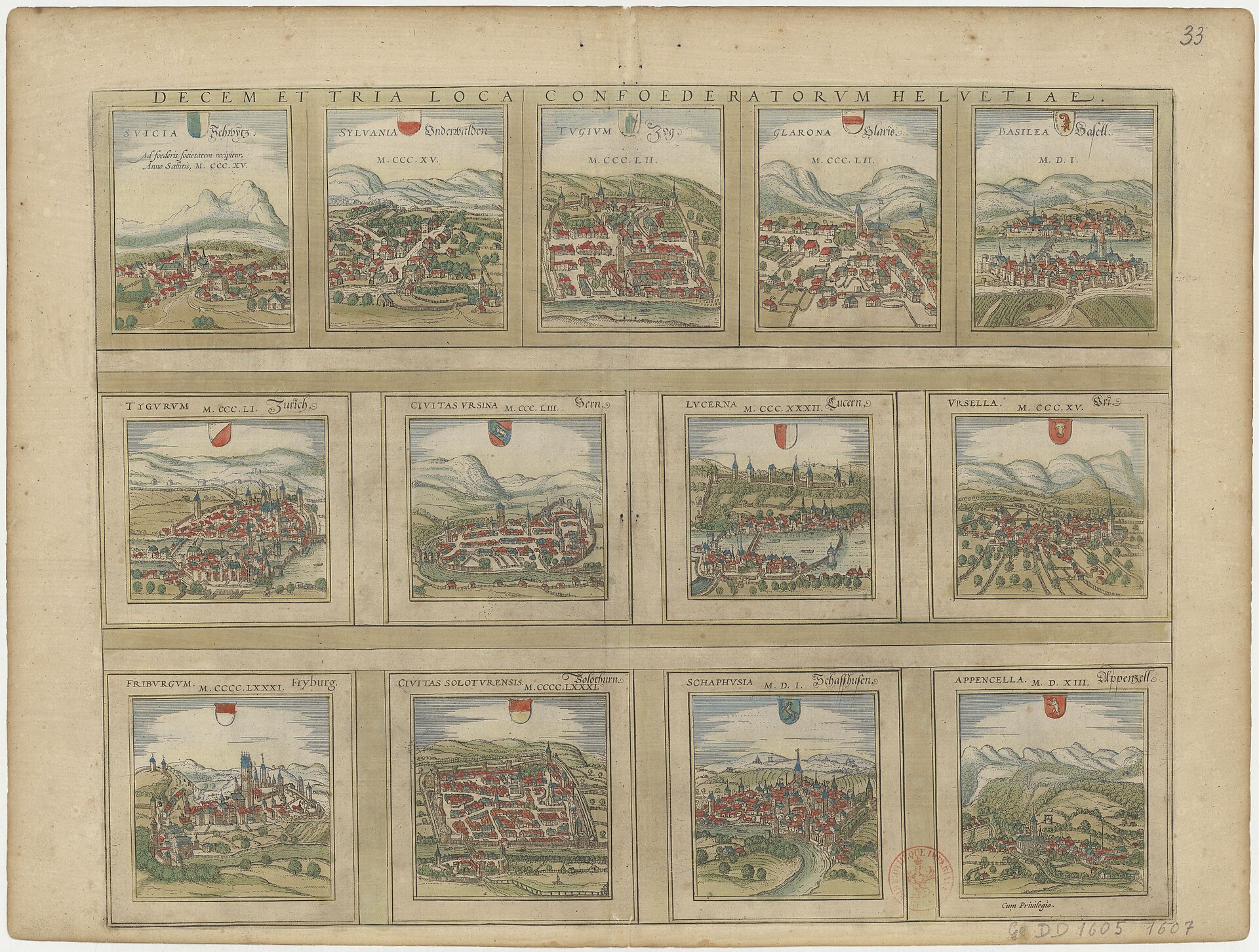
Bird's-eye view of Lucerne (Lucerna), from Braun & Hogenberg, Decem et tria loca confoederatorum Helvetiae
Small bird's-eye panel showing Lucerne’s riverside town with walls, towers, bridge and several church spires visible along the waterfront.
Public domain (plate dated 1645)

Castles of Lucerne

More cities to explore
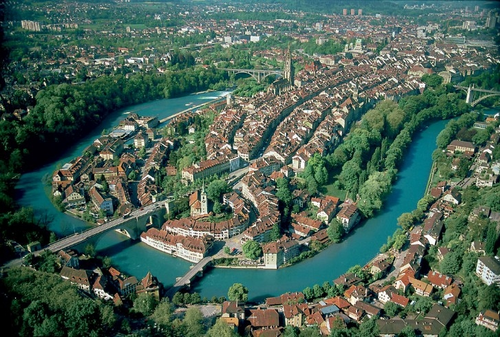 SwitzerlandBernExplore it in 1500 · 1750
 GermanyFreiburgExplore it in 1530
 NetherlandsUtrechtExplore it in 1400 · 1700
 EnglandLondonExplore it in AD 200 · 1390 · 1600 · 1885
Castles of Europe · Landmarks of Europe · create your own reconstruction.