Historic Cities · France
Avignon through the ages
Avignon is the prefecture of the Vaucluse department in the Provence-Alpes-Côte d'Azur region of southern France. Located on the left bank of the river Rhône, the commune has a population of 92,188 (2023), with about 16,000 living in the ancient town centre enclosed by its medieval walls.

Avignon in 1350
City of the Popes
This is Avignon at the height of the papal court under Clement VI: the Palais des Papes rises in new white stone while cardinals and their retinues give the lanes a towered, princely air. You will cross the Rhône with traders and pilgrims on the Saint-Bénézet bridge, pass tight medieval walls, busy quays of wine and goods, money-changers' tables and the pale massed masonry of the papal palace under scaffolds.
Avignon's skyline is dominated by the pale blocks of the Palais des Papes and the squat bell-tower of Notre-Dame des Doms, set above a rocky terrace; red-liveried cardinals show as bright spears in narrow, ochre-roofed streets. Roofs are low terracotta masses, façades of limestone and stucco, and the Rhône runs muddy and swift beneath the arched Saint-Bénézet bridge. The city is compact inside thick crenellated walls, quays crowded with barges and barrels, and scaffolds and cranes mark ongoing grand building works.
The route: 16 streets, squares and views
View from Villeneuve → Pont Saint-Bénézet → Quays by the Bridge → Île de la Barthelasse → Porte de l'Oulle → Rue des Changeurs → Place du Marché → Rue des Teinturiers → Livrées des Cardinaux → Approach to the Palais → …
Step inside, 9 interiors
Bridge Chapel · Wine Merchants' Warehouse · Money-changers' Counting-House · Cardinal's Audience Chamber · Grand Tinel · Great Chapel · Cathedral Nave · Giovannetti's Chapel Workshop · Stag Room
Planned from the Wikipedia record: Avignon Papacy.
Its story
The story of Avignon.
The Rock, the Cavares and the Roman Colony
The Rocher des Doms, the spur above the left bank of the Rhône, has been occupied since the Neolithic. The name, first recorded by Artemidorus of Ephesus, has been read either as "city of violent wind" or, more likely, as "lord of the river". The settlement began as a Greek trading post founded by Phocaeans from Marseille around 539 BC, and by the fourth century BC the Massaliotes were signing treaties of alliance with Avignon and Cavaillon. Fortified on its rock, it became and long remained the capital of the Cavares.
The Roman legions arrived in 120 BC and the Cavares, allied to Marseille, became Roman with them. Avennio was placed in Gallia Narbonensis and stayed a federated city of Marseille until Caesar's lieutenants took Marseille itself; it became a city of Roman law in 49 BC, a colony in 43 BC, and under Hadrian the Colonia Julia Hadriana Avenniensis. The first wooden bridge across the Rhône has been dated by dendrochronology to 290, and by the third century a small Christian community had formed outside the walls, around what became the Abbey of Saint-Ruf. The first bishop attested by record is Nectarius, present at the council at Riez on 29 November 439.
Sacked, Ceded and Fought Over, 472–1032
The Burgundians sacked Avignon in 472, and in 500 Clovis I besieged the town, where Gundobad had taken refuge after losing Lyon; Gregory of Tours records that the Frankish king devastated the fields and cut down the vines and olive trees. In 536 Vitiges, king of the Ostrogoths, ceded Provence to the Merovingians. The seventh and eighth centuries were the darkest stretch in the town's history: it fell to the Franks under Theuderic II in 612, after the Council of Chalon-sur-Saône in 650 the see stood vacant for 205 years, in 734 it fell to the Saracens, and in 737 Charles Martel destroyed it for having sided with them against him.
Part of the old bridge was restored in 890, so the river could be crossed again, and the union of Provence with Upper Burgundy in 932 made Avignon one of the largest cities of the new Kingdom of Burgundy. In September 973 William and Rotbold, sons of Count Boso II of Avignon, mobilised the Provençal nobility and cleared the Saracen base at Fraxinet, taking the title of Counts of Provence, William seated at Avignon and Rotbold at Arles. When Conrad II inherited the Kingdom of Burgundy in 1032 Avignon passed to the Holy Roman Empire, and the Rhône became a frontier crossable only on the old bridge. Some in the town still use "Empire land" for the Avignon bank and "Kingdom land" for Villeneuve on the French side.
From Consulate to Submission, 1129–1290
Held jointly by the counts of Provence and of Toulouse, and with distant German rulers as nominal overlords, Avignon set up its own administration, creating a consulate in 1129, two years before neighbouring Arles. A Jewish seal of the fourth century has been found in the town, but a Jewish presence is attested from the twelfth century, the community living in the quarter of the Rue Vieille Juiverie, or possibly the Rue Abraham. A bridge some 900 metres long was built across the Rhône between 1171 and 1185.
At the end of the twelfth century Avignon declared itself an independent republic, and in the Albigensian Crusade it took the side of Raymond VII of Toulouse. In 1226 the citizens refused to open the gates to Louis VIII of France and the papal legate; the town was besieged from 10 June to 12 September, taken, forced to pull down its walls and fill its moat, and the bridge was destroyed in the fighting. Avignon declared itself a republic again in 1249 on the death of Raymond VII, whose heirs were away on crusade, but on 7 May 1251 it submitted to two younger brothers of Louis IX, Alphonse of Poitiers and Charles of Anjou, co-lords through the female line of the county of Provence. Alphonse's share descended to Philip the Fair, who ceded it in 1290 to Charles II of Naples, thereafter sole lord of the whole city.
Capital of Christendom, 1309–1403
In 1309 Clement V chose Avignon, then still in the Kingdom of Arles and ruled with the surrounding Comtat Venaissin by the Angevin kings of Sicily, as his residence at the time of the Council of Vienne, and from 9 March 1309 until 13 January 1377 the papacy sat there rather than in Rome. Philip the Fair, whose kingdom ended on the far bank, taxed the city when the Rhône flooded into it, on the ground that in flood it technically lay within his domain. John XXII, a former bishop of the diocese, made Avignon the capital of Christendom; Benedict XII built the Old Palace and Clement VI the New, and on 9 June 1348 Clement VI bought the town outright from Joanna I of Naples, Countess of Provence, for 80,000 florins. Innocent VI paid for the walls, raised between 1349 and 1368 and flanked by thirty-nine towers.
The papal library was the largest in Europe in the fourteenth century, with 2,000 volumes, and around it gathered clerics of letters who were pupils of Petrarch, and the Clementine Chapel drew Philippe de Vitry, who devised the Ars Nova. Boniface VIII's university of 1303, formed out of the town's existing schools, filled with students rewarded by the pontiffs with books or benefices; law was its leading faculty, and John XXIII added theology in 1413 along with university jurisdiction and exemption from tax. Agents of the great Italian banking houses followed the popes, settling as money-changers and as intermediaries between the Apostolic Camera and its debtors in the quarter known as the Exchange, while traders brought grain and wine from Provence and the country round Lyon, fish from as far as Brittany, and cloth and tapestries from Bruges and Tournai.
The Black Death reached Avignon in 1348 and killed almost two-thirds of the population. Urban V made the first attempt to return to Rome but found the situation there impossible; Gregory XI left on 13 September 1376, ending the first Avignon papacy, after which the city was governed by a legate. His early death brought on the Western Schism, and the antipopes Clement VII (1378–1394) and Benedict XIII (1394–1403) reigned at Avignon in turn, seven popes and two antipopes in all.
Governed by Legates, Coveted by France, 1476–1790
Avignon and the Comtat remained papal possessions until the Revolution, ruled through a legate, usually the cardinal-nephew, and, permanently from 1542, a vice-legate, generally a commoner rather than a cardinal. A public council of forty-eight councillors chosen by the people, four clergy and four doctors of the university met under the viquier, but its resolutions required the vice-legate's approval. Innocent XII abolished the legateship on 7 February 1693, and Pius VI did away with the vice-legate's office on 12 June 1790.
The enclave's survival was precarious: the French crown kept a large standing garrison at Villeneuve-lès-Avignon, directly across the river. Louis XI sent troops to occupy the city in 1476 over the appointment of the legate. Francis I occupied the papal territory in 1536 to deny it to Charles V; the people received him well and were granted the privileges of French subjects, including the right to hold state offices, and French forces withdrew in 1538. In 1562 the city was besieged by Huguenots under François de Beaumont, baron des Adrets. Louis XIV seized Avignon and the Comtat in 1663 in retaliation for an attack on his ambassador to the Holy See, annexed them again in 1688 and gave them back on 20 November 1689; Louis XV occupied the Comtat from 1768 to 1774 and Avignon itself from 1768 to 1769, substituting French institutions and leaving behind a pro-French faction.
Being outside the kingdom had its uses. James Francis Edward Stuart, son of the James II driven from the English throne, settled in the papal city with his Jacobite companions in 1716 and was received with honours by the vice-legate. The Courrier d'Avignon, founded by François Morénas on 2 January 1733, was published in the enclave and so escaped the French system of press control while remaining subject to the papal authorities. The old bridge, repeatedly collapsing in floods and patched with wooden spans, was abandoned for good in 1669.
Annexation and the Glacière Massacres, 1791–1822
On 12 and 13 September 1791 the National Constituent Assembly voted the annexation of Avignon and the reunion of the Comtat Venaissin with France, following a referendum put to the inhabitants of the Comtat. On the night of 16 to 17 October 1791, after a mob lynched the commune's secretary-clerk, wrongly suspected of intending to seize church property, sixty people were summarily executed and their bodies thrown into the dungeon of a tower of the Palais des Papes, the Massacres of La Glacière.
Federalist insurgents under General Rousselet held the city briefly in July 1793, and in October 1795 the chevalier Alexandre Mottard de Lestang took it for the royalists with 10,000 men before the city was retaken and he was shot. In 1793 Avignon and the Comtat, together with the former principality of Orange, were made into the department of Vaucluse with Avignon as its capital; the Treaty of Tolentino confirmed the annexation on 19 February 1797, the Pope renouncing "purely and simply, all the rights to which he might lay claim over the city and territory of Avignon, and the Comtat Venaissin". During the White Terror of 1815 the Bonapartist Marshal Guillaume Marie Anne Brune was assassinated in the city by royalists. The archdiocese, reduced to a bishopric under the Concordat of 1801, was re-established in 1822.
Railways, Bombing and the Festival, 1847 Onwards
The Avignon–Marseille railway opened on 18 October 1847, the present Avignon Centre station was built in 1860, and an electric tramway network replaced the horse-drawn company in November 1898. Twentieth-century growth took place mainly outside the walls, and the population nearly doubled between 1920 and 1975 despite the cession of Le Pontet in 1925 and the Second World War. Marshal Pétain visited twice during the war, in December 1940 and October 1942. In 1944 Allied bombing struck the railway junctions, the bridges, and German infrastructure and command posts. On 11 November 1948 the city received a citation at divisional level, carrying the Croix de Guerre with silver star.
The first week of dramatic art was held in September 1947, founded by Jean Vilar, and became officially the Festival d'Avignon in 1954; it runs as the formal "Festival In" inside the Palace of the Popes alongside the "Festival Off" of undiscovered plays and street performance. In 1984 the Université d'Avignon et des Pays de Vaucluse was created, nearly two centuries after the medieval university was abandoned and closed in 1792. The historic centre, with the Palais des Papes, the cathedral and the Pont Saint-Bénézet, was inscribed as a UNESCO World Heritage Site in 1995, and the Avignon TGV station was built between 1998 and 2001. Avignon is the prefecture of the Vaucluse department, with a population of 92,188 in 2023, of whom about 16,000 live inside the medieval walls.
From the archive
Avignon on paper: the old town as it was mapped.
A period plan or bird's-eye view of the old town, drawn between 1500 and 1850, the streets this page's reconstructions walk. Public domain, with its source named.
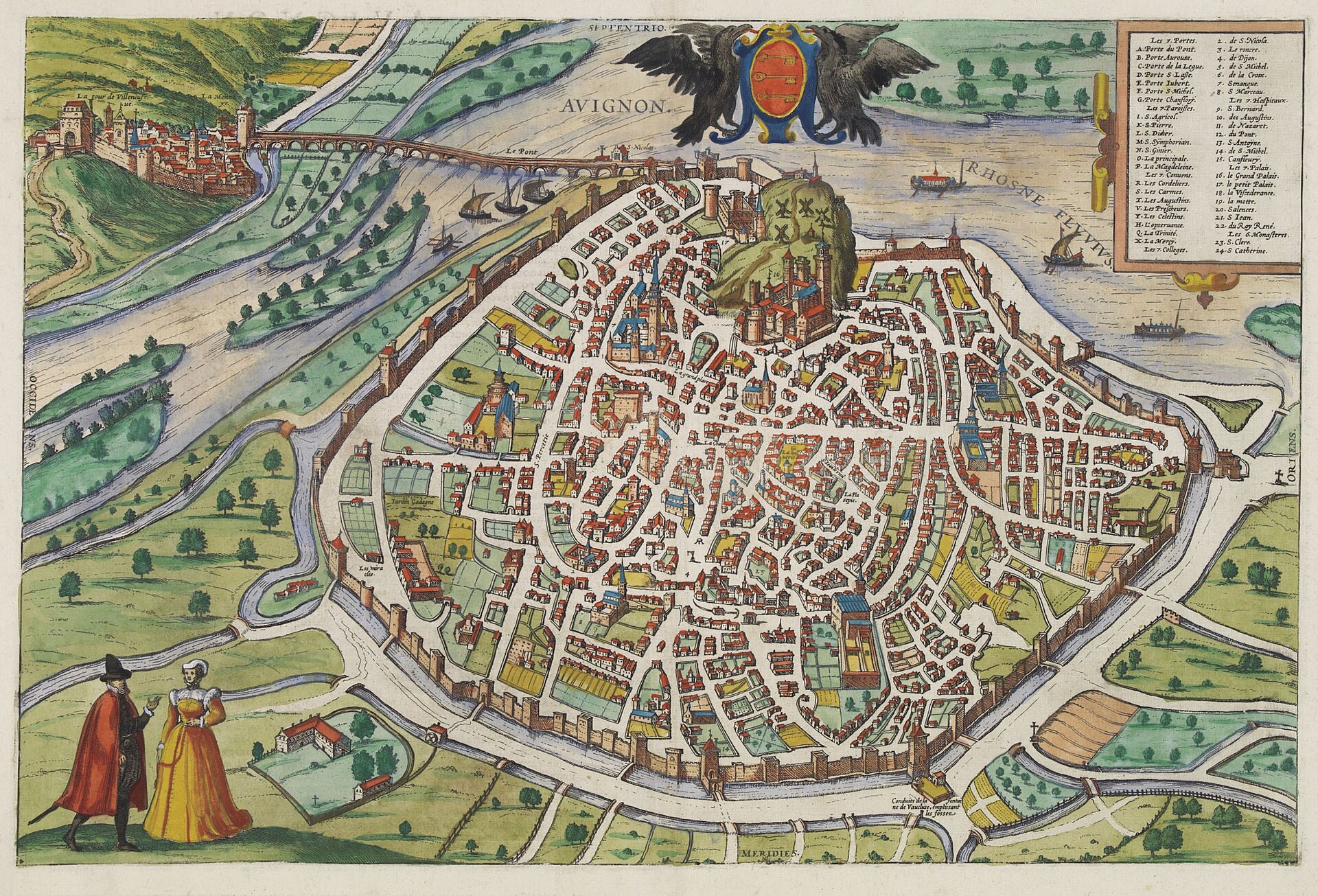
Bird's-eye view of Avignon, from Braun & Hogenberg's Civitates orbis terrarum
Shows Avignon’s walled old town with its gates and streets, the Rhône and Pont Saint‑Bénézet, the Papal Palace on the rocky hill and enclosed city blocks.
1575 · Georg Braun , Franz Hogenberg · Wikimedia Commons
Public domain (plate dated 1575)

Castles of Avignon


More cities to explore
 FranceMarseilleExplore it in 100 BC · 1750
 FranceLyonExplore it in AD 100 · 1500 · 1835
 FranceParisExplore it in 1250 · 1670 · 1789 · 1889
 FranceRouenExplore it in 1431 · 1540 · 1876
Castles of Europe · Landmarks of Europe · create your own reconstruction.