Historic Cities · France
Marseille through the ages
Marseille is a city in southern France, the prefecture of the Bouches-du-Rhône department and of the Provence-Alpes-Côte d'Azur region. Situated in Provence, it marks the eastern end of the Côte Bleue on the Mediterranean coast. Marseille is the second-most populous city proper in France, after Paris, with 886,040 inhabitants in 2023 over a municipal territory of 241 km2 (93 sq mi).

Marseille in 100 BC
Greek Massalia
Massalia in 100 BC is a thriving Phocaean trading colony crowned by temples and a theatre on its northern hills and ringed by pink stone ramparts around the Lacydon harbour. This walk moves from the Gulf of Lion into the Lacydon basin, along busy quays and shipyards, past markets and artisans, finishing on the hill that watches the sea lanes to Ionia and the Rhone.
Low, sunbaked houses and flat-tiled roofs cluster around a narrow inlet, the Lacydon, whose quays are stacked with amphorae and ringed by shipsheds and timber masts. Pink Cassis limestone ramparts, punctuated by square towers, rise above wooden porches; columned temples and a cut‑into‑slope theatre crown the northern hills. The harbour gleams with oiled hemp, sailcloth and cedar hulls, and the air carries salt, pine resin and wine‑must.
The route: 22 streets, squares and views
Gulf of Lion Approach → Rhone Delta → Lacydon Entrance → Lacydon Quays → Shipsheds (Neosoikoi) → Ramparts Gate → Agora (Harbour Market) → Potters' Quarter → Fish Market → Wine Merchants' Quay → …
Step inside, 13 interiors
Merchant's Courtyard House · Neosoikoi Slipway Hall · Gate Tower Guardroom · Stoa of the Agora · Potter's Workshop · Fishmongers' Exchange Hall · Wine Merchant's Counting-room · Great Amphora Repository · Main Shipwright's Shed · Cella of Artemis · Cella of Apollo · Skene and Orchestra · Arsenal Storehall
Planned from the Wikipedia record: Massalia.
Marseille in 1750
Marseille of the Levant Trade
This walk visits Marseille at the height of its 18th‑century Mediterranean trade: the Vieux‑Port crowded with Levantine and Mediterranean masts, the forts guarding the harbour mouth, and workshops of soap and sugar behind the quays. You will move from the bay into the heart of the port, through the Canebière and Le Panier, and finish high above the city at the little chapel of Notre‑Dame de la Garde.
In 1750 Marseille is a working Mediterranean port: a low, dense skyline of tiled roofs and ochre stone, punctured by masts packed rail to rail in the Vieux‑Port and the squat profiles of seventeenth‑century forts. Quays sit close to narrow streets and newly cut promenades; smoke rises from boiling cauldrons at soap works and chimneys of small sugar refineries. Light is hard, blue and sunlit in the harbour, warm and dusty in the alleys.
The route: 21 streets, squares and views
Château d'If and Bay → Harbour Mouth with Forts → Fort Saint‑Jean → Fort Saint‑Nicolas → Vieux‑Port → La Loge Quay → La Lenche (Fishmarket) → Hôtel de Ville → The Arsenal → Corderie (Ropeworks) → …
Step inside, 12 interiors
Fort Guardroom · Fishmongers' Arcade · Chamber of Maritime Commerce · Shipwrights' Great Shed · Ropewalk Gallery · Boiling House · Sugar Boiling House · Quarantine Ward · Merchant Counting House · Oil Merchants' Warehouse · Domed Chapel · Hôtel‑Dieu Ward
Planned from the Wikipedia record: History of Marseille.
Its story
The story of Marseille.
Massalia, Founded from Phocaea c. 600 BC
Marseille began as Massalia, established within the modern city around 600 BC by colonists from Phocaea, on the Aegean coast of Asia Minor. It became the preeminent Greek polis of the Hellenised region of southern Gaul, and Marseille is reckoned the oldest city in the country and one of the oldest continuously inhabited settlements in Europe. Thucydides records the link between Massalia and the Phocaeans, noting that the Carthaginians opposed the venture and that their fleet was defeated.
The founding was also told as a legend, in which the Phocaean Protis (Euxenes in Aristotle's version) was invited to a banquet given by Nann, chief of the local Ligurian tribe, for the suitors of his daughter Gyptis. She handed the ceremonial cup of wine to Protis, and the couple settled on the hill north of the cove of the Lacydon, from which the city grew.
At its height in the 4th century BC the city held about 50,000 people on some fifty hectares inside a wall, governed as an aristocratic republic with an assembly formed by the 600 wealthiest citizens. Its traders worked inland up the Durance and the Rhône and ran overland routes to Switzerland and Burgundy, reaching as far north as the Baltic, exporting local wine, salted pork and fish, coral and cork. Its most famous citizen, the navigator Pytheas, was the first scientist to observe that the tides were connected with the phases of the moon; between 330 and 320 BC he sailed into the Atlantic as far north as England, Iceland and Norway, hoping to open a sea route for Cornish tin, but the voyage made no money and was never repeated. The city's wealth rested instead on standing between an inland Gaul hungry for Roman goods and wine, which Massalia was steadily exporting by 500 BC, and Rome's appetite for new products and slaves.
Rome's Ally, the Sack of 739, and Recovery under the Counts of Provence
In 123 BC Massalia faced an invasion by the Allobroges and Arverni under Bituitus and entered an alliance with Rome. Roman legions beat the Gauls at Vindalium in 121 BC, and in exchange the city yielded a strip of its territory for the Via Domitia, the road to Spain. Independence lasted a little longer, though Rome organised the province of Transalpine Gaul around the city and in 118 BC founded a colony at Narbo Martius that then competed with it. In April 49 BC, during Caesar's war against Pompey and most of the Senate, Massalia sided with the exiled government and closed its gates to Caesar on his way to Spain. The siege that followed was over by September: the Massaliote fleet was defeated and the city fell, keeping nominal autonomy but losing its trading empire.
Christianity appeared here early, attested by catacombs above the harbour and by records of Roman martyrs; Provençal tradition holds that Mary Magdalen evangelised Marseille with her brother Lazarus.
The decline of the Roman Empire did not reach Marseille before the 8th century, probably because of the efficient defensive walls it had inherited from the Phocaeans. Even after the town fell to the Visigoths in the 5th century it became an important Christian intellectual centre, home to John Cassian, Salvian and Sidonius Apollinaris, and it went on to a golden age in the 6th century as a major commercial centre of the Mediterranean. In or before 736 Umayyad Arab forces occupied the city at the invitation of the local ruler, duke Maurontus, as allies against his enemy Charles Martel. In 739 Martel's armies punished Marseille for rejecting his appointed governor, and its prosperity ended suddenly. The city did not develop again before the 10th century, having suffered 150 years of attacks by Greeks and Saracens, and regained its wealth and trading power under the counts of Provence.
Angevin Rule, Two Revolts, the Plague of 1348 and the Sack of 1423
Between 1212 and 1218 the city was governed de facto by the Confraternity of the Holy Spirit. The counts of Provence allowed Marseille, run by a consul, great autonomy until Raymond Berengar IV asserted control; the city resisted at first, then acknowledged his suzerainty in 1243. After his death his daughter Beatrice of Provence married Charles I of Anjou, brother of Louis IX of France, in 1246, making Charles count.
Charles continued his father-in-law's administrative changes, which reignited discontent, and Marseille rebelled in 1248 under two local nobles, Barral of Baux and Boniface of Castellane, while he was away on the Seventh Crusade. He returned in 1250 and forced the city to surrender in 1252. It rose again in 1262 under Boniface of Castellane and Hugues des Baux, and Charles quelled the revolt in 1263.
Bubonic plague struck in 1348 and returned intermittently until 1361. As a major port, Marseille is believed to have been one of the first places in France to meet the epidemic; some 15,000 people died in a city that had held 25,000 during the prosperity of the previous century. Its fortunes fell further when it was sacked and pillaged by the Aragonese in 1423.
King René's Ramparts and the Ottoman Fleet, 1437–1673
Population and trade recovered. In 1437 René of Anjou, Count of Provence, arrived and established Marseille as the most fortified settlement in France outside Paris, raising the town to the status of a city and granting it certain privileges. He used it as a strategic maritime base for the reconquest of his kingdom of Sicily, and, wanting the harbour mouth solidly defended, ordered a series of ramparts built on the ruins of the old Maubert tower between 1447 and 1453. René also founded the Corporation of Fishermen, and the guild established a position of power among the merchants of the city.
Marseille was united with Provence in 1481 and incorporated into France the following year, but soon acquired a reputation for rebelling against the central government. The fortress of Château d'If was built after a visit by Francis I some thirty years later, and did little to stop the army of the Holy Roman Empire besieging the city a few years afterwards. In 1536 Marseille became a naval base for the Franco-Ottoman alliance, with a Franco-Turkish fleet stationed in the harbour, threatening the Holy Roman Empire and Genoa in particular.
Plague returned towards the end of the 16th century, and the hospital of the Hôtel-Dieu was founded soon afterwards. A century later Louis XIV came in person at the head of his army to quash a local uprising against the governor; the forts of Saint-Jean and Saint-Nicholas were raised above the harbour and a large fleet and arsenal established in it. The Hôtel de Ville was completed in 1673.
The Great Plague of 1720 and the Volunteers of 1792
Through the 18th century the port's defences were improved and Marseille grew more important as France's leading military port in the Mediterranean. In 1720 the Great Plague of Marseille killed 100,000 people in the city and the surrounding provinces; the population had recovered by the middle of the century.
The local population embraced the French Revolution and sent 500 volunteers to Paris in 1792 to defend the revolutionary government. The rallying song they sang on the march became known as La Marseillaise, and on 14 July 1795 it became the national anthem of France; accounts differ over where it belongs, one making Marseille its birthplace, another holding that it was born in Strasbourg and only first sung in Paris by the volunteers who gave it its name. In 1793 the Federalists rose against the Jacobins, and once the more moderate revolutionaries were squeezed out the rebellion became a monarchist fight against the republic. After the republic won, the city was renamed Ville-sans-nom, the Nameless City, in punishment.
Port of the Empire, 1830–1934
The 19th century brought industrial innovation and growth in manufacturing: the rise of the French Empire and the conquests from 1830 onward, Algeria above all, stimulated maritime trade and raised the city's prosperity, and the opening of the Suez Canal in 1869 widened it further. The Old Port was replaced as the main port for trade by the Port de la Joliette during the Second Empire. In 1871, in support of the Paris Commune, the people of Marseille established a commune of their own with the aid of local sections of the National Guard; the army suppressed it quickly.
In the first half of the 20th century the city celebrated its standing as port of the empire with the colonial exhibitions of 1906 and 1922, and the monumental staircase of the railway station, glorifying French colonial conquests, dates from then. In 1934 Alexander I of Yugoslavia arrived at the port to meet the French foreign minister Louis Barthou and was assassinated there by Vlado Chernozemski.
Corsicans had been arriving since the 1880s, mostly poor and agrarian, seeking jobs and better opportunities on the urban mainland; Marseille became known as the first Corsican city and the capital of Corsica. They concentrated in working-class neighbourhoods near the Old Port and kept the clan attachments of a then very decentralised Corsica, a system that eventually turned into organised crime as discrimination and extreme poverty closed other routes, producing the Corsican mafia. Many also enlisted in the colonial army after being promised money and an escape from poverty: 22 per cent of French colonial soldiers were Corsican, against around 2 per cent of the French population at the time. Corsicans became an important political bloc, many of them socialist or communist, and in the 1920s rallied to Simon Sabiani, who with mayor Siméon Flaissières became the face of the left in the city and in practice ran Marseille alongside the mafia figures he had long been connected with.
Vichy, the Round-up of January 1943, and the Gateway Port
Henri Tasso was elected mayor in 1935, and Sabiani, expelled from most of the left, joined the French Popular Party of the former Communist dissident Jacques Doriot and led it in Marseille, becoming known as the Mussolini of Marseille; clans of the Corsican mafia under Paul Carbone and François Spirito worked with him to consolidate that power. German and Italian forces bombed the city in 1940. Marseille was administered as part of the Vichy regime, Sabiani partly governing it and organising the city's branch of the Legion of French Volunteers against Bolshevism, for which the French Resistance put him on a list of collaborators to kill. He fled at the end of the war to Italy, Argentina and finally Spain.
The Germans occupied the city from November 1942 to August 1944. On 22 January 1943, as part of Action Tiger, over 4,000 Jews were seized in Marseille; they were held in detention camps before being deported to German-occupied Poland to be murdered. The Old Port was destroyed by the Germans in January 1943. The Allies liberated the city on 29 August 1944, General Joseph de Goislard de Monsabert leading roughly 130,000 French troops as part of Operation Dragoon.
Much of the city was rebuilt in the 1950s, and the governments of East Germany, West Germany and Italy paid reparations with compound interest for civilians killed, injured, left homeless or destitute in the war. The Corsican mafia kept its hold, and with the American mobster Lucky Luciano devised the French Connection, a heroin trafficking system dismantled in the 1970s. From the 1950s onward the city served as the entry port for over a million immigrants to France, part of a longer sequence: Greeks and Italians from the end of the 19th century, until at one point up to 40 per cent of the population was of Italian origin; Russians in 1917; Armenians in 1915 and 1923; Vietnamese in the 1920s, in 1954 and after 1975; Spaniards after 1936; Maghrebis between the wars; sub-Saharan Africans after 1945; Maghrebi Jews in the 1950s and 1960s; and in 1962 some 150,000 pieds-noirs from newly independent Algeria. The docks declined in the 1970s after the oil crisis and were later redeveloped with European Union funds. Marseille is the prefecture of the Bouches-du-Rhône department and of the Provence-Alpes-Côte d'Azur region, with 886,040 inhabitants in 2023, and holds the third largest Jewish community in Europe after London and Paris.
From the archive
Marseille on paper: the old town as it was mapped.
A period plan or bird's-eye view of the old town, drawn between 1500 and 1850, the streets this page's reconstructions walk. Public domain, with its source named.
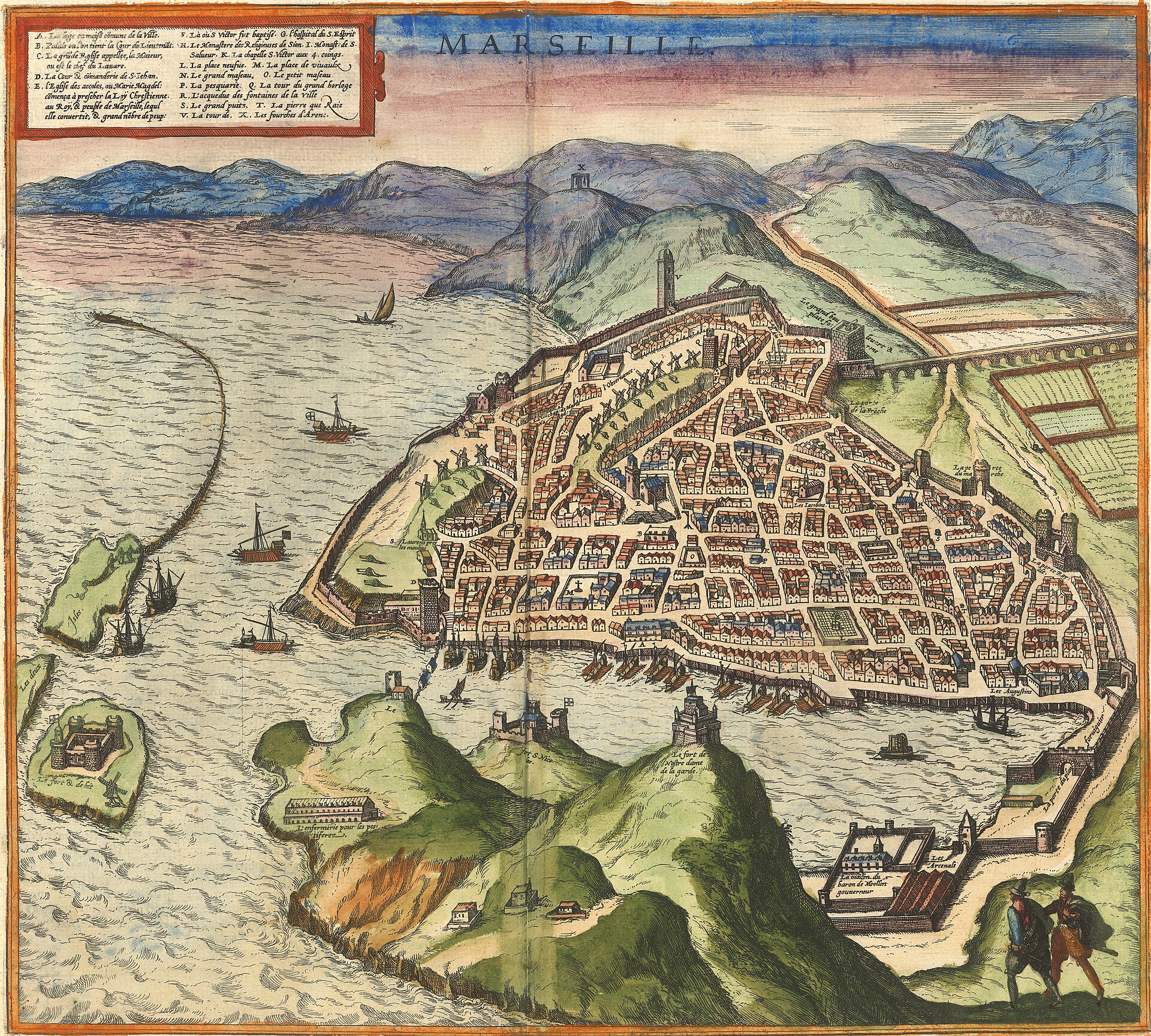
Bird's-eye view of Marseille, from Braun & Hogenberg's Civitates Orbis Terrarum
Fortified old town with walls and gates, dense street grid, harbour piers and nearby islands visible.
1575 · Georg Braun · Wikimedia Commons
Public domain (plate dated 1575)
In this city
Landmarks of Marseille, see each in its prime


Ships tied to Marseille
- HMS Repulse: Landed 500 refugees from the Spanish Civil War at Marseille in late 1936
More cities to explore
 FranceAvignonExplore it in 1350
 FranceCarcassonneExplore it in 1300 · 1890
 FranceParisExplore it in 1250 · 1670 · 1789 · 1889
 FranceRouenExplore it in 1431 · 1540 · 1876
Castles of Europe · Landmarks of Europe · create your own reconstruction.