Historic Cities · France
Bordeaux through the ages
Bordeaux is a city on the river Garonne in the Gironde department, southwestern France. A port city, it is the capital of the Nouvelle-Aquitaine region, as well as the prefecture of the Gironde department. Its inhabitants are called "Bordelais" (masculine) or "Bordelaises" (feminine). The term "Bordelais" may also refer to the city and its surrounding region.

Bordeaux in 1360
English Bordeaux
This is Bordeaux at the height of English rule in Gascony, when the city supplies claret and wine casks sail under English bills of lading. The walk follows the river crescent, the busy quays and the cathedral quarter, passing pilgrims, port workers, merchants and the palace by the water.
A low, crenellated skyline of stone towers, church spires and wooden hoardings sits on a broad horseshoe bend of the Garonne. Roofs are tile and thatch, streets are narrow and paved unevenly, quays are cluttered with barrels and plank ramps, and pale limestone facades rise above timber shops. Autumn light is cool and the river's tide defines the city's life and colour.
The route: 22 streets, squares and views
Vineyards Outside Bordeaux → Road and City Ramparts → Garonne Bend from Afar → Palais de l'Ombrière → Quays of the Garonne → Wine Warehouses → The Autumn Wine Fleet → Port Market at Low Tide → Sailors' Stairs → Saint-Seurin Basilica → …
Step inside, 13 interiors
Prince's Great Hall · Prince's Private Audience Chamber · Cellar of New Claret · Ship's Wine Hold · Coopers' Workshop · Pilgrim Nave · Pilgrim Dormitory · Cathedral Nave · Choir and High Altar · Bell Chamber · Tanners' Wet Loft · Merchant Market Hall · Cask Loft
Planned from the Wikipedia record: Bordeaux.
Bordeaux in 1780
Golden-age Bordeaux
Bordeaux in 1780 is at the peak of its maritime prosperity, its honey-coloured stone façades and newly ordered boulevards the visible signs of vast transatlantic trade. This walk traces the river quays, the warehouses of the Chartrons, the new theatre and the intendants' promenades, ending atop Pey-Berland for a wide view of sails, carts and the city’s curved riverfront.
A crescent of honey-coloured limestone façades runs along the Garonne, their unified plane punctuated by classical colonnades and narrow medieval towers. Low-slung negociant warehouses and chianti-coloured chai roofs back onto broad stone quays crowded with masts, canvas and barrel staves. Sunlight off the Atlantic brings a clear, slightly salty brightness; streets are wide where Tourny rebuilt them and still narrow and patched in the old market quarters.
The route: 23 streets, squares and views
Lormont Hill → Garonne Ferry Crossing → Quai des Chartrons → Chartrons Warehouses → Rue Notre-Dame (Chartrons) → Landing at La Barre → Place Royale → The River Quays → Bourse Riverside Façade → Place de la Comédie → …
Step inside, 13 interiors
Negociant's Wine Chai · Riverside Merchant Salon · Customs Counting Room · Trading Hall · Coffeehouse Parlour · Horseshoe Auditorium · Marble Grand Staircase · Panelled Mercantile Salon · Gatehouse Guardroom · Covered Market Hall · Archbishop's Stair Hall · Upper Gallery · Great Nave and Choir
Planned from the Wikipedia record: Bordeaux.
Its story
The story of Bordeaux.
Burdigala: Roman Trade Centre and Frankish County, 300 BC to the House of Poitiers
Around 300 BC the site was the settlement of the Bituriges Vivisci, a Celtic tribe who gave the town the name Burdigala, probably of Aquitanian origin. Rome's first recorded involvement here went badly: at the Battle of Burdigala in 107 BC, Romans defending the Allobroges, a Gallic tribe allied to Rome, were beaten by the Tigurini under Divico, and the consul Lucius Cassius Longinus was killed in the fighting. The city came under Roman rule around 60 BC and became an important commercial centre for tin and lead, acquiring an amphitheatre and the monument known as Les Piliers de Tutelle. The Romans also brought the vine to the region, probably in the mid-first century and at first only to supply wine for local consumption; production has been continuous since. Burdigala was enough of an administrative centre that a university was created there by the Romans in 286 to train administrators, teaching only rhetoric and grammar, with Ausonius and Sulpicius Severus among its teachers. It was sacked by the Vandals in 276, attacked by them again in 409, by the Visigoths in 414 and by the Franks in 498, after which it fell into a period of relative obscurity.
In the late sixth century the city re-emerged as the seat of a county and an archdiocese within the Merovingian kingdom of the Franks, though royal Frankish power was never strong there; around 585 Gallactorius was made Count of Bordeaux and fought the Basques. In 732 the troops of Abd er Rahman stormed the fortifications and overwhelmed the Aquitanian garrison, and Duke Eudes met them at the Battle of the River Garonne somewhere near the Dordogne. The death toll was high and Eudes was defeated, but he kept enough troops to fight at Poitiers and so retain his grip on Aquitaine. His son Hunald's rebellion in 737 drew a Frankish expedition that captured Bordeaux, and Hunald's son Waifer later confirmed the city as a capital of Aquitaine alongside Bourges; it was one of Waifer's last important strongholds to fall in the closing stage of the war of 760–768 against King Pepin the Short.
The counts who followed were charged with keeping the Basques in check and holding the mouth of the Garonne against the Vikings, who appeared around 844. In the autumn of 845 the Vikings raided Bordeaux and Saintes; Count Seguin II marched against them, was captured and was executed. The port was a busy trade centre, but its stability was threatened by these incursions and by political instability, and continuity of government returned only with the restoration of the Ramnulfid dukes of Aquitaine under William IV and his successors, the House of Poitiers.
The English Wine Trade, 12th Century to 1453
From the 12th century the city flourished again after the marriage of Eléonore, Duchess of Aquitaine and the last of the House of Poitiers, to Henry II Plantagenêt, Count of Anjou and grandson of Henry I of England, who succeeded to the English crown months after the wedding. Bordeaux now sat inside the Angevin Empire, which stretched from the Pyrenees to Ireland. Henry granted tax-free trade status with England, which made the wine trade, the city's main source of income, more profitable still, and cloth and wheat came back the other way. The belfry known as the Grosse Cloche and the cathedral of Saint-André were built in this period, the cathedral in 1227, taking in the artisan quarter of Saint-Paul.
Under the terms of the Treaty of Brétigny the city became briefly the capital of an independent state, from 1362 to 1372, under Edward, the Black Prince. In 1441, while Bordeaux was still an English town, Pope Eugene IV created a university there at the request of the archbishop Pey Berland, whose name is carried by the quadrangular Gothic tower annexed to the cathedral in 1440–1450. English rule ended at the Battle of Castillon in 1453, after which the city was annexed by France.
Parliament, the Fronde and the Port of the Moon, 1462–1789
Bordeaux created a local parliament in 1462, and at the Renaissance the collège de Guyenne made it an intellectual centre. The city adhered to the Fronde, and was effectively annexed to the Kingdom of France only in 1653, when the army of Louis XIV entered it.
The 18th century was another golden age. The Port of the Moon supplied the majority of Europe with coffee, cocoa, sugar, cotton and indigo, becoming France's busiest port and the second busiest in the world after London. Perhaps 5,000 buildings in the centre, including those on the quays, date from these decades. Bordeaux was among the first French cities, after Nancy, to enter an era of large-scale urban projects, worked under the intendants Nicolas-François Dupré de Saint-Maur and then the Marquis de Tourny by Jacques Gabriel and his son, architects to Louis XV: the Place de la Bourse was laid out between 1735 and 1755 as a setting for an equestrian statue of the king, and the Grand Théâtre followed in 1780.
That prosperity rested on slavery. Bordeaux shipowners mounted some 500 slave expeditions and deported 150,000 Africans. The triangular trade itself accounted for only about 5 per cent of the city's wealth; the other 95 per cent came from direct trade with the Caribbean in the goods enslaved people produced: sugar, coffee, cocoa. In the same period a major migration ran the other way, with Aquitanians leaving for the Caribbean colonies and Saint-Domingue, now Haiti, the most popular destination: 40 per cent of the white population of the island came from Aquitaine, and they prospered on plantation incomes.
Girondists, Saint-Domingue and the Collapse of the Port, 1789–1814
Many local revolutionaries at the beginning of the French Revolution in 1789 were Girondists, a party of the provincial bourgeoisie that favoured abolishing aristocratic privileges but opposed the Revolution's social dimension. The city's commercial power stood in dire contrast to widespread poverty among its inhabitants, and a shortage of food and resources had produced frequent episodes of mass unrest well before the Revolution. In 1793 the Montagnards under Robespierre and Marat came to power and, fearing that the bourgeoisie would misappropriate the Revolution, executed a great number of Girondists; the local Montagnard Section renamed Bordeaux "Commune-Franklin", in homage to Benjamin Franklin.
A slave revolt broke out in 1791 at Saint-Domingue, the most profitable of the French colonies, and the Montagnard Convention abolished slavery three years later. In 1802 Napoleon revoked the manumission law but lost the war against the army of former slaves, and Haiti became independent in 1804. The loss of the colony collapsed Bordeaux's port economy, which had depended on colonial trade and the trade in slaves. The Revolution also closed the university: the National Convention abolished it in 1793 and replaced it in 1796 with the École centrale, housed in the former buildings of the collège de Guyenne, and it reappeared only under Napoleon in 1808.
The region produced several prominent abolitionists (Montesquieu, Laffon de Ladébat and Elisée Reclus), while the revolutionaries Boyer-Fonfrède, Gensonné, Guadet and Ducos were members of the Society of the Friends of the Blacks. Towards the end of the Peninsular War, in 1814, the Duke of Wellington sent William Beresford with two divisions to seize Bordeaux, and they met little resistance: the city was largely anti-Bonapartist, most of it supported the Bourbons, and the British troops were treated as liberators.
Rebuilt by Shipowners, and the Government's Refuge, 1815–1940
From the Bourbon Restoration the traders and shipowners rebuilt the economy, undertaking the city's first bridge and its customs warehouses, and shipping traffic grew through the new African colonies. Bordeaux's own 18th-century rebuilding became a model elsewhere: Georges-Eugène Haussmann, long the city's prefect, drew on it when Napoleon III asked him to transform Paris. The Bordeaux Wine Official Classification of 1855 fixed the region's five premier cru red wines, four from the Médoc and one, Château Haut-Brion, from Graves.
In 1870, at the beginning of the Franco-Prussian War, the French government relocated temporarily from Paris to Bordeaux. It did so again during the First World War, and very briefly again in the Second, when it became clear that Paris would fall into German hands.
Occupation, Visas and the U-Boat Pens, 1940–1943
Bordeaux fell under German occupation. In May and June 1940 the Portuguese consul-general, Aristides de Sousa Mendes, granted thousands of Portuguese visas (which were needed to pass the Spanish border) to refugees fleeing the German occupation.
From 1941 to 1943 the Italian Royal Navy ran BETASOM, a submarine base in the city, and Italian submarines fought in the Battle of the Atlantic from it. The base was also a major one for German U-boats and served as headquarters of the 12th U-boat Flotilla. The massive reinforced concrete pens built for the submarines proved impractical to demolish, and part of the structure is now used as a cultural centre for exhibitions.
World Heritage and the Slavery Memorials, 2007 Onwards
In 2007 the 40 per cent of the city's surface area around the Port of the Moon was inscribed on the UNESCO World Heritage List, as "an inhabited historic city, an outstanding urban and architectural ensemble, created in the age of the Enlightenment, whose values continued up to the first half of the 20th century, with more protected buildings than any other French city except Paris". The city holds 362 monuments historiques.
The slaving past has been marked in public. After pressure exerted by Karfa Diallo's association, the municipality installed a commemorative plaque on the quays from where the first slave ship departed, and entrusted the Musée d'Aquitaine with four permanent rooms on the city's history of Atlantic trade and colonial slavery. A statue of Modeste Testas was unveiled in 2019: an Ethiopian woman enslaved by the Bordeaux-based Testas brothers, she was trafficked by them from West Africa to Philadelphia, where one of the brothers coerced her to have two children by him, and was ultimately freed and lived in Haiti. The bronze was made by the Haitian artist Woodly Caymitte.
Bordeaux is the capital of the Nouvelle-Aquitaine region and the prefecture of the Gironde. Its commune of 49 square kilometres held 267,991 inhabitants in January 2023, below the 284,494 recorded at the 1954 census; the wider metropolitan area counted 1,376,375 people in January 2020, only a fifth of them inside the city proper.
From the archive
Bordeaux on paper: the old town as it was mapped.
A period plan or bird's-eye view of the old town, drawn between 1500 and 1850, the streets this page's reconstructions walk. Public domain, with its source named.
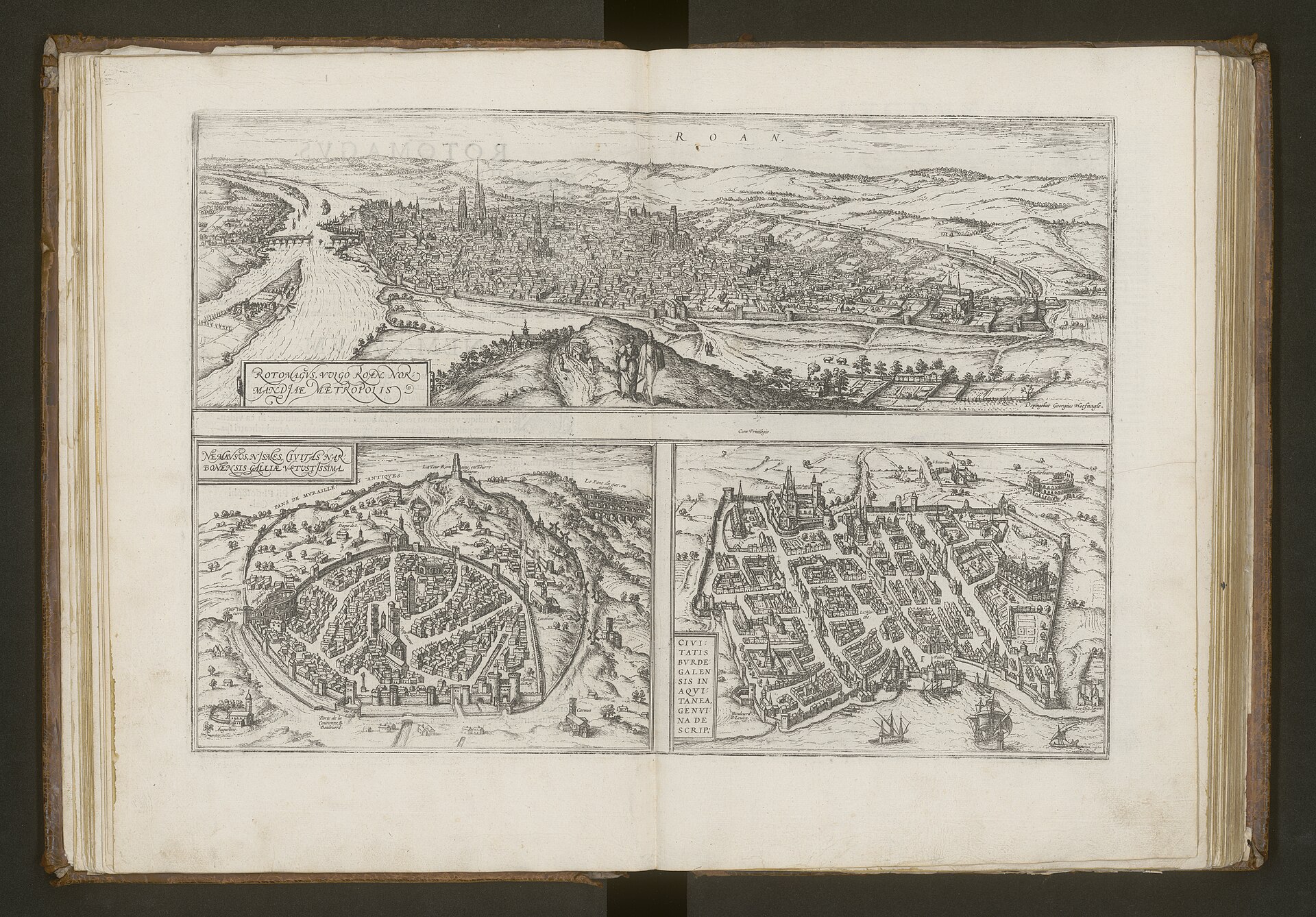
Bird's-eye plan of Bordeaux (Civitatis Burdegalensis), from Braun & Hogenberg's Civitates Orbis Terrarum
Oblique bird's-eye plan showing Bordeaux's walled medieval core, harbour quays on the Garonne, streets and blocks, and fortified gates.
1577 · Georg Braun · Wikimedia Commons
Public domain (plate dated 1577)
More cities to explore
 FranceCarcassonneExplore it in 1300 · 1890
 FranceParisExplore it in 1250 · 1670 · 1789 · 1889
 FranceRouenExplore it in 1431 · 1540 · 1876
 FranceLyonExplore it in AD 100 · 1500 · 1835
Castles of Europe · Landmarks of Europe · create your own reconstruction.