Historic Cities · Romania
Brașov through the ages
Brașov is a city in Transylvania, Romania and the county seat of Brașov County.

Brașov in 1500
Saxon Kronstadt
Kronstadt sits at the foot of the Carpathians as a prosperous Transylvanian Saxon guild town defending trade routes and passes. The walk passes the walled town's gates and bastions kept by guilds, the enormous Gothic Black Church, the council square and the Romanian quarter of Schei outside its own gate.
The town is a compact, walled guild-city beneath the steep, wooded slope of Tâmpa, its skyline dominated by the dark stone mass of the Gothic Black Church and the squat watchtowers of the town walls. Roofs are steep and terracotta, facades of plaster and exposed timber or squared sandstone, streets narrow and cobbled; markets cluster in the wide council square while ox carts and pack trains arrive from the southern mountain passes.
The route: 21 streets, squares and views
Road to the Bran Pass → Tâmpa Foothills Approach → Șchei Gate → Saint Nicholas, Schei → First Romanian School (exterior) → Rope-makers' Bastion → Weavers' Bastion → Blacksmiths' Bastion → Catherine Gate → White Tower → …
Step inside, 13 interiors
Saint Nicholas Church Interior · First Romanian School Classroom · Ropemakers' Vaulted Store · Weavers' Bastion Armory · Blacksmiths' Forge Hall · Bârsa River Merchant Warehouse · Nave of the Black Church · Choir and High Altar · Council House Council Chamber · Council Tower Guardroom · Cloth Merchant's Workshop · Tinsmiths' Workshop · Guild Row Meeting Hall
Planned from the Wikipedia record: Transylvanian Saxons.
Brașov in 1900
Habsburg Brașov
This is Brassó in the last decades of Austro-Hungarian rule: a compact Transylvanian market town where a Gothic Black Church towers over a ring of new shopfronts and hotel awnings. Walkers climb Tâmpa above the red-tiled roofs, a new Neolog synagogue raises its towers, an Orthodox cathedral anchors the eastern approach, and timber and wool mills hum at the town's edges.
The town pinches into a dense medieval core of red-brown tile roofs and narrow streets, ringed by stout stone walls and guild towers. The Black Church’s dark gothic mass dominates the skyline; new late-19th-century façades and striped hotel awnings line the council square. On the eastern approach the Romanian quarter and Orthodox church cluster by the Bârsa river, while timber yards and wool mills smoke at the periphery. Paths and clearings climb Tâmpa above the rooftops.
The route: 20 streets, squares and views
Bârsa Valley Approach → Poarta Șchei (Waisenhaus Gate) → Șchei Street → St. Nicholas Church, Șchei → Șchei Central School → Bârsa River Mills → Poarta Ecaterinei (Catherine's Gate) → Weavers' Bastion → White Tower (Turnul Alb) → Black Tower (Turnul Negru) → …
Step inside, 14 interiors
Iconostasis Chamber · Carding Room · Gate Passage · Weavers' Loom Hall · Sentry Chamber · Grand Café Interior · Council Chamber · Merchant's Upstairs Parlour · Haberdasher's Showroom · Organ Loft · Neolog Prayer Hall · Kosher Butcher's Shop · Main Nave · Summit Shelter
Planned from the Wikipedia record: Brașov.
Its story
The story of Brașov.
The Teutonic Knights and the Burzenland, 1211–1252
The hills around Brașov carry traces of continuous settlement long before any document names the place: Neolithic and Bronze Age material at Valea Cetății, Pietrele lui Solomon, Șprenghi, Tâmpa, Dealul Melcilor and Noua, with Dacian citadels on the first three sites and a Roman-style construction on Șprenghi Hill. No written record mentions the town until the thirteenth century.
Transylvanian Saxons were invited in by Hungarian kings between 1141 and 1300 to build towns, open mines and work the land; the settlers came chiefly from the Rhineland, Flanders and the Moselle, with others from Thuringia, Bavaria, Wallonia and France. In 1211 Andrew II of Hungary settled the Teutonic Knights in the Burzenland to hold the kingdom's frontier, and on the site of the village they built Kronstadt, the city of the crown. The knights were evicted by 1225, but the colonists they had brought stayed, alongside the local population, in three separate settlements: Corona around what became the Black Church, Martinsberg west of Cetățuia Hill, and Bartholomä on the eastern side of Șprenghi Hill. The oldest surviving building in the town, the church of St Bartholomew, was raised around 1260.
The names arrived in documents in the same decades. Corona appears in the Catalogus Ninivensis, a list of Premonstratensian houses in Hungary, in the 1230s; a convent of Premonstratensian sisters under the patronage of St Catharina had been founded beside the later Black Church in 1228. In 1252 Béla IV granted land lying between the Romanians of Cârța, the Saxons of Barasu and the Székelys of Sebeș, the first attested form of the name Brașov, though historians disagree whether Barasu meant the town or the district around it. In 1241 the Tatar invasion took the fortress on Șprenghi Hill.
The Guilds, Hunyadi's Walls and the Saxon University
What the town did for a living was trade. It sat where the routes linking the Ottoman lands to western Europe crossed, and tax exemptions on top of that position let the Saxon merchants accumulate considerable wealth and political weight. Crafts followed the trade: the furriers drew up the first guild statute in 1424, and by 1798 forty-three guilds were operating in Brașov with 1,227 masters between them, among them smiths, cloth-makers, tanners, goldsmiths, potters, weavers, armourers and bowyers. The town walls were expanded continually, with individual towers maintained by individual craft guilds in the medieval manner.
The Ottoman advance reached the Burzenland in 1421 and again in 1438, and by treaty the Turks obtained the fortress on Tâmpa above the town. Between 1448 and 1453 John Hunyadi bought that fortress back and ordered it destroyed, its stone carried down to strengthen the walled town in the valley: eight bastions set at hundred-metre intervals, thirty-two defensive towers, two or three rings of wall and a water-filled ditch around them. The Black Church was finished in 1477; its second tower was never built for want of funds. In 1486 Brașov and the whole Burzenland entered the Saxon University, the self-governing body of the Transylvanian Saxons, when the Andreanum privilege was confirmed for the Saxons of Sibiu, Mediaș, Brașov and the Burzenland.
Honterus's Press and the Romanian Books of Șchei
In 1521 Johann Benkner, the judge of Brașov, received a letter from Neacșu of Câmpulung reporting Turkish troop movements beyond the Danube. Written in Romanian, it is among the oldest surviving documents in the language. The humanist Johannes Honterus set up the town's first printing press in 1533 and its first gymnasium in 1544, and a paper mill followed in 1546. In 1559 the deacon Coresi printed at Brașov his first book in Romanian, Întrebare creștinească.
The Romanian and Bulgarian population lived in the Șchei district outside the walls, the Hungarians in Blumăna, and the Saxons within the walls and in the northern suburbs. Șchei's church and school drew donations from more than thirty hospodars of Moldavia and Wallachia and from Elizabeth of Russia. The first teaching in Romanian took place there in 1583, on the same ground where Coresi had printed; in 1628 the archpriest Vasile of Șchei wrote the first local chronicle on a Romanian subject. The schoolmasters of Șchei produced the first Romanian calendar-almanac, printed by Petcu Șoanu in 1731, and the first Romanian grammar, written by Dimitrie Eustatievici in 1757. Joseph II, Holy Roman Emperor and sovereign of Transylvania, granted the Romanians citizenship rights for a brief period late in the eighteenth century.
Michael the Brave, the Habsburg Revolt and the Fire of 1689
On 4 October 1599 Michael the Brave entered Brașov and joined his army to the rebel Székely troops; the next day he was handed the key of the town, and after taking Transylvania he held his first diet in the Casa Sfatului. Defence work continued around the town. The Cetățuia on Dealul Cetății was first built in timber in 1524, then captured and destroyed on the order of Petru Rareș, who laid the foundations of the stone building that replaced it; burnt in 1618 and rebuilt in 1625, it later served as a garrison for the Habsburg armies and, in the 1940s and 1950s, as a prison.
In 1688 the townspeople rose against the new Habsburg authorities; the rising was put down and its leaders executed. On 21 April 1689 a great fire laid waste the walled town, leaving few buildings untouched. The authorities banned the building of wooden houses afterwards, and reconstruction ran on for more than a century. Plague and other epidemics returned repeatedly across these centuries, from 1495 to 1756; effective containment measures were taken for the first time in 1660.
Gazeta de Transilvania, the Railway and the Change of State, 1835–1918
The town's first credit institution, the Casa generală de economii, opened in 1835. Three years later George Barițiu began editing Gazeta de Transilvania, the first Romanian-language newspaper in the Grand Principality of Transylvania, alongside the review Foaie pentru minte, inimă și literatură. In 1848 the programme document Prințipurile noastre pentru reformarea patriei was drawn up in Brașov by Alexandru Ioan Cuza, Vasile Alecsandri, Alecu Russo, Costache Negri, Gheorghe Sion and Ion Ionescu de la Brad, demanding the union of all Romanians in a single state; the Romanians of Șchei demonstrated for political rights on 11 April. In 1850 the Romanian gymnasium was founded under Andrei Șaguna, Metropolitan of Sibiu, and it still bears his name. That year the town held 21,782 people: 8,874 Germans, 8,727 Romanians and 2,939 Hungarians.
Franz Joseph signed the law for a railway linking Brașov to Budapest by way of Sibiu on 6 December 1862, and the first train arrived on 30 March 1873; the Brașov–Ploiești line opened in 1879. A steam tram ran from Bartolomeu station through the main square to Săcele from 1891, and on 1 October 1911 Aurel Vlaicu flew his new machine out of the yard of the Andrei Șaguna gymnasium. By 1910 the population had reached 41,056, of whom 17,831 were Hungarians, 11,786 Romanians and 10,841 Germans.
In August 1916 the Romanian Army occupied Brașov and Gheorghe Baiulescu was installed as mayor, the town's first Romanian one. The Central Powers retook the area at the Battle of Brassó between 7 and 9 October 1916; Baiulescu's term ended on 8 October and the previous mayor, Karl Ernst Schnell, was reinstated on the 9th. After the collapse of Austria-Hungary, the Great National Assembly at Alba Iulia proclaimed the union of Transylvania with Romania on 1 December 1918, and Romanian forces occupied Brașov permanently on 7 December as Hungarian forces withdrew northwards. Because the town lay near the centre of the enlarged country, the king and some Transylvanians proposed it as the new national capital; nothing came of it.
The Jewish Community and the Deportations, 1828 Onwards
The first Jewish community in Brașov was established in 1828 and joined the Neolog association in 1868; Orthodox Jews founded their own religious organisation in 1877. The Neolog synagogue, seating 800, was built between 1899 and 1905. Zionist organisations appeared from 1920. By 1930 there were 2,594 Jews in the town, four per cent of the population, and in 1940 the two communities, which had kept separate institutions through the interwar years, opened a jointly managed school.
In autumn 1940, under the National Legionary State, the Iron Guard nationalised every Jewish institution in Brașov and seized most of the shops owned by Jews. From 1941 Jews were drafted into forced labour battalions, and those from across southern Transylvania were concentrated in the town, joined by a further two hundred refugees from Ploiești. In August 1942, 850 Jews aged between eighteen and fifty were drafted into labour battalions and set to work in Brașov, others being sent to Predeal and Bran; in spring 1943, 250 young men were sent to the Suraia camp to build fortifications. By August 1944 the battalions had been reduced to between 250 and 300 men and most of the rest had been dismissed from service. The Jewish population rose to 3,500 in 1945 and 1946.
The town was badly damaged by American bombing between 1943 and 1944. In January 1945 the Saxons of Brașov were deported to the Soviet Union, part of the forced deportation of ethnic Germans from Romania at the end of the war. Most of them emigrated to West Germany after Romania became a communist state. At the 2011 census 1,079 residents, half of one per cent, gave their ethnicity as German.
Stalin City, the Truck Works and the Revolt of 1987
Industry had begun between the wars, above all at the IAR aircraft plant, which built the first Romanian fighter aeroplanes used in the Second World War. After the armistice with the Soviet Union on 12 September 1944 the factory turned to repairing trucks, and from October 1945 to building agricultural tractors; the IAR 22 was the first Romanian-made wheeled tractor, and in 1948 the works was renamed Uzina Tractorul Brașov. On 22 August 1950 the city itself was renamed Orașul Stalin, Stalin City, by a decree of Constantin Ion Parhon, the nominal head of state, which described the change as an honour to the leader of the Soviet people and liberator of the Romanian one; it became the capital of the region of the same name and kept it until December 1960. Aircraft manufacture resumed in 1968, first as ICA and later again as IAR, at a new site at Ghimbav; much of the old Brașov plant was demolished in 2013 and 2014.
Heavy industry under the communist government drew workers from across the country and reshaped the population: at the 2011 census 91.3 per cent of residents were Romanians and 7.1 per cent Hungarians. On 15 November 1987 workers at the truck works revolted over unpaid wages and worsening conditions. Workers from other plants and a large part of the town's population joined them. The revolt was put down by the security forces, and its leaders were imprisoned, tortured and deported. During the revolution of 21 to 25 December 1989 there was violence in Brașov in which 84 people were killed and 236 wounded; the city holds the title of martyr-city.
Brașov was made a municipiu on 17 February 1968 and is the seat of Brașov County. The 2021 census recorded 237,589 inhabitants, making it the sixth most populous city in Romania, with 371,802 in the metropolitan area created in 2005. Heavy industry has declined but not disappeared, with truck, auto-parts, bearing, furniture and textile manufacture still in the city. Part of the medieval fortification ring has been restored using UNESCO funds, and two of the town gates, Poarta Ecaterinei and Poarta Șchei, still stand.
From the archive
Brașov on paper: the old town as it was mapped.
A period plan or bird's-eye view of the old town, drawn between 1500 and 1850, the streets this page's reconstructions walk. Public domain, with its source named.
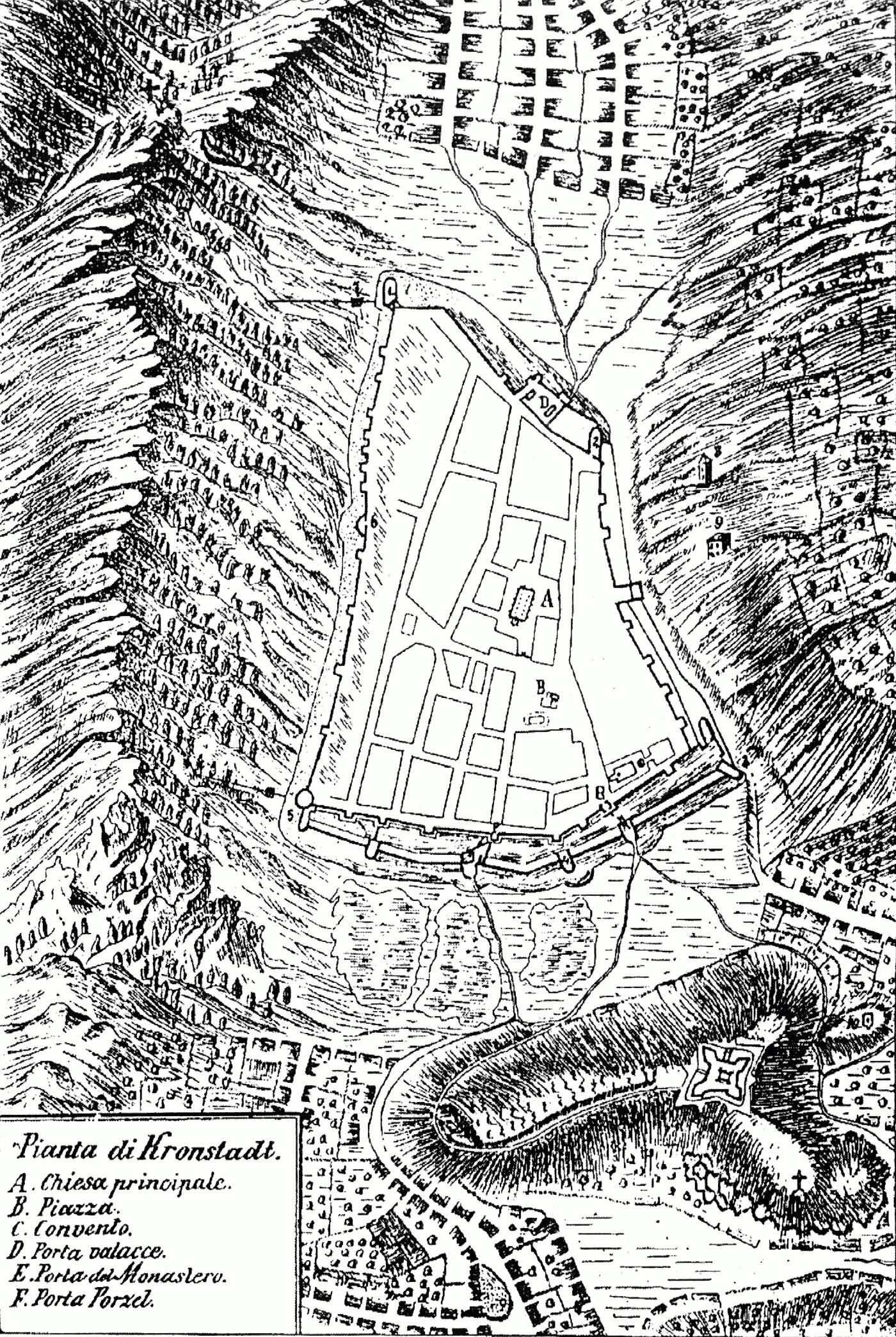
Bird's-eye plan (Pianta di Kronstadt) of Kronstadt (Brașov) by Giovanni Morando Visconti
Walled town plan showing ramparts and bastions, marked gates, inner street blocks and a principal church.
1699 · Alex:D · Wikimedia Commons
Public domain (plate dated 1699)
More cities to explore
 RomaniaSighișoaraExplore it in 1710
 NetherlandsUtrechtExplore it in 1400 · 1700
 EnglandLondonExplore it in AD 200 · 1390 · 1600 · 1885
 FranceParisExplore it in 1250 · 1670 · 1789 · 1889
Castles of Europe · Landmarks of Europe · create your own reconstruction.