Historic Cities · Romania
Sighișoara through the ages
Sighișoara is a city on the Târnava Mare River in Mureș County, central Romania. Located in the historic region of Transylvania, Sighișoara had a population of 23,927 according to the 2021 census. It is a popular tourist destination for its well-preserved old town, which is listed by UNESCO as a World Heritage Site since 1999.

Sighișoara in 1710
The Saxon Citadel
Schäßburg in 1710 is a living Saxon craftsmen's citadel perched above the Târnava Mare, its fortified wall ringed by guild towers and dominated by the tall Clock Tower with its baroque helm and turning figures. This walk leads from the river approach through the Clock Tower gate into the Citadel Square, past workshops, covered wooden steps and orchards to the Church on the Hill, where the town spreads like a patchwork of ember-coloured roofs.
The skyline is dominated by the 64-metre Clock Tower with its baroque helm and clock-figures turning each hour; squat, narrow houses crowd the rectangular Citadel Square beneath steep, terracotta-tiled roofs the colour of embers. Thick medieval walls, regularly spaced guild towers and shuttered timber-framed façades enclose cobbled lanes. A covered wooden stair climbs the slope to the Gothic Church on the Hill. Below the walls the Târnava Mare feeds mills and orchards while ox carts wait at the gate.
The route: 10 streets, squares and views
Târnava Plain Approach → Lower Town Market → Clock Tower Gate → Citadel Square → Tailors' Tower → Tinsmiths' Tower → Ropemakers' Tower → Covered Scholar's Stairs → Church on the Hill Forecourt → Churchyard Vantage
Step inside, 5 interiors
Clock Tower Mechanism Room · Vaulted Cellar Tavern · Tailors' Guild Hall · Tinsmith's Workshop · Frescoed Nave
Planned from the Wikipedia record: Sighișoara.
Its story
The story of Sighișoara.
Saxon Settlers on the King's Land, 1191–1367
From the middle of the twelfth century German craftsmen and merchants, the Transylvanian Saxons, were invited into Transylvania by Géza II, King of Hungary, to settle and defend the frontier of his realm, to mine, and to build up the region's economy. The colonists were in fact Franconians from the northern Rhineland, and the label Saxon that attached to them carries no direct connection to the Saxons of northern or eastern Germany. They held the fundus regius, the king's land, under privileges set out in the Diploma Andreanum granted by Andrew II in the thirteenth century and later confirmed under the autonomy of the Saxon University, guaranteed by Matthias Corvinus at the end of the fifteenth century. A Roman military watch post, Sandava, had stood somewhere close by.
The chronicler Georg Kraus recorded a Saxon settlement on the site by 1191. The first documentary attestation comes in 1280, when a charter records a town built on the site of a Roman fort as Castrum Sex, the "six-sided camp", after the fort's irregular hexagon. Other forms follow in quick succession: Schaäsburg in 1282, Schespurg in 1298, Segusvar in 1300. By 1337 the place had become a royal centre, and in 1367 the kings awarded it urban status as the Civitas de Segusvar.
Nineteen Guilds and the Walls They Built, 1350–1884
The great Tatar invasion of 1241 found the settlement still unfortified. Work on the town wall began in 1350; it ran to 950 metres, stood four metres high at first and was raised by another three to four metres in the fifteenth century. It carried fourteen towers, each one the charge of a single guild, and four bastions; nine towers and three bastions remain, of which the Clock Tower is the most prominent. The German artisans who dominated the urban economy were also the men who built the defences.
The craftsmen's guilds, nineteen of them, received their first written statutes in 1376, codifying older law and custom: they restricted any increase in the number of employees and organised the buying of raw materials. Competition between the guilds of different towns was ferocious, locksmiths from Brașov who brought poor locks and padlocks to the Sighișoara market could have them confiscated by the local locksmiths. As the craftsmen grew richer they reached the town council, until then reserved to the feudal patriciate; the first was a representative of the goldsmiths, Nikolaus, who took a juror's seat in 1393. Through the sixteenth and seventeenth centuries the town is estimated to have supported as many as fifteen guilds and twenty handicraft branches, with artisans from across the Holy Roman Empire coming to it; the Baroque sculptor Elias Nicolai lived there. The guilds were dissolved in 1884, their function gone.
The school on the hill is first mentioned in 1522, and the Richttage (the judgement days of the town's neighbourhood associations) are first documented in 1526.
Vlad Dracul's Mint and the Name Sighișoara, 1431–1514
Between 1431 and 1435 the Wallachian voivode Vlad Dracul lived in the town in exile, waiting for the moment to take the Wallachian throne and holding these districts in the name of Sigismund of Luxembourg, King of Hungary. He had coins struck in the town, although coinage was otherwise a monopoly of the Hungarian kings, and he issued the first document to carry the town's Romanian name. Sighișoara is attested in writing from 1435; the form entered Romanian through Hungarian, adapted from Segesvár, in which vár means fort. His son Vlad the Impaler appears to have been born in the town in 1431.
In 1514, when György Dózsa's peasant war spread across nearly the whole of Transylvania, the peasants around Sighișoara gathered around a man recorded as Ioan Secuiul.
Ransom, Plague and Fire, 1600–1788
In 1600 the citadel was attacked by troops under Michael the Brave, and afterwards attacked and plundered by troops under General Basta; the inhabitants escaped with their lives by paying a ransom of 50,000 florins: "borrowed money", as the chronicler Krauss put it. Moise Székely came against the town with Ottoman troops in 1603, Stephen Bocskai's forces in 1605, and János Kemény's in 1662. It was also a place where princes were chosen: George I Rákóczi was elected Prince of Transylvania here, Ferenc Rhédey on 2 November 1657 and Ákos Barcsay on 7 October 1658. Georg Kraus (1607–1679), the town's notary, left records of the years 1606 to 1666 that are an important source for seventeenth-century Transylvania.
Plague killed 2,000 inhabitants in 1646 and 4,000 in 1709. Fire nearly destroyed the town in 1676, taking 624 houses, seven defensive towers and the Monastery Church, and burned through it again in 1788. During the anti-Habsburg rising of 1703–1711 the kuruc, led in the Târnave country by Vasile Neagu and Bucur Câmpeanu, attacked the citadel as a stronghold of the labanc, the emperor's side; after heavy fighting they judged that they could not take it and withdrew.
Johannes Kelpius (1673–1708), born in the town, emigrated to the American colony of Pennsylvania in the late seventeenth century and founded a religious community there.
The Battle at Albești, 31 July 1849
In 1849 the town was occupied by troops under General Forró, and later again by troops under Józef Bem. On 31 July 1849, on the plain at Albești beside the town, Bem's Hungarian revolutionary army was defeated by the Russian army under Lüders. A monument was raised in 1852 to the Russian general Skariatin, who was killed in the battle. The Hungarian poet Sándor Petőfi is generally believed to have died there too, and a monument to him was built at Albești in 1897.
From Austria-Hungary to Romania: the Censuses of 1910 to 1992
After the First World War the town passed with Transylvania from Austria-Hungary to the Kingdom of Romania. Between the wars it was the seat of Târnava Mare county. Aurel Mosora, who had commanded the national guard in Sighișoara in 1918, became its first Romanian mayor, serving from 1934 to 1938.
The town's newspapers were German. The Sächsisches Volksblatt appeared from 1869, the Schäßburger Anzeiger from 1872 to 1900 and then as the Schäßburger Zeitung from 1901, and the Großkokler Bote from 1879 until 1944. A symphony orchestra played here until the Second World War, and Johannes Brahms visited the town on a concert tour. Hermann Oberth (1894–1989), one of the founding figures of rocketry and astronautics, was born in Sighișoara.
The censuses record what became of the town's communities. In 1910, of 11,587 inhabitants, 5,486 were German, 3,031 Romanian, 2,687 Hungarian and 383 of other nationalities. In 1930 the population of 13,033 included 5,236 Germans, 4,366 Romanians, 2,896 Hungarians, 356 Roma and 146 Jews; by confession there were 5,034 Lutherans, 4,425 Orthodox, 1,320 Roman Catholics, 1,195 Reformed, 581 Unitarians, 257 Greek Catholics and 161 of the Jewish faith. In 1948, of 15,992 inhabitants, 9,363 were Romanian, 6,320 German and 2,136 Hungarian. By 1992 the town had grown to 34,537 people, of whom 25,387 were Romanian and 6,948 Hungarian, and only 1,327 German.
Ioan Dăneșan, mayor in the 1970s, is associated with the demolition of listed buildings from the town's architectural heritage. Otto Lurtz was made an honorary citizen for saving many lives in the floods of 1970.
The Citadel Listed and the Dracula Park Refused, 1999–2021
The historic centre has been on the UNESCO World Heritage list since 1999 and on the list of historic monuments of Mureș County. The town is made up of the medieval stronghold on the hill, the Cetatea, and the lower town in the valley of the Târnava Mare; it is one of the few fortified towns in Eastern and Southeastern Europe still inhabited. Most of the 164 houses in the town that are at least three hundred years old are treated as historical monuments.
Between 2001 and 2003 a proposal for a Dracula theme park in the Braite nature reserve near Sighișoara was considered and then rejected, after opposition from local civil society groups, from national and international media and from politically influential figures, on the grounds that it would detract from the town's medieval character and destroy the reserve. A medieval festival is held in the old citadel each July, and the town is a stop on the Via Transilvanica long-distance trail. The 2021 census counted 23,927 inhabitants, down from 28,102 in 2011: 65.69 per cent Romanian, 12.57 per cent Hungarian and 2.93 per cent Roma, with 17.64 per cent not stating an ethnicity.
From the archive
Sighișoara on paper: the old town as it was mapped.
A period plan or bird's-eye view of the old town, drawn between 1500 and 1850, the streets this page's reconstructions walk. Public domain, with its source named.
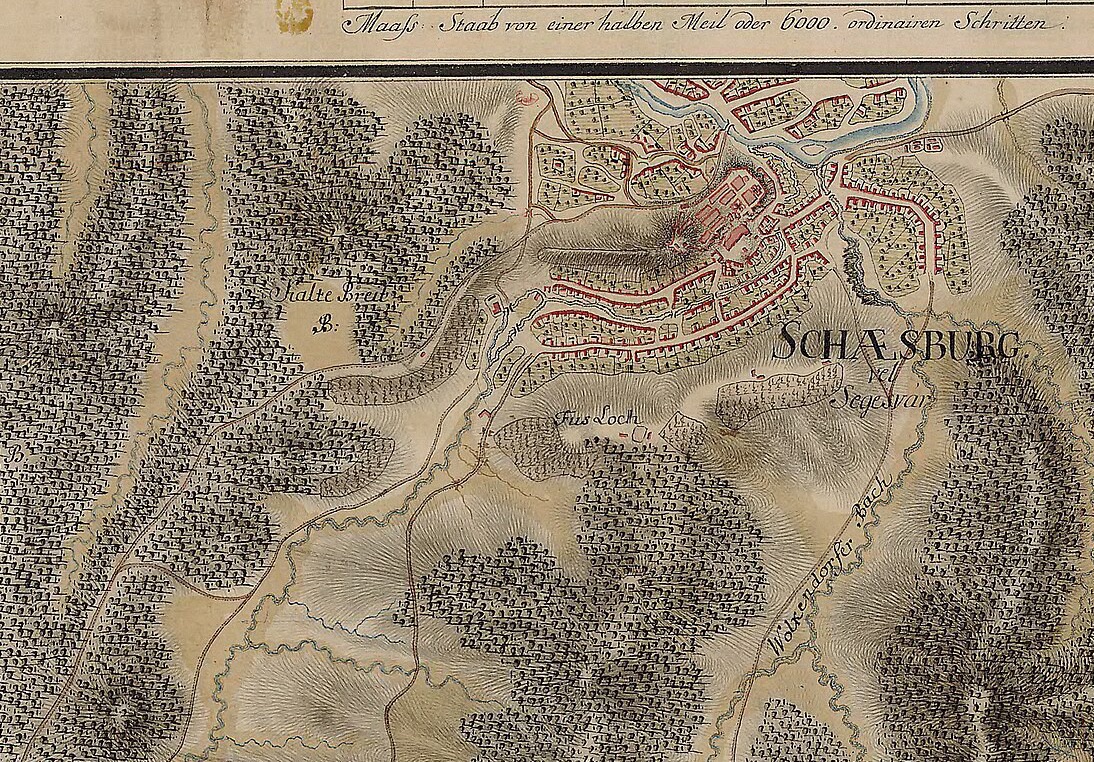
Schäßburg vel Segesvar on the Josephinian Land Survey of Transylvania
The citadel hill with its walled upper town is drawn in red above the lower streets and the Târnava crossing, surveyed road by road for Joseph II between 1769 and 1773.
1769 · Josephinian Land Survey · Wikimedia Commons
Public domain (plate dated 1769)
More cities to explore
 RomaniaBrașovExplore it in 1500 · 1900
 NetherlandsUtrechtExplore it in 1400 · 1700
 EnglandLondonExplore it in AD 200 · 1390 · 1600 · 1885
 FranceParisExplore it in 1250 · 1670 · 1789 · 1889
Castles of Europe · Landmarks of Europe · create your own reconstruction.