Historic Cities · England
Canterbury through the ages
Canterbury is a city and UNESCO World Heritage Site in the Canterbury district, county of Kent, England; it was a county borough until 1974. Lying on the River Stour not far from its mouth on the Strait of Dover, the city has a mild oceanic climate.

Canterbury in AD 200
Roman Durovernum
Durovernum Cantiacorum is the civitas capital of the Cantiaci, a compact, prosperous Roman market and administrative town on the Stour at the convergence of roads to the Channel ports. The walk passes the theatre and temple precinct, the forum and public baths, gravelled shopping streets and timber-fronted workshops, tile and pottery yards, mills on the river and the town walls being raised in flint and tile.
A low, compact skyline of timber fronts, tile roofs and the semicircular mass of a stone theatre rises beside the wide ribbon of the River Stour. Streets are gravelled, flanked by one-storey wooden shops and occasional stone houses with mosaic thresholds. Smoke and kiln-ash hang above pottery yards; flint and tile foundations and newly raised stretches of wall punctuate the perimeter, while carts and donkeys move along the main Roman road, Watling Street.
The route: 24 streets, squares and views
Watling Street Approach → Stour Crossing → West Gate → Stour Quay → Mill on the Stour → Gravelled Main Street → Forum and Basilica → Temple Precinct → Great Theatre → Public Baths → …
Step inside, 13 interiors
Roadside Taberna Interior · Watermill Wheel Pit · Basilica Central Hall · Temple Cella Inner Chamber · Vaulted Theatre Passages · Heated Caldarium Chamber · Apodyterium Changing Room · Potter's Workshop and Kiln · Tile Kiln Stoking Room · Baker's Shop and Donkey Mill · Mosaic Atrium with Impluvium · Household Triclinium Dining Room · Bronzework Foundry Interior
Planned from the Wikipedia record: Durovernum Cantiacorum.
Canterbury in 1400
Chaucer's Canterbury
Canterbury in 1400 is England's chief pilgrim city, its cathedral precinct dominated by a newly rising nave while hostelries and badge-sellers swell the streets. The walk shows the city from the Stour approach, through its rebuilt walls and bustling markets, past St Augustine's Abbey, and up to a high viewpoint that takes in the cathedral and the river.
Stone and timber sit close across narrow medieval streets: the cathedral's pale Caen and Kentish stone rises above red-tiled roofs and dark oak-framed houses. The River Stour threads the town with timber quays and small boats; the city wall and its newly rebuilt towers punctuate the skyline. Markets cluster on the High Street and Buttermarket, while masons' scaffolds mark Yevele's soaring new nave at the cathedral.
The route: 21 streets, squares and views
Watling Street Approach → Westgate Towers → Stour at Westgate → Burgate → The Buttermarket → Mercery Lane → St George's Street → King's School Close → Cathedral West Front → Yevele's New Nave → …
Step inside, 12 interiors
Westgate Guard Chamber · Covered Market Hall · Pilgrims' Dormitory · School Hall · Cathedral Crypt · Great Nave Vault · Parish Nave · Trinity Shrine Chamber · Abbey Refectory · Abbey Chapter House · Castle Great Hall · Riverside Warehouse
Planned from the Wikipedia record: Canterbury.
Its story
The story of Canterbury.
The Walled Town on Watling Street, Roman to Norman
Canterbury is first recorded as the main settlement of the Cantiaci, the Celtic people who held most of modern Kent. Roman forces captured it in the 1st century AD and rebuilt it as Durovernum Cantiacorum, with new streets on a grid, a theatre, a temple, a forum and public baths. No major military garrison was kept there, but its position on Watling Street relative to the Kentish ports of Rutupiae (Richborough), Dubrae (Dover) and Lemanae (Lymne) gave it considerable strategic importance. In the late 3rd century, to defend against barbarian attack, an earth bank and a wall with seven gates were thrown around 130 acres of it.
Although counted as one of the 28 cities of sub-Roman Britain, Durovernum appears to have been abandoned for around a hundred years after the Romans left in 410, holding only a few farmers and gradually decaying. Over the century that followed an Anglo-Saxon community formed inside the Roman walls as Jutish refugees arrived, possibly intermarrying with the people already there, and trades grew up in pottery, textiles and leather. Gold coins were being struck at a Canterbury mint by 630. Danish raids in 842 and 851 caused great loss of life.
In 1011 a large Viking army besieged the city and pillaged it. Remembering that destruction, the inhabitants did not resist William the Conqueror's invasion in 1066, and William immediately ordered a wooden motte-and-bailey castle raised against the Roman wall; it was rebuilt in stone in the early 12th century. Canterbury Castle was captured by Prince Louis of France during his invasion of 1215, before the death of King John cost him his English supporters, who went over to the young Henry III.
Augustine's See and the King's School, from 597
In 597 Pope Gregory the Great sent Augustine to convert King Aethelberht of Kent to Christianity. After the conversion Augustine chose Canterbury, a Roman town, as the centre of his episcopal see in Kent, and an abbey and a cathedral were built; he became the first Archbishop of Canterbury. The Synod of Hertford in 672 gave the see authority over the entire English Church. In 978 Archbishop Dunstan refounded the abbey Augustine had built and named it St Augustine's Abbey. A school is held to have been established by Augustine shortly after his arrival, though the documented history of what is now the King's School begins only after the dissolution of the monasteries, when it took its present name in honour of Henry VIII.
Becket's Shrine and the Pilgrim Town, 1170-1448
Archbishop Thomas Becket was murdered in the cathedral in 1170, and pilgrims from all parts of Christendom came to visit his shrine. That pilgrimage supplied the framework for Geoffrey Chaucer's 14th-century collection of stories, The Canterbury Tales.
The Black Death reached Canterbury in 1348. The city's population then stood at 10,000, the tenth largest in England; by the early 16th century it had fallen to 3,000. In 1363, during the Hundred Years' War, a Commission of Inquiry found that disrepair, stone-robbing and the filling-in of ditches had eroded the Roman wall, and between 1378 and 1402 the wall was virtually rebuilt with new towers added.
During Wat Tyler's Peasants' Revolt in 1381 the castle and the Archbishop's Palace were sacked, and Archbishop Sudbury was beheaded in London. In 1413 Henry IV became the only sovereign buried at the cathedral. In 1448 Canterbury was granted a city charter giving it a mayor and a high sheriff; the city still has a Lord Mayor and a Sheriff.
The Shrine Broken, 1504-1538
The cathedral's main tower, Bell Harry, was completed in 1504, ending four hundred years of building. During the Dissolution of the Monasteries the city's priory, its nunnery and its three friaries were closed. St Augustine's Abbey, at the time the fourteenth richest in England, was surrendered to the Crown; its church and cloister were levelled and the rest dismantled over the next fifteen years, although part of the site was converted to a palace. In 1538 Henry VIII had Becket's shrine demolished and its gold, silver and jewels removed to the Tower of London. Becket's images, name and feasts were obliterated throughout the kingdom, and the pilgrimages ended.
Strangers, Silk and the Christmas Riots, 1548-1648
In the mid-16th century many Huguenots, facing persecution and conflict in the Low Countries, fled and resettled in Reformed regions such as England, and Canterbury hosted the first congregation of so-called 'refugee strangers' in the country. That first Huguenot church was founded around 1548, in part by Jan Utenhove, who had relocated from Strasbourg, alongside Valerand Poullain and Francois de la Riviere; when Utenhove travelled to London in 1549, de la Riviere remained to lead the congregation. With the accession of Mary I the Huguenot residents were compelled to flee in 1553-4, going with the English Marian exiles to Emden, Wesel, Zurich, Strasbourg and Frankfurt, and later to Basel, Geneva and Aarau.
After Elizabeth I's accession a small number returned to London, Utenhove among them in 1559. Huguenots in London were sent to Sandwich in 1561, a settlement that grew rapidly as refugees arrived from Artois and Flanders, and in June 1575 it relocated almost entirely to Canterbury, which had gained a small Huguenot population the previous year; others came from the temporary settlements at Rye and Winchelsea. The refugees were granted use of the church of St Alphege in 1575 but from the following year worshipped in the crypt of the cathedral, and the Church of the Crypt became the nucleus of the community. By the 17th century French-speaking Huguenots made up two-fifths of Canterbury's population. They introduced silk weaving to the city, and by 1676 it had outstripped the weaving of wool.
In 1620 Robert Cushman negotiated the lease of the Mayflower at 59 Palace Street, for the purpose of transporting the Pilgrims to America. In 1647 the city's puritan mayor banned church services on Christmas Day and riots broke out, remembered as the Plum Pudding Riots. The rioters' trial the following year led to a Kent revolt against Parliamentarian forces, contributing to the start of the second phase of the Civil War; Canterbury itself surrendered peacefully to the Parliamentarians at the Battle of Maidstone.
Silk Supplanted, Hops and the Crab and Winkle Line, 1770-1900
By 1770 the castle had fallen into disrepair, and many parts of it were demolished during the late 18th and early 19th centuries. In 1787 every gate in the city wall except the Westgate, which served as the city jail, was pulled down after a commission found them an impediment to new coach travel. Canterbury Prison opened just outside the city boundary in 1808. By 1820 imported Indian muslins had supplanted the city's silk weaving, and its trade was thereafter largely in hops and wheat.
The Canterbury & Whitstable Railway, known locally as the Crab and Winkle line, ran from 3 May 1830 and was the first regular passenger steam railway in the world. Bankrupt by 1844, it was bought by the South Eastern Railway, which connected the city to its larger network in 1846. The London, Chatham & Dover Railway arrived in 1860, and the competition and cost-cutting between the two lines was resolved by merging them as the South Eastern & Chatham in 1899; because rival companies had built them, there is still no direct interchange between Canterbury West and Canterbury East stations. Between 1830 and 1900 the city's population grew from 15,000 to 24,000.
Bombed in 1942, Rebuilt as a University City
Barracks and voluntary hospitals were set up around the city during the First World War. In the Second, 135 separate raids dropped 10,445 bombs on Canterbury, destroying 731 homes and 296 other buildings, among them Simon Langton Girls' Grammar School and the missionary college that had been installed in St Augustine's Abbey in 1848 for the Church of England's representatives in the British colonies. 119 civilians died through enemy action in the borough. The most devastating raid came on 1 June 1942, during the Baedeker Blitz.
Before the end of the war the architect Charles Holden drew up plans to redevelop the city centre. Opposition among residents was strong enough to produce the Citizens' Defence Association, which swept to power in the 1945 municipal elections, and rebuilding of the centre eventually began ten years after the war. A ring road was constructed in stages outside the walls, and the centre was later pedestrianised. The Whitefriars Shopping Centre was redeveloped between 1999 and 2005, and in 2000 the Canterbury Archaeological Trust carried out a major excavation there known as the Big Dig.
The biggest expansion of the city came in the 1960s with the arrival of the University of Kent and Christ Church College, founded in 1962 as a Church of England teacher training college and made a university in 2005. The 2021 census recorded 55,087 inhabitants, including one of the highest student-to-permanent-resident ratios in Britain; tourism, higher education and retail are the three primary sectors, tourism alone worth over £450 million and drawing 7.2 million visitors in 2015. The cathedral, the ruins of St Augustine's Abbey and Saxon St Martin's Church together form a UNESCO World Heritage Site. A 2023 report by the Poverty Working Group of the Canterbury Sustainable Development Goals Forum set out evidence of increasing poverty in the city, using life expectancy figures, the number of meals provided by food banks, and interviews with those working to help people in poverty.
From the archive
Canterbury on paper: the old town as it was mapped.
A period plan or bird's-eye view of the old town, drawn between 1500 and 1850, the streets this page's reconstructions walk. Public domain, with its source named.
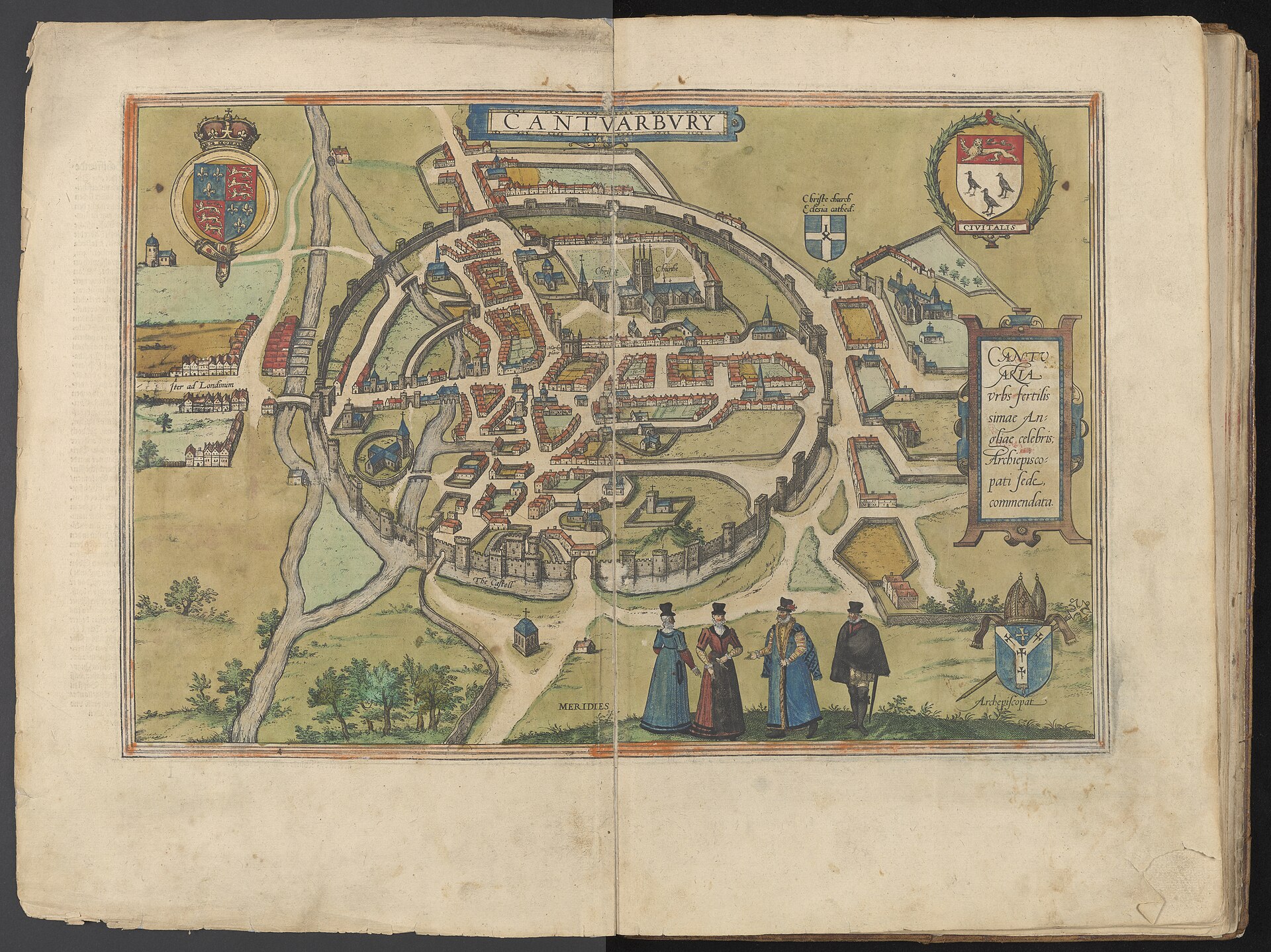
Bird's-eye view of Canterbury, from Braun & Hogenberg's Civitates Orbis Terrarum
Shows Canterbury’s circuit of medieval city walls with gates, the cathedral with twin towers, the castle and river channels.
1590 · Georg Braun · Wikimedia Commons
Public domain (plate dated 1590)


Castles of Canterbury


More cities to explore
 EnglandLondonExplore it in AD 200 · 1390 · 1600 · 1885
 EnglandDunwichExplore it in 1280
 EnglandYorkExplore it in AD 300 · AD 950 · 1420 · 1800
 EnglandBathExplore it in AD 100 · 1500 · 1790
Castles of Europe · Landmarks of Europe · create your own reconstruction.