Historic Cities · Czechia
Český Krumlov through the ages
Český Krumlov is a town in the South Bohemian Region of the Czech Republic. It has about 13,000 inhabitants. The town is located on the Vltava River in the Bohemian Forest Foothills.

Český Krumlov in 1600
Rosenberg Krumlov
This is Krumlov at the height of the last Rosenberg court, a compact riverside town threaded by the Vltava and crowned by the Renaissance-updated castle. The walk shows the castle’s painted round tower, Saint Vitus’ spire above tight red-tiled roofs, timber rafts and waterfront breweries in Latrán, and the scratched false-stone façades of the burgher streets.
A tight horseshoe of red tile roofs and pale plaster walls crowded into a Vltava meander, the town dominated by the castle on its rocky promontory and Saint Vitus’s late Gothic spire. Buildings display Renaissance sgraffito and cheap false stonework, timber frames and steep clay tiles; narrow cobbled lanes drop to wooden quays where rafts and small cargo boats tie up, and smoke from brewhouses and bakeries hangs low in cool Bohemian light.
The route: 22 streets, squares and views
Vyšný vrch Approach → Horní brána Gate → Náměstí Svornosti → Town Hall Façade → Vnitřní Město Lane → Lazebnický Most → Old Town Quay → Latrán Brewery → Latrán Square → Church of Saint Vitus → …
Step inside, 13 interiors
Town Council Chamber · Mash House of Latrán · Latrán Brewery Cellar · Saint Vitus Nave · Round Tower Observatory · Renaissance Audience Chamber · Castle Music Salon · Alchemist's Furnace Chamber · Merchant Counting Room · Raftmen's Boathouse · Mill Wheel Chamber · Cooper's Barrel Workshop · Monastery Scriptorium
Planned from the Wikipedia record: Český Krumlov.
Český Krumlov in 1780
Schwarzenberg Krumlov
A princely Baroque residence set within a compact medieval town, governed from the castle high on the Vltava bend by the Schwarzenbergs. The walk shows the castle's layered bridges and gardens, the intact Baroque theatre and Masquerade Hall, bears in the moat, rafts and cargo moving on the river, and the arcaded market streets below.
The castle crowns a steep rocky headland above a tight Vltava meander; red-tiled town roofs and timber-framed houses press up the slope toward stone fortifications. Baroque additions (stuccoed façades, painted theatre wings, a five-storey cloaked bridge of brick and plaster) stand beside medieval towers, arcaded market fronts and narrow cobbled streets. The riverfront is busy with rafts, poles and bundled timber, the palette of plaster, dark timber, brick and river-borne brown-green water.
The route: 23 streets, squares and views
Vyšný vrch Viewpoint → Vltava Meander → Horní Brána Gate → Latrán Street → Raftsmen Quay, Latrán → Svornosti Square Arcades → Latrán Riverside Stairs → Lower Castle Courtyard → Stone Fountain → Bear Moat → …
Step inside, 11 interiors
Arcaded Market Hall · Burgrave's Great Hall · Bear-Keeper's Chamber · Cloak Bridge Passage · Mirrored Corridor · Baroque Audience Auditorium · Stage with Wings and Windlasses · Masquerade Ball Hall · Timber Warehouse Loft · Raftsmen's Inn Common Room · Meat Market Hall
Planned from the Wikipedia record: Český Krumlov Castle.
Its story
The story of Český Krumlov.
The Vitkovci Castle and the Two Towns, c. 1250-1334
The name comes from the Middle High German Krumme Aue, crooked meadow, and describes the position: the town sits inside a tight bend of the Vltava. The qualifier Český (Bohemian) was attached in the 15th century to distinguish the place from Moravský Krumlov in southern Moravia. The area had been permanently settled for a very long time (the oldest traces are dated to the Older Stone Age, with dense settlement proven in the Bronze Age around 1500 BC, Celtic settlement in the Younger Iron Age around 400 BC and the first Slavic settlement in the 6th century AD), and in the Early Middle Ages trade routes ran through the territory along the river. The castle was founded shortly before 1250 by a local branch of the Vitkovci, descendants of Witiko of Prčice, and the first written mention of the place is a deed of 1253, where it appears as Chrumbenowe.
The town grew in two stages. Latrán formed first and without a plan, immediately below the castle, and was settled mostly by people with some administrative connection to it; a second, deliberately founded settlement, the Old Town, was laid out afterwards inside the river meander. Czechs and Germans were both present from the foundation, and a Jewish community is documented from 1334.
The Rosenberg Seat, 1302-1602
The Vitkovci line of Krumlov died out in 1302. King Wenceslaus II took the estate and castle by escheat and ceded them to the Rosenbergs, who in time made Krumlov their principal residence and the chief administrative centre of their dominion. Peter I of Rosenberg, Lord Chamberlain to King John of Bohemia, had the upper castle built in the early 14th century and founded the church of St Jošt in Latrán around 1330; the parish church of St Vitus went up in 1407–1439 on the foundations of an older church of 1309. The estates prospered most in the 15th century under Oldřich II of Rosenberg, when the territory attached to Krumlov was considerably enlarged. The lords pushed trade and craft work inside the town walls, and the family's five-petalled rose is still carved and painted across the houses of the inner town and Latrán.
William of Rosenberg joined Latrán and the Old Town in 1555, ending the separation of the two settlements, had the castle rebuilt in Renaissance form in the later 16th century, and ordered the Jesuit college in Horní street built in 1586–1588. The town hall on Náměstí Svornosti dates from 1597, made by merging three Gothic houses behind a single Renaissance front. His brother Peter Vok, the last of the line, paid for the Budějovická gate of 1598–1602, the work of Domenico Benedetto Cometta of Eckthurn and the only gate of the medieval circuit still standing. Bears first appeared at Krumlov in the 16th century, kept by the Rosenbergs to advertise a claimed kinship with the Roman Orsini family, whose name puns on orso, bear; their keeping in the castle moat is documented from after 1700 and has continued, with interruptions, since.
Gold, German Miners and the Language of the Sermon
Gold was found next to the town in the late 15th century and German miners came to settle, shifting an already mixed population further. German came to predominate as mining grew, though sermons were still preached in Czech in one of the churches until the 1780s, when the church of St Jošt was closed under the Josephine reforms, in 1787 or 1788 by differing accounts. That church had been rebuilt in 1594–1599 and handed to Krumlov's Protestants under the dedication of the Holy Trinity, rededicated to St Jošt around 1615, and run by the Jesuits until 1773. By the 19th century, of some 8,300 inhabitants, 72 per cent spoke German and 18 per cent Czech.
Sold to the Habsburgs: Eggenberg and Schwarzenberg Dukes, 1602-1918
In 1602 Peter Vok sold Krumlov to Emperor Rudolf II, who gave it to his illegitimate son Julius d'Austria. After the Bohemian Revolt and the Battle of White Mountain in 1620, Emperor Ferdinand II granted the town to the Eggenberg family and it became the seat of the Duchy of Krumlov. Johann Christian I of Eggenberg had the castle's Baroque theatre built in 1680–1682; its scenery, props and stage machinery survive and its equipment is protected as a national cultural monument. The plague column on Náměstí Svornosti, carved in 1716 by Matěj Václav Jäckel, was paid for by Duchess Marie Ernestine of Eggenberg.
From 1719 to 1947 the castle belonged to the Schwarzenbergs. Joseph I Adam of Schwarzenberg built the multi-storey Cloak Bridge in 1764 and re-equipped the theatre with up-to-date stage machinery in 1765–1766. Brewing had been carried on in the town since 1560. In the 19th century industry and modern transport arrived and most of the town fortifications were pulled down; Jan Adolf II of Schwarzenberg (1799–1888) is credited with driving the modernisation of the South Bohemian economy. Krumlov remained the administrative head of the duchy and of the Schwarzenberg dominion until 1918.
Krumau and Krumlov, 1910-1947
The census of 1910 counted 8,662 inhabitants, of whom 7,367–85 per cent, were German and 1,295 Czech. After the First World War the town was placed in the Bohemian Forest Region of the new Czechoslovakia, but German-Austrian deputies declared the region part of German-Austria; the Treaty of Saint-Germain-en-Laye recognised the area as Czechoslovak in 1919. The Czech form of the name was made official only by a decree of the Ministry of the Interior of 30 April 1920.
Under the Munich Agreement the town was annexed by Nazi Germany in 1938 as part of the Sudetenland, within the Reichsgau Oberdonau, and from 1938 to 1945 was officially called Krummau an der Moldau. Most of the Czech population had to leave the town that year. The synagogue on Plešivec, built in 1908 and described as the first reinforced-concrete structure in Austria-Hungary, was closed in 1938; a Jewish community had been documented in Krumlov since 1334. Ruth Hálová, born in the town in 1926 and later a microbiologist and translator, was one of the Jewish children brought out by Nicholas Winton. Adolf Schwarzenberg (1890–1950), head of the Krumlov and Hluboká branch of the family, was an anti-fascist.
After the Second World War the town's long-standing German majority was expelled and Krumlov was returned to Czechoslovakia. The great majority of German inhabitants left after 1945, closing some seven centuries of Czech and German life side by side in the town, at times violent and at times peaceable. The castle passed out of Schwarzenberg hands in 1947.
Disrepair, UNESCO Listing and the Tourist Economy since 1963
The historic town fell into disrepair during the Communist period, although the medieval centre was made an urban monument reservation in 1963. Since the Velvet Revolution of 1989 much of it has been restored, and in 1992 the centre together with the castle complex was inscribed as a UNESCO World Heritage Site, among the first in the country; the Plešivec suburb was declared a separate urban conservation zone in 2003. The floods of August 2002 damaged the town.
The economic changes after 1989 closed works such as the OTAVAN clothing factory, and a new industrial zone was laid out at Domoradice in the 1990s, but tourism now underpins the local economy, with an above-average number of hotels and restaurants for a town of this size. The Eggenberg brewery, brewing since 1560, closed in 2014, and a small brewery has worked in the former premises since 2016. The painter Egon Schiele, who lived here, is commemorated in the Egon Schiele Art Centrum. About 13,000 people live in Český Krumlov today; it is the seat of a district of 45 municipalities and a municipality with extended powers.
From the archive
Český Krumlov on paper: the old town as it was mapped.
A period plan or bird's-eye view of the old town, drawn between 1500 and 1850, the streets this page's reconstructions walk. Public domain, with its source named.
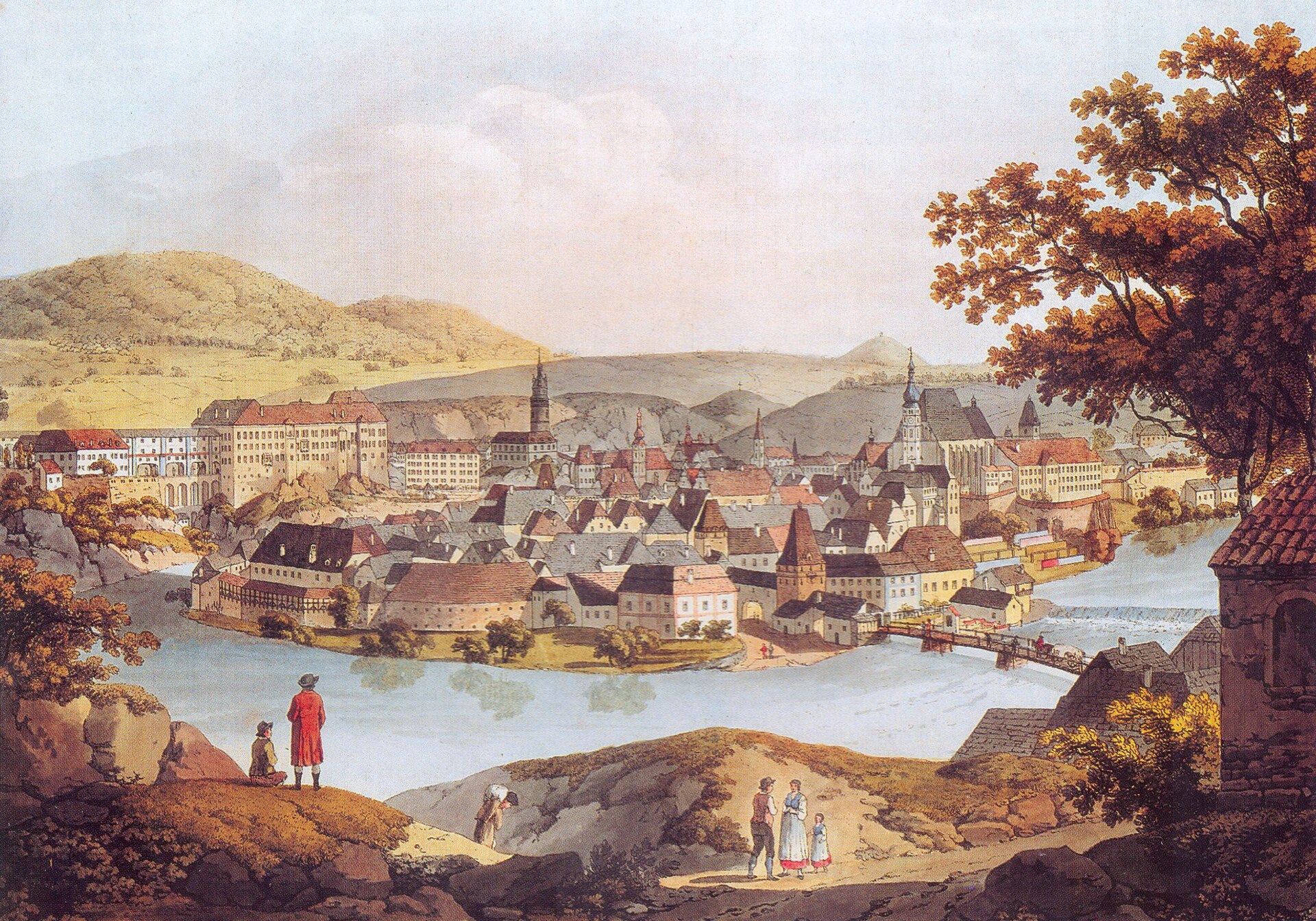
Český Krumlov from the south, by Karel Postl
The Vltava's horseshoe bend wraps the old town, the castle and its Round Tower rising on the left, St Vitus's spire over the roofs and the mill weir and timber bridge below.
1810 · Karel Postl · Wikimedia Commons
Public domain (plate dated 1810)
More cities to explore
 CzechiaPragueExplore it in 1370 · 1600 · 1890
 CzechiaKutná HoraExplore it in 1495
 NetherlandsUtrechtExplore it in 1400 · 1700
 EnglandLondonExplore it in AD 200 · 1390 · 1600 · 1885
Castles of Europe · Landmarks of Europe · create your own reconstruction.