Historic Cities · Czechia
Kutná Hora through the ages
Kutná Hora is a town in the Central Bohemian Region of the Czech Republic. It has about 22,000 inhabitants. The history of Kutná Hora is linked to silver mining, which made it a rich and rapidly developing town.

Kutná Hora in 1495
Royal Silver Town
Kutná Hora in 1495 stands at the height of its medieval silver economy: mines, mint and masons push the town's wealth into stone and coin. The walk shows scaffolded building sites and rooflines, busy market streets with ore‑laden carts, the mint courts and the abbey fields beyond the town.
A compact medieval town of dark limestone and honeyed sandstone roofs rises from a wooded ridge above the Vrchlice stream. Pointed Gothic towers and scaffolded vaults puncture the skyline; timber roofs, plastered gables and carved stone facades line narrow winding streets. Dust and smoke from smelters hang low over the market, while white‑hooded miners and wagon teams animate the lanes and quarry slopes.
The route: 15 streets, squares and views
View from Kaňk Hill → Vlašský dvůr Gate → Upper Market (Horní náměstí) → Dodecagon Fountain (Rejsek's Fountain) → Stone House (Kamenný dům) → Church of Saint James → Vlašský dvůr Mint Towers → St Barbara's Scaffolded Choir → Barbora Spur Approach → Hrádek Above Vrchlice → …
Step inside, 9 interiors
Royal Audience Hall · Upper Market Butchers' Bay · Merchant's Great Hall · Italian Court Minting Chamber · St Barbara Rising Vaults · Kaňk Smelter Casting Shed · Horse‑Whim Drive House · Osel Mine Gallery · Sedlec Abbey Choir
Planned from the Wikipedia record: Kutná Hora.
Its story
The story of Kutná Hora.
Ore, the Abbey and the Silver Rush, to 1300
Ore was being worked here long before there was a town. At the Celtic site between Libenice and Kaňk, excavation in 1981 turned up a smelting furnace of the second or first century BC holding ten kilograms of slag, with traces of pyrrhotine, chalcopyrite, sphalerite and copper, evidence of early underground working in the Kaňk hill. Silver dinars struck between 985 and 995 have been found at Malín, now part of the town. In 1142 Miroslav of Cimburk, a courtier of Duke Vladislav II, founded Sedlec Abbey, the first Cistercian house in Bohemia, settling it with monks from Waldsassen in Bavaria: a house of an order line that concerned itself with mining, which may explain why, against usual Cistercian practice, this one was planted in country already settled and farmed. The abbey owned the ground on which the later town grew.
Silver found near Sedlec solved the abbey's financial troubles and drew settlers, many from nearby German-speaking regions. Mining began in 1260; around the same date Čáslav and Kolín were granted the Jihlava mining law, apparently because burghers in the district were already digging for silver, and a settlement called Antiqua Cuthna appears shortly after. A silver rush followed early in the reign of Wenceslaus II: several thousand people moved in for the work, and the mining settlement that grew on the hill above the Vrchlice valley was laid out so irregularly that the pattern is still legible. The first mention of the place under its Latin name, Mons Cuthna, is from 1289, when Kolín and Čáslav were still disputing jurisdiction over it; from 1291 it had its own court and a royal mining office. By the end of the thirteenth century the district was producing roughly a third of Europe's silver.
Ius Regale Montanorum and the Prague Groschen, 1300–1409
In 1300 King Wenceslaus II issued a new royal mining code, the Ius regale montanorum, which set out the administrative and technical terms on which mines were to be run, asserted the crown's rights over silver and coinage, introduced a single currency and concentrated its striking at Kutná Hora. The mint was run under Italian specialists from Florence, which is how the building came to be called the Vlašský dvůr, the Italian Court, and the Prague groschen was struck there from 1300. The town was besieged by the army of Albert I in 1304 and again in 1307 and held out both times behind hastily raised defences; in 1318 it was raised to the status of a town with privileges. The yield of the mines, above all the Osel shaft, underwrote royal power in Bohemia and paid for the building schemes of the Luxembourgs through the fourteenth century. Kutná Hora became the second town of the Kingdom of Bohemia after Prague and its main financial centre.
The town's churches fell under the administration of Sedlec Abbey, which sat outside it, so in 1384 a miners' brotherhood was formed to raise a mining church of its own, St Barbara's, on land of the Vyšehrad chapter beyond the town wall. It was intended to answer both the cathedral at Sedlec and St Vitus in Prague; Peter Parler drew the design and Johann Parler carried it on. Wenceslaus IV kept the Italian Court as a residence and had it enlarged, and there on 18 January 1409 he signed the Decree of Kutná Hora, giving the Czech nation at Prague University three votes in faculty elections against one for the three other nations combined. Seven years earlier, in December 1402, Sigismund had taken the town by force after imprisoning Wenceslaus IV; the residents defended it hard, and after several bloody skirmishes the defenders were marched to Kolín to kneel in submission.
The Shafts, the Chalice and Žižka's Fire, 1413–1485
In 1413 miners attacked Malín and killed inhabitants who had obstructed their digging, and in 1416 they murdered a royal envoy; national and religious quarrels broke out in the town. In 1419 the town began persecuting Utraquists and had many of them thrown into abandoned shafts. It supported Sigismund in 1420, who used it as the base for his unsuccessful attack on the Taborites, but when Jan Žižka sacked Sedlec Abbey in 1421 the town submitted to Jan Želivský on terms requiring opponents of the chalice to leave. Part of the German population was expelled in 1422–24 and two large fires struck; Sigismund set one himself as he withdrew in 1422, and the burghers put it out. In 1424 Žižka burned the town thoroughly, and Taborites resettled and governed it until the Battle of Lipany in 1434.
The coinage collapsed with the town. Only poor hellers were struck, and trade in Bohemia shifted to the Meissen groschen. In 1436 Sigismund negotiated a settlement between the new owners of property and the old, together with a religious peace. Silver mining was restored in 1469, and a further religious peace was concluded at Kutná Hora in 1485.
The Diet of 1471 and the Miners' Revolt of 1496
George of Poděbrady was elected hetman in the Italian Court in 1444 and marched from it to take Prague in 1448; he did much to rebuild the Court, gathered an army there against Matthias Corvinus and in 1469 forced him to negotiate. After George's death his widow, Johana of Rožmitál, summoned the diet to the royal audience hall of the Italian Court, where it sat from 20 to 28 May 1471. Respected by both the Catholic and Utraquist sides, she carried George's will through, and on 27 May Vladislaus Jagiellon was elected King of Bohemia there, a decision taken with a Hungarian army threatening the country.
Better technique raised the yield of the mines again to its peak, and the building and printing followed: in 1489 Martin of Tišnov printed the richly illustrated Kutná Hora Bible. From that year Italian bishops resided in the town to ordain Utraquist priests, provincial diets met there, and it rivalled Prague in importance. In mid-July 1496 the miners rose across the town and its district over pay and living conditions. With King Vladislaus out of the country, the revolt was put down on the order of the Poděbrady hetman Oněk Kamenický of Tepice, and in August thirteen of the miners' leaders were beheaded, ten at Poděbrady and three at Křivoklát. Fragmentary accounts say the king reviewed the proceedings in 1497 and punished those responsible for the executions.
Flooded Shafts and the Closing of the Mint, 1530–1727
Mining was cut back in the 1530s as the deepest shafts filled with water and the ore grew poorer, and the most important mining zone was closed in 1543. Striking of the Prague groschen ended in the middle of the century (in 1547 by one account, 1550 by another), and decline set in quickly, hastened by silver arriving from South America and pushing the price down. After the estates' resistance of 1547 the town lost part of its liberties. Conditions in sixteenth-century Kutná Hora are recorded in the anecdotal memoirs of Mikuláš Dačický, who lived from 1555 to 1610. The town's mayor Jan Šultys of Felsdorf, formerly a mint official, served as a director in the estates' revolt, was executed in Prague in 1621, and his head hung on the town gate for more than a hundred years.
Religious freedom was curtailed after the Battle of White Mountain. Non-Catholic clergy were expelled in 1623, and plague in 1625 together with exile cut the population by a quarter. Ferdinand II confiscated part of the town's estates and gave them to the Jesuits, who were invited in 1626, founded a Latin school and built a great college beside St Barbara's, where Bohuslav Balbín, Jiří Plachý-Ferus and the town's historian Jan Kořínek taught. The Thirty Years' War brought further difficulty, and two major raids by the Swedish army in 1639 and 1643 caused heavy damage and a fall in population. Recovery came at the end of the 1650s through crafts and through the Jesuit schools. Attempts early in the eighteenth century to open new silver mines found the veins too thin to pay; the mint was closed in 1727 and Kutná Hora ceased to be a mining town.
Tobacco, Rails and the Deportations, 1812–1945
Great fires damaged the town in 1770 and again in 1823, and by the early nineteenth century it was still among the larger towns of the Czech lands but was losing weight. What replaced silver was manufacturing. A tobacco factory was founded in 1812 in the buildings of the former Cistercian monastery at Sedlec and began making cigarettes in 1882; it has been owned by Philip Morris ČR since 1992 and employs more than 800 people. The brewery founded by the Dačický of Heslov family, documented from 1538, closed in 2010. The railway from Kolín to Havlíčkův Brod opened in 1869 and the branch to Zruč nad Sázavou in 1905. Until 1918 the town was the seat of one of the ninety-four district authorities of Bohemia under Austria-Hungary, and it passed with the rest of Bohemia into Czechoslovakia after the collapse of the empire.
The town had a part in the Czech national revival: the archaeologist Jan Erazim Vocel and the playwright Josef Kajetán Tyl were born there, Karel Havlíček Borovský lived and worked there in 1850–51, and many national societies were founded. Its Gothic buildings were restored at the end of the nineteenth century, St Barbara's being completed by Josef Mocker between 1884 and 1893. The 1921 census counted 14,370 people in 1,169 houses, among them 188 Jews and 98 residents declaring German nationality; the 1930 census counted 13,892 people, of whom 140 were Jews. Kutná Hora had a Jewish community. Between 1939 and 1945, during the occupation of Czechoslovakia by Nazi Germany, it was dissolved by mass deportations, many of them through the Theresienstadt Ghetto, and it never recovered.
Zinc at Kaňk, UNESCO and Foxconn, 1950–2023
Kaňk, Perštejnec and Sedlec were joined to the town in 1950. Silver had been exhausted by the turn of the seventeenth and eighteenth centuries, but zinc and lead ores were still worked at Kaňk until 1991. A ČKD engineering works and foundry opened in 1967, and the largest employer headquartered in the town is now Foxconn Technology CZ, with more than 1,500 staff. The historic centre has been protected as an urban monument reservation since 1961 (at 61 hectares the fourth largest in the country), and in 1995 the centre together with Sedlec Abbey and the Sedlec Ossuary was inscribed on the UNESCO World Heritage List. About 22,000 people live in the town; in 2023 the Sedlec monuments drew 290,000 visitors and St Barbara's 250,000.
From the archive
Kutná Hora on paper: the old town as it was mapped.
A period plan or bird's-eye view of the old town, drawn between 1500 and 1850, the streets this page's reconstructions walk. Public domain, with its source named.
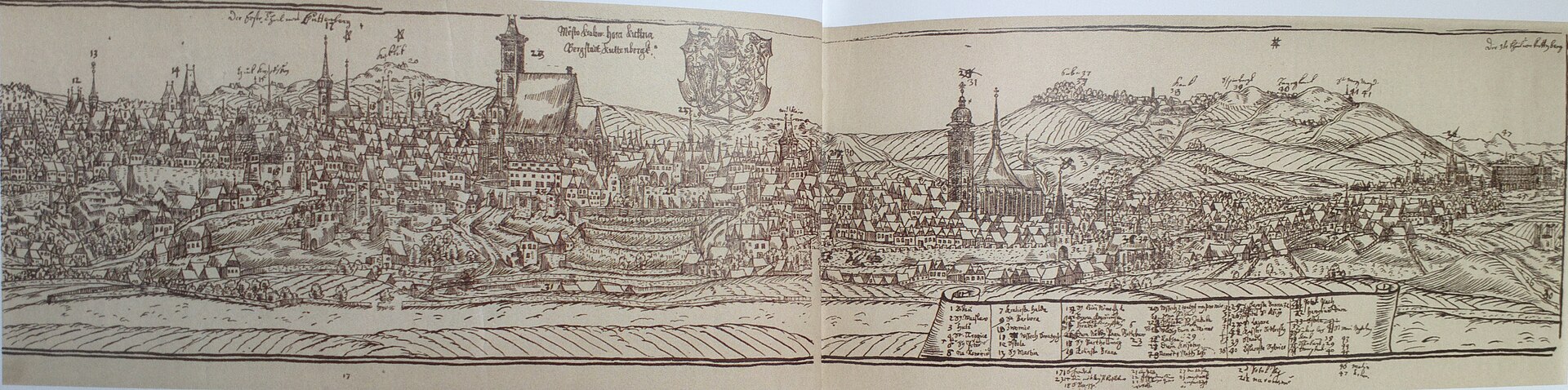
Bird's-eye view of Kutná Hora, by Johann Willenberger (1602)
Panoramic view showing the river in front, dense medieval roofscape and the large churches of St Barbara and St James rising among multiple spires.
1602 · Johann Willenberger · Wikimedia Commons
Public domain (plate dated 1602)

More cities to explore
 CzechiaPragueExplore it in 1370 · 1600 · 1890
 CzechiaČeský KrumlovExplore it in 1600 · 1780
 NetherlandsUtrechtExplore it in 1400 · 1700
 EnglandLondonExplore it in AD 200 · 1390 · 1600 · 1885
Castles of Europe · Landmarks of Europe · create your own reconstruction.