Historic Cities · Czechia
Prague through the ages
Prague is the capital and largest city of the Czech Republic and the historical capital of Bohemia. Located on the Vltava River, the city has a population of about 1.4 million, making it the twelfth-largest city in the European Union. Its metropolitan area is home to approximately 2.3 million people.

Prague in 1370
Charles IV's Prague
Prague in 1370 is the imperial capital in the midst of Charles IV's building programme: a new stone bridge climbs across the Vltava, St. Vitus's choir rises at the Castle under Parler's workshop, and the vast New Town spreads with markets and colleges. The walk follows river, market and royal route from the city's approach across the water to the terraces of Hradčany, showing civic bustle, craftsmen at work and the skeletons of great Gothic projects.
The skyline is a scatter of steep red tile roofs, pointed Gothic gables and the rising silhouette of St. Vitus's choir above the castle hill; scaffolds and cranes stitch the air where masons set ashlar. Streets are a mix of narrow timber-front lanes and the wide paved markets of the New Town, the Vltava dark and full of boats, river mills turning. Walls and towers are pale sandstone and lime, shopfronts display cloth and pewter, and smoke from hearths hangs in cool river mist.
The route: 22 streets, squares and views
Prague from Vyšehrad → Vyšehrad Fortress → South Bank Quay → Stone Bridge Approach → Bridge Midspan → Old Town Bridge Tower → Lesser Town Bridge Tower → Malá Strana Quay → Bridge Midpoint View → Lesser Town Square → …
Step inside, 14 interiors
Vyšehrad Basilica Nave · Stone Pier Stonemasons' Bay · Old Town Gate Chamber · Lesser Town Gate Hall · Masons' Lodge on the Bridge · Meat Market Hall · Old Town Council Chamber · Nave of Týn Church · Carolinum Great Hall · Prayer Hall, Old New Synagogue · New Town Masons' Lodge · Chevet of St Vitus · Wenceslas Chapel · Castle Royal Hall
Planned from the Wikipedia record: History of Prague.
Prague in 1600
Rudolfine Prague
This is Prague at the height of Rudolf II's court: a capital turned centre of collectors, alchemists and astronomers, where the castle's new northern wing houses a vast Kunstkammer. The walk moves from a river approach through the Old Town and Jewish quarter, across the Stone Bridge to Malá Strana, and up the royal route to the castle terraces and Golden Lane.
The city reads as clustered spires and dark Gothic pinnacles above a river of barges and mill-wheels, roofs of red tile and lead flashing, narrow streets of timber and plaster, and heavy stone façades near the castle. Smoke and chimney-soot contrast with the pale limestone of cathedrals; the scale is compact, alleys crowded with market stalls, porters and horse traffic while the castle's northern wing and its Kunstkammer assert imperial presence above it all.
The route: 21 streets, squares and views
View from Vyšehrad → Powder Gate → Celetná Street → Old Town Square → Church before Týn → Maisel Synagogue → Old-New Synagogue → Old Jewish Cemetery → Old Town Bridge Tower → Stone Bridge → …
Step inside, 12 interiors
Powder Gate Guard Chamber · Celetná Apothecary Shop · Old Town Hall Council Chamber · Old-New Synagogue Prayer Hall · Rabbi Loew's Study · Kampa Mill Interior · Vladislav Hall Great Hall · Alchemist's Crucible Room · Imperial Kunstkammer Cabinet · Castle Menagerie Aviary · St. Vitus Cathedral Nave · Imperial Observatory Chamber
Planned from the Wikipedia record: Rudolf II, Holy Roman Emperor.
Prague in 1890
National Revival Prague
Prague in 1890 stands at the crest of the Czech National Revival, when new museums, theatres and civic monuments assert a modern Czech identity amid the old medieval fabric. The walk follows river embankments, tram-lined boulevards and cobbled lanes to cathedral terraces, the crowded astronomical clock and the gilded dome of the National Theatre, passing markets, workshops and newly fashionable Art Nouveau details.
The city silhouette is a tangle of church spires and red-tiled roofs punctured by the dark mass of Prague Castle and the pointed towers of St. Vitus; stone bridges and river embankments frame the Vltava. Streets are narrow, cobbled and lit by gas; horse trams clatter along wider boulevards. New civic buildings in pale stone and stucco rise beside Baroque and Gothic fronts, while gilded domes and the theatre's bright metalwork catch the light.
The route: 21 streets, squares and views
Letná Terrace → Prague Castle (Hradčany) → St. Vitus Forecourt → Nerudova Street → Malostranské náměstí → Kampa Island → Charles Bridge → Old Town Bridge Tower → Křižovnické náměstí → Old Town Square → …
Step inside, 15 interiors
Nave of St. Vitus Cathedral · St. Nicholas Nave · Kampa Mill Hall · Tower Gate Chamber · Klementinum Library Hall · Clockworks Chamber · Old-New Synagogue Sanctuary · Patriotic Kavárna · Powder Tower Gate Hall · Tailor's Workshop · Sokol Gymnasium Hall · Museum Pantheon Hall · National Theatre Auditorium · Dvořák Concert Hall · Vyšehrad Basilica Nave
Planned from the Wikipedia record: History of Prague.
Its story
The story of Prague.
From the Boii to the Castle Above the Ford, 500 BC–1257
Trade routes between southern and northern Europe followed the Vltava through this country long before there was a city here. From around 500 BC the Celtic Boii, the first inhabitants known by name, gave Bohemia its name; Germanic tribes displaced them, and Slavic tribes settled the central Bohemian region probably in the sixth century. A fortified settlement stood on the castle rock from the year 800, and construction of what became Prague Castle began near the end of the ninth century, the first masonry dating from 885 at the latest. Prince Bořivoj, the first Bohemian ruler acknowledged by historians, moved his seat there from Levý Hradec. His grandson Wenceslas sought an equal partnership with the Saxon dynasty, a policy his brother Boleslav opposed, and that opposition is given as the main reason for his assassination on 28 September 935.
By the early tenth century the ground around and below the castle was a trading centre where merchants from across Europe gathered; the merchant and traveller Ibrahim ibn Ya'qub wrote in 965 that "Prague is built from stone and lime, and it has the biggest trade centre". Part of the duchy's income came from the Prague slave trade, which trafficked pagan Slavs to slavery in al-Andalus during the tenth and eleventh centuries. A bishopric was founded in 973, its first Czech bishop Vojtěch, later canonised as St Adalbert. The first stone bridge over the Vltava, the Judith Bridge, was built at the ford in 1170. Under Přemysl Otakar I, who made Bohemia a hereditary kingdom in 1212, German colonists were invited into Bohemia and Moravia and German town law introduced, and the settlements around the castle received town privileges in turn: the Old Town in 1230, and in 1257 under Otakar II the quarter later called Malá Strana, whose German inhabitants administered their own law under Magdeburg rights.
Charles IV's Imperial Capital and the Hussite Wars
Prague flourished under Charles IV, born in the city in 1316 and king of Bohemia from 1346. The bishopric was raised to an archbishopric in 1344, the year construction began on the Gothic St Vitus Cathedral, and Charles founded the university that now carries his name, the oldest in Central Europe. He laid out the New Town adjoining the Old Town himself, rebuilt the castle and Vyšehrad, and in 1357 raised the bridge now called the Charles Bridge to replace the Judith Bridge, which a flood had destroyed in 1342. Crowned Holy Roman Emperor in 1355, he made Prague the capital of the empire. By the 1470s the city held around 70,000 inhabitants and was the third-largest in the Holy Roman Empire.
The reign of Charles's son Wenceslaus IV, from 1378, was turbulent. At Easter 1389 members of the Prague clergy announced that Jews had desecrated the host and encouraged mobs to pillage, ransack and burn the Jewish quarter; nearly the entire Jewish population of the city, about 750 people, was murdered. From 1402 Jan Hus, a theologian and rector of the university, preached in the Bethlehem Chapel, using Czech so that his arguments for reform of a corrupt church would carry widely. Summoned to the Council of Constance and tried for heresy, he was burned at the stake at Konstanz in 1415.
Four years later the people rebelled under the Prague priest Jan Želivský and threw the city councillors from the windows of the New Town Hall, the first Defenestration of Prague; Wenceslaus IV died sixteen days afterwards. His half-brother Sigismund came to claim the crown with an army of 30,000 crusaders and was beaten by peasant rebels and Hussite troops under Jan Žižka at the Battle of Vítkov Hill in 1420; the crusades that followed failed too. After Žižka's death the Hussites split, and the most radical of them were defeated at Lipany in 1434 once the moderates sided with the Czech Catholics.
Rudolf II's Court and the Ruin After White Mountain, 1526–1648
The Bohemian estates elected Ferdinand I of Habsburg in 1526. Rudolf II, elected king in 1576, chose Prague as his home and made it a centre of European culture again: his court at the castle took in astrologers and magicians alongside the astronomers Tycho Brahe and Johannes Kepler. In 1609, under pressure from the Protestant estates, the Catholic Rudolf issued an imperial charter granting religious freedoms unparalleled in the Europe of the day, and many German Lutherans and Calvinists emigrated to Bohemia.
Tension between the Protestant estates and the pro-Habsburg Catholics ended in the defenestration of 23 May 1618, when Catholic governors were thrown from the windows of Prague Castle; they survived, and the incident opened the Thirty Years' War. The estates refused Ferdinand II and elected the Calvinist Frederick V of the Palatinate king in 1619, but the Protestant army was crushed at the Battle of White Mountain on 8 November 1620. Twenty-seven Protestant leaders (three noblemen, seven knights and seventeen burghers, among them Jan Jesenius, rector of the university) were executed on the Old Town Square on 21 June 1621, and others were exiled or fled. No faith but Catholicism was permitted afterwards; the upper classes could convert or emigrate, and German was given equal standing with Czech. Saxony attacked the city in 1631, and Swedish troops took the west bank in 1648, carrying off the Codex Gigas. After the Peace of Westphalia the imperial court moved to Vienna and Prague declined, its population falling from 60,000 before the war to 20,000.
Jewish Prague: Golden Age, Expulsion and the Clearance of Josefov
Jews had lived in Prague since the end of the tenth century, and the Old New Synagogue of 1270 still stands. The seventeenth century is considered the golden age of Jewish Prague: the community numbered some 15,000 people, roughly 30 per cent of the whole city, the largest Ashkenazic community in the world and the second largest Jewish community in Europe after Thessaloniki. Judah Loew ben Bezalel, the Maharal, served as chief rabbi from 1597 to 1609 and his tomb in the Old Jewish Cemetery became a place of pilgrimage. By 1708 Jews made up about a quarter of the city's population.
In 1745 Maria Theresa expelled the Jews from Prague on the allegation that they had collaborated with the Prussian army. She allowed them to return in 1748, but the Jewish share of the city's population never recovered. The ghetto gates were opened in 1848, and the quarter, renamed Josefov, was formally incorporated into Prague in 1850; it was then demolished in the clearance known in Czech as the asanace around the start of the twentieth century.
Fire, Prussian Siege and the Industrial City, 1689–1848
A great fire devastated Prague in 1689 and spurred a rebuilding that gave the city its baroque character, paid for by rich merchants and noblemen who filled it with palaces, churches and gardens. An outbreak of plague in 1713 and 1714 killed twelve to thirteen thousand people. War came twice in the middle of the century: Frederick the Great of Prussia took the city in 1744 after a severe and prolonged siege that destroyed a large part of it, and in 1757 Prussian bombardment destroyed more than a quarter of Prague and heavily damaged St Vitus Cathedral.
The economy recovered and the population reached 80,000 by 1771. In 1784, under Joseph II, the four municipalities of Hradčany, Malá Strana, Staré Město and Nové Město were merged into a single city. The Industrial Revolution took hold quickly, the new factories drawing on the coal mines and ironworks of the nearby regions; the first suburb, Karlín, was laid out in 1817, and twenty years later the population passed 100,000. The first railway connection was built in 1842, and the revolutions of 1848 reached Prague and were fiercely suppressed.
The Czech National Revival and the First Republic, 1848–1938
Prague had a large German-speaking population in 1848, but the share fell to about 14 per cent, some 42,000 people, by 1880 and to 6.7 per cent, about 37,000, by 1910, the result of a great influx of Czechs from the rest of Bohemia and Moravia and of the rising prestige of the Czech language during the national revival. The Czech national movement won a majority in the town council in 1861, and in 1891 the council ordered all German inscriptions removed from the city, while Czechs demanded equal status for Czech and German across Bohemia and Moravia.
The defeat of Austria-Hungary in the First World War brought Czechoslovakia into being, and Prague was chosen as its capital, with Prague Castle as the seat of President Tomáš Garrigue Masaryk. Thirty-seven further municipalities were incorporated at the beginning of 1922, raising the population to 676,000, and by 1938 it reached a million. Mayor Karel Baxa banned notices in German and German inscriptions on burial urns, and the city's Germans met with discrimination after independence. German-language literary life nonetheless revived as German-speaking emigrants settled in the city: Max Brod, Egon Erwin Kisch, Joseph Roth, Alfred Döblin, Franz Kafka and Leo Perutz all wrote for the liberal Prager Tagblatt.
Protectorate, Uprising and the Capital Restored
Hitler ordered the German army into Prague on 15 March 1939 and proclaimed Bohemia and Moravia a German protectorate from the castle. Citizens were oppressed and persecuted: politicians including the prime minister Alois Eliáš, university professors and students and many others were murdered, imprisoned or sent to concentration camps. Most of the city's Jews were deported and killed; the German occupation caused the deaths of 77,297 Czechoslovak Jews, whose names are inscribed on the walls of the Pinkas Synagogue. In 1942 Reinhard Heydrich was assassinated in Prague by Jozef Gabčík and Jan Kubiš in Operation Anthropoid, and Hitler ordered bloody reprisals. American bombing on 14 February 1945 killed 701 people and injured more than a thousand and destroyed the Emmaus Monastery and the Vinohrady Synagogue; American pilots described it as a navigational mistake, and a deliberate raid on military factories the following month killed about 370.
The Prague uprising began on 5 May 1945, two days before the German capitulation, Czech citizens fighting alongside the defecting 1st Infantry Division of the Russian Liberation Army. Several thousand Czechs were killed in four days of street fighting, with atrocities committed by both sides; the Red Army entered the city almost unopposed at daybreak on 9 May. The German army had left the previous morning, and about 50,000 German-speaking citizens fled or were expelled under the Beneš decrees, a number of local massacres occurring with an unknown death toll. Of the nearly 50,000 Jews in Prague before the war, only about 800 remained in the community by the early 1990s; most survivors emigrated under communism, particularly after the coup, the founding of Israel in 1948 and the invasion of 1968.
Prague became the centre of a communist coup in February 1948 and the capital of a state under Soviet control. The Czechoslovak Writers' Congress of June 1967 took a strong position against the regime, and a student demonstration at Strahov that October pushed the new party secretary Alexander Dubček to open the reforms known as the Prague Spring. Warsaw Pact forces invaded the country and the capital on 21 August 1968 and suppressed them; Jan Palach and Jan Zajíc burned themselves to death in January and February 1969 in protest at the normalisation that followed, and Soviet military occupation lasted until 1991. After riot police beat back a peaceful student demonstration in 1989, the Velvet Revolution filled the streets and ended communist rule. The historic centre was inscribed as a UNESCO World Heritage Site in 1992, and in 1993, after the split of Czechoslovakia, Prague became the capital of the new Czech Republic, a city of about 1.4 million people.
From the archive
Prague on paper: the old town as it was mapped.
A period plan or bird's-eye view of the old town, drawn between 1500 and 1850, the streets this page's reconstructions walk. Public domain, with its source named.
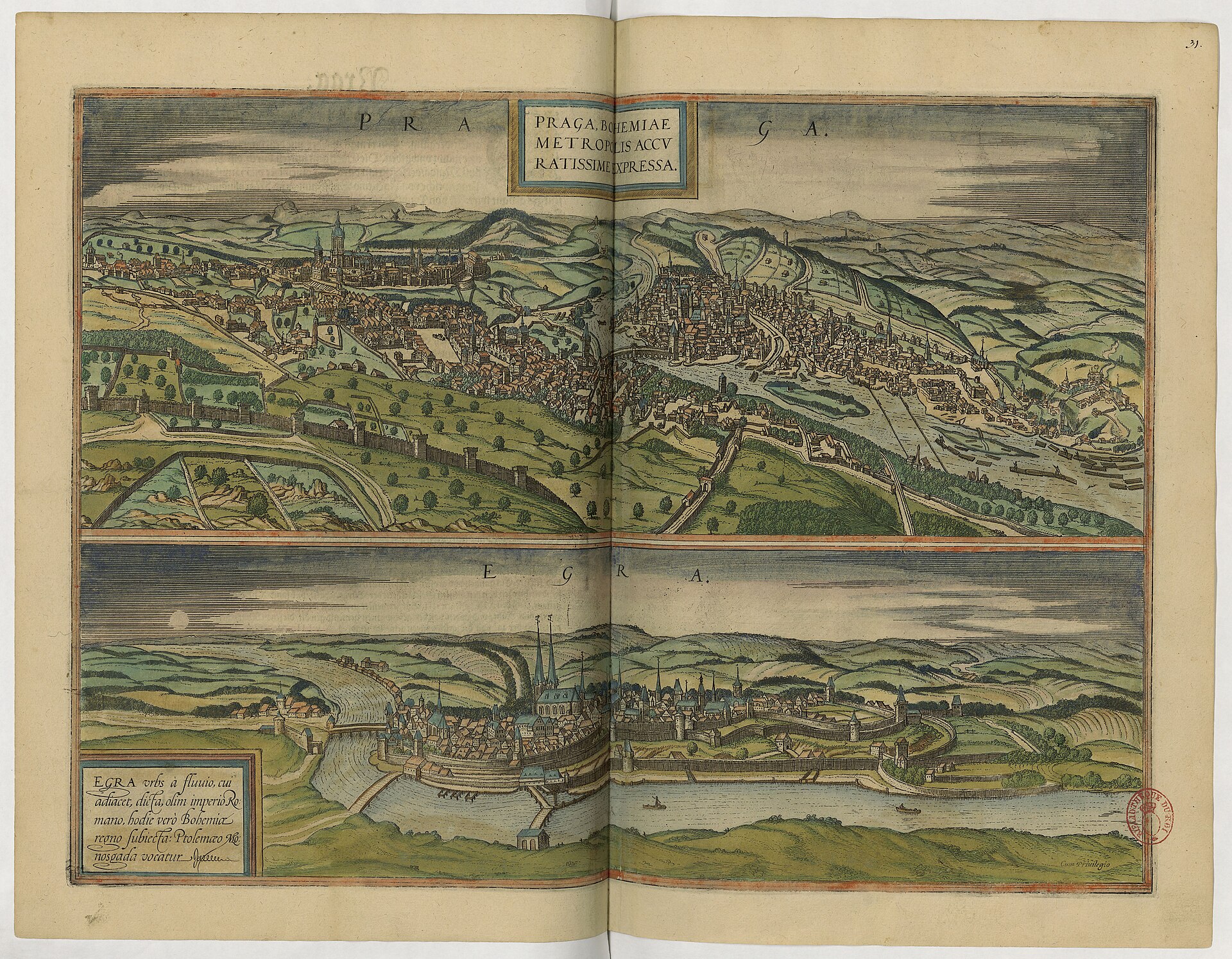
Bird's-eye view of Prague, from Braun & Hogenberg's Civitates Orbis Terrarum
Prague's medieval core with city walls and gates, the Vltava River and bridges, Prague Castle with cathedral spires, and dense streets and blocks.
Public domain (plate dated 1582)
In this city
Landmarks of Prague, see each in its prime


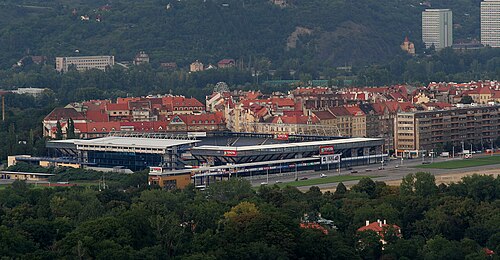
Castles of Prague


More cities to explore
 CzechiaKutná HoraExplore it in 1495
 GermanyDresdenExplore it in 1560 · 1750 · 1905
 CzechiaČeský KrumlovExplore it in 1600 · 1780
 NetherlandsUtrechtExplore it in 1400 · 1700
Castles of Europe · Landmarks of Europe · create your own reconstruction.