Historic Cities · Germany
Dresden through the ages
Dresden is the capital city of the German state of Saxony and its second most populous city after Leipzig. It is the 12th most populous city of Germany, the fourth largest by area, and the third-most populous city in the area of former East Germany, after Berlin and Leipzig.

Dresden in 1560
Electoral Dresden
Dresden in 1560 is the compact river town newly established as the Elector's residence, its castle receiving Renaissance courts and cabinets of curiosity. Walk the stone bridge, the market lanes and the castle terraces to see craftsmen, court retinues and the first Kunstkammer gathered beside growing Italian-style fortifications.
The skyline is low and serrated: steep red and brown tiled roofs, clusters of timber-framed houses and the squat mass of the Residenzschloss with new Renaissance gables and sgraffitoed façades, all set beside the broad, muddy Elbe and its old stone bridge. Streets are narrow, cobbled and busy with packhorses, carts, river barges and open workshops; nearby earthwork bastions and curtain walls show visible work by Italian engineers.
The route: 20 streets, squares and views
Loschwitz Heights → Drezdany Settlement → Steinerne Brücke → Bridgehead Market → Pirnaisches Tor → Altmarkt Square → Kreuzkirche Forecourt → Rathaus Lane → Muenzgasse → Schmiedestraße → …
Step inside, 12 interiors
Bridge Guardroom Chamber · Kreuzkirche Nave · Council Chamber of Elders · City Minting Hall · Court Goldsmith's Workshop · Renaissance Arcaded Courtyard · Long Stable Corridor · Electoral Kunstkammer Cabinets · Marshal's Judges' Hall · Electoral Alchemist's Laboratory · Riverside Warehouse Chamber · Engineers' Timber Workshop
Planned from the Wikipedia record: Dresden.
Dresden in 1750
Augustan Dresden
This is Dresden at the high Baroque of Augustus III: a compact royal capital where the new stone bell-dome of the Frauenkirche crowns the Neumarkt, the Zwinger's gilded Kronentor announces court spectacle, and the Hofkirche rises in scaffolding. The walk follows river quays, palace courts, market squares and grand façades where porcelain, opera and princely pageant shape daily life.
A low, clear skyline of domes, steep red-tile roofs and articulated sandstone façades sits above the Elbe; the Frauenkirche’s pale bell-dome punctuates the Neumarkt while the Zwinger’s crown gate and the rising tower of the Hofkirche break the horizon. Streets are narrow and paved, light is cool and river-bright, carriages and mule-drays share space with market stalls, powdered courtiers and apron-clad artisans.
The route: 22 streets, squares and views
Neustädter Elbufer → Augustusbrücke → Brühlsche Terrasse → Brühlsches Palais → Stallhof → Residenzschloss Forecourt → Schlossstraße → Taschenbergpalais → Zwinger Kronentor → Zwingerhof → …
Step inside, 13 interiors
Elbe Boatmen's Tavern · Bridge Customs House · State Audience Chamber · Royal Riding Hall · Green Vault · Electoral Kunstkammer · Palace Staircase Hall · Porcelain Cabinet · Court Opera Stage · Court Opera Backstage · East-Asian Display Room · Galleried Rotunda · Royal Mint Workshop
Planned from the Wikipedia record: Dresden.
Dresden in 1905
Jugendstil Dresden
Dresden in 1905 is a prosperous royal capital where baroque palaces and new Jugendstil buildings sit beside the wide Elbe. The walk follows river terraces and museum streets past the gleaming Semperoper, the academy dome, café promenades and the neighborhoods where Die Brücke painters gather.
The city’s skyline in 1905 is a stitched horizon of ochre sandstone, pale stucco façades, copper-green domes and patterned slate roofs, punctured by church towers and the new glass dome of the art academy. Broad river steps, iron tramlines and leafy promenades run along the Elbe; Jugendstil ornament appears in shopfronts and new town apartments while grand Baroque and Neo‑Renaissance public buildings anchor the compact Altstadt.
The route: 20 streets, squares and views
Weißer Hirsch Viewpoint → Blaues Wunder (Loschwitzer Brücke) → Alaunstraße → Dresden-Neustadt Bahnhof → Kunstakademie (Academy) → Brühlsche Terrasse Cafés → Terrassenufer Quay → Augustusbrücke → Theaterplatz / Semperoper → Theaterstraße → …
Step inside, 14 interiors
Brücke Founders' Studio · Neustadt Station Concourse · Glass‑Dome Drawing Studio · Café Central Artists' Room · Steamboat Company Waiting Room · Grand Auditorium Tiers · Cathedral Nave and High Altar · Grünes Gewölbe Treasure Chamber · Taschenberg Ballroom · Sistine Madonna Salon · Royal Post Telegraph Hall · Frauenkirche Central Nave · Choir and Organ Loft · Canaletto Tea Room
Planned from the Wikipedia record: Dresden.
Its story
The story of Dresden.
The Margrave's Bridgehead, 1206–1661
Dresden began as a German trading settlement on the south bank of the Elbe, established by Dietrich, Margrave of Meissen. The first documentary evidence dates to 1206, when Dietrich chose the place as his interim residence; a record of 31 March that year calls it Dresdene. The name is Sorbian, from Drežďany, taken to mean either woods or the dwellers of a lowland forest. In 1220 a stone bridge was built across the Elbe on the site of today's Augustus Bridge, tying the German town to the Sorbian settlement of Drezdany on the north bank; by 1350 that older place was recorded as Antiqua Dresdin, and later as Altendresden, old Dresden.
The town changed hands repeatedly after the death of Henry the Illustrious in 1288, taken by the Margraviate of Brandenburg in 1316 and restored to the Wettin dynasty in 1319. The decisive break came in 1485, when the Wettin brothers divided their lands under the Treaty of Leipzig: Ernest kept the Elector title and the western and northern territories, while Albert took the Meissen area and made Dresden the capital of the Duchy of Saxony. After the Schmalkaldic War, Duke Moritz was granted the electoral title in 1547 and Dresden became the capital of the Electorate of Saxony. The Striezelmarkt, first held in 1434, is reckoned the oldest Christmas market confirmed by a charter.
The Reformation prevailed in Dresden in 1539, and from about 1571 the city held to a strict Lutheranism. Catholic services were not held there again until 1661.
A Court in Two Kingdoms, 1697–1793
In 1697 the Elector Frederick Augustus I was crowned King Augustus II the Strong of Poland, and the Saxon court converted to Catholicism so that the crown could be taken. Dresden thereby became, by personal union, a family seat of Polish monarchs, and postal routes were laid to Poznań, Thorn (Toruń) and Warsaw. Augustus drew musicians, architects and painters from across Europe, and under him and his successor Frederick Augustus II most of the city's baroque landmarks were built, among them the Zwinger and the two churches that marked the confessional split at the top of the state: the Catholic Hofkirche and the Lutheran Frauenkirche.
The court's conversion did not carry the city with it. Catholic congregations were only put on an equal legal footing with the Protestant ones in 1807, and remained a small minority by numbers. In 1726 a soldier who had recently converted from Catholicism killed a Protestant clergyman, and rioting followed for two days.
The Treaty of Dresden of 1745 ended the Second Silesian War between Prussia, Saxony and Austria; the Seven Years' War of 1756 to 1763 brought heavy destruction, with the city captured by Prussian forces, recaptured, and subjected to a failed Prussian siege in 1760. Friedrich Schiller finished his Ode to Joy in Dresden in 1785, and in 1793 Tadeusz Kościuszko began preparations in the city for the Polish uprising that answered the Second Partition of Poland.
Napoleon's Kingdom, the Railway and the May Uprising, 1806–1863
In 1806 Dresden became the capital of the Kingdom of Saxony that Napoleon established, and the French Emperor used it as a base of operations, winning the Battle of Dresden there on 27 August 1813. The Congress of Vienna placed the kingdom in the German Confederation in 1815. The Technical School, forerunner of the present Dresden University of Technology, was founded in 1828; steamboat traffic began on the Elbe in 1837; and in 1839 the city's first railway opened, running direct to Leipzig.
Dresden was a centre of the German revolutions of 1848 and 1849. In the May Uprising, rebel Saxon troops with students, democrats, miners and workers behind them declared a provisional government at the Town Hall, and the city's first opera house was destroyed in the street fighting. Prussian forces and loyal Saxon troops put the rising down, leaving over 150 dead and many imprisoned; Frederick Augustus II fled the city and regained it with Prussian help. By 1852 the population had reached 100,000, among the first German cities to do so after Hamburg, Berlin and Breslau.
The failed Polish uprisings of 1831, 1848 and 1863 sent a stream of exiles to Dresden, among them much of the Polish artistic and political elite: the composer Frédéric Chopin, the soldier Józef Bem and the writer Adam Mickiewicz, who wrote Dziady, Part III, in the city.
Cameras, Cigarettes and the First Free State, 1871–1933
As capital of the Kingdom of Saxony, Dresden entered the newly founded German Empire in 1871 and became a substantial economic centre with motor car production, food processing, banking and the manufacture of medical equipment; the Albertstadt, a large military facility, was built in the 1870s. By the early twentieth century the city was particularly known for its camera works and its cigarette factories. In the First World War it suffered no war damage but lost many of its inhabitants.
Dresden served as capital of the first Free State of Saxony from 1918, was an economic and cultural centre of the Weimar Republic, and remained a centre of European modern art until 1933. The population peaked in 1933 at over 640,000, the highest figure in its history.
Book Burnings, Deportation and the Executions at Münchner Platz, 1933–1945
After the Nazi seizure of power two book burnings were staged in the city in 1933, one by the SA on Wettiner Platz and one by the German Student Union at the Bismarck Column on Räcknitzhöhe. Between 1933 and 1945 the Jewish community of Dresden was reduced from over 6,000–7,100 people were persecuted as Jews, to 41. Emigration accounted for most of that fall, and later deportation and murder. The Semper Synagogue was destroyed in November 1938 on Kristallnacht.
During the German invasion of Poland in September 1939 the Gestapo carried out mass arrests of local Polish activists. More than 1,300 people were executed by the Nazis at Münchner Platz, a courthouse in Dresden, among them labour leaders, people classed as undesirables, and resistance fighters; around two thirds of those executed came from the Protectorate of Bohemia and Moravia. At the time of the bombing, prisoners were digging a large hole into which a further 4,000 prisoners were to be disposed of, and the raids stopped the work.
The city held several forced labour subcamps of the Stalag IV-A prisoner-of-war camp for Allied prisoners and seven subcamps of the Flossenbürg concentration camp, in which some 3,600 men, women and children were imprisoned, mostly Polish, Jewish and Russian. In April 1945 most surviving prisoners were sent on death marches to destinations in Saxony and German-occupied Czechoslovakia; some women were probably murdered and some managed to escape.
The Raids of 13–15 February 1945
By the last months of the war Dresden was a major communications hub and manufacturing centre with 127 factories and major workshops, designated by the German military as a defensive strongpoint with which to hinder the Soviet advance. Alongside its roughly 600,000 inhabitants it was sheltering some 300,000 refugees who had fled the Red Army's advance into Silesia. The city was attacked seven times between 1944 and 1945.
The bombing by the Royal Air Force and the United States Army Air Forces between 13 and 15 February 1945 was controversial. On the night of 13 to 14 February, 773 RAF Lancaster bombers dropped 1,181.6 tons of incendiary bombs and 1,477.7 tons of high explosive, and the inner city was largely destroyed. The Dresden Historians' Commission, thirteen prominent German historians, concluded in an official report of 2010 that casualties numbered between 22,500 and 25,000. The Allies described the operation as the legitimate bombing of a military and industrial target; several researchers have argued that the February attacks were disproportionate. Those killed were mostly women and children, and the Albertstadt garrison was not specifically targeted. The city's population stood at 368,519 in 1945.
From Rubble Trains to Silicon Saxony, 1945–2019
Dresden fell within the Soviet occupation zone, and the damage was extensive enough that a narrow-gauge light railway was built simply to carry the debris away: seven lines, 5,000 staff and 40 locomotives, the last train running until 1958 and the last clearance team disbanded only in 1977. Firms such as Dresdner Bank left in the communist era to avoid nationalisation. The city became a major industrial and research centre of the German Democratic Republic and the seat of Bezirk Dresden between 1952 and 1990. In the 1950s and 1960s the East German authorities razed the ruins of churches and palaces including the Gothic Sophienkirche and rebuilt much of the centre in a socialist modern style, for economic reasons and to break with its past as a royal capital and bourgeois stronghold. The ruins of the Frauenkirche were left standing as a war memorial.
On 3 October 1989 trains carrying East German refugees from Prague passed through Dresden on their way west, and local activists and residents joined the civil disobedience spreading across the GDR, demonstrating for the removal of the communist government. The Free State of Saxony was re-established in 1990 with Dresden as its capital, and Soviet troops withdrew in the early 1990s. Restoration of the Frauenkirche ran from 1994 to 2005 on privately raised money, its gold cross made in London and paid for by donations to the Dresden Trust in Britain. Each 13 February thousands gather to commemorate the destruction of the city; from 1999 neo-Nazi groups have organised demonstrations in Dresden among the largest of their kind in post-war Germany.
UNESCO declared the Dresden Elbe Valley a World Heritage Site in 2004, placed it on the endangered list in 2006 and withdrew the title in June 2009 over the construction of the Waldschlösschen Bridge, only the second site ever removed from the list. In 2006 the city sold its subsidised housing organisation WOBA to the Fortress Investment Group for 987.1 million euros and paid off its remaining loans, becoming the first large German city to be debt-free. The semiconductor industry that gives the region the name Silicon Saxony was built up from 1969; the capital of Saxony had 557,075 inhabitants in 2019.
From the archive
Dresden on paper: the old town as it was mapped.
A period plan or bird's-eye view of the old town, drawn between 1500 and 1850, the streets this page's reconstructions walk. Public domain, with its source named.
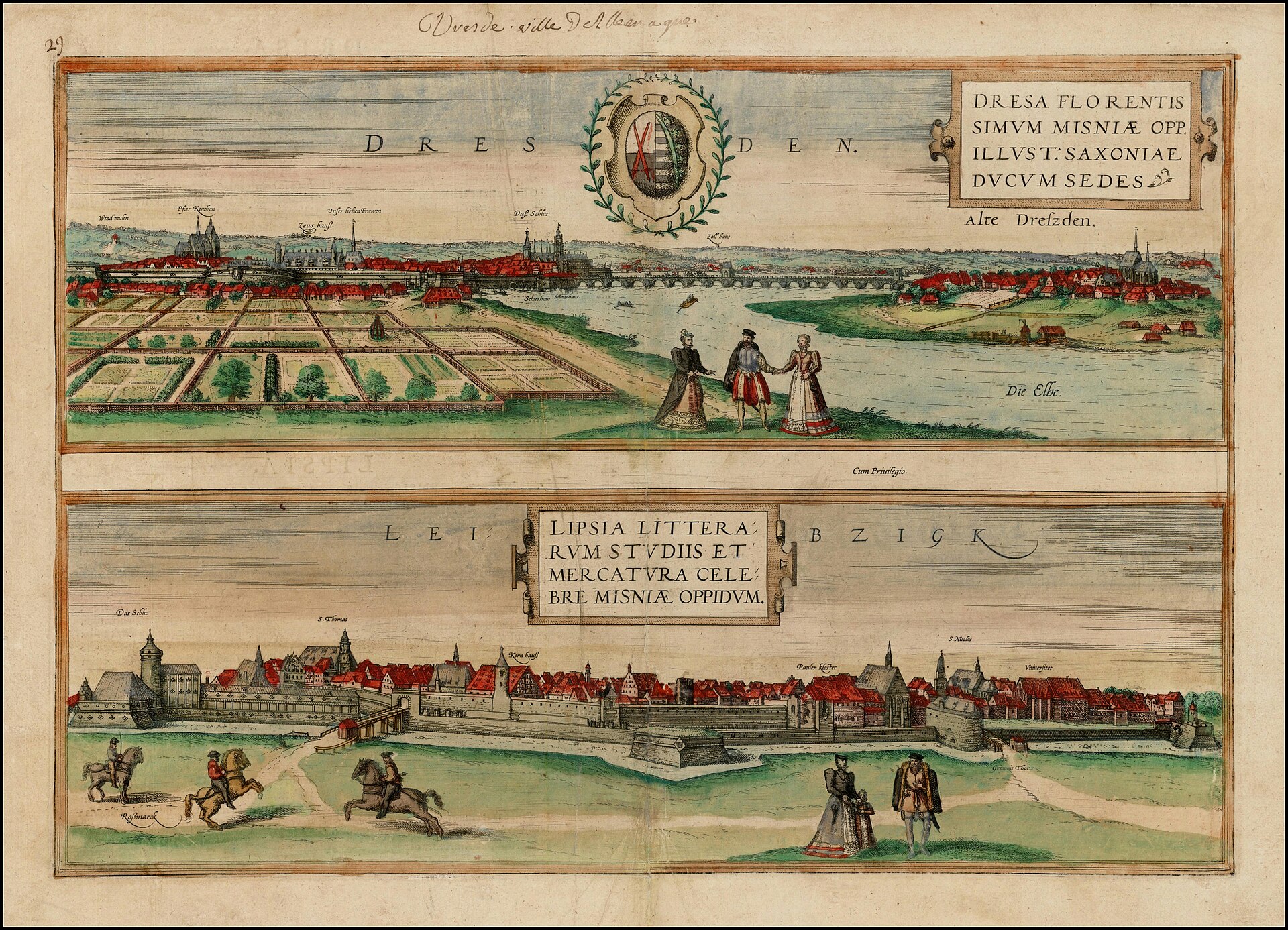
Bird's-eye view of Dresden (Alte Drezden), from Braun & Hogenberg's Civitates Orbis Terrarum
Shows the Elbe and long stone bridge, the riverside old town with palace and church spires, riverside houses and formal gardens on the near bank.
1588 · Georg Braun / Frans Hogenberg · Wikimedia Commons
Public domain (plate dated 1588)

Ships tied to Dresden
- SMS Schleswig-Holstein: Her bell was held by the Bundeswehr military history museum in Dresden
Castles of Dresden

More cities to explore
 CzechiaPragueExplore it in 1370 · 1600 · 1890
 CzechiaKutná HoraExplore it in 1495
 GermanyBerlinExplore it in 1750 · 1871 · 1928
 GermanyMunichExplore it in 1500 · 1700 · 1900
Castles of Europe · Landmarks of Europe · create your own reconstruction.