Germany · Restored
Moritzburg Castle
Schloss Moritzburg
Moritzburg Castle is a Baroque palace on a symmetrical artificial island near Dresden, originally a 16th-century hunting lodge remodelled in the early 18th century as a country seat. The palace is noted for its four round corner towers with domed roofs, a central chapel spire, extensive baroque interiors and formal gardens and ponds on the surrounding estate.
First raised
1542
Its prime
1733
Today
Restored
As it stood in 1733
What Moritzburg Castle looked like in its prime.
A symmetrical, four-wing Baroque palace set on a man-made island surrounded by a broad reflective lake; each corner has a tall, cylindrical tower capped by a red, domed roof and small lantern, linked by pale yellow plastered façades with regular rows of tall rectangular windows and white trim. The central mass rises to a steep dark spire over the chapel, with red-tiled rooflines and a stone terrace at the water’s edge punctuated by two small lakeside pavilions; the layout faces a formal U-shaped park and avenues to the north.
Its story
The story of Moritzburg Castle.
From Hunting House to Schloss, 1542–1672
Between 1542 and 1546 Duke Moritz of Saxony had his master builder Hans Dehn-Rothfelser raise a Renaissance hunting house some 13 kilometres north-west of Dresden. It was first called the Dianenburg, after the goddess of the hunt, and only later renamed for the duke himself. Even in that first form the lodge showed the outline it keeps today: four stout round towers joined by an encircling defensive wall. From 1550 it doubled as the administrative seat of the Amt Moritzburg, and the surrounding woods and carp ponds (some dug as early as the sixteenth century) became a favourite hunting ground of Saxony's electors.
Elector John George II added the chapel to plans by Wolf Caspar von Klengel, an early example of Baroque architecture. The elector laid the foundation stone himself on 1 November 1661 (the birthday of his wife, Magdalena Sibylle) sealing three commemorative talers struck for the occasion inside it. The chapel was completed by 1672, as Klengel enlarged the old hunting house into a proper schloss.
Augustus the Strong's Baroque Island Palace
In 1697 Elector Augustus the Strong converted to Catholicism to secure his election as King of Poland, and the formerly Protestant chapel at Moritzburg received Catholic consecration at a Christmas service in 1699; Catholic worship has been held there ever since. Plans to remake the lodge as a Baroque hunting palace followed from 1703, and in October 1719 Johann David Heinichen's Serenata di Moritzburg was premiered here to frame a royal hunt.
Through the 1720s Matthäus Daniel Pöppelmann, with Zacharias Longuelune, carried out the transformation: the courtyard walls came down, the central block was raised and widened and tied to the corner towers by new wings, and the whole was ringed with terraces, ramps and bridges. Four small ponds were merged into one great pond, leaving the palace on a symmetrical artificial island. A formal French-style park was begun on the northern shore in 1728 but never finished; Augustus died in 1733 and the work stopped with him.
His descendant Elector Frederick Augustus III drew the wider landscape into the ensemble late in the eighteenth century: the Rococo Little Pheasant Castle (1770–1776), the Well of Venus, and a miniature harbour on the Great Lake with jetty and a painted brick lighthouse. Miniature fortifications dubbed the Dardanelles were built along the shore so the court could restage naval battles, notably the Battle of Chesma of 1770.
Feathers, Antlers and a Tsar's Gift
In 1723 Augustus acquired a state bed whose canopy and curtains held roughly a million peacock, pheasant, guinea-hen and duck feathers: woven into the cloth as weft by its French maker, Le Normand, rather than glued or tied. Augustus at once had the curtains remade as wall hangings, giving the Federzimmer, the feather room, its name. The ensemble came to Moritzburg in 1830 and, after a nineteen-year restoration, has been on view again since 2003.
The trophy rooms record two centuries of courtly hunting. The dining hall carries 71 red-deer trophies, most between 270 and 400 years old, among them the heaviest red-deer antler in the world at 19.8 kilograms and nearly two metres across. The Monströsensaal holds 39 contorted antlers, including the 66-point head taken by Frederick III of Brandenburg in 1696, and over a door of the Steinsaal hangs the antler of an extinct giant deer, more than 10,000 years old, a gift from Tsar Peter the Great to Augustus, thought to have been found in Crimea.
The Last Wettin and the Buried Treasure
Prince Ernst Heinrich of Saxony made Moritzburg his home from 1933 to 1945, the last resident of the House of Wettin. The finest holdings of the castle library (medieval monastic manuscripts, incunabula and Renaissance bindings) had been moved for safekeeping and were destroyed in the air raids on Dresden on the night of 13–14 February 1945. That year the Wettins were dispossessed by the Soviet administration, but not before burying much of their treasure in wooden crates in the castle park. Soviet troops found and removed most of it; on 4 October 1996 amateur archaeologists unearthed several remaining chests of jewel-set goldsmiths' work, since restored to pre-war condition.
A museum of Baroque art was installed in the palace between 1946 and 1949, and the chapel was restored from 1985 to 1989. A 1545 tapestry of Emperor Charles V by Seger Bombeck (Ernst Heinrich's property, taken to Sigmaringen in 1945) returned to Saxony in 2001 and has been shown at Moritzburg since May 2024.
Step inside
11 places to explore in 1733.
The record describes 11 distinct spots at Moritzburg Castle, including 7 interiors: main entrance hall with royal carriages, palace chapel (early baroque), speisesaal (dining room) with antler trophies and more. Create your own photoreal reconstruction and explore every one, more scenes means more rooms, more angles, and more of the place to stand in.
Build Your Own Castle
Recreate Moritzburg Castle with AI to explore it.
The artist rebuilds it as it stood in 1733, a photoreal reconstruction that belongs to you alone. Pay with coins, no subscription needed.
Recreate this castle →Defend this castle →Whose castle
Clans who held Moritzburg Castle.
The families that held Moritzburg Castle for a decade or more across its history, follow a name to its clan.
Wettin
Seat of Saxony's ruling House of Wettin from Duke Moritz's hunting lodge of 1542–46 until 1945, when Prince Ernst Heinrich, its last resident, left.
From the archive
Moritzburg Castle on paper: the measured plan and period views.
The survey plan and photographs below are the ground truth this page's reconstructions are checked against, drawn and photographed while the castle was still a working garrison. Every image is public-domain or openly licensed, with its source named.
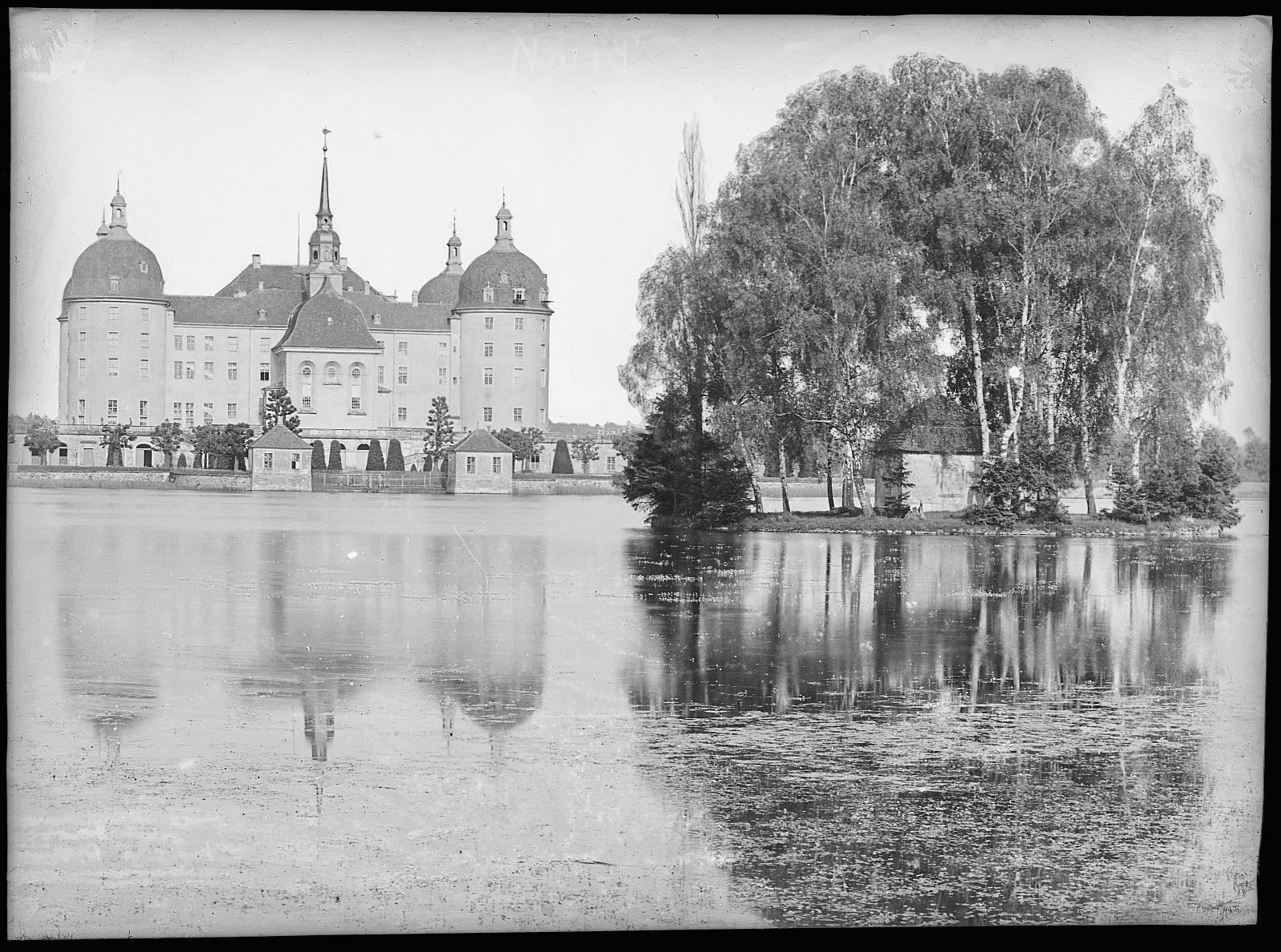
Moritzburg. Castle
· Deutsche Fotothek (via Europeana)
Public domain
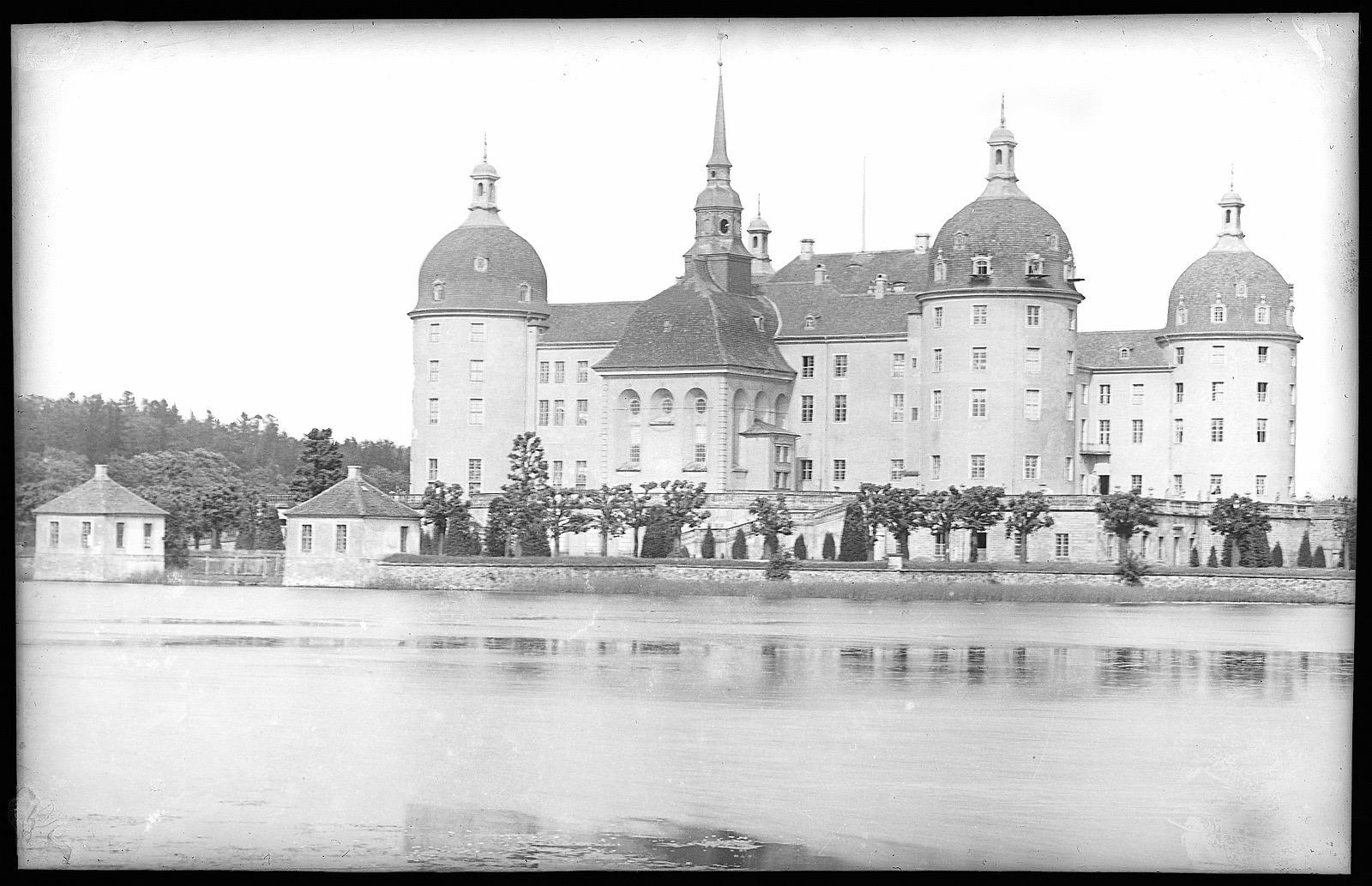
Moritzburg. Schloss
· Deutsche Fotothek (via Europeana)
Public domain
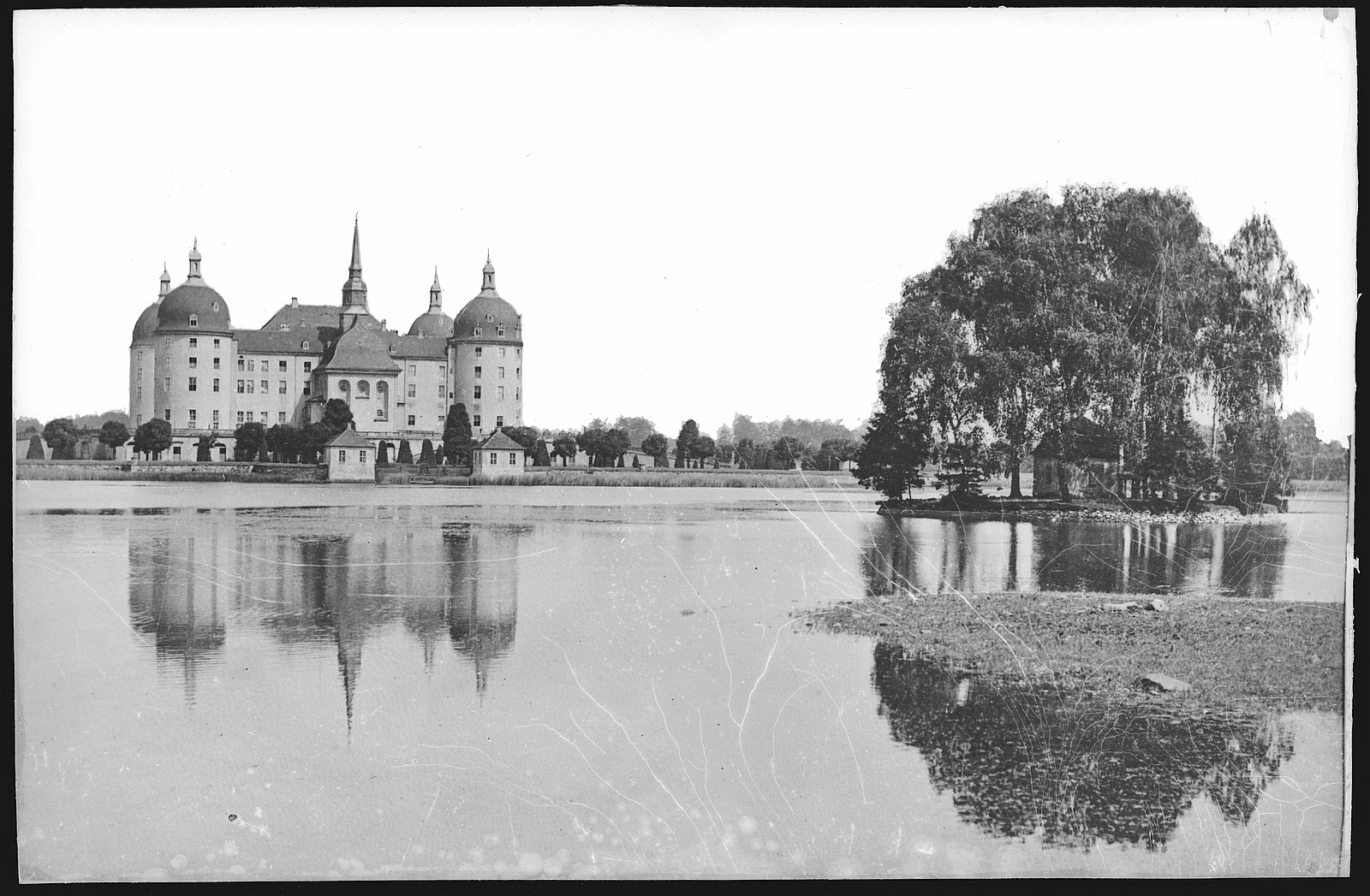
Moritzburg. Schloss
· Deutsche Fotothek (via Europeana)
Public domain

Questions about Moritzburg Castle
What is the history of Moritzburg Castle?
What is inside Moritzburg Castle?
Why was Moritzburg Castle built, and what was it used for?
Where is Moritzburg Castle?
When was Moritzburg Castle built?
Which family or clan held Moritzburg Castle?
What did Moritzburg Castle look like in its prime?
Is Moritzburg Castle still standing or is it a ruin?
Who built Moritzburg Castle?
Can you visit Moritzburg Castle?
More castles of Germany


Explore the city