Historic Cities · Portugal
Coimbra through the ages
Coimbra, officially the City of Coimbra, is a city and a municipality in Portugal. The population of the municipality at the 2021 census was 140,796, in an area of 319.40 square kilometres (123.3 sq mi). It is the fourth-largest metropolitan area in Portugal after Lisbon, Porto, and Braga, and is the largest city of the district of Coimbra and the Central Region.

Coimbra in 1750
City of the Doctors
Coimbra in 1750 is a baroque university city clinging to a limestone hill above the broad Mondego, its academical life poured into cloistered colleges and narrow climbing lanes. The walk moves from the river and willow meadows up through the Arco de Almedina into the Alta, past the newly gilt Joanina Library, the clock tower and the stone colonnades, to a rooftop panorama over the Mondego.
Low, terracotta roofs tumble up a steep limestone ridge to the white and ochre walls of the Alta, pierced by narrow shaded alleys and colonnaded walks. The Joanina’s dark oak and gilt facades and the freshly finished clock tower punctuate a skyline of church towers and monastery roofs. By the river, willow flats and reeded banks frame a modest quay of boats and oxcarts; stone bridges and Roman cryptoporticus remain visible at the city’s base.
The route: 17 streets, squares and views
Willow Flats of the Mondego → Ponte de Santa Clara → Santa Clara-a-Nova Convent → Ribeira do Mondego → Arco de Almedina → Rua da Almedina → Rua da Sofia → Alta's Climbing Lanes → Paço das Escolas Courtyard → Torre da Universidade → …
Step inside, 8 interiors
Student Supper Table · Chapel of São Miguel · Belfry and Clock Chamber · Main Gilded Book Hall · Side Reading Gallery · Cloister of Silence · Romanesque Nave · Roman Cryptoporticus Gallery
Planned from the Wikipedia record: University of Coimbra.
Its story
The story of Coimbra.
Aeminium, Ataces and the Serpent and the Lion
The Romans founded the civitas of Aeminium on a limestone table above the Mondego in the time of Augustus, walled it, and laid it out on an orthogonal plan with the cardo maximus and decumanus maximus crossing at the forum. Administratively it fell under Conímbriga, some 15 kilometres to the south; what it had that its neighbour did not was position, on the north-south traffic between Bracara Augusta and Olisipo, with a waterway opening connections to the interior and the coast. When Conímbriga was sacked by the Sueves and Visigoths between 465 and 468 and abandoned, its diocese moved to Aeminium, which took the dead city's name with it, Conimbriga, later Colimbria. The cryptoporticus of the Roman forum survives as part of what is now the Machado de Castro National Museum.
In 409 the Iberian Peninsula was overrun and the lower Mondego recognised Hermeric of the Suebi as its ruler, until Ataces, king of the Alans, took the city from him. Later chronicles describe his rule in terms that are partly legendary: an Arian who persecuted Catholics ferociously and set the whole population to work on the walls, his prisoners either beheaded before them, their bodies serving as foundations, or worked like pack animals in the building. Elipando, bishop of Coimbra, was among those made to carry stone and clay for it.
Hermeric crossed the Douro to take the city back, was beaten, and bought peace with a marriage: his daughter Cindazunda went to Ataces. The same tradition holds that her image was set in a vase between a serpent and a lion, the emblems of the two kings, and that the masons carved the device into the walls they were building; it has been the arms of Coimbra ever since. The Visigoths took the region afterwards, and under them King Wittiza created the County of Coimbra as a fief for his son Ardabast, with its seat at Emínio, until the Muslim invasion from the south.
Qulumriyah, 714–1116
Coimbra capitulated to Musa bin Nusair in 714. Under Muslim rule it was not a large settlement, but within al-Andalus it was the largest agglomerated centre along the northern Tagus valley, with a walled enclosure of 10 hectares holding between 3,000 and 5,000 inhabitants. It traded between the Christian north and the Arab south and kept a substantial Mozarabic community. The Almedina and the Arrabalde date from this period, as does the governor's fortified palace, which the early Portuguese kings later converted into their royal palace.
It changed hands repeatedly. Hermenegildo Guterres took it in 878 and it became the seat of the County of Coimbra; Almanzor attacked it in 986 and it returned to Muslim rule in 987. The definitive reconquest came in 1064, in the Beiras campaign, when Ferdinand I of León and Castile took the city after a siege of six months, from 20 January to 9 July. The Banu Dānis and the other Muslims of the region were forced out. Ferdinand appointed the Mozarab Sisnando Davides to reorganise the economy and administer the lands around the city, and Coimbra became the most important place south of the Douro. Muslim forces returned in 1116 and took two castles built to protect the territory: at Miranda da Beira the garrison was slaughtered, at Santa Eulália the governor surrendered rather than face the same.
Royal Seat of the New Kingdom, from 1096
In 1096 Alfonso VI of León and Castile placed the County of Portucale and the County of Coimbra together under Henry of Burgundy, who had married his illegitimate daughter Theresa. Henry pushed the frontier south against Moorish forces, and on his death in 1112 Theresa held both counties as one. Their son Afonso Henriques took up residence in the old seat of the Christian county (whose centre moved here from Guimarães in 1131), and sent expeditions south and west, building a chain of castles at Leiria, Soure, Rabaçal, Alvorge and Ansião. Six kings of the first dynasty were born in the city, and Afonso Henriques and Sancho I were buried in it.
Through the twelfth century he governed fertile, river-served country behind a fortified city of more than 6,000 people, among them magnates, knights and senior clergy. He funded the Monastery of Santa Cruz, founded in 1131 by Theotonius and the leading Portuguese monastic house of its day, promoted the building of the Old Cathedral, rebuilt the Roman bridge in 1132, repaired the roads and the walls of the old city, and in 1179 granted the concelho a formal foral confirming its powers. Accounts differ on how long Coimbra remained the kingdom's capital: one dates the role from 1131 to 1255, another holds that the city kept it until the end of the first dynasty in the late fourteenth century, when it passed to Lisbon.
The medieval city divided sharply. The Cidade Alta held the aristocracy and the clergy; merchants, artisans and labourers lived in the Cidade Baixa by the Mondego, and there were an old and a new Jewish quarter. Queen Elizabeth of Portugal founded the Monastery of Santa Clara-a-Velha on the left bank in the first half of the fourteenth century; it stood too near the river, and repeated flooding drove the nuns out in the seventeenth century to Santa Clara-a-Nova uphill, the Queen's Gothic tomb going with them. Coimbra is known too for the loyalty of its alcaide-mor, Martim de Freitas: in the war between Sancho II and his brother Afonso III, he refused to hand over the keys of Coimbra castle until he had gone to Toledo and confirmed for himself that Sancho II, to whom he had sworn vassalage, was dead.
The University Settles, 1288–1733
King Dinis I petitioned the pope for a studium generale in 1288 and obtained confirmation in 1290; the institution was set up in Lisbon. It was moved to Coimbra in 1308, sent back to Lisbon by Afonso IV in 1338, and only definitively transferred in 1537, when John III handed over the royal palace itself; by 1544 the university had spread through the whole complex. From that point the city's life turned on it, and the colleges founded here by the religious orders, which offered an alternative for decades, were wound up as education in Portugal was secularised.
The fifteenth and sixteenth centuries made Coimbra one of the main artistic centres of the country, on the strength of episcopal, monastic and royal patronage: Manuel I, the bishops and the orders employed the Pires and Castilho families and the Frenchmen João de Ruão and Nicholas of Chanterene, whose work includes the Manueline remodelling of Santa Cruz with the tombs of Afonso Henriques and Sancho I, the Manga Fountain and the portal of the Old Cathedral. The university added the Baroque Joanina Library in the eighteenth century and the University Tower, built to António Canevari's design between 1728 and 1733.
Pombal's Reform, the French Occupations and the Railway, 1772–1875
In 1772 the Marquis of Pombal, chief minister to José I, reformed the university and gave the sciences a large place in it; the instruments and materials bought then are held in the university's Science Museum and make up one of the most important historical science collections in Europe. The same drive to modernise cost the city its medieval walls and castle, demolished almost entirely. In that year too Luísa de Jesus, a 23-year-old local woman, was sentenced to death for multiple infanticide, the last woman executed in Portugal.
The first half of the nineteenth century was hard. French troops under Andoche Junot and André Masséna occupied the city during the Peninsular War. On 6 October 1810 a force of 4,000 Portuguese militia under Nicholas Trant retook it, dealing Masséna a heavy blow, and in March 1811 the militia held it against the retreating French army. The religious orders were afterwards expelled, and that expulsion and municipal reform forced a redrawing of the city's civil parishes in 1854. Recovery came in the second half of the century: the electric telegraph and gas lighting in 1856, the railway in 1864, the railway bridge over the Mondego eleven years later, and the city pushed out into the Quinta de Santa Cruz.
Student Bodies, the Estado Novo and the Alta Cleared, 1880–1950
The modern student culture dates from these decades. The Orfeon Académico de Coimbra was formed in 1880 by a law student, the Associação Académica de Coimbra on 3 November 1887 and the Tuna Académica in 1888; the Teatro dos Estudantes da Universidade de Coimbra followed in 1938, founded by Paulo Quintela and Manuel Deniz-Jacinto, and became known for cultural resistance. Coimbra fado grew out of these academic traditions, its best-known figures the guitarist Carlos Paredes and the singer José Afonso, known as Zeca. The Festa das Latas goes back to the nineteenth century, when students marked the end of the academic year with as much noise as they could make, tin cans included.
Electric trams were inaugurated on 1 January 1911, linking the old quarter to the growing suburbs of Celas, Olivais, Penedo da Saudade and Calhabé. Between 1940 and 1950 the residential quarter of the Alta was demolished to make room for the university to expand. Under the Estado Novo the university's students were an active force against the dictatorship.
A University City, 2013 Onwards
On 22 June 2013 the university's historic buildings, the Alta and Rua da Sofia, were inscribed on the UNESCO World Heritage list, the citation calling Coimbra "an outstanding example of an integrated university city with a specific urban typology as well as its own ceremonial and cultural traditions that have been kept alive through the ages".
The municipality covers 319.40 square kilometres and had 140,796 inhabitants at the 2021 census, with around 460,000 in its intermunicipal community, and it is the largest city of the district of Coimbra and of the Central Region. Its wealth still rests largely on the university, with about 28,000 students and more than 38,000 in higher education in the city overall, alongside health sciences: two large state hospital centres, the regional branch of the national cancer institute, and the national forensic science institute, which is headquartered here. The municipal holiday falls on 4 July, for Queen Elizabeth of Portugal, who died on that day in 1336.
From the archive
Coimbra on paper: the old town as it was mapped.
A period plan or bird's-eye view of the old town, drawn between 1500 and 1850, the streets this page's reconstructions walk. Public domain, with its source named.
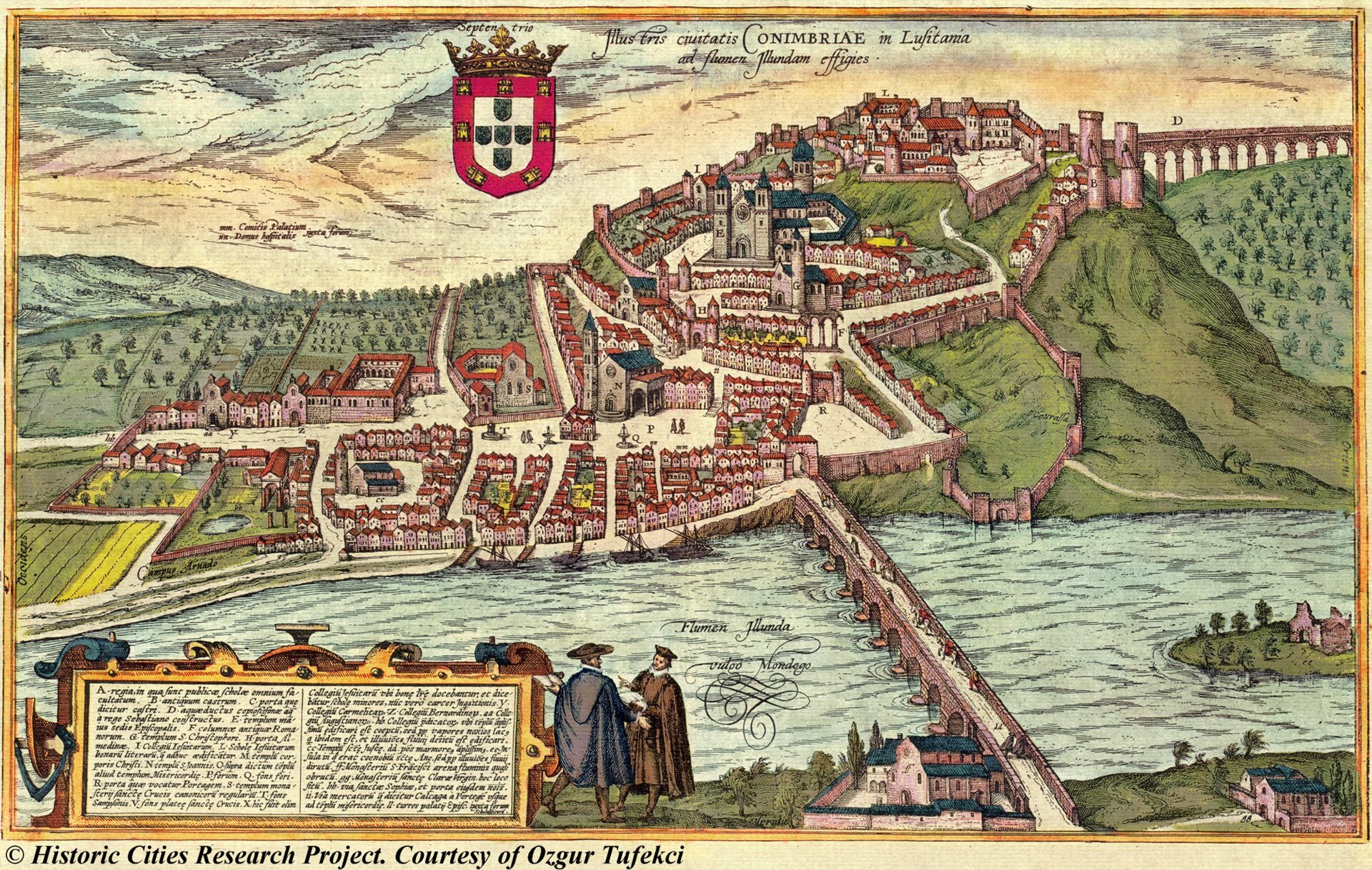
Bird's-eye view of Coimbra (Illustris civitatis Conimbriae in Lusitania), from Braun & Hogenberg's Civitates Orbis Terrarum
Fortified old town with concentric walls and gates, the cathedral and hilltop castle, the Mondego river and the long arched bridge are clearly shown.
1598 · BRAUN, Georg, 1541-1622; HOGENBERG, Frans · Wikimedia Commons
Public domain (plate dated 1598)
More cities to explore
 PortugalPortoExplore it in 1500 · 1790 · 1900
 PortugalSintraExplore it in 1854
 PortugalLisbonExplore it in 1550 · 1750 · 1890
 NetherlandsUtrechtExplore it in 1400 · 1700
Castles of Europe · Landmarks of Europe · create your own reconstruction.