Historic Cities · Portugal
Sintra through the ages
Sintra, officially the Town of Sintra, is a town and municipality in the Greater Lisbon region of Portugal, located on the Portuguese Riviera. The population of the municipality in 2021 was 385,654, in an area of 319.23 square kilometres (123.26 sq mi). Sintra is one of the most urbanized and densely populated municipalities of Portugal.

Sintra in 1854
Romantic Sintra
Sintra in 1854 is at the height of its Romantic reinvention: Ferdinand II's Arabian-tinged Pena Palace crowns the ridge while restored Moorish battlements and the old National Palace define the town below. The walk moves between painted ramparts, camellia-filled quintas and mist-softened terraces, encountering ox carts, donkey guides and the town's market life under the shadow of white chimneys and Atlantic haze.
The town's silhouette is a collage of painted ramparts, polychrome domes and crenellated stone against a green, fern‑fringed Serra. Whitewashed houses and tile fronts cluster in narrow streets beneath the National Palace's twin chimneys; higher, the Moorish Castle's stone battlements run along the ridge. Gardens and quintas interleave with laurel and eucalyptus, camellias and tree ferns, terraces opening to a cool, Atlantic-lit mist that softens distance and colour.
The route: 16 streets, squares and views
View from Colares Plain → Praia das Maçãs Outlook → Rua da Ferraria → Praça da Vila → National Palace Exterior → Calçada dos Clérigos → Calçada da Trindade → Town Market → Palácio de Seteais Terrace → Road to Pena → …
Step inside, 10 interiors
Tile-fronted Tavern · Swan Room · Magpie Room · Town Market Hall · Seteais Salon · Arab Room · Royal Chapel · Cistern Chamber · Friars' Cell · Camellia Conservatory
Planned from the Wikipedia record: Sintra.
Its story
The story of Sintra.
The Sacred Mountain Beside Olisipo
Occupation of these hills runs back a long way. Vestiges at Penha Verde date to the early Palaeolithic; an open-air site at São Pedro de Canaferrim, beside the chapel of the Castelo dos Mouros, yielded decorated ceramics and microlithic flint tools of the fifth millennium BC; and a late Bronze Age settlement of the ninth to sixth centuries BC lay inside the walls of the later castle. The best-known object from those centuries is the Sintra Collar, a middle Bronze Age gold neck-ring found near the town at the end of the nineteenth century and part of the British Museum's collection since 1900.
The name descends from the medieval Suntria, which points to an Indo-European root carrying the sense of bright star or sun; Varro and Columella called the place the sacred mountain. What made it matter, though, was what lay beside it: Olisipo, the commercial centre founded by the Turduli Oppidani that became Lisbon. Romanisation of the Foz do Tejo reached the area in the middle of the second century BC, and Sintra fell inside the Civitas Olisiponense, linked by road to the main route into the city. Under Muslim rule the place was Xintara; the geographer Al-Bacr described it as one of the towns dependent on Lisbon in al-Andalus, close to the sea, and permanently submerged in a fog that never lifts.
Sigurd's Failure and the Surrender of November 1147
Umar ibn Muhammad al-Mutawakkil, ruler of the Taifa of Badajoz, placed his territory under the suzerainty of Alfonso VI of León in the face of the Almoravid advance, and Alfonso took Santarém, Lisbon and the castle of Sintra between 30 April and 8 May 1093. He did not hold them long: Sintra and Lisbon fell to the Almoravids shortly afterwards. In 1108 Sigurd the Crusader, son of Magnus III of Norway, landed at the mouth of the Colares river on his way to the Holy Land and tried and failed to take the castle; Count Henry retook it in July 1109. The decisive change came only with the conquest of Lisbon in October 1147 by Afonso Henriques, supported by crusaders. The castle surrendered that November and was absorbed into Christian territory along with Almada and Palmela, and Afonso Henriques founded the church of São Pedro de Canaferrim inside its walls to mark it.
The Foral of 1154, the Judiaria and the Mouros-Forros
On 9 January 1154 Afonso Henriques signed a foral for Sintra with all its regalia, creating the municipality that still exists; its territory was eventually divided among four large parishes, São Pedro de Canaferrim at the castle, São Martinho in the town, and Santa Maria and São Miguel in the Arrabalde. The land was fertile and was parcelled out fast to convents, monasteries and military orders, which took houses, estates, water-mills and vineyards across the district through the twelfth and thirteenth centuries; in 1157 or 1158 the king gave houses and estates near the palace to Gualdim Pais, master of the Knights Templar. From 1261 the town was administered by an alcaide representing the Crown and two judges elected by the townspeople.
The early town contained a substantial Sephardic community with its own synagogue and quarter, the Judiaria, a name that survives in the street-names of the historic centre. There was also a community of mouros-forros, free Moors, at Colares; in 1281 they complained to King Denis about the weight of the dues laid on them, and he cut those dues to a quarter of the harvest in exchange for labour at the town palace. In 1287 Denis granted the town and its seigneurial holdings to Queen Elizabeth; they passed afterwards to the Infante Afonso, later Afonso IV, and remained his until 1334 before reverting to the Casa da Rainha.
Plague reached the town in the middle of the fourteenth century; a document of 1350 records that it killed five of the municipal scribes, and the real toll was probably far higher. Ferdinand, who reigned from 1367 to 1383, granted Sintra to Leonor Teles de Menezes along with Vila Viçosa, Abrantes and Almada, to the consternation of his private council. Nearness to the capital also made the district a labour pool: when Ferdinand resolved to wall Lisbon in 1373 he demanded money or workers from Sintra as from a long list of other towns. In the dynastic crisis of 1383 to 1385 Sintra sided with Leonor Teles and the proclamation of her daughter Beatrice, wife of John I of Castile, as queen; after the Castilian army was beaten at Aljubarrota in August 1385 by Portuguese and English troops under Nuno Álvares Pereira, the town passed to the Master of Aviz.
A Summer Seat of the House of Aviz, 1385–1580
John I broke the practice of handing Sintra to the Casa da Rainha. He granted the estate to Count Henrique Manuel de Vilhena, probably around 1383, then revoked it when Vilhena took Beatrice's side, keeping the property himself and enlarging it. Until the end of the seventeenth century the royal palace was one of the court's principal residences and summer seats: John I was there when he decided on the conquest of Ceuta in 1415, Afonso V was born there and died there, and John II was acclaimed sovereign there.
Men from the town went out with the Atlantic voyages: Gonçalo de Sintra, a squire in the household of the Infante Henry, was sent as captain of a caravel to the African coast in 1443 and died near the Ouro River in 1444, and Pedro de Sintra and Soeiro da Costa later mapped much of the Atlantic coast of Africa. At the end of the fifteenth century Queen Eleanor of Viseu, wife of John II and chief patron of the Portuguese Misericórdias, built the Hospital e Gafaria do Espírito Santo here to support lepers in the region; in 1545 it passed to the Santa Casa da Misericórdia of Sintra.
Manuel I summered at Sintra for its cool air and its game. He rebuilt the Gothic church of São Martinho and in 1511 founded the monastery of Nossa Senhora da Pena on the highest peak, which he transferred to the Order of Saint Jerome. Through the second half of the century the aristocracy built estates across the district, and from 1542 João de Castro, Viceroy of India, lived at the Quinta da Penha Verde.
The Spanish Crown and the Court's Departure, 1580–1778
With the death of the Cardinal-King Henry in 1580, Philip II of Spain inherited the kingdom, beginning a union of the crowns that lasted until 1640, and Portuguese political weight moved from Sintra to Vila Viçosa, seat of the House of Braganza. Sebastianism, the belief that King Sebastian would return, ended in denunciations of false claimants: in 1585 Mateus Alvares, born on Terceira in the Azores and guardian of the hermitage of São Julio, passed himself off as Sebastian and raised trouble in Sintra, Rio de Mouro and Ericeira. Thirty people were hanged and many more punished. When Philip IV of Spain, Philip III of Portugal, visited in 1619, families fled to the hills. Through the union the district suited Portuguese nobles who wanted distance from the Castilian court and bought land accordingly; at the Restoration in 1640 the municipality had around 4,000 residents.
The court then drifted away for good. The war with Spain from 1640 to 1668, the rise of Mafra under John V with its palace-convent, and the building of the royal palace at Queluz from 1747 all cut royal visits, of which only two are documented in the period. Afonso VI ended his life in the town: alleging his insanity and the incapacity of his heir, the Duke of Cadaval and the Infante Peter led a coup in 1667 that imprisoned the king, and the Cortes of Lisbon confirmed Peter as regent and heir in 1668. Afonso was held at the Paço da Ribeira, then in the fortress of São João Baptista at Angra in the Azores, and finally, after a plot to kill the regent was uncovered, at the Paço da Vila in Sintra from 1674 until his death there in 1683.
The Lisbon earthquake of 1755 destroyed the centre of the town and killed a number of its people; building and restoration filled the second half of the century, including work on the palace rooms for the visit of Queen Maria I in 1787. The first industrial plant in the municipality, the Fábrica de Estamparia de Rio de Mouro, was founded in 1778.
Bought by the Romantics, 1787–1910
From the third quarter of the eighteenth century and through most of the nineteenth, foreign travellers and Portuguese aristocrats bought their way into the district for its landscape and its climate. William Beckford stayed at Seteais in the summer of 1787 with the Marquis of Marialva, master of the horse for the kingdom. Gerard Devisme built a neo-Gothic mansion at Monserrate between 1791 and 1793, Beckford rented it from him in 1794, and Francis Cook took the estate later. Carlota Joaquina, wife of the prince regent John, bought the Ramalhão estate and palace early in the nineteenth century. Byron called the place Cintra's glorious Eden, and Lawrence's, a hotel opened in 1764, was still trading in 2018.
In 1838 the king-consort Ferdinand II, a German prince of the House of Saxe-Coburg-Gotha and husband of Maria II, bought the remains of the sixteenth-century Jeronymite monastery of Nossa Senhora da Pena and a large area around it. The palace he and the Baron von Eschwege built over it replaced the old town palace as the summer residence of the court, though from the later nineteenth century Louis I and Carlos I finished their summers at Cascais instead. A railway contract regulated by decree on 26 June 1855 between the government and Count Claranges Lucotte was rescinded in 1861, and the line to Lisbon opened only on 2 April 1887. By the early twentieth century Sintra was an established summer address for aristocrats and the very rich; Carvalho Monteiro, whose fortune earned him the nickname Monteiro dos Milhões, built a neo-Manueline palacete on an estate bought from the Baroness of Regaleira.
Republic, Colares Wine and Unchecked Building, 1908 Onwards
The proclamation of the republic in 1910 changed what the town was for: economic development was now promoted, with agriculture, industry and commerce pushed as the region's future. A wine-growing zone had been demarcated at Colares in 1908, a commission was set up to monitor the quality of the wines and promote their export, and in 1914 the Associação Comercial e Industrial de Sintra was established to manage the concession. In the name of secular progress parts of the inherited fabric were pulled down: the annexes of the medieval village bordering the palace went in 1911, and the nave of the Misericórdia church was cut back to the presbytery so the road could be widened. Backed by the railway and the summer traffic, these were the decades of the fastest urbanisation the town had known.
The damage produced institutions to study and protect what was left, chiefly the Instituto Histórico de Sintra of the 1920s; in 1927 Félix Alves Pereira rediscovered the Neolithic settlements at Santa Eufémia. In 1944, before his arrest, the Vichy France prime minister Pierre Laval had planned to move to an estate at Sintra, where a house had been leased for him.
De Groer's municipal plan of 1949 was drawn to shield the town and its surroundings from uncontrolled building, and largely held the setting close to its nineteenth-century state; in the areas next to the main town, however, building ran unchecked until the middle of the 1980s and threw up whole new neighbourhoods. The municipality, in existence since 1154, held 385,654 people in 2021 across 319.23 square kilometres, most of them in the Queluz-Portela corridor in the south-east and roughly 80 per cent born outside the town. Industry has given ground to commerce, retail and services; the historic centre, with its nineteenth-century estates, gardens and royal palaces, is inscribed as a UNESCO World Heritage site, and the parks and monuments run by Parques de Sintra drew 3.2 million visitors in 2017.
From the archive
Sintra on paper: the old town as it was mapped.
A period plan or bird's-eye view of the old town, drawn between 1500 and 1850, the streets this page's reconstructions walk. Public domain, with its source named.
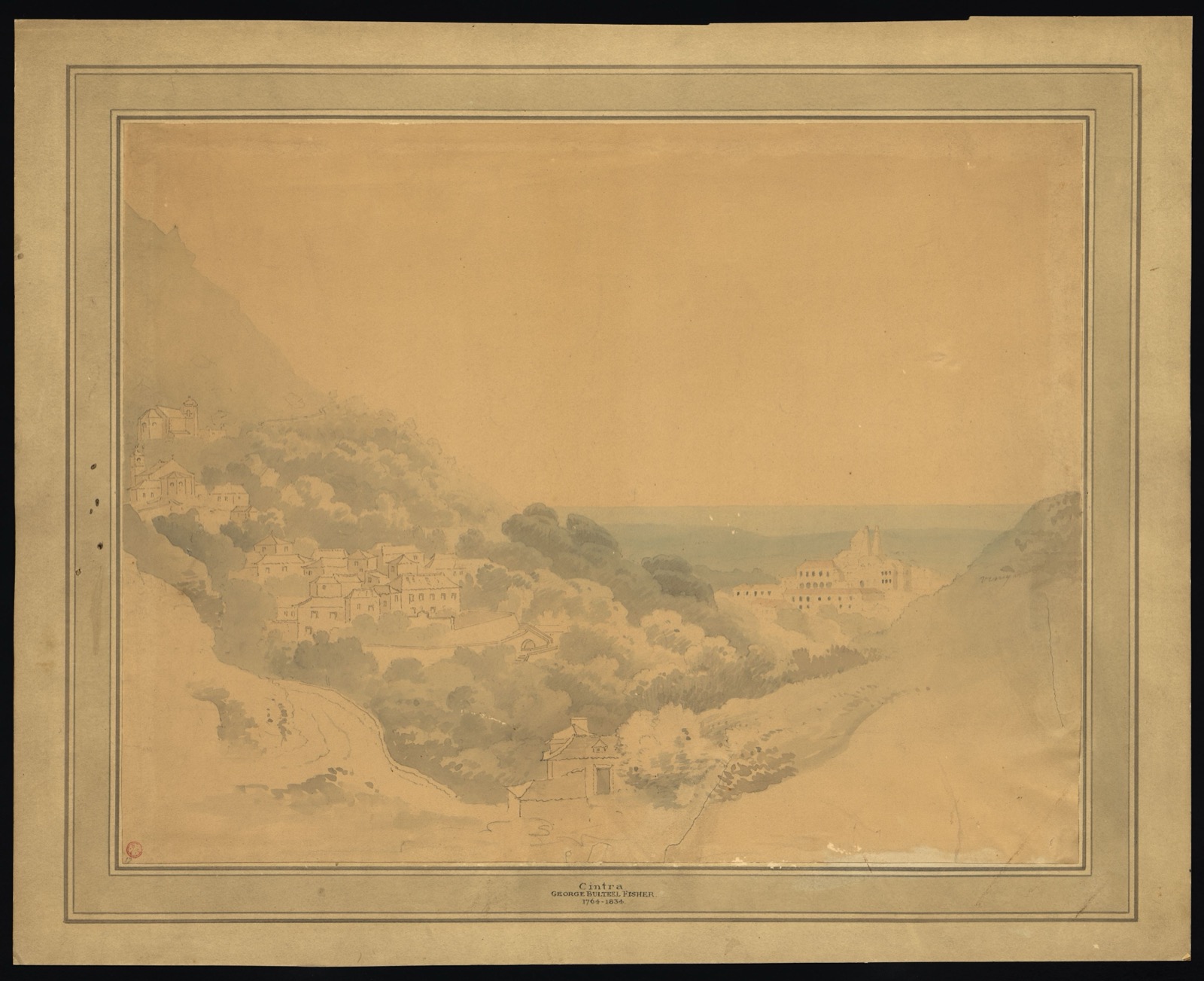
Cintra, drawn by George Bulteel Fisher
The village climbs the ravine below the Serra, the National Palace's twin conical kitchen chimneys rising at its centre and the coastal plain opening away to the right.
1809 · George Bulteel Fisher · Biblioteca Nacional de Portugal · Europeana
Public domain (plate dated 1809)
In this city
Landmarks of Sintra, see each in its prime


Castles of Sintra

More cities to explore
 PortugalLisbonExplore it in 1550 · 1750 · 1890
 PortugalCoimbraExplore it in 1750
 PortugalPortoExplore it in 1500 · 1790 · 1900
 NetherlandsUtrechtExplore it in 1400 · 1700
Castles of Europe · Landmarks of Europe · create your own reconstruction.