Historic Cities · Portugal
Lisbon through the ages
Lisbon is the capital and most populous city of Portugal, with an estimated population of 658,236 as of 2025, within its administrative limits and 3,353,000 within the metropolis, as of 2025. The city lies in the western portion of the Iberian Peninsula, on the northern shore of the River Tagus.

Lisbon in 1550
Age of Discovery Lisbon
Lisbon in 1550 is a maritime entrepôt at the height of Portugal’s global empire, its riverfront crowded with carracks and the institutions that organise spice, slave and silver traffic. The walk follows the Tagus from the estuary across Belém’s Manueline monuments into the Ribeira’s quays and through the merchant streets, ending at the castle that watches the city and harbour.
A low, riverside city of pale stone and red tile, Lisbon’s skyline is defined by Manueline pinnacles, church towers and the squat forms of arriving carracks. Streets slope from the castle down to broad quays where wooden masts and furled sails crowd the Tagus; façades are limewashed or dressed in local limestone, awnings and drying sails add darker tones, and the light carries salt and spice in the air between warehouses and churches.
The route: 22 streets, squares and views
Mar da Palha → Torre de Belém → Mosteiro dos Jerónimos → Belém Quays → Casa da Índia → Paço da Ribeira → Terreiro do Paço → Cais da Ribeira → Spice Quays → Mercado da Ribeira → …
Step inside, 13 interiors
River Tower Guard Chamber · Monastery Nave of Santa Maria · South Cloister Arcade · Royal Counting Chamber · Guarded Holding Chamber · Riverside Great Hall · Great Cargo Hold of a Carrack · Covered Spice Market Hall · Merchant's Counting Room · Goldsmith's Workshop · Carmelite Choir · Old Cathedral Nave · Castle Great Hall
Planned from the Wikipedia record: History of Lisbon.
Lisbon in 1750
Baroque Lisbon
Lisbon stands in its last gilded years before the disaster of 1755: a royal capital of baroque churches, azulejo‑clad palaces and a busy Tagus harbour threaded with tall merchant ships and small fishing craft. This walk follows the river and the old quarters (quays, squares, the aqueduct's great arches, narrow Alfama lanes and the hilltop castle) showing the city's public face and everyday labour in 1750.
The 1750 skyline is a close, terraced patchwork of red tile roofs, whitewashed and pastel plaster façades punctuated by church towers and the crenellated outline of São Jorge Castle. Along the Tagus stand quays and low palaces faced with blue and green azulejos; farther inland alleys tighten into shadowy stone, while broad aqueduct arches stride across valleys. Light is warm and dusty, streets are cobbled, and masts and pennants crowd the river.
The route: 22 streets, squares and views
Torre de Belém Approach → Jerónimos Monastery Forecourt → Alcântara Quay → Cais do Sodré Waterfront → Cais da Ribeira → Terreiro do Paço → Ópera do Tejo Façade → Rua Direita (Baixa) → Rua dos Mercadores → Praça do Rossio → …
Step inside, 12 interiors
Belém Tower Governor's Chamber · Jerónimos Cloister Gallery · Sailmakers' Loft · Ribeira Fishmarket Hall · Royal Azulejo Hall · Merchant Exchange Hall · Silk Mercer's Workshop · Gilded Chancel of São Roque · Carmo Convent Nave · Águas Livres Arcade Vault · Choir of São Vicente de Fora · Cathedral Nave
Planned from the Wikipedia record: History of Lisbon.
Lisbon in 1890
Fin-de-siècle Lisbon
Lisbon in 1890 stands between the rebuilt Pombaline Baixa and newly cut boulevards, a capital reshaped after the quake yet turning toward modernity. The walk moves from the Tagus waterfront through the ordered Baixa, the theatrical Rossio and Chiado, the hillside Alfama where fado lives, up to the castle ramparts that watch over the city and river.
The skyline is low and terraced, punctured by church towers and the castle on the highest hill; most buildings are stone and stucco, many facades dressed in glazed azulejos in blues and creams. The Baixa shows the Pombaline grid of regular facades and straight streets opening to the Praça do Comércio, while newer avenues bear broad sidewalks, plane trees and gas lamps. Streets bustle with horse-drawn trams, omnibuses, hawkers and clerks in dark coats, while the river throws a bright, salt-soft light across quays and rigging.
The route: 22 streets, squares and views
Tagus Approach, Cacilhas → Cais das Colunas → Praça do Comércio → Arco da Rua Augusta → Rua Augusta → Rua da Prata → Rua do Ouro → Praça da Figueira → Rossio (Praça D. Pedro IV) → Estação do Rossio → …
Step inside, 12 interiors
Maritime Customs Exchange · Figueira Municipal Meat Hall · Rossio Horseshoe Ticket Hall · Chiado Poets' Café · Trindade Theatre Auditorium · Santa Justa Ironworks · Glória Funicular Engine Room · Grand Avenida Hotel Lobby · Manueline Stone Courtyard · Alfama Fado Tavern · Cathedral Nave · Castle Keep Great Stair
Planned from the Wikipedia record: History of Lisbon.
Its story
The story of Lisbon.
Alis Ubbo: the Harbour on the Sea of Straw
The Mar da Palha, the Sea of Straw, is a basin in the Tagus estuary 23 kilometres across at its widest and the best natural port on the Atlantic coast of Portugal. Iron Age people held the hill where the castle and cathedral now stand from the 8th to the 6th centuries BC, and Phoenician pottery found near both shows they traded with the Phoenicians, who kept a post on the site supposedly called Alis Ubbo, "Pleasant Haven" or "Safe Harbour". Most modern historians hold that Lisbon began as an indigenous settlement in contact with the Phoenicians rather than as a Phoenician foundation.
The consul Decimus Junius Brutus Callaicus brought Olissipo into the Roman world by alliance in 138 BC and walled it against Lusitanian raids. It was made a municipium and named Olisipo Felicitas Julia by either Julius Caesar or Octavian. Around 30,000 people lived there, and the town linked the northern countries to the Mediterranean, selling garum, a luxury fish sauce, salt, and the Lusitanian horses renowned in antiquity. The Visigothic king Walia plundered and burnt it in 419; under later Visigothic rule it was called Ulixbona, and its Greek, Syrian and Jewish merchants went on trading with the Byzantine Empire.
Al-Ushbuna and the Crusader Siege of 1147
Muslim troops under Abdelaziz ibn Musa took the city in 714, and al-Ushbuna became again the commercial and administrative centre of the Tagus; contemporary accounts describe it as one of the largest cities in Europe, several times the size of Paris or London. Mozarabic Christians kept their own bishop and were tolerated as dhimmi on payment of the jizyah, and the Jewish community, present since the city's earliest days, grew more influential as its merchants added Levantine spices and medicines to the older trade in salt, fish and horses. Rebuilt to a Middle Eastern pattern of walls, mosque, medina and alcácer, it kept a hilltop castle that survives in altered form as the Castelo de São Jorge. In 844 several dozen Viking boats sailed into the Sea of Straw and held the city for a time after a thirteen-day siege.
Afonso I failed to breach the walls in 1137, and crusaders failed again in 1140. In June and July 1147 a force of 164 boatloads of English, Norman and Rhenish crusaders sailed from Dartmouth for the Holy Land; bad weather forced them into Porto, where they were persuaded to join a fresh assault. The Portuguese attacked by land while the crusaders brought up their siege engines, and the Moors capitulated on 22 October. By the account of the priest Raol, Germans from Cologne and the Flemish contingent broke their oaths to the king once inside, looting Muslims and Mozarabs alike and cutting the throat of the elderly Mozarab bishop; plague afterwards killed thousands among both populations. Afonso I took possession on 1 November, when the great mosque was dedicated to St Mary as a cathedral, and made the English crusader Gilberto of Hastings the city's first bishop.
Capital of the Kingdom: the Foral of 1179 to Ceuta, 1415
Afonso I granted Lisbon a foral in 1179 and opened a new fair to restore its trade. Its merchants, Christian and Jewish, rebuilt the old links to Seville, Cádiz and Constantinople and opened new ones to the northern ports the Muslims had rarely visited. Afonso III moved his court, the archives and the treasury from Coimbra to Lisbon in 1256. Castilian forces took the city in 1373 and left only on payment of a ransom, after which the Fernandine Walls were built.
The Jewish quarter lay along the Rua Nova dos Mercadores around the Great Synagogue, and Jews may have made up a tenth of the population or more. However eminent an individual Jew became, they were quartered separately, forbidden to go out at night, made to wear distinctive clothes and to pay extra taxes, and were the first victims of popular revolts. The Moorish quarter was the corresponding ghetto: with the Muslim elites gone to North Africa, most of its people worked low-wage jobs or were slaves of Christians. An earthquake in 1290 killed thousands, and the Black Death in 1348 killed half the population.
When Ferdinand I died without a male heir the crown passed in principle to John I of Castile. For the merchants of Lisbon, union with Castile meant severing the trade links with England and northern Europe on which the city lived, and they and the lesser nobles backed the Master of Avis. His forces survived the siege of Lisbon in 1384 and won the Battle of Aljubarrota in 1385; he was acclaimed John I, a new aristocracy rose out of the merchant class, and only from this point did the centre of power in Portugal move south to Lisbon. The capture of Ceuta in 1415 gave the city's merchants a foothold on the caravan trade in gold and ivory.
Mistress of the Seas: the Casa da Índia and the Massacre of 1506
Ottoman conquests in North Africa, Egypt and the Middle East cut into the spice, gold and ivory trades on which Lisbon depended, and its merchants, many of them descendants of Jews or Muslims with links across the Maghreb, resolved to reach the sources directly. Prince Henry organised the effort with funds from the Order of Christ and founded mariners' schools; the Gulf of Guinea was reached around 1460, the year he died. Vasco da Gama's ships, sent on the merchants' initiative but with royal funding, reached India in 1498, and Pedro Álvares Cabral reached Brazil in 1500.
For a time Lisbon sold Europe goods no one else could supply: pepper, cinnamon and diamonds carried on the Carreira da Índia, Chinese porcelain and silk, slaves from Mozambique, brazilwood and Brazilian sugar. The great trading houses, the Casa da Índia among them, collected the revenue and paid for the Jerónimos Monastery and the Torre de Belém, each classified a UNESCO World Heritage Site in 1983. The wealth rested in part on slavery: the first African slaves were sold in the Praça do Pelourinho, separated from their families, worked without pay and brutally treated, and by the mid-16th century a tenth of the population was of African descent.
When Spain expelled its Jews in 1496 many fled to Lisbon, perhaps temporarily doubling its population. In 1497 Manuel I decreed that all Jews convert to Christianity, those refusing being expelled only after their property was expropriated. In 1506 remarks by a converso at the Church of São Domingos, inflamed by three Dominican friars, set off a massacre of New Christians in which between 3,000 and 4,000 people were killed. The king ordered an investigation, two of the friars were burned alive, and the Dominicans were expelled from their convent. The Inquisition became formally active in 1536 and held its first auto-da-fé in the Palace Square in 1540. Since the goods of the condemned reverted to the inquisitors it worked as an instrument of control over the merchant class, and many merchants left for England or the Netherlands with their naval and cartographic knowledge.
Spanish Kings and the Brazilian Fifth, 1580–1755
Sebastian I and much of the Portuguese nobility were killed at Alcácer Quibir in 1578, and the succession crisis that followed was settled by force: Philip II of Spain defeated the troops of António, Prior of Crato, at Alcântara and was crowned Philip I of Portugal in 1581. Through the 17th century the Dutch, English and French took the Portuguese trading posts that supplied the city, and the spice trade went into long decline; Lisbon lost population and standing. On 1 December 1640 conspirators stormed the royal palace and citadel and acclaimed the Duke of Braganza king as John IV.
What relieved the country's finances was gold, found in 1693–95 in what is now Minas Gerais in Brazil. The royal fifth of everything mined began arriving in Lisbon in 1699 and peaked at more than three tonnes a year in the early 1750s, and the clergy and aristocracy spent it on Baroque palaces and on the Church of Santa Engrácia, later the National Pantheon. The gold drew large numbers of Portuguese emigrants to Brazil, and Lisbon merchants, undercut by British-financed rivals with direct access to the mines, turned to buying captive Africans at Luanda and selling them for gold at Rio de Janeiro.
1 November 1755: the Earthquake and Pombal's City
The first shock struck at 9.40 on the morning of All Saints' Day, followed by a second at ten and a third at noon. Many who ran for the open riverside squares were drowned about half an hour later by a seven-metre tsunami. Fires burned for six days and looting was widespread. Two thirds of the city was destroyed, including 17,000 of the 20,000 more lightly built houses of the poor; of 180,000 inhabitants, between 30,000 and 60,000 died. Voltaire turned the disaster against philosophical optimism in his Poème sur le désastre de Lisbonne of 1756 and again in Candide in 1759.
The Marquis of Pombal, effectively ruler of Portugal under Joseph I, answered the king's question about what to do with the words "Bury the dead. Feed the living. Rebuild the city." He refused advice to move the capital and had the Baixa laid out afresh by Eugénio dos Santos and Carlos Mardel under the chief engineer Manuel da Maia: wide straight avenues set at right angles, standardised façades, pine piles driven into the sandy soil, and a wooden bracing frame, the gaiola pombalina, designed to flex in an earthquake rather than come apart. Royal income from Brazil paid for almost the whole reconstruction; the work was not finished until 1806.
Pombal used the crisis politically, limiting the power of the Church and expelling the Jesuits; members of the Távora family were tortured and publicly executed in 1759 over an alleged plot against the king, a charge some historians hold to have been fabricated to break the old aristocracy. By the 1770s he had neutralised the Inquisition, and the New Christians who made up much of the educated middle class were freed from the restrictions that had barred them from high office. Pombal was dismissed when Maria I succeeded her father, and the police force created under her in 1780 expelled Freemasons, Jacobins and liberals.
Occupation, Republic, Revolution and the Capital Today
The royal family, aristocracy and high clergy sailed for Brazil on 29 November 1807, a day before General Junot's army entered Lisbon; Rio de Janeiro served as capital of the United Kingdom of Portugal, Brazil and the Algarves from 1808 to 1821. A British force under Wellesley and Beresford forced Junot out in late 1808, after which the British administered Lisbon and the country as virtual colonies. In 1820 Liberals in Porto rebelled, a coup in Lisbon expelled the British governors, and the Constitution of 1822 ended the privileges of the clergy and the nobility.
Carlos I and his heir Luís Filipe were assassinated in the Terreiro do Paço in 1908, and on 5 October 1910 a republican coup ended the monarchy. The coup of 28 May 1926 established the Estado Novo, which suppressed civil liberties and political freedom and ruled until 1974 as the longest-lived dictatorship in Western Europe. During the Second World War Lisbon was one of very few neutral, open Atlantic ports in Europe, a gateway for refugees to the United States and a haven for spies; more than 100,000 people fleeing Nazi Germany left through it. The Carnation Revolution, launched in Lisbon with a military coup on 25 April 1974, brought the regime down; Portugal withdrew from its African colonies and East Timor, and in 1974 and 1975 large numbers of refugees from those colonies arrived in the city.
Portugal joined the European Community in 1986, and the eastern municipality was rebuilt for Expo '98, held 500 years after Vasco da Gama's voyage to India. The city had 658,236 residents in 2025 within an administrative area of 100.05 square kilometres and its recent growth is essentially due to arrivals from abroad, the share of foreign nationals having roughly doubled between 2014 and 2019 to 17.48 per cent. Tourism had reached about six visitors for every resident by 2022, with a plurality of city-centre houses converted to tourist accommodation and housing supply squeezed as a result. Wages and purchasing power remain among the lowest of any European capital, and the city has a high level of youth emigration, mostly to France, the United Kingdom, Luxembourg, Switzerland and Belgium.
From the archive
Lisbon on paper: the old town as it was mapped.
A period plan or bird's-eye view of the old town, drawn between 1500 and 1850, the streets this page's reconstructions walk. Public domain, with its source named.
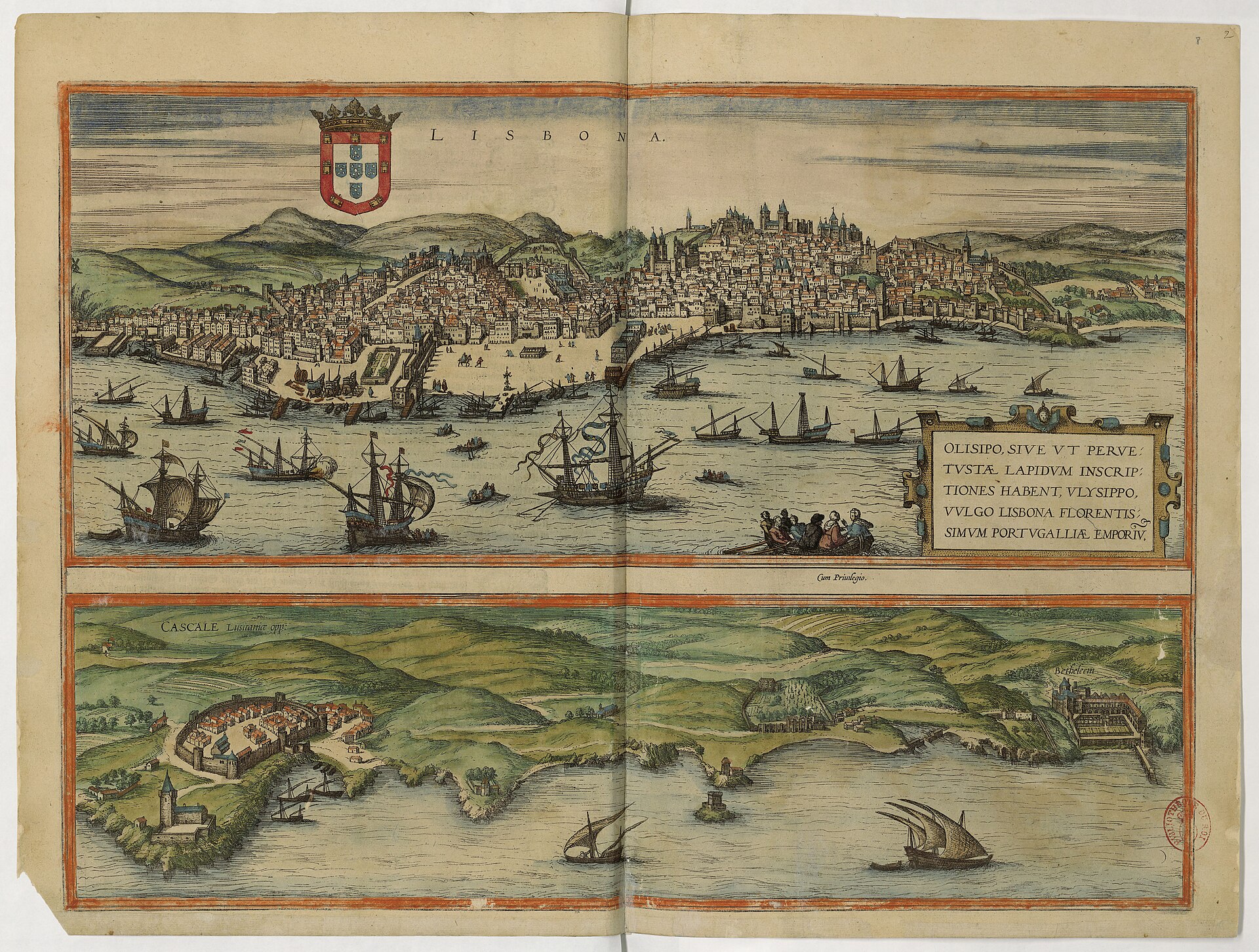
Bird's-eye view of Lisbon, from Braun & Hogenberg's Civitates Orbis Terrarum
Shows Lisbon's riverside harbour with many ships, the waterfront quays, city walls and gates, dense hilltop streets and the castle on the summit (São Jorge).
Public domain (plate dated 1582)
In this city
Landmarks of Lisbon, see each in its prime


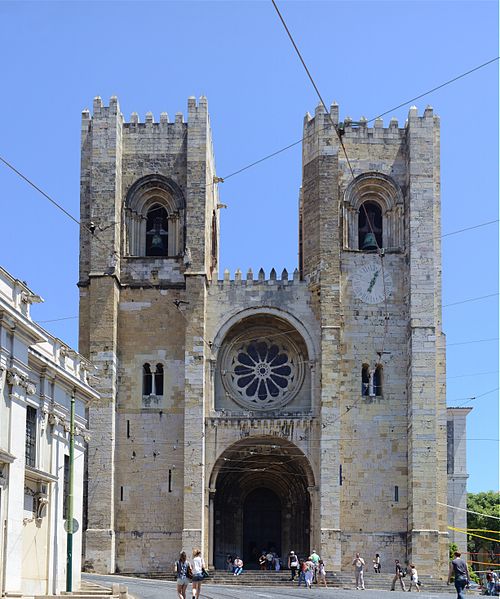
Ships tied to Lisbon
- SMS Schleswig-Holstein: At Lisbon her fleet chief was received by President Oscar Carmona
Castles of Lisbon

More cities to explore
 PortugalSintraExplore it in 1854
 PortugalCoimbraExplore it in 1750
 PortugalPortoExplore it in 1500 · 1790 · 1900
 NetherlandsUtrechtExplore it in 1400 · 1700
Castles of Europe · Landmarks of Europe · create your own reconstruction.