Historic Cities · Croatia
Dubrovnik through the ages
Dubrovnik, historically also known as Ragusa, is a city in southern Dalmatia, Croatia, by the Adriatic Sea. It is one of the most prominent tourist destinations in the Mediterranean, a seaport and the centre of the Dubrovnik-Neretva County. In 2021, its total population was 41,562.

Dubrovnik in 1300
Medieval Ragusa
Ragusa in 1300 lives as a fortified Adriatic commune under Venetian oversight, its walls and towers already enclosing the broad Stradun and a busy harbour. This walk follows the working waterfront, the early stone houses along the main street, cloisters and warehouses, and the city walls that watch the sea and the road to the Slavic hinterland.
A low, compact medieval port: thick quarried stone walls and squat towers rim a pale, sun-bleached town of clay-tiled roofs and narrow alleys. The Stradun is a broad, filled-in channel of worn pale limestone; the harbour shows oared galleys and small cargo cogs, wooden stocks and tarred ropes. Colours are bleached white and ochre stone, dark timber, and the green-blue Adriatic; scale is intimate, not grand, streets busy with merchants, sailors and friars.
The route: 22 streets, squares and views
Gruž Bay Approach → Old Port → Harbour Arsenal → Porta Ploča → Eastern Quay Customs → Stradun → Rector's Palace → Fish Market → Salt Warehouse → Dominican Cloister → …
Step inside, 12 interiors
Galley Bays · Gatehouse Guardroom · Customs Counting Room · Audience Hall · Fish Market Shed · Salt Vault · Chapter House · Parish Nave · Friars' Refectory · Meat Market Hall · Shipwrights' Workshop · Tower Magazine Chamber
Planned from the Wikipedia record: Republic of Ragusa.
Dubrovnik in 1550
Golden Age Ragusa
This is Ragusa at the height of its maritime and diplomatic power: a compact limestone city-state whose merchants and fleet rival those of Venice. The walk moves from the Adriatic approach through the eastern harbour, along the Stradun past Sponza and the Rector's Palace, and finishes on the high city walls looking over the fleet and the patrician gardens of the coast.
White limestone walls and terraces rise directly from the Adriatic, tiled with low red terracotta roofs and pierced by compact gates and towers. The narrow Stradun is a bright ribbon of smoothed stone between rows of arcaded houses; loggias, carved Gothic and early Renaissance portals, and the newly elegant Sponza and Rector's Palace punctuate the line. A busy harbour fills with late-medieval galleys and merchant carracks, their masts a forest against the sky.
The route: 20 streets, squares and views
Approach from Lokrum → Old Harbour (Porto Vecchio) → St. John's Fortress → Arsenal and Shipyards → Revelin Fortress → Ploče Gate → Onofrio's Fountains → Stradun (east end) → Sponza → Luža Square and Orlando → …
Step inside, 14 interiors
Warehouse Longroom · Shipowner's Counting Room · Gate Guard Chamber · Patrician Palazzo Salon · Customs Court · Open Loggia Stage · Grand Stone Atrium · Patron's Chapel · Friars' Cloister · High Marble Nave · Stone Gatehouse Chamber · Bastion Hall · Gruž Chandlery Office · Round Keep Chamber
Planned from the Wikipedia record: Republic of Ragusa.
Dubrovnik in 1780
Baroque Dubrovnik
Ragusa in 1780 is the aristocratic Republic rebuilt in a restrained Baroque after the catastrophic 1667 earthquake and still governed by its patrician institutions. The walk passes the Stradun's pale limestone pavement and uniform houses, the new cathedral and Saint Blaise's church, the harbour and shipyards, and the public stairs and squares where civic ceremonies and everyday commerce meet.
The city appears as a compact island of pale limestone and neatly aligned Baroque façades under low red-tile roofs, ringed by high stone walls and rounded bastions. Two slender bell towers and the cathedral dome puncture a low, regular skyline; the Stradun runs like a bright ribbon of worn marble between narrow, shadowed alleys. The Adriatic glints against quays and fortress rock, and the air carries salt and the sound of oars and market cries.
The route: 22 streets, squares and views
Lokrum and Harbour Approach → St. John's Fortress → Old Port (Riva) → Ploče Gate (Porta di Ploče) → Onofrio Fountain → Stradun (Placa) → Luža Square and Column → Sponza Palace → Rector's Palace → Cathedral of the Assumption → …
Step inside, 12 interiors
Coopers' Workshop at the Riva · Sponza Customs Hall · Great Hall of the Rector · Cathedral Treasury · High Altar with City Model · Franciscan Pharmacy and Herb Room · Dominican Chapter House · Jesuit College Library · Nave of the Jesuit Church · Gundulić Coffeehouse Room · Arsenal Shipwright's Hall · Pile Gate Guardroom
Planned from the Wikipedia record: Republic of Ragusa.
Its story
The story of Dubrovnik.
Laus, Epidaurum and the Dispute over the Founding
The classical account of the city's beginning is in Constantine VII's De Administrando Imperio, written around 950. It says Ragusa was founded in the seventh century by refugees from Epidaurum, a city some fifteen kilometres to the south, when that place was destroyed by Slavs fighting alongside the Avars, and that the name comes from Lausa, the rocky island the newcomers settled on. Ragusa remained the official name until 1808, and of the city within the Kingdom of Dalmatia until 1918; Dubrovnik, most likely from the Proto-Slavic word for oak, is first recorded in the Charter of Ban Kulin in 1189.
Both standard explanations have since been put in doubt. Excavations in 2007 uncovered an eighth-century Byzantine basilica and parts of the walls; work under the cathedral turned up two earlier churches, one dated to the fifth century; and soundings under the Stradun found the street to be a natural sandy beach rather than made ground over a filled channel, which would mean the island of Laus never existed as a separate rock. Antun Ničetić argued in 1996 that the harbour was established by Greek sailors as a staging point midway between Budva and Korčula.
Venice, the Statutes of 1272 and the Peace of Zadar, 992–1380
After the fall of the Ostrogothic Kingdom the town came under the protection of the Byzantine Empire, and it was burned by Tsar Samuel around 992. Venice used the Crusades to take the city in 1205 and held it until 1358; three risings against Venetian rule failed, but the city kept its own Minor and Major Councils and Senate, and in 1272 the commune received Statutes that codified Roman practice and local custom and set out rules for town planning and for quarantine. Fire destroyed most of the town on the night of 16 August 1296.
The city added its territory by purchase and cession rather than by conquest: Lastovo in 1240 from Stefan Uroš I of Serbia; the Pelješac peninsula with Ston in 1333, ceded by Tsar Dušan against a payment of 500 perpers; Mljet in 1345; and Konavle, with Cavtat, on 31 December 1426. Ston let it watch the shipping around the mouth of the Neretva. By the Peace of Zadar in 1358 Venice gave up its possessions on the eastern Adriatic, and the city accepted the symbolic overlordship of Louis I of Hungary, paying 500 ducats a year for a suzerainty that carried almost no practical influence and that shielded it from Venice. After Louis died in 1380 it became a recognised republic, electing its own rector.
Trading Under a White Flag: Ancona, the Ottomans and Goa
An aristocracy of Latin-Dalmatian descent governed through the Major Council, which chose the Senate for foreign affairs and the Minor Council for executive business; the rector was elected for a single month at a time to head off corruption, and there was no standing army. The Republic legislated early in matters other states came to later: a medical service in 1301, a pharmacy in 1317 that has remained in operation, an almshouse in 1347, a quarantine hospital in 1377 and an orphanage in 1432. In 1438 the Neapolitan engineer Onofrio della Cava replaced the cisterns with a twenty-kilometre water supply and two public fountains.
Wealth came from trade rather than from land. The city was for centuries the ally of Ancona, the other Adriatic republic that stood against Venice, and the two ran a route from Dubrovnik across to Ancona and on through Florence to Flanders, against the Venetian road through Austria and Germany. Ragusa was also an important base for the traffic of the Balkan slave trade: people were carried from the Balkans across the Adriatic to the Aegean and sold on to Spain in the west or Egypt in the south. The Republic abolished slave trading early in the fifteenth century (the decree is dated 27 January 1416 in one account and 1418 in another), and it was then that the city adopted the white flag bearing the word Libertas.
From 1382 to 1804 it paid an annual tribute to the Ottoman sultan, which bought access to the Black Sea, lower customs duties, Turkish backing in trade disputes with Venice, and an overland network into the Balkan interior that no other Christian state matched. Its merchants reached Portuguese Goa between 1530 and 1535 and founded a settlement called São Braz after Saint Blaise, the city's patron, said to have held some 12,000 inhabitants before the trade fell away in the 1570s. Conversos (Jews from Spain and Portugal who had converted to Christianity) were drawn to the port, and in May 1544 a ship landed there carrying Portuguese refugees alone.
Latin was the official language until 1472, but as Slavic migration from inland Dalmatia grew most of the population came to speak Croatian, and the Romance-descended governing families tried to bar Slavic languages from the councils. Croatian entered literary work from the mid-fifteenth century and the city became a centre of Croatian literature; the poet Ivan Vidalić, writing in 1564, called it the 'crown of Croatian cities'.
The Earthquake of 1667 and the Sale of the Coast Strip
The Republic's decline had several causes at once. The Atlantic discoveries moved the trade routes, the new Venetian landing stage at Split cut into its business and its monopoly on trade with the Ottomans ended, while French, English and Dutch shipping crowded the Mediterranean. The earthquake of 1667 came on top of that: it killed more than 5,000 people, levelled most of the public buildings and was followed shortly by fire.
The wars between the Ottomans and the European powers left the Republic exposed in another way. In 1699 it was forced to sell two patches of its mainland to the Ottomans rather than be caught in the clash with the advancing Venetians (that strip of land is today the only access Bosnia and Herzegovina has to the Adriatic), and at the Peace of Passarowitz in 1718 it gave up the corridor between Neum and Klek for the same reason, so that Venetian Dalmatia never touched its border. The economy recovered in the eighteenth century and the merchant fleet was rebuilt, and with the nobility thinned by the earthquake the merchant citizenry became the strongest force in it.
Occupied by Deception, Abolished by Decree, 1806–1815
On 26 May 1806 French forces entered the territory of the neutral Republic without permission, and General Jacques Lauriston asked that his troops be allowed to rest and take food and drink in the city before going on to French holdings in the Bay of Kotor. The request was a ruse: once inside they occupied the city in Napoleon's name. Russian and Montenegrin troops came onto Ragusan territory almost immediately, fighting the French and raiding as they went, and besieged the occupied city, during which 3,000 cannonballs fell on it. In 1808 Marshal Marmont proclaimed the Republic abolished and its territory joined to the Napoleonic Kingdom of Italy, taking the new title of Duke of Ragusa; in 1810 it passed with Istria and Dalmatia into the French Illyrian Provinces.
After seven years of occupation, encouraged by French desertions following the failed invasion of Russia, every class of Ragusan society rose against the French under the lead of the patricians. On 18 June 1813, with British help, they forced the surrender of the French garrison on Šipan, then Ston and Lopud, and the rising spread across the mainland from Konavle; they then besieged the city with the Royal Navy under Captain William Hoste. Austria sent a force under General Todor Milutinović, ostensibly to help its Ragusan allies, but its purpose was to take the city for itself: one of the Republic's temporary governors was won over with promises of power and kept the eastern gate shut against the insurgents while Austrian troops entered from the west.
The flag of Saint Blaise flew beside the Austrian and British colours for two days, until on 30 January Milutinović ordered Mayor Sabo Giorgi, the last Rector of the Republic, to take it down; Giorgi refused, saying the masses had hoisted it. The government never signed a capitulation and never renounced its sovereignty, which under the rules Austria itself had adopted for the Congress of Vienna should have meant restoration, and its elected representative was refused a hearing there while smaller former states were admitted.
Austrian Dalmatia, Yugoslavia and the Daksa Executions, 1815–1979
The territory was absorbed into the Habsburg Kingdom of Dalmatia, and in 1815 the old noble assembly met for the last time at the summer house in Mokošica; further attempts to restore the Republic came to nothing. A narrow-gauge railway linking the port to the interior of Bosnia and Herzegovina ran from 1901 to 1976, and a tram service from 1910 to 1970.
The city joined the Kingdom of Serbs, Croats and Slovenes in 1918, became part of the Zeta Banovina when Yugoslavia was divided in 1929, and passed to the Banovina of Croatia in 1939. In the Second World War it lay within the Independent State of Croatia, an Axis puppet state, occupied by the Italian army and then by the German army after 8 September 1943. Yugoslav Partisans liberated the city in October 1944, arrested more than 300 citizens and executed 53 without trial on the small island of Daksa. Political prosecutions continued, and on 12 April 1947 more than ninety citizens were seized and imprisoned. After the war the remaining Dalmatian Italians of Dubrovnik left Yugoslavia for Italy in the Istrian-Dalmatian exodus: Austrian censuses had counted 331 habitual Italian speakers in the central settlement in 1890 and 409 in 1910, about 4.6 per cent each time, while in 2011 twenty-seven people declared themselves Italian.
Tourism grew under communist rule. The Dubrovnik Summer Festival was founded in 1950, the Adriatic Highway opened in 1965 after a decade of work, connecting the city to Rijeka along the whole coast, and the Old City was inscribed on the UNESCO World Heritage list in 1979. Tourist income paid for much of the city's development, including its airport, and led to the decision to demilitarise the Old Town.
The Siege of 1991–1992 and the City After It
Despite that demilitarisation, the Yugoslav People's Army, by then made up primarily of Serbs, attacked the city after Croatia declared independence in 1991, and the new Croatian government set up a military outpost in the city itself. Montenegro, led by Momir Bulatović and Milo Đukanović and allied to Slobodan Milošević in Serbia, declared that Dubrovnik should not remain in Croatia; by that time most residents identified as Croatian, with Serbs 6.8 per cent of the population. The attack began on 1 October 1991 and the siege lasted seven months. The heaviest artillery attack fell on 6 December, killing 19 people and wounding 60. The Croatian Red Cross put the number of civilians killed at 114, among them the poet Milan Milišić. Foreign newspapers were criticised for giving more attention to the damage to the Old Town than to the human casualties.
The shelling damaged 56 per cent of the city's buildings to some degree, and the walled historic city took 650 artillery hits. The Croatian Army lifted the siege in May 1992 and cleared the surrounding area by the end of October, though the risk of sudden attack lasted a further three years. Repairs were carried out in the original style under UNESCO guidance, mostly between 1995 and 1999. The International Criminal Tribunal for the former Yugoslavia indicted army officers over the bombardment; General Pavle Strugar, who coordinated the attack, was sentenced to seven and a half years.
The city is the seat of Dubrovnik-Neretva County, and its population was 41,562 at the 2021 census, down from 42,615 in 2011 and 49,728 in 1991. By 2018 visitor numbers had forced the council to stagger cruise-ship arrivals across the week, and in 2023 the mayor announced a ban on wheeled luggage in the Old Town to cut the noise on its paving.
From the archive
Dubrovnik on paper: the old town as it was mapped.
A period plan or bird's-eye view of the old town, drawn between 1500 and 1850, the streets this page's reconstructions walk. Public domain, with its source named.
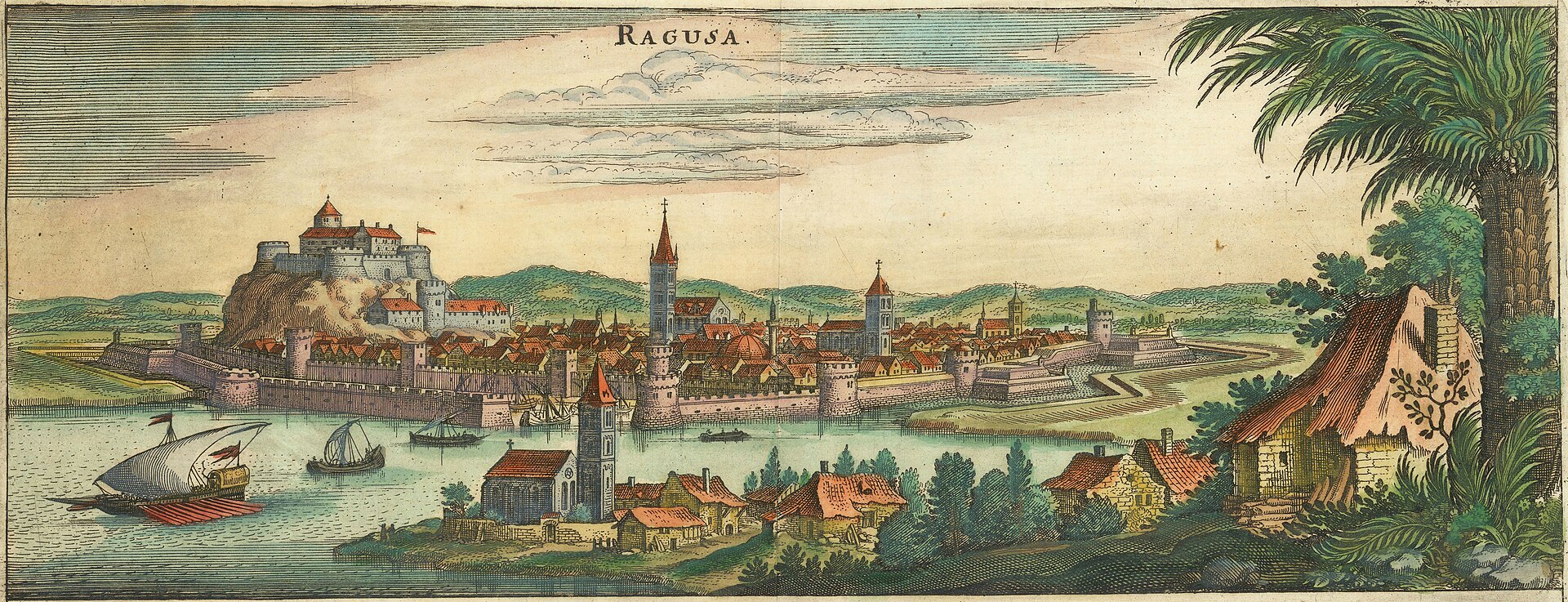
Bird's‑eye view of Ragusa (Dubrovnik), Matthäus Merian, 1638
Shows the walled old town with bastioned towers and gates, harbour with ships, prominent church bell‑towers and a fortress on the headland.
1638 · Matthaus Merian · Wikimedia Commons
Public domain (plate dated 1638)

More cities to explore
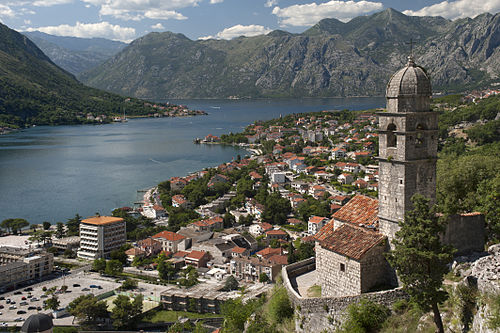 MontenegroKotorExplore it in 1750
 Bosnia and HerzegovinaMostarExplore it in 1665
 CroatiaSplitExplore it in AD 305 · 1600
 CroatiaZadarExplore it in 1580
Castles of Europe · Landmarks of Europe · create your own reconstruction.