Historic Cities · Montenegro
Kotor through the ages
Kotor, historically known as Cattaro, is a town in Coastal region of Montenegro. It is located in a secluded part of the Bay of Kotor. The city has a population of 13,347 and is the administrative center of Kotor Municipality.

Kotor in 1750
Venetian Cattaro
This is Cattaro in the mid-18th century, the Venetian port folded into the deep elbow of the bay and ringed by fortifications that climb the limestone to San Giovanni. The walk passes the Sea Gate into the medieval grid, St Tryphon's twin towers, the palazzi of old families, the busy quay with galleys and trabaccoli, and the mariners' rites performed in the squares.
The town sits compact at the head of the Bay of Kotor, a close cluster of pale stone houses and terracotta roofs set beneath towering limestone cliffs. Venetian palazzi and the Romanesque cathedral punctuate a skyline of narrow towers rather than broad domes; massive stone walls run directly up the slope to the fortress of San Giovanni. Streets are narrow, sun-cut and shadow-deep; the quay is alive with oared galleys, small trading trabaccoli and domestic boats bobbing on dark Adriatic water.
The route: 10 streets, squares and views
Bay of Cattaro → Sea Gate → Square of Arms → St Tryphon's Cathedral → St Luke's Square → Palazzo Pima → Palazzo Grgurina → The Quay (Riva) → Škurda Gorge & North Gate → Fort San Giovanni
Step inside, 5 interiors
Cistern Court · Relic Chapel · Captain's Hall · Marineers' Guild Hall · Chart-Maker's Studio
Planned from the Wikipedia record: Kotor.
Its story
The story of Kotor.
From Ascrivium to Dekatera, 168 BC–1143
The site was once populated by the Illyrians, and the exact date at which the first settlement was founded is not known; some accounts put the oldest settled area two millennia back. The town enters the written record in 168 BC and was settled in Roman times under the names Acruvium, Ascrivium or Ascruvium, within the Roman province of Dalmatia.
It has been fortified since the early Middle Ages. In 535, after expelling the Ostrogoths, the Emperor Justinian built a fortress above Ascrivium. The town was plundered by the Saracens in 840, and in the tenth century Constantine VII Porphyrogennetos extended the defences towards the peak of Saint Ivan.
Kotor was one of the more influential Dalmatian city-states, with an initially Romance-speaking population; the Dalmatian language was still spoken here until the eleventh century. It belonged in this period to Byzantine Dalmatia, and the modern name probably derives from the Byzantine form Dekatera or Dekaderon.
In 1002 the town was damaged under occupation by the First Bulgarian Empire, and the following year the Bulgarian Tsar Samuil ceded it to Duklja, then a vassal duchy of that empire. The local population resisted the arrangement and, using its alliance with Dubrovnik, held on to a high degree of autonomy. Duklja grew more powerful under the Vojislavljević dynasty and became independent of Byzantium in 1040; Kotor remained autonomous until Duklja was subdued by Byzantium again in 1143.
City of the King: Nemanjić Rule and the Statute of 1301
In 1185 the town was conquered by Stefan Nemanja, ruler of the Grand Principality of Serbia and founder of the Nemanjić dynasty. Kotor was by then an episcopal see subordinate to the archbishopric of Bari, and in the thirteenth century Dominican and Franciscan houses were established here to check the spread of Bogomilism. Under Nemanjić rule the town was only partially absorbed: it kept its republican institutions and a long list of privileges, a status set out in its statute of 1301.
What it did for a living was carry Serbian trade to the Adriatic. By the fourteenth century the commerce of Cattaro (in Serbian Kotor, grad kraljev, the city of the King) rivalled that of the Republic of Ragusa and the other major trading towns of the eastern Adriatic, and it remained the most important trading port of the Kingdom of Serbia and then the Serbian Empire until that empire's downfall in 1371. The Cathedral of Saint Tryphon in the old town dates from 1166.
Hungary, Bosnia and the Turn to Venice, 1368–1420
In 1368 the town was attacked by the Balšići under Đurađ I. After the Serbian Empire fractured it was taken by the Kingdom of Hungary, and between 1371 and 1384 it changed hands repeatedly between Hungary and the Republic of Venice. From 1384 to 1391 it was held by the Kingdom of Bosnia under Tvrtko I Kotromanić, who claimed the Serbian throne and minted his coins in Kotor.
After Tvrtko's death in 1391 Kotor became fully independent. Its administration, wary of the looming Ottoman danger, asked Venice for protection, and in 1420 the town acknowledged Venetian suzerainty.
Venetian Albania: Siege, Plague and Earthquake, 1420–1797
Kotor was part of the province of Venetian Albania from 1420 to 1797, and the fortifications that ring the old port were built during those four centuries of Venetian rule. In the fourteenth and fifteenth centuries settlers arrived from the oblasts of Trebinje (the country around the forts of Klobuk, Ledenica and Rudina), and from the Duchy of Saint Sava at Gacko and Dabar.
The Venetian centuries were punctuated by disaster and attack. The Ottoman Empire besieged the town in 1538 and again in 1657; plague struck in 1572; and earthquakes in 1563 and 1667 nearly destroyed it.
Local self-government survived longer than Venetian law allowed. Through the fifteenth and sixteenth centuries the customs of the local administration, including the right of the popolari to elect urban representatives, went unchanged and were tolerated by the city's Provveditore despite Venetian prohibitions on such institutions. In 1627, during a dispute between the popolari and Kotor's nobility, the consultare Fulgenzio Micanzio revoked that right, strengthening the position of the urban elite.
Habsburg, French and British Hands, 1797–1918
The Treaty of Campo Formio passed the town to the Habsburg monarchy in 1797. The Treaty of Pressburg assigned it in 1805 to the Napoleonic Kingdom of Italy, though it was in fact held by a Russian squadron under Dmitry Senyavin; after the Russians withdrew it was united with the Kingdom of Italy in 1806 and with the French Empire's Illyrian Provinces in 1810.
It was taken from the French by a British attack on the bay led by Commodore John Harper in the brig sloop HMS Saracen of eighteen guns. To seal off Kotor, residents along the shore hauled the becalmed ship in by rope. Saracen's crew afterwards dragged naval 18-pounders up above Fort St John, the fortress near the town, and were reinforced by Captain William Hoste in HMS Bacchante of thirty-eight guns. The French garrison surrendered on 5 January 1814. The Congress of Vienna restored the town to the Habsburgs, and until 1918 Cattaro was the seat of a district, one of the thirteen Bezirkshauptmannschaften of the Kingdom of Dalmatia.
The Cattaro Mutiny and the Fading of Italian Kotor
During the First World War Cattaro was one of three main bases of the Austro-Hungarian Navy, home port of the Austrian Fifth Fleet of pre-dreadnought battleships and light cruisers and a base for Austrian and German submarines. The Cattaro mutiny of Austro-Hungarian sailors began here on 1 February 1918; it remained isolated and was abandoned after three days when loyal troops arrived. Four sailors were subsequently executed under naval law. The surrounding area saw some of the fiercest fighting between local Montenegrins and Austria-Hungary. The town came under the allied occupation of the eastern Adriatic in 1918, and afterwards became part of Yugoslavia under the name Kotor.
There had long been a substantial Italian-speaking community here; Italian was the main language of the town until the nineteenth century, when it began to decline in favour of Serbian. The Austrian censuses counted 623 habitual Italian speakers in the central settlement in 1890–18.7 per cent of the population, and 257, or 8.1 per cent, in 1910. The majority of the Italian population left for Italy after the Treaty of Rapallo of 1920.
Between 1941 and 1943 the Kingdom of Italy annexed the Kotor area, which became the Province of Cattaro, one of three provinces of the Italian Governorate of Dalmatia, covering 547 square kilometres in fifteen comuni with 39,800 inhabitants. Most of the town's inhabitants were Orthodox, with some Roman Catholics. After the war the 300 remaining Dalmatian Italians of Kotor left Yugoslavia for Italy in the Istrian-Dalmatian exodus. In 2011, 31 people in the municipality declared themselves Italian, 0.14 per cent of the population. Above the entrance to the old town, a stone relief bearing the emblem of Yugoslavia replaced, after the socialist revolution, one carved with the Venetian lion of St Mark.
A Town of 1,360, Two World Heritage Listings and the Cruise Trade
Kotor is the administrative centre of Kotor Municipality, which also takes in the towns of Risan and Perast and many small hamlets around the bay; the municipality had 21,916 inhabitants at the 2023 census. The administrative limits of the town proper cover only the old town and hold 1,360 people, while the wider urban area including Dobrota and Škaljari comes to close to 13,000. The town remains the seat of the Catholic Bishopric of Kotor, which covers the whole gulf; in 2011, 78 per cent of its citizens were Orthodox Christians and 12 per cent Roman Catholic.
The fortified town carries two UNESCO World Heritage listings: as part of the Natural and Culturo-Historical Region of Kotor, and, from 2017, as part of the Venetian Works of Defence between the 16th and 17th Centuries: Stato da Terra – western Stato da Mar. Tourism has grown since the early 2000s, much of it arriving by cruise ship, and the town received over 250,000 visitors in 2019.
From the archive
Kotor on paper: the old town as it was mapped.
A period plan or bird's-eye view of the old town, drawn between 1500 and 1850, the streets this page's reconstructions walk. Public domain, with its source named.
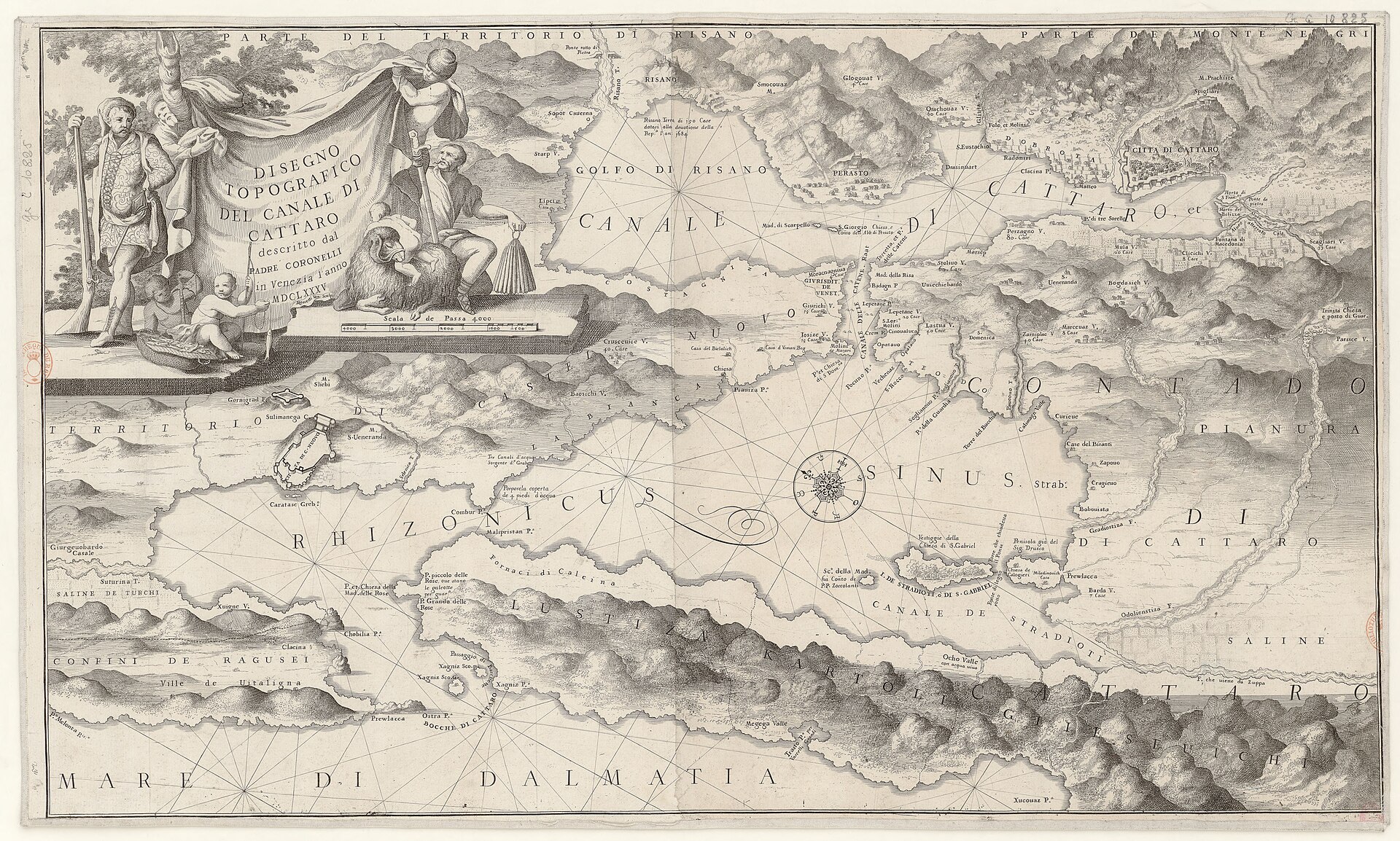
Disegno topografico del Canale di Cattaro, by Vincenzo Maria Coronelli (1685)
Depicts the walled Città di Cattaro with bastioned ramparts, gates, harbour and internal street blocks.
Public domain (plate dated 1685)
More cities to explore
 CroatiaDubrovnikExplore it in 1300 · 1550 · 1780
 Bosnia and HerzegovinaMostarExplore it in 1665
 NetherlandsUtrechtExplore it in 1400 · 1700
 EnglandLondonExplore it in AD 200 · 1390 · 1600 · 1885
Castles of Europe · Landmarks of Europe · create your own reconstruction.