Historic Cities · Bosnia and Herzegovina
Mostar through the ages
Mostar is a city and the administrative centre of Herzegovina-Neretva Canton of the Federation of Bosnia and Herzegovina, an entity of Bosnia and Herzegovina, and the historical capital of Herzegovina.

Mostar in 1665
Bridge of the Bazaars
This is Mostar in the mid‑17th century, an Ottoman river town grown around Hayruddin's single soaring bridge and the bazaars that step to the water. The walk shows the Stari Most and its towers, the Kujundžiluk coppersmiths, riverside mosques and the fruit‑filled courtyards and tanneries that line the emerald Neretva.
A pale tenelija limestone arch spans the emerald Neretva with a single elegant curve some thirty metres across and roughly twenty‑four metres above the summer water, flanked by the squat stone towers Tara and Halebija. Narrow stone streets and stepped bazaars tumble to the riverbank; grey stone roofs and wooden balconies overhang alleys. Koski Mehmed Pasha's minaret and small wooden bridges punctuate the skyline, while coppersmiths, fruit stalls, orchards and tannery vats colour the banks.
The route: 9 streets, squares and views
View from Hum → Bijela Tabija → Čaršija (Market Quarter) → Tepa Market → Kujundžiluk (Coppersmiths' Street) → Kriva Ćuprija (Crooked Bridge) → Koski Mehmed‑Pasha Mosque → Stari Most and Towers → Radobolja Tanneries
Step inside, 5 interiors
Galleried Han Courtyard · Hammam's Steam Room · Coppersmith's Workshop Booth · Prayer Hall under Painted Dome · Carved Divanhana Overlooking Neretva
Planned from the Wikipedia record: Stari Most.
Its story
The story of Mostar.
The Bridge Keepers' Town and the Bridge of 1566
Mostar exists because of a crossing. The old trade road out of the Bosnian hinterland met the Neretva here, where the river was easiest to bridge, and carried on towards the sea. By the mid-fifteenth century two towers guarded a wooden suspension bridge over it, and the earliest documented mention of the place is of them: on 3 April 1452 Ragusans of Dubrovnik wrote that Vladislav Hercegović had turned against his father Stjepan and seized Blagaj and other places, including “Duo Castelli al ponte de Neretua”. A charter of King Alfonso V of Aragon in 1454 refers to it indirectly as Pons, the bridge. The name Mostar, from the mostari or bridge keepers, appears in an Ottoman register of 1468–69 and in a Dubrovnik council document of 1474.
The Ottomans took the district in the 1460s and the settlement grew into a town named Köprühisar, fortress at the bridge. The first Ottoman survey recorded only a cluster of houses (fifteen by one count, nineteen by another), and a register of 1519 lists Mostar as a castle with four Muslim and eighty-five Christian households. From 1474 it was the seat of a subaşı, and of a kadiluk with its own judge, and because the town lay on the route between the Adriatic and the mineral-rich districts of central Bosnia, settlement spread to the right bank.
The stone Old Bridge was raised in 1566 on the orders of Sultan Suleiman the Magnificent, designed by Mimar Hayruddin, a student of Sinan, spanning some 28 metres about 20 metres above the water. In the seventeenth century the traveller Evliya Çelebi wrote that it was “like a rainbow arch soaring up to the skies”, and that in sixteen countries he had never seen a bridge so high. Economic ascent followed: through the later sixteenth and seventeenth centuries Mostar was the leading craft and trading town of Herzegovina, with perhaps 10,000 inhabitants by the end of that period. The eighteenth century brought stagnation and a falling population.
Ali-Pasha's Pashalik and the New Churches, 1832–1878
Early in the nineteenth century Mostar was a stronghold of resistance to Ottoman centralising reform under the ayan Ali-aga Dadić. After the Bosnian landowners' movement collapsed in 1832, a separate Herzegovinian pashalik was created with its seat at Mostar under Ali-pasha Rizvanbegović, who held it until 1851. As central power weakened and the Christian population's weight in the town's life grew, the authorities began permitting Christian religious building. The Old Orthodox Church of 1834 was the first church built in Mostar; the town had been the seat of the Serbian Orthodox metropolitan of Herzegovina since 1777, and the Orthodox community received its Cathedral of the Holy Trinity in 1873, built as a gift from the Sultan. The Catholics built the bishop's residence at Vukodol in 1847 and the Franciscan church of SS Peter and Paul in 1866. The tanzimat reforms arrived late, municipal administration only in 1866, and Austria, Italy, Russia, Britain and France opened consulates in the last years of Ottoman rule. During the Herzegovina uprising of 1875–78 Mostar was the seat of the Ottoman governor.
Presses, Railways and Nineteen Forts: Habsburg Mostar, 1872–1941
Franjo Milićević founded the first Croatian printing house in Bosnia and Herzegovina at Mostar in 1872, and out of it came the country's first newspapers, textbooks and manuals in Croatian, among them Hercegovački bosiljak in 1883 and Osvit in 1898.
Austria-Hungary took Mostar on 5 August 1878 and held Bosnia and Herzegovina until 1918. In forty years the administration and the city council, with figures such as Mustafa Mujaga Komadina, laid a grid of broad avenues over the western bank, linked the two banks with three new bridges, and installed a modern water supply, sewerage, electric light and rail and road links to the rest of Bosnia and to Dalmatia. The tobacco factory opened in 1880 and a coal mine in 1919; in 1881 Mostar became the seat of the Catholic diocese of Mostar-Duvno, and the town was made one of four Habsburg fortress belts in the country, carrying nineteen fortified works. Between the wars it raised no factory at all, lying in the Mostar oblast from 1922 to 1929, then in the Primorska banovina, and from 1939 to 1941 in the Banovina of Croatia.
Velika Župa Hum and the Killings of 1941–1945
After the Axis attack on Yugoslavia and the proclamation of the Independent State of Croatia, Mostar fell within the Italian zone of interest inside the NDH and became the seat of Velika župa Hum, one of twenty-two such districts. Ustaša units, Italian and German divisions and Home Guard regiments were headquartered in the town, and a Mostar battalion fought with the Partisans.
The bishop of Mostar, Alojzije Mišić, described the Ustaša killings of Serb civilians in and around the town in the summer of 1941: “From Mostar and Čapljina the railway carried six full wagons of women, mothers and girls, children under ten, to the station at Šurmanci, where they were taken out of the wagons, led into the hills and thrown alive into deep ravines. All were hurled down and killed… In the city of Mostar itself, hundreds were bound, taken out of the city and killed like animals.” Mišić also testified to mass Ustaša killings of Orthodox people around Mostar who had already converted to Catholicism, part of the policy of forced conversion. The synagogue was severely damaged during the war and later converted into a theatre; the Jewish memorial cemetery survives.
Partisans entered Mostar on 14 February 1945, a date marked as the city's liberation day; Mostar Croats also commemorate on that day Franciscans and civilians killed as the Partisans came in.
Aluminium, Bauxite and a Population of 100,000, 1945–1991
Under socialist Yugoslavia Mostar became an industrial city, producing plastics, tobacco, bauxite, wine, aircraft and aluminium. Between 1948 and 1974 a metal-working plant, cotton textile mills and an aluminium works were added, and dams at Grabovica, Salakovac and Mostar harnessed the Neretva for hydroelectric power; the SOKO military aircraft factory and the Hepok food concern were among the larger employers. The population rose from 18,000 in 1945 to 100,000 by 1980, and expansion went westward because the eastern bank had poor infrastructure. In 1981 Mostar's GDP per head stood at 103 per cent of the Yugoslav average.
A university was founded in 1977, taking the name Džemal Bijedić. Through the 1970s and 1980s the municipality ran a ten-year plan to conserve the old town, which drew visitors from the Adriatic coast and won an Aga Khan Award for Architecture in 1986. The 1991 census recorded 127,000 inhabitants: 34.6 per cent Bosniaks, 34 per cent Croats, 18.8 per cent Serbs and 13.6 per cent Yugoslavs or other.
Siege, Division and the Destruction of the Bridge, 1992–1995
After Bosnia and Herzegovina declared independence in April 1992 the town was besieged by the Yugoslav People's Army following clashes with Croat forces. The battle for Mostar began on the afternoon of 3 April 1992, when a remotely detonated tanker exploded at Zalik opposite the JNA's Northern Camp barracks, killing one soldier and three civilians; JNA artillery then shelled districts outside its control. On 7 June the Croatian Army launched Operation Jackal to relieve Mostar and break the siege of Dubrovnik, supported by the Croatian Defence Council, which a sizeable number of Bosniaks had joined. By 12 June the HVO had secured the west of the city and by 21 June the Army of Republika Srpska was pushed out of the east. Most of the city's bridges and many religious buildings were destroyed or badly damaged, among them the Catholic cathedral, the Franciscan monastery and twelve of the fourteen mosques; after the VRS withdrew, the Serbian Orthodox Žitomislić Monastery and the Cathedral of the Holy Trinity were demolished.
Through late 1992 tensions between Croats and Bosniaks rose, and in the summer the HVO purged Bosniaks from its own ranks. On 9 May 1993 it launched a general attack on east Mostar. In the first days the Baba Bešir Mosque was mined and Muslim men were separated from women, children and the elderly and held and beaten in the Faculty of Mechanical Engineering building, where ten members of the Army of Bosnia and Herzegovina died of the violence. The International Criminal Tribunal for the former Yugoslavia found that from June 1993 to April 1994 east Mostar and the Donja Mahala district in the west “were subjected to a prolonged military attack by the HVO, including intense and continuous fire and shelling”, which “caused many casualties, including the deaths of numerous civilians and representatives of international organisations. Ten mosques were heavily damaged or destroyed… HVO soldiers raped many women.” More than 100,000 shells were fired into east Mostar; Bosniaks were systematically expelled from the west, and thousands were held in the Heliodrom, Dretelj and Gabela camps, where they were tortured and killed, and taken to the front lines as human shields. On 8 November 1993 HVO tank fire brought down the Old Bridge.
In the Prlić and others case the tribunal found a joint criminal enterprise and crimes against humanity aimed at “the domination of Croats in the Croatian Republic of Herzeg-Bosnia by ethnic cleansing of the Muslim population”. The appeals chamber judged that the destruction of the Old Bridge had also served a military purpose, while confirming that the shelling of east Mostar amounted to terrorising the population. The Croat–Bosniak conflict ended with the Washington Agreement in 1994 and the war with the Dayton Agreement in 1995. Around 2,000 people from Mostar were killed. Between 60 and 75 per cent of buildings in the east were destroyed or heavily damaged, against around 20 per cent in the Croat-held part; the city lost 21,000 inhabitants and was left divided along the Neretva, with most Serbs having fled.
The Rebuilt Bridge and a City Without Elections, 1996–2020
The Mostar Agreement of February 1996 produced an Interim Statute and a year of European Union administration under Hans Koschnick, formerly mayor of Bremen, and more than fifteen million dollars was spent on restoration. The project to rebuild the Old Bridge to its original design and restore the neighbourhoods around it began in 1999 and was largely finished by spring 2004, paid for by Spain, the United States, Turkey, Italy, the Netherlands and Croatia, and opened on 23 July 2004 under heavy security. The Aga Khan Trust for Culture and the World Monuments Fund ran a five-year rehabilitation of the historic core, and in July 2005 UNESCO inscribed the Old Bridge and its surroundings on the World Heritage List.
Reunifying the administration proved harder than rebuilding the stone. In 2003 the High Representative, Paddy Ashdown, established an international commission on Mostar whose report described how power-sharing between the HDZ and the SDA had entrenched division and corruption, with “rampant parallelism” in the city's structures. In February 2004 Ashdown imposed a new Statute abolishing the six wartime municipalities, creating a single administration, budget and mayor, and cutting the number of elected officials from 194 to 35. In November 2010 the Constitutional Court struck that framework down as discriminatory; no compromise followed, so no local elections could be held in 2012 or 2016, and the outgoing mayor Ljubo Bešlić stayed in office for eight further years as the only person able to allocate the budget, disbursing some thirty million euros a year without legislative oversight while services declined. In October 2019 Irma Baralija won a case against Bosnia and Herzegovina at the European Court of Human Rights over the absence of elections, and a deal in June 2020 led to amendments to the electoral law and a vote on 20 December 2020.
Mostar is the administrative centre of Herzegovina-Neretva Canton and the historical capital of Herzegovina. The 2013 census recorded 105,797 people in the municipality and 60,195 in the city itself, of whom 48.4 per cent were Croats, 44.1 per cent Bosniaks and 4.1 per cent Serbs. Public schools have been divided between a Croat curriculum and the Federal curriculum since the first year of the war, and of the pre-war industries Aluminij remains the one large survivor from the Yugoslav period.
From the archive
Mostar on paper: the place as it was mapped.
A period map that sets the place down, drawn between 1500 and 1850, the ground this page's reconstructions walk. Public domain, with its source named.
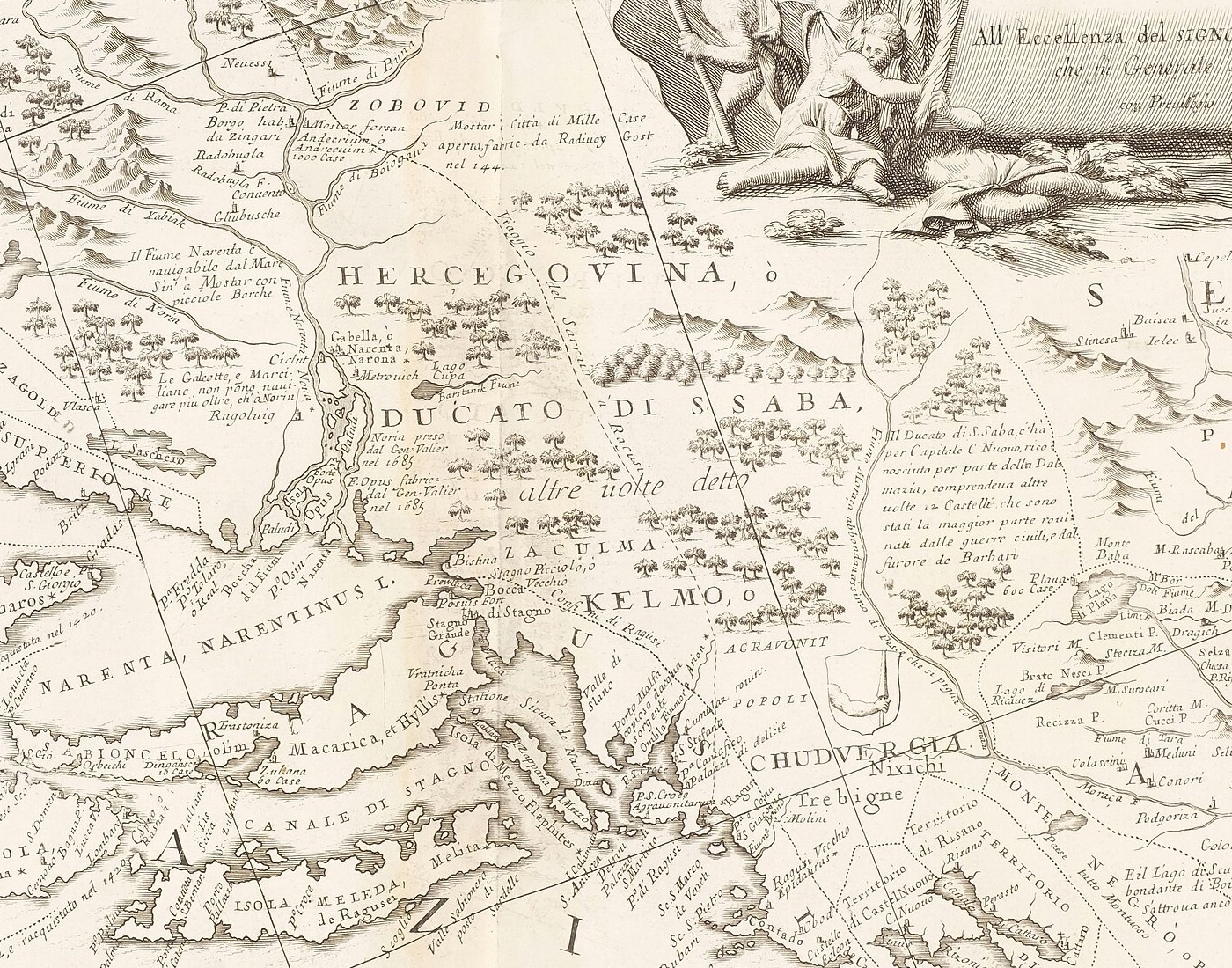
Mostar on Coronelli's map of Dalmatia and Herzegovina, from the Atlante Veneto
Coronelli names Mostar a città di mille case on the Narenta, and notes beside it that the river is navigable up from the sea to the town by small boat.
1691 · Vincenzo Coronelli · Wikimedia Commons
Public domain (plate dated 1691)

Castles of Mostar

More cities to explore
 Bosnia and HerzegovinaSarajevoExplore it in 1600 · 1910
 CroatiaDubrovnikExplore it in 1300 · 1550 · 1780
 NetherlandsUtrechtExplore it in 1400 · 1700
 EnglandLondonExplore it in AD 200 · 1390 · 1600 · 1885
Castles of Europe · Landmarks of Europe · create your own reconstruction.