Historic Cities · Bosnia and Herzegovina
Sarajevo through the ages
Sarajevo is the capital and largest city of Bosnia and Herzegovina, with a population of 275,524 in its administrative limits. The Sarajevo Canton, containing the city of Sarajevo and nearby municipalities, is home to 413,593 inhabitants.

Sarajevo in 1600
Ottoman Sarajevo
This is Sarajevo at the height of its Ottoman endowment city: a concentrated complex of mosques, endowed markets, caravanserais and civic gifts around the Miljacka. The walk moves from the river and the outer approaches into the Baščaršija quarter, through market alleys, caravan courtyards and the clock-tower, finishing on the fortified ridges that frame the city.
Low domes and slender minarets puncture a compact skyline; the Miljacka threads stone arches and narrow quays through a close cluster of timber houses and whitewashed façades. Covered bezistans and the packed roofs of hans sit beside open courtyards and the clang of smithies, while clock-towers and endowed fountains mark shaded arcades. Surrounding limestone ridges hold terraced gardens and timber balconies that step down to the bazaar.
The route: 22 streets, squares and views
Ilidža Approaches → Brodac Village → Imperial Mosque → Baščaršija Bazaar → Gazi Husrev-beg Mosque → Mosque Fountain → Gazi Husrev-beg Bezistan → Coppersmiths' Alley → Morica Han → Tašlihan → …
Step inside, 13 interiors
Hammam Steam Chamber · Carpeted Prayer Hall · Medrese Classroom · Domed Ablutions Canopy · Covered Bezistan Aisle · Coppersmith Workshop · Caravanserai Upper Gallery Room · Tašlihan Gallery Room · Clock Mechanism Chamber · Miller's Grinding Chamber · Merchant Counting House · Synagogue Prayer Room · Granary Chamber
Planned from the Wikipedia record: History of Sarajevo.
Sarajevo in 1910
Habsburg Sarajevo
This is Sarajevo in the middle years of Austro-Hungarian rule, where imperial planning and Ottoman urban life sit cheek by jowl along the Miljacka. The walk moves from a hilltop approach into the railway arrival, follows the Appel Quay's Vienna-style façades and trams, then threads the Ottoman bazaar and mosque quarter toward late‑19th-century cathedrals, synagogues and civic buildings.
A narrow valley city of low roofs and domes squeezed between wooded hills, Sarajevo in 1910 shows Ottoman timber and stone bazaars beside newly built Vienna‑style apartment blocks and striped Moorish‑revival masonry. The Miljacka slips under many small bridges, tram wires cross the sky, and church spires, mosque minarets and the red‑and‑cream town hall puncture a modest skyline of three or four storeys.
The route: 24 streets, squares and views
Trebević Summit View → Sarajevo Railway Station → Appel Quay → Trams on Appel Quay → Town Hall (Vijećnica) → Miljacka at City Hall → Latin Bridge → Markale Market → Baščaršija Square → Sebilj Fountain → …
Step inside, 13 interiors
Main Waiting Hall · Stained-Glass Atrium · Inat Kuca Dining Room · Old Coffeehouse Interior · Coppersmith's Workshop · Mosque Prayer Hall · Brusa Bezistan Passage · Tanners' Vaulted Workshop · Haberdasher's Showroom · Cathedral Nave · Ashkenazi Prayer Hall · Museum's Grand Gallery · Hotel Evropa Dining Room
Planned from the Wikipedia record: History of Sarajevo.
Its story
The story of Sarajevo.
Isa-Beg Ishaković's Saray, 1461–1660
Ottoman forces took the citadel of Hodidjed, north-east of the present Old City, in 1429; the ground modern Sarajevo stands on lay in the Bosnian province of Vrhbosna, and scholars still disagree over whether a town called Vrhbosna stood on the site of the modern city or only a small marketplace called Tornik. The city proper was founded in the 1450s, with 1461 usually taken as its founding date. Isa-Beg Ishaković, the first Ottoman governor of Bosnia, picked the village of Brodac and exchanged land with its residents, giving them what is now Hrasnica in Ilidža. There he built a mosque, a covered market, a public bath, a caravanserai, a bridge and the governor's palace, the saray that gave the city its name. Through four centuries of Ottoman rule its official name was Saraybosna.
Under the second governor, Gazi Husrev-beg, most of what is now the Old Town was built, including the library that carries his name; by the middle of the 16th century Sarajevo had more than a hundred mosques and was known for the size of its marketplace. Many local Christians converted to Islam, an Orthodox population grew, and a colony of Ragusan merchants settled in the city. Following the expulsion of the Jews from Spain at the end of the 15th century and the Ottoman invitation to resettle, Sephardic Jews arrived in Sarajevo, which became a leading centre of Sephardic culture and of the Ladino language; their quarter ran over several blocks of Baščaršija, and among what they brought was the Sarajevo Haggadah. At the height of the empire Sarajevo was the largest and most important Ottoman city in the Balkans after Istanbul, and by 1660 its population was estimated at more than 80,000.
Sacked in 1697, and the Last Day of Our Freedom, 1832
In 1697, during the Great Turkish War, Prince Eugene of Savoy led a Habsburg raid on Sarajevo. His men looted it thoroughly, then set it alight and destroyed nearly all of it in a single day; only a handful of neighbourhoods, some mosques and an Orthodox church were left standing, and the city was left plague-infected. It was rebuilt but never fully recovered. Further fires weakened it, the largest in 1788, and the Miljacka flooded the bazaar in 1783 and 1791. Plague took about 15,000 lives in 1762 and some 8,000 more in 1783; Mula Mustafa Bašeskija chronicled the city through these decades. By 1807 only some 60,000 residents remained.
Serbia's independence from the Ottoman Empire in the early 19th century drove a wedge between Sarajevo and Istanbul. Husein-Kapetan Gradaščević, demanding Bosnian independence from the Ottomans, fought several battles around the country; the last was at Sarajevo Field in 1832, where he was betrayed by a fellow Bosniak and defeated. "This is the last day of our freedom," he said there. The rebellion failed, and the Ottoman state held Bosnia for several more decades, making Sarajevo an important administrative centre by 1850.
The People's Government and the Battle of Sarajevo, 1878
By the spring of 1878 Ottoman authority in the Bosnia Vilayet had collapsed: the imperial army could neither feed nor clothe its garrisons, and some three thousand armed deserters roamed the countryside. On 28 June the Treaty of Berlin gave Austria-Hungary a mandate to occupy and administer Bosnia, though not to annex it, cancelling the autonomy the Treaty of San Stefano had promised earlier that year and which the province's Muslim population had welcomed. A People's Assembly, seated in June with Muslim, Serb, Croat and Jewish delegates, was forced by the crowd on 9 July out of the Konak, and with most of its Muslim landowners gone it passed into the hands of the agitator Salih Vilajetović, known as Hadži Lojo, who on 5 July had led a crowd to the Konak crying "You can give away Stambul, but not Bosnia". After street fighting on 27 July the Ottoman commander Hafiz Pasha was captured at the Bijela Tabija fortress and jailed, and the assembly's leaders proclaimed a People's Government at the Gazi Husrev-beg Mosque, with the cleric Muhamed Hadžijamaković as commander of its army.
The Austro-Hungarian Army crossed into Bosnia on 29 July 1878 under Josip Filipović, and in Sarajevo local Serbs took up arms alongside the Muslim fighters they had fought during the Herzegovina uprising of 1875–1877. At about half past six on the morning of 19 August the artillery opened on the city with 52 guns; the infantry came in from Ilidža and met some 5,000 armed citizens fighting street by street and house by house, women and children among them, and by half past one the battle was effectively over. Austro-Hungarian losses were reported as 57 dead and 314 injured, against around 400 casualties among the defenders. On 23 August Filipović empanelled a court with summary powers, and nine Sarajevo Muslims were hanged over the following days for leading the resistance, beginning with Hadžijamaković and, on 24 August, the cleric Abdulah Kaukčija.
Habsburg Rebuilding, Annexation and 28 June 1914
A fire that burned down much of the central čaršija opened ground for redevelopment. For the first time in centuries the city spread beyond its old borders, and much of the present central municipality of Centar dates from this period, along with the National Museum, the brewery, the City Hall and the Sacred Heart Cathedral. A tramway was established in 1885, before Vienna had one, the city serving as a testing ground for the technology, and a western education system was introduced under which Sarajevo's inhabitants began writing in Latin script for the first time.
In 1908 the territory was formally annexed and turned into a condominium controlled jointly by Austrian Cisleithania and Hungarian Transleithania. By 1910 the city held just under 52,000 people. On 28 June 1914 Gavrilo Princip, a Bosnian Serb and member of Young Bosnia, shot Archduke Franz Ferdinand and his wife Sophie, Duchess of Hohenberg, during their visit to the city, setting off the chain of events that led to the First World War. Anti-Serb riots followed, causing two deaths and the destruction of property. Most of the fighting of the war took place nearer Belgrade, and Sarajevo largely escaped damage.
From the Drina Banovina to the Ustaše Terror, 1918–1945
After the war Sarajevo became part of the Kingdom of Yugoslavia, the centre first of the Bosnian region and then of the Drina Banovina. It was no longer a national capital and saw little investment between the wars. Following a German bombing campaign the city was taken on 15 April 1941, and all of Bosnia and Herzegovina was assigned to the Independent State of Croatia, the Ustaše puppet state. Sarajevo then had 85,000 inhabitants: 34 per cent Muslim, 29 per cent Catholic Croat, 25 per cent Orthodox Serb and 10 per cent Jewish, all four groups speaking the same language.
The main Sephardi synagogue, Il Kal Grande, was looted, burned and destroyed immediately after the occupation. Within months the centuries-old Sephardi and Ashkenazi communities of Sarajevo, which made up the great majority of Bosnian Jewry, were rounded up in the Old Synagogue, the Stari hram, and deported to their deaths in Croatian concentration camps. Roughly 85 per cent of Bosnia's Jewish population died at the hands of the Nazis and the Ustaše. The Sarajevo Haggadah survived because Derviš Korkut, chief librarian of the National Museum, smuggled it out of the city.
Ustaše policy was to force one third of the Serbs in the state to convert to Roman Catholicism, expel one third to Serbia and kill the remainder, and to exterminate the Jews and Roma. In Sarajevo, Serbs were dismissed from the city government, the Cyrillic alphabet was banned and Orthodox church services stopped. The police, staffed by Ustaše loyalists, raided Serb neighbourhoods at night and took small groups to the countryside to be killed; in the largest such raid, on 11 August 1941, about a hundred Serbs were arrested on allegations of ties to the Chetniks or Partisans, about a dozen executed and the rest sent to camps. Most of those killed were intellectuals, targeted as the bearers of the national culture. Bosnian Muslims known to be loyal to Yugoslavia were executed too, some for writing Serbo-Croatian in Cyrillic rather than the Latin script the regime favoured. On 12 October 1941 a group of 108 notable Muslim citizens signed the Resolution of Sarajevo Muslims, condemning the persecution of Serbs and demanding security for all citizens whatever their identity. By mid-summer 1942 around 20,000 Serbs had taken refuge in the city from Ustaše terror in the countryside. Between February and May 1945 Maks Luburić ran a Ustaše headquarters at Villa Luburić as a place of torture and execution, 323 of whose victims were identified after the war. The Partisan resistance was led by Vladimir Perić, known as Valter, killed in the fighting on 6 April 1945, the day Sarajevo was liberated.
Socialist Capital and the 1984 Winter Olympics
Sarajevo became the capital of the Socialist Republic of Bosnia and Herzegovina. The republican government invested heavily, raising residential blocks in Novi Grad and Novo Sarajevo and building up industry until the city was an important regional industrial centre; from a post-war population of 115,000 it grew steadily, and in 1981 income per head stood at 133 per cent of the Yugoslav average. The 1984 Winter Olympics, won against bids from Sapporo and from Falun and Gothenburg, were followed by a boom in tourism. The last Yugoslav census, in 1991, recorded 527,049 people in the ten municipalities of Sarajevo: 49.2 per cent Bosniaks, 29.8 per cent Serbs, 10.7 per cent Yugoslavs, 6.6 per cent Croats and 3.6 per cent others, including Jews and Roma.
The Siege, 1992–1996, and the City That Followed
When Bosnia and Herzegovina declared independence from Yugoslavia, Sarajevo became the capital of the new state and the local division of the Yugoslav People's Army established itself on the surrounding mountains. In the middle of a massive peace protest, a demonstrator named Suada Dilberović was shot by unidentified gunmen firing from a nearby skyscraper. Bosnian Serb forces of Republika Srpska and the Yugoslav People's Army besieged the city from 5 April 1992 to 29 February 1996, blockading it from 2 May. A force of 18,000 in the hills fired on Sarajevo with artillery, mortars, tanks and sniper rifles, while the defenders inside were poorly equipped and could not break out. The city went without electricity, heating, water and medical supplies, and shells landed at an average of 329 impacts a day, with a high of 3,777 on 22 July 1993.
Cultural sites were targeted alongside economic and political ones: the Gazi Husrev-beg Mosque, the Cathedral of the Sacred Heart and the Jewish cemetery were damaged, and the old City Hall and the Olympic museum destroyed. On the night of 25 August 1992 the National and University Library, the central repository of Bosnian written culture, was deliberately shelled with incendiary rounds and burned out, taking with it about 700 manuscripts and incunabula. During the siege 11,541 people were killed, including more than 1,500 children, and a further 56,000 wounded, nearly 15,000 of them children; other accounts put the figures at around 12,000 killed and 50,000 wounded. After the Dayton Agreement the siege was declared over on 29 February 1996, and the division of territory it set out was followed by the departure of some 62,000 Sarajevo Serbs from the city and its suburbs, leaving a far more monoethnic city than the one that had gone by the nickname of Europe's Jerusalem.
Nearly every building had been damaged and mines lay in the surroundings, but by 2003 the ruins were gone and bullet holes had become a rarity; mortar scars in the pavement were filled with red resin, leaving floral patterns since known as Sarajevo Roses. Sarajevo is the capital of Bosnia and Herzegovina, of the Federation of Bosnia and Herzegovina and of Sarajevo Canton, and remains the de jure capital of Republika Srpska; all national institutions and foreign embassies are in the city, and the canton generates almost a quarter of the country's economic output. The 2013 census counted 413,593 people in Sarajevo Canton, and the Old Jewish Cemetery, almost five hundred years old, is on the UNESCO tentative list.
From the archive
Sarajevo on paper: the place as it was mapped.
A period map that sets the place down, drawn between 1500 and 1850, the ground this page's reconstructions walk. Public domain, with its source named.
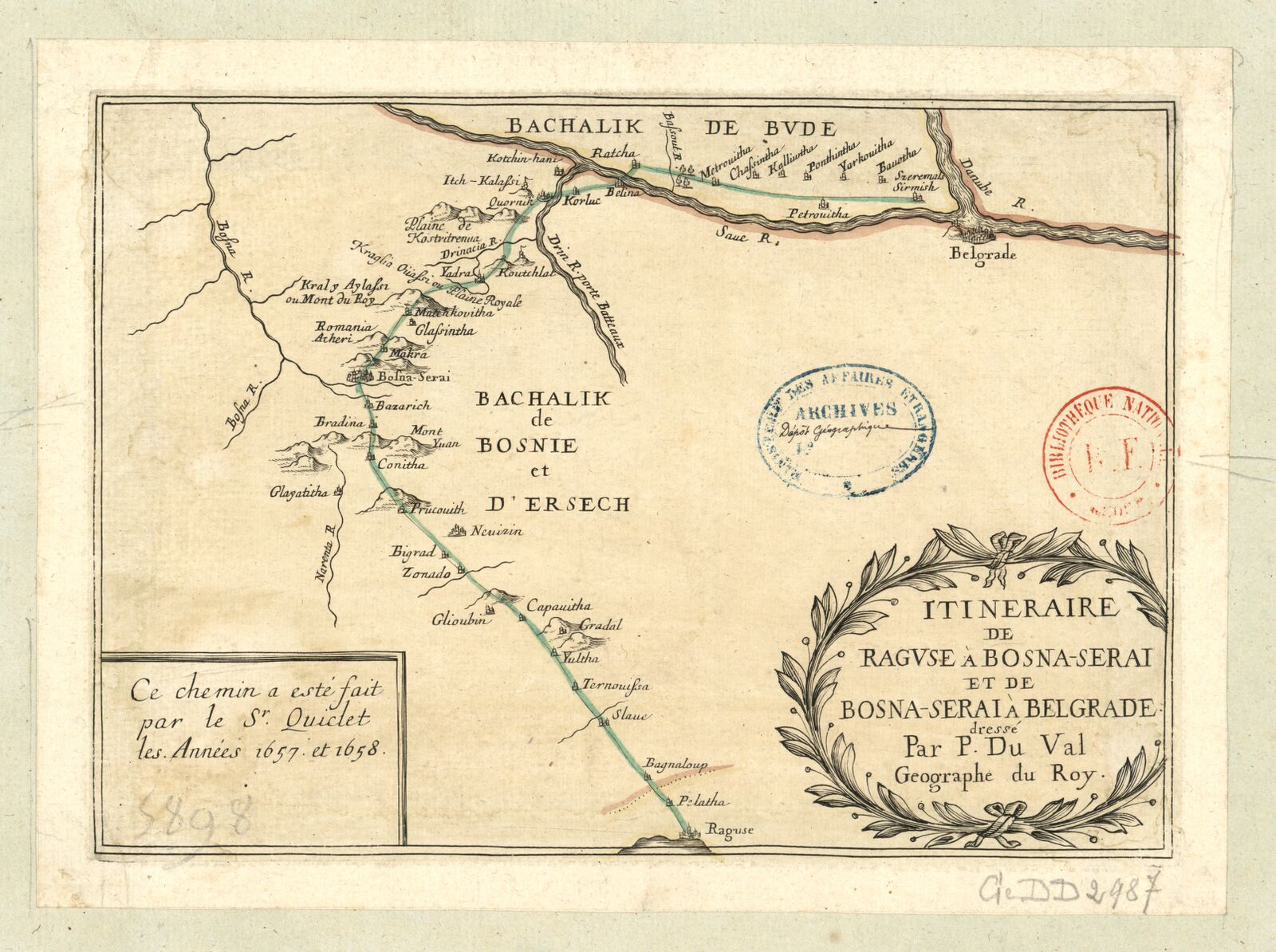
Bosna-Serai on Pierre Du Val's itinerary from Ragusa to Belgrade
Bosna-Serai — Sarajevo — sits on the Bosna at the hinge of the caravan road, halfway between Ragusa on the Adriatic and Belgrade on the Danube, drawn from a journey made in 1657 and 1658.
1658 · Pierre Du Val · Bibliothèque nationale de France · Gallica
Public domain (plate dated 1658)
Ships tied to Sarajevo
- SMS Viribus Unitis: Carried Franz Ferdinand towards Bosnia, and his body back after Sarajevo
More cities to explore
 Bosnia and HerzegovinaMostarExplore it in 1665
 CroatiaDubrovnikExplore it in 1300 · 1550 · 1780
 NetherlandsUtrechtExplore it in 1400 · 1700
 EnglandLondonExplore it in AD 200 · 1390 · 1600 · 1885
Castles of Europe · Landmarks of Europe · create your own reconstruction.