Historic Cities · Croatia
Zadar through the ages
Zadar, historically known as Zara, is the oldest continuously inhabited city in Croatia. It is situated on the Adriatic Sea, at the northwestern part of Ravni Kotari region. Zadar serves as the seat of Zadar County and of the wider northern Dalmatian region.

Zadar in 1580
Venetian Zara
Zara in 1580 stands as Venice's fortified Dalmatian capital, newly ringed with modern bastions and a ceremonious Land Gate by Sanmicheli. This walk passes the city's Roman core, its straight Kalelarga, marble quays crowded with galleys, and the low islands and saline flats that supply its salt and wine.
The city reads as a compact stone town of pale limestone and red tile, its low Roman bulkings interrupted by medieval towers and the recent angular silhouette of Venetian bastions. A round, squat St Donatus sits upon the old forum, the slim campanile of St Anastasia pierces the skyline, and marble quays line a small, busy harbour where wooden galleys and round Adriatic cargo ships ride at anchor under bright Adriatic light.
The route: 16 streets, squares and views
Approach from Ugljan → Land Gate (Porta Terraferma) → Foša Moat and Bridge → Bastion of San Michele → Five Wells Square → Kalelarga (Calle Larga) → Roman Forum Paving → St Donatus Exterior → Cathedral Square → St Anastasia Campanile → …
Step inside, 9 interiors
Cistern Chamber · Franciscan Cloister · Rotunda of St Donatus · Cathedral Nave · Campanile Bell Chamber · Captain's Stone House · Galley Joiners' Workshop · Chrysogonus Nave · Salt Magazine
Planned from the Wikipedia record: Zadar.
Its story
The story of Zadar.
Iadera: Liburnian Sea Power and Colonia Iulia
Zadar was laid out as a Liburnian settlement in the 9th century BC on a small stone islet and embankments, tied to the mainland by a narrow isthmus that made a natural harbour of the strait to its north. The Liburnians were sailors and merchants with a later reputation for piracy; by the 7th century BC the town was an important centre of their trade with the Phoenicians, Etruscans and Greeks, and a main seat of the Liburnian thalassocracy. Its people, the Iadasinoi, are first named in a Greek inscription of 384 BC from Pharos on Hvar, which records them leading an eastern Adriatic coalition against the Greek colonists: 10,000 men in 300 ships sailed from Zadar to besiege Pharos and were beaten at sea by the Syracusan fleet of Dionysius.
When Illyricum was assigned to Julius Caesar in 59 BC, Iadera became a Roman municipium. The urban Liburnian centres backed Caesar in the civil war, and at the end of 48 BC he rewarded them with colony status; the city took the title colonia Iulia Iader and legionary veterans settled there. It was supplied by a 40-kilometre aqueduct from lake Vrana. Zadar had its own bishop by the end of the 3rd century, and by some estimates the city and its ager held around ten thousand people in the 4th century, a mixture of Liburnians and Roman colonists.
Seat of Byzantine Dalmatia, 481–998
The city grew poor under Ostrogothic rule from 481, and an earthquake in the 6th century destroyed whole complexes of Roman building, whose stone was later reused in houses; the population fell and was made up again from the hinterland. Justinian's campaign to recover the western provinces brought Zadar to the Byzantine Empire in 553. An Avar invasion devastated Dalmatia in 568, and Zadar was the only city to survive the waves of Avar and Slav attack that followed, protected by its belt of inland plains. When the Dalmatian capital Salona was destroyed in the 640s, Zadar became the seat of the Byzantine archonty of Dalmatia and its prior held jurisdiction over the whole of it.
Early in the 9th century the bishop Donatus and the city duke Paul mediated between the Franks under Pepin and Byzantium; the Franks held the city briefly before the Treaty of Aachen returned it in 812. Its living came from the sea, and Byzantine Dalmatia was less a territory than an alliance of city communes headed by Zadar, whose autonomy let them develop as free communes. The citizens spoke Dalmatian, but Croatian had spread through the region from the 7th century and was predominant inland and on the islands by the end of the 9th; Croatian settlers arrived from the 10th century and entered every class in the city, holding the posts of prior, judge and priest. In 998 the army of the Bulgarian emperor Samuel besieged the city and was held off; in the same year Zadar asked Venice for protection against the Neretvian pirates, and the fleet of Doge Pietro Orseolo II used the opening to take Dalmatia by surprise.
Four Centuries of Revolt Against Venice, 1030–1409
From the 1030s the city was formally a vassal of Byzantium, and the patrician Madi family led a movement for full independence. Its wish to be a city-state brought repeated conflict with Venice: in 1049–1050 the zaratini expelled the Venetian count Orso Giustinian and turned to Petar Krešimir IV of Croatia, but were quickly put down. Coloman of Hungary, having already annexed Croatia, occupied Zadar in 1105 or 1114; it returned to Venice in 1116, surrendered to Stephen III of Hungary in 1161 and was retaken the same year. In 1183 it passed to Béla III, beginning a twenty-year war during which Zadar, enjoying strong autonomy under Hungarian hegemony, made alliances with Pisa and the Kingdom of Sicily.
That war ended in 1202, when Doge Enrico Dandolo turned the Fourth Crusade against the city. The crusaders owed Venice for sea transport to Egypt and could not pay, so the Venetians used them to besiege Zadar, which was ransacked, demolished and robbed while its people fled into the countryside. Pope Innocent III excommunicated the Venetians and crusaders involved. Revolts followed in 1239 and 1242, after the second of which Venice planted a colony of Venetians in the city, and again in 1311, before Zadar accepted new pacts of submission in 1313. Louis I of Hungary conquered the city outright in 1357, and the Treaty of Zadar forced Doge Giovanni Dolfin to renounce Venice's dominion over the city and all Dalmatia.
Between the 11th and 14th centuries the city's trade and seamanship carried it to a leading place among the towns of the eastern Adriatic; the Chest of Saint Simeon was made, and in 1396 the Dominican Order founded the University of Zadar, the oldest university in present-day Croatia. The oldest surviving writing in Dalmatian comes from the city, including the lettere zaratine of 1325 and 1397; how the medieval population divided between Croatian and Romance speakers is disputed, and the accounts flatly contradict one another. The long argument with Venice was settled by purchase rather than arms: on 31 July 1409 Ladislaus of Naples, losing his grip on Dalmatia in the Hungarian civil war, sold Zadar and his dynasty's rights to the province for 100,000 ducats.
The Bastions, the Plague and the Arbanasi, 1409–1797
Venice took possession without a fight but met resistance from leading Zadar families, answered with persecution and confiscation. The city remained the administrative seat of Dalmatia, now under Venetian rule over the whole province except the Republic of Ragusa. When the Ottomans took the continental hinterland at the beginning of the 16th century, the city stood within range of Turkish artillery, and a new system of castles and walls was begun; the forty-year works swept away houses, churches and the entire suburb of Varoš of St Martin, and left Zadar the biggest fortified city in Dalmatia. In 2017 the fortified city was inscribed on the UNESCO World Heritage list as part of the Venetian Works of Defence between the 16th and 17th centuries.
Behind the walls the Renaissance held: the humanist Giovanni Francesco Fortunio, who wrote the first Italian grammar, worked in the city, while Croatian writing was prolific in the hands of Petar Zoranić, Brne Karnarutić and Juraj Baraković. Distilleries in Zadar have produced Maraschino from the marasca cherries of Ravni Kotari since the 16th century. Population and economy stagnated under the continuous Ottoman threat, and several large outbreaks of bubonic plague struck in the 16th and 17th centuries, leaving the city short of both people and money. Venice sent new colonists, and under the archbishop Vicko Zmajević the Arbanasi, Catholic Albanian refugees, settled and formed a new suburb.
Austrian Capital and the National Quarrel, 1797–1918
The Treaty of Campo Formio ended the Republic of Venice in 1797 and brought Zadar under the Austrian crown. It was handed briefly to the Napoleonic Kingdom of Italy in 1806 and added to the French Illyrian Provinces in 1809; the first newspaper printed in Croatian, Il Regio Dalmata – Kraglski Dalmatin, appeared there between 1806 and 1810. The French garrison capitulated to an Austrian blockade on 9 December 1813, and from the Congress of Vienna until 1918 Zadar remained the capital of the Austrian crownland of Dalmatia. Its population grew in the second half of the 19th century on economic growth and immigration; the southern walls were pulled down and the city opened as a port, and 27 factories were working before the First World War.
After 1848 Italian and Croatian national movements divided the city, each founding its own political parties, and Zadar served as a centre of the Croatian cultural and national revival. Sources on both sides claim a majority, and they conflict. The Austro-Hungarian censuses near the end of the century record Italian as the habitual language of most people in the city itself, 9,018 against 2,551 Croatians in 1900, but of only a third of the surrounding county. Austrian policy in Dalmatia fostered Croatian culture at the expense of Italian, to weaken any future territorial claim by the Kingdom of Italy.
The Zara Enclave, the Bombing and the Italian Exodus
The Treaty of London of 1915 had promised Italy northern Dalmatia, including Zadar, for entering the war. Italian troops occupied the city on 4 November 1918 and took over the governorship on 5 December, with Admiral Enrico Millo proclaimed governor of Dalmatia. The Treaty of Rapallo of 12 November 1920 awarded Zadar to Italy as an enclave of 104 square kilometres, organised as the province of Zara and declared a free port in 1921. About 9,000 Croats left after the handover, for Šibenik, Split, Zagreb, Dubrovnik and elsewhere, while settlers arrived from Italy; the 1921 census counted 12,283 Dalmatian Italians, 66 per cent of the population, against 11,552 in 1910 when they had been 32 per cent. Cut off from its hinterland the city's economy declined, and Split took over its role as the administrative centre of Dalmatia.
Zadar was one of the starting points of the Axis invasion of Yugoslavia on 6 April 1941. Under the Rome Treaties the Independent State of Croatia handed almost all of Dalmatia to Italy, and the city became the centre of the Governorate of Dalmatia. Croats under Italian rule were subjected to a policy of forced assimilation, and the Partisan movement took root in the city even though more than 70 per cent of its population was Italian. After the Italian armistice was announced on 8 September 1943, German troops entered Zadar on 10 September and placed it under the Italian Social Republic.
The Allies bombed Zadar from November 1943 to October 1944. Estimates of the dead range from under 1,000 to as many as 4,000 of the city's 20,000 inhabitants, and 80 per cent of its buildings were destroyed; the city has been called the Dresden of the Adriatic. The German army and most of the Italian administration left in late October 1944, and the Partisans took the city on the 31st. Its population had been 24,000 at the start of the war and was 6,000 by the end of 1944. Nominal Italian sovereignty lasted until the Paris Peace Treaties took effect on 15 September 1947. In the Istrian–Dalmatian exodus that followed, an estimated 10,000 Italians emigrated; the last Italian schools in the area closed in October 1953, and at the 2011 census 90 people declared themselves Italian, 0.12 per cent of the city.
Rebuilt, Besieged and Rebuilt Again, 1947–2021
Zadar became part of the Socialist Republic of Croatia within Yugoslavia in 1947. Growth was slow at first (the 1948 census counted a little over 13,000), but quickened from the mid-1950s as the government pushed migration from the countryside into the towns. The city held 25,000 people in 1961, 43,000 in 1971, 60,000 in 1981 and 76,000 in 1991, while the Adriatic Highway, the railway and a civil airport opened it to tourism.
Serb separatists from the Dalmatian hinterland sealed the roads in the Log Revolution of 1990, cutting Dalmatia off from the rest of Croatia. When war broke out in March 1991 a number of non-Serbs were expelled from the area and several Croatian policemen were killed, leading to the anti-Serb riot in Zadar that year; Serbs then made up about 14 per cent of the population. The Yugoslav People's Army and the forces of the SAO Krajina occupied part of the hinterland and shelled the city, damaging homes and UNESCO-protected sites, and in the nearby village of Škabrnja Krajina Territorial Defence troops killed 62 Croatian civilians and five prisoners of war. Land links to Zagreb were cut for over a year, the only connection between north and south running by way of the island of Pag. The siege lasted until January 1993, when Operation Maslenica brought Zadar and its surroundings under Croatian control and restored the bridge link; attacks continued until the war ended in 1995.
The 2021 census recorded 70,779 residents, the fifth-largest city in Croatia and the second-largest in Dalmatia, of whom 67,134 declared themselves Croats and 1,371 Serbs. Zadar is the seat of Zadar County, and its economy runs on tourism, seaborne trade, agriculture, fishing and fish farming, engineering, chemicals and banking.
From the archive
Zadar on paper: the old town as it was mapped.
A period plan or bird's-eye view of the old town, drawn between 1500 and 1850, the streets this page's reconstructions walk. Public domain, with its source named.
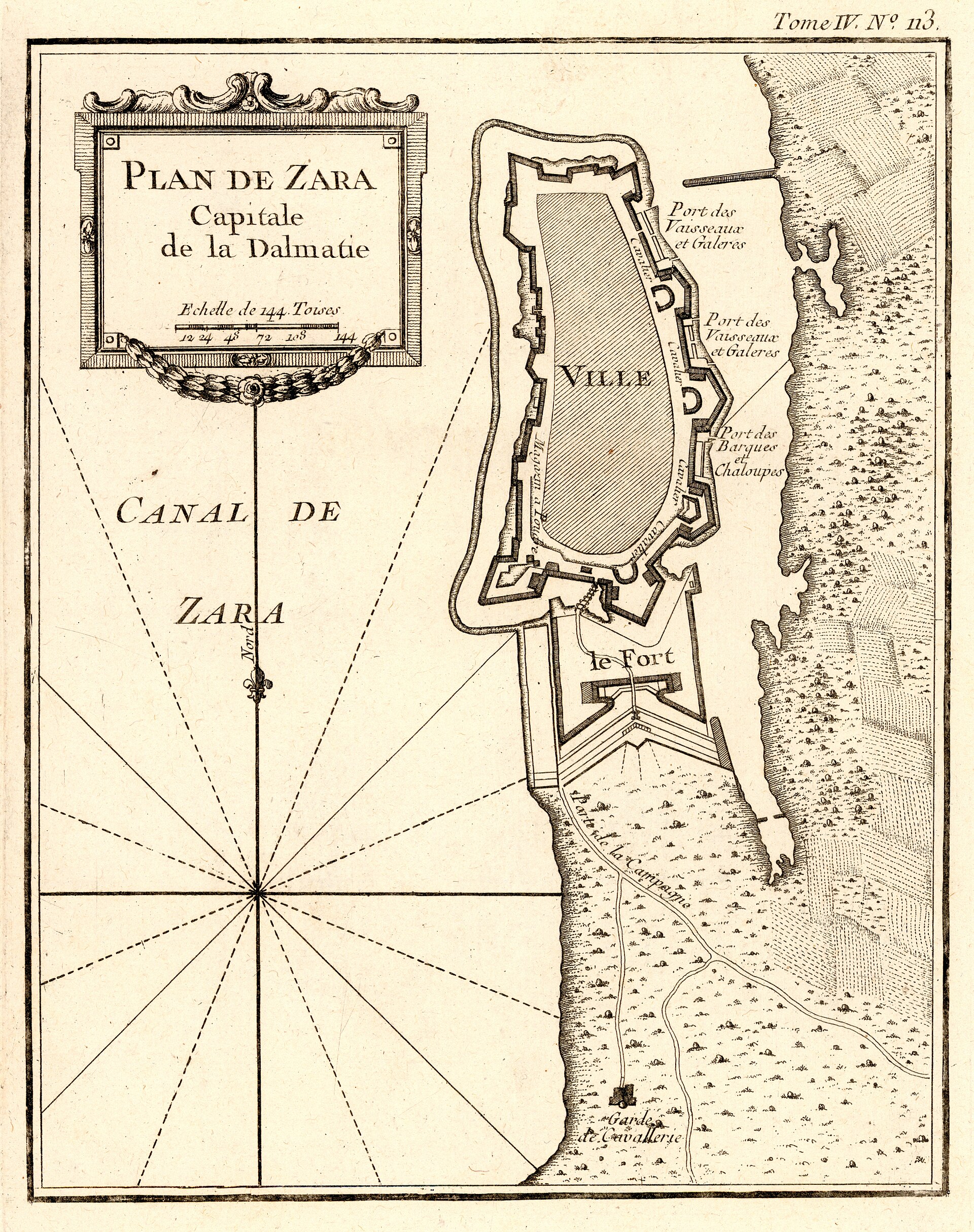
Plan de Zara, Capitale de la Dalmatie (Jacques‑Nicolas Bellin)
Depicts Zadar's walled old town with bastioned ramparts, harbour quays, the Canal de Zara and an outer triangular fort.
1674 · Jacques-Nicolas Bellin · Wikimedia Commons
Public domain (plate dated 1674)
Ships tied to Zadar
- Zara: Named for Zara, now Zadar, and presented with her battle flag in the city
Castles of Zadar

More cities to explore
 CroatiaSplitExplore it in AD 305 · 1600
 SloveniaLjubljanaExplore it in AD 200 · 1910
 CroatiaDubrovnikExplore it in 1300 · 1550 · 1780
 NetherlandsUtrechtExplore it in 1400 · 1700
Castles of Europe · Landmarks of Europe · create your own reconstruction.