Historic Cities · Croatia
Split through the ages
Split is the second-largest city in Croatia, after the capital Zagreb, situated on the eastern shore of the Adriatic Sea. As the administrative seat of Split-Dalmatia County and the largest city on the Croatian coast, it serves as a key economic, cultural, and transportation hub for the region.

Split in AD 305
Diocletian's Palace
This is the palace-city Diocletian ordered on the Dalmatian shore as he retired in 305 AD, half imperial residence and half fortified garrison. The walk follows the palace's sea-facing apartments, the colonnaded peristyle with imported red granite, the domed mausoleum and the four great gates, then out along the roads that link Spalatum to Salona and the open sea.
A compact, heavily fortified Roman compound pressed to a shallow Adriatic bay: massive white-limestone curtain walls pierced by four principal gates and projecting towers, a low southern façade rising directly from the water, and a shallow skyline of domes and octagonal towers. Surfaces are pale Brač limestone and the deep red of Egyptian granite columns; streets are narrow, paved, and busy with soldiers, sailors, gardeners and market stalls under a sharp Mediterranean light.
The route: 22 streets, squares and views
Mare Adriaticum Approach → Portus Spalatum → Seaward Substructures → Porta Meridionalis → Imperial Seafront → Western Domed Hall → Peristilium → Mausoleum Exterior → Temple of Jupiter → Cardo Maximus → …
Step inside, 12 interiors
Seaward Substructure Store Hall · Seaward Amphora Cellar Vault · Golden Gate Guardroom · Imperial Kitchen and Hearths · Western Domed Audience Hall · Peristyle Vestibule with Oculus · Imperial Mausoleum Chamber · Cardo Market Taberna · Decumanus Bakers' Hall · Western Gate Vaulted Passage · Gardener's Pavilion and Beds · Northern Tower Guard Barracks
Planned from the Wikipedia record: Diocletian's Palace.
Split in 1600
Venetian Split
Spalato in 1600 is a Venetian maritime stronghold built inside the shell of Diocletian’s Roman palace, watched over by the cathedral campanile and newer Venetian walls. The walk moves from the Adriatic approach into the palace-quarter and out again to Marjan hill, showing harbour galleys, city squares with a clock and loggia, caravan traffic from the Ottoman hinterland, and houses grafted into ancient arcades.
The skyline is a close-knit mix of Roman stone and Venetian fortification: low limestone houses and tiled roofs pressed against Diocletian’s arcade columns, the squat round bulk of the emperor’s mausoleum pierced by the campanile of Saint Domnius, and Venetian bulwarks and a small castle along the shore. Narrow lanes cut the palace block into sunlit courts and deep shade; the harbour bristles with oared galleys and lateen sails; laundry and drying herbs flap across the imperial walls.
The route: 22 streets, squares and views
Brač Channel Approach → Port of Spalato → Riva Quay → Galleys on the South Quay → Venetian Arsenal → Bronze Gate (Porta Aenea) → Decumanus Street → Peristyle (Peristil) → Palace Vestibule → Mausoleum Exterior → …
Step inside, 13 interiors
Riva Harbour Inn · Quayside Sailors' Tavern · Galley Carpenters' Shed · Bronze Gate Guardroom · Peristyle Household Atrium · Palace Wine and Oil Cellars · Round Nave of the Cathedral · Belfry Bell Chamber · Clocktower Keeper's Room · Magistrate's Audience Hall · Covered Fish Market Hall · Varoš Stone Kitchen · Arcade Weavers' Workshop
Planned from the Wikipedia record: History of Split.
Its story
The story of Split.
Aspálathos and Diocletian's Palace, 3rd Century BCE–480 CE
The city began as the Greek colony of Aspálathos, planted by settlers from Issa (modern Vis, itself a colony of Syracuse) at a date not exactly known, estimated to the 3rd or 2nd century BCE. It lived off trade with the surrounding Illyrian tribes, chiefly the Delmatae. When Rome conquered the Illyrians in the wars of 229 and 219 BCE and organised the province of Dalmatia, the provincial capital went to Salona a short distance away, and Spálathos passes out of view, overshadowed by the city it would one day succeed.
In 293 CE the emperor Diocletian began a heavily fortified palace at Spalatum, near his home town of Salona, fronting the sea so that its occupant could leave by that route if he had to. It was finished on schedule in 305, and Diocletian, who had announced his retirement after an illness in 303, became the first Roman emperor to leave office voluntarily. Its last imperial occupant was Julius Nepos, made western emperor in 473 and deposed within two years, who returned in 475 and ruled Dalmatia from the palace until local political enemies murdered him there in 480.
The Salonitans Take the Palace, 639–650
Split's history as a city in its own right begins with the sack of Salona by the Avars in 639. Accounts conflict over how it fell (by treachery, by ruse, or because the defence was simply abandoned), but it fell with little or no resistance despite newly rebuilt walls. Most of the region's Roman population was killed or expelled and the coast was settled by Croats, then subject to the Avar khagans; the Romans of Salona fled by sea to Šolta, Brač, Hvar, Vis and Korčula, where they lived in huts for about a decade, short of drinking water.
A leader emerged among them, known only as Severus the Great, who persuaded most of the survivors to return, not to the ruins of Salona but to Diocletian's palace, three centuries old and impossible to besiege effectively from the land. They occupied it around 650, meaning to hold it only until Salona could be retaken, which never proved possible. The Croats destroyed their crops and confined them within the gates until the emperor Constans II granted them an imperial mandate to establish themselves in the palace as the city of Spalatum. They rededicated the Temple of Jupiter to the Virgin Mary and recovered from the ruins the remains of Saint Domnius, a bishop of Salona executed on Diocletian's order; the pope invested the new see with the authority of the ancient archbishopric of Salona.
A Free City Between Venice and Hungary, 751–1420
The palace-city remained a Byzantine possession in law, administered through Ravenna and, after Ravenna fell to the Lombards in 751, from Zadar, though in practice it ran its own affairs. The hinterland was lost to the Duchy of the Croats, and from the Latin of the inhabitants an independent Dalmatian language developed, in which the place was Spalatrum or Spalatro. In 925 Tomislav's Kingdom of Croatia emerged inland, and a synod held at Split that year decreed that "no one should presume to celebrate the divine mysteries in the Slavonic language, but only in Latin and Greek", checking Bishop Gregory of Nin. Raided by the Narentines from the sea and the Croats from the hinterland, the city offered its allegiance to Venice in exchange for security; Doge Pietro II Orseolo defeated the Narentines in 998 and proclaimed himself Duke of Dalmatia.
Hungary arrived in 1105, when Coloman, having conquered Croatia, stormed Zadar and advanced on Split, which surrendered on a guarantee of its ancient privileges. The terms were substantial: no tribute, its own count and archbishop for the king to confirm, its old Roman laws and its own judge, and no foreigner to live inside the walls against the citizens' will. Sovereignty then changed hands repeatedly between doges and Hungarian kings until 1141, when Géza II marched on Split and Trogir and both accepted him voluntarily, keeping Venice out for 186 years. The end came by sale: Ladislaus of Naples, the loser of a twenty-year Hungarian civil war, sold his disputed rights over Dalmatia to Venice for 100,000 ducats in 1409, and on that pretext the Republic took over the city by 1420.
Venetian Spalato and the Klis Pass Trade, 1420–1797
Under Venice the city's autonomy was greatly reduced, its highest authority a prince and captain appointed from Venice. The city archives show a population by then largely Croatian, Romance Dalmatian names having become uncommon; Croatian was the common language, while Italian was spoken by notaries, schoolteachers and merchants. The city lived by carrying goods between the Adriatic and the Ottoman-held interior through the Klis pass just inland. Split itself remained a heavily fortified Venetian outpost surrounded by Ottoman territory, and its hinterland was not won back from the Ottomans until the Morean War of 1699.
In the later 16th century Daniel Rodriga, a Jewish merchant, worked to persuade the Venetian authorities to make Split the key point on a new trade route linking Venice with the Ottoman Empire. Approval came in 1581 and he moved there to oversee construction of a scala, or stopover complex; the work stalled, and the Venetian government resumed it and completed it in 1592 as a state-owned venture. Illiteracy was extremely high, Venetian rule showing little interest in schools or medical provision, and the gains of the period went mostly to the aristocracy. Split was the home of Marko Marulić, whose Judita, written in the city in 1501 and printed in Venice in 1521, is widely held to be the first modern work of Croatian literature. Venetian rule ended after 377 years when the Treaty of Campo Formio ceded the city to the Habsburg monarchy in 1797.
French Rule, Habsburg Dalmatia and the Name Split, 1805–1910
The Treaty of Pressburg put Split into the Napoleonic Kingdom of Italy in 1805, and in 1806 it was taken directly into the French Empire, with General Auguste de Marmont as military commander of Dalmatia; from 1809 it formed part of the Illyrian Provinces. Large investments were made, new streets cut and parts of the ancient fortifications removed. An Austrian force helped by a British force under Captain William Hoste occupied Split in November 1813, and the Congress of Vienna ceded the city to Austria in 1815.
Split then belonged to the Kingdom of Dalmatia, a separate administrative unit, and under Austria it can generally be said to have stagnated; the upheavals of 1848 gained no ground there and the city did not rebel. What 1848 produced was two factions: the pro-Croatian Unionists, later called the Puntari, who wanted Dalmatia united with Croatia-Slavonia and were strongest in Split, and the pro-Italian Autonomists, whose aims ran from autonomy within Austria-Hungary to union with the Kingdom of Italy. Antonio Bajamonti was mayor from 1860 until 1880, and his party lost the elections of 1882 to a city lawyer, Dujam Rendić-Miočević. The Italian-speaking community of the central settlement numbered 1,969 in the census of 1890, 12.5 per cent of the population, and 2,082 in 1910; in that year the city council made Split the official name in place of Spljet.
Chief Port of the Kingdom, Italian Province, 1918–1945
With the dissolution of Austria-Hungary, Dalmatia and Split passed to the Kingdom of Serbs, Croats and Slovenes, and the city saw a series of incidents between 1918 and 1920. Because Rijeka, Trieste and Zadar had been annexed by Italy, Split became the most important port in the kingdom, and the Lika railway connecting it to the rest of the country was completed in 1925. On the state's renaming as the Kingdom of Yugoslavia in 1929 the port became the seat of a new administrative unit, the Littoral Banovina, and after the Cvetković-Maček agreement it fell within the Banovina of Croatia.
Italy occupied Split in April 1941, after the invasion of Yugoslavia by Nazi Germany. The city formally became part of the Independent State of Croatia, but the Ustaše could not establish their rule there because the Italians assumed all power in Dalmatia, and on 18 May 1941 the Treaties of Rome annexed it to Italy outright, in the province of Spalato. The Italian Governatorate of Dalmatia held 390,000 inhabitants, of whom 280,000 were Croats, 90,000 Serbs and 5,000 Dalmatian Italians. Italian rule met heavy opposition from the Croat population: the first armed resistance group was organised on 7 May 1941, and between September and October 1941 alone citizens assassinated ten officials of the occupation. On 12 June 1942 a fascist mob attacked the city's synagogue and destroyed its library and archive; worshippers were beaten as they left, and Jewish-owned shops were targeted the following day.
In September 1943, after the Italian capitulation, Tito's brigades held the city for a few weeks, and 8,000 Italian soldiers of the Bergamo division prepared to fight alongside them against the Waffen SS Prinz Eugen; the Partisans also executed up to 41 members of the Italian police forces, later found in mass graves. They were then forced to retreat as the Wehrmacht placed the city under the authority of the Independent State of Croatia, and the Germans killed the Italian soldiers as traitors, among them three generals and 48 officials, in the Trelj massacre. The city was bombed by Axis forces and also by the Allies, causing hundreds of deaths. The Partisans captured Split on 26 October 1944 and made it the provisional capital of Croatia, and German forces in the area formally surrendered on 10 November. After the war the remaining Dalmatian Italians of Split left Yugoslavia for Italy in the Istrian-Dalmatian exodus.
Shipyards, Shelling and Tourism, 1945–2023
In socialist Yugoslavia the city had its largest economic and demographic expansion: dozens of factories and companies were founded and the population tripled, swelled by waves of rural migrants from the undeveloped hinterland, the Shtokavian-speaking Vlaji, who came to outnumber the old urban Fetivi families and the island-born Boduli alike. Shipbuilding did particularly well, and Split became the largest passenger and military port in Yugoslavia, housing the headquarters of the Yugoslav Navy. In 1981 its GDP per head stood 37 per cent above the Yugoslav average, part of a level of output and employment it has not since regained.
When Croatia declared independence in 1991 the city still held a large JNA garrison and the Yugoslav navy's headquarters, and a months-long stand-off with the Croatian National Guard and police flared periodically into incidents. On 15 November 1991 the light frigate Split fired a small number of shells at the old centre, the airport and an uninhabited stretch of hills above Kaštela, killing at least two civilians employed by Jadrolinija and injuring six other people; sailors who had refused to attack Croat civilians, most of them Croats themselves, were held in the vessel's brig. The JNA and the navy evacuated all their Split facilities in January 1992, and economic recession followed.
Most of the factories closed or fell far below their pre-war output, and the city turned towards commerce, services and tourism. The historic core built in and around Diocletian's palace has been a UNESCO World Heritage Site since 1979. Split is now the second-largest city in Croatia and the administrative seat of Split-Dalmatia County; the 2021 census recorded 160,577 inhabitants, and in 2023 the city recorded 965,405 tourist visits and 3,050,389 overnight stays.
From the archive
Split on paper: the old town as it was mapped.
A period plan or bird's-eye view of the old town, drawn between 1500 and 1850, the streets this page's reconstructions walk. Public domain, with its source named.
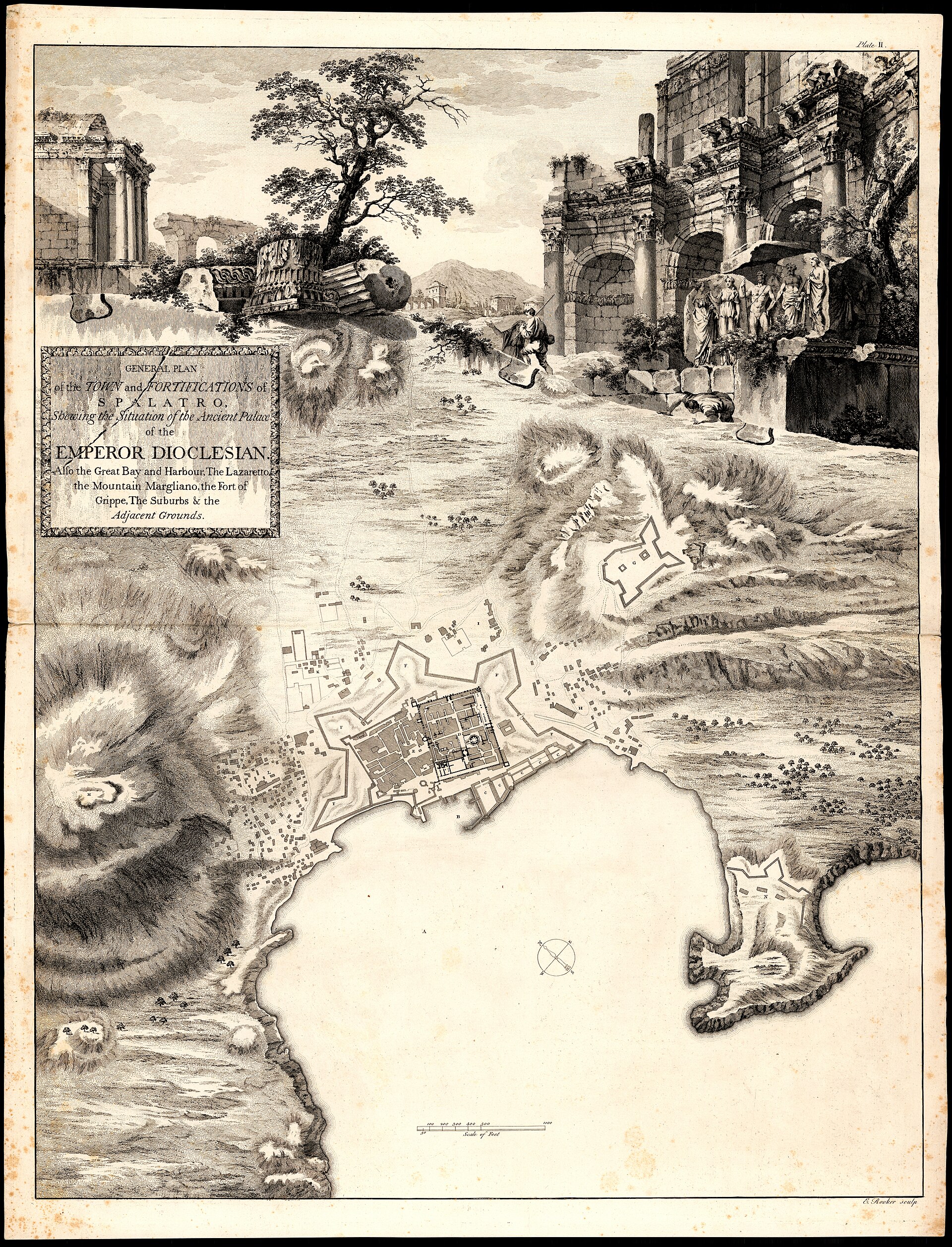
General plan of the town and fortifications of Spalatro, showing the ancient palace (Edward Rooker)
Detailed plan showing Diocletian’s palace inside the walled town, bastioned outer fortifications, gates, harbour and nearby forts on the headland.
1674 · Edward Rooker · Wikimedia Commons
Public domain (plate dated 1674)
In this city
Landmarks of Split, see each in its prime


More cities to explore
 Bosnia and HerzegovinaMostarExplore it in 1665
 CroatiaZadarExplore it in 1580
 CroatiaDubrovnikExplore it in 1300 · 1550 · 1780
 NetherlandsUtrechtExplore it in 1400 · 1700
Castles of Europe · Landmarks of Europe · create your own reconstruction.