Historic Cities · Germany
Erfurt through the ages
Erfurt (German pronunciation: [ˈɛʁfʊʁt] ) is the capital and largest city of the Central German state of Thuringia, with a population of around 216,000. It lies in the wide valley of the River Gera, in the southern part of the Thuringian Basin, north of the Thuringian Forest, and in the middle of a line of the six largest Thuringian cities, stretching from Eisenach in the west, via Gotha, Erfurt,

Erfurt in 1505
Luther's Erfurt
Erfurt in 1505 is a prosperous late‑medieval woad city whose spires and steep gables rise above the Gera; its university draws scholars and bursae into the narrow streets. This walk moves from the abbey hill and cathedral down through the market quarters, across the bridge of shops and along the mill channels to the Augustinian friary where many young scholars, including Martin Luther, found shelter.
The skyline is a compact cluster of stone towers and slender Gothic spires above a sea of red‑tiled roofs and steep timbered gables. Streets are narrow, cobbled and shadowed; façades are painted or exposed timber, peppered with shop signs. The Gera threads the town with shallow mill channels and low stone bridges; dyehouses and woad vats supply a recurring wash of deep blue. Scale is human: crowded alleys, open market squares and dense rows of merchant yards.
The route: 15 streets, squares and views
Petersberg View → Petersberg Abbey → Domberg (Cathedral Hill) → Domplatz Stairs → Erfurt Cathedral and St Severus → Domplatz Square → Fischmarkt → Krämerbrücke (Merchants' Bridge) → Old Synagogue Quarter → Gera Mill Channels → …
Step inside, 8 interiors
High Choir with Wolfram Candelabrum · Severus Stone Nave · Merchant's Shop Parlour · Miller's Wheelhouse · Woad Vaulted Storehouse · Collegium Maius Lecture Hall · Georgenburse Common Hall · Augustinian Chapter Room
Planned from the Wikipedia record: Erfurt.
Its story
The story of Erfurt.
The Ford on the Gera and the Woad Towns, 742-1483
The town enters the written record in 742, when Saint Boniface wrote to Pope Zachary that he had established three dioceses in central Germany, one of them "in a place called Erphesfurt, which for a long time has been inhabited by pagan natives". Zachary confirmed all three the following year, but in 755 Erfurt was brought into the diocese of Mainz. People had been on the ground far longer: a dig at Frienstedt west of the modern city turned up a large Germanic village whose sacrificial shaft yielded a comb carrying what has been identified as the oldest Germanic word yet found in Central Germany, written in runic script. The Thuringi inhabited the area around 480 and gave their name to Thuringia around 500.
The name points to the ford across the Gera, and the crossing is why the town mattered. Erfurt sat on the Via Regia, one of the most used east-west roads between France and Russia, running by way of Frankfurt, Erfurt, Leipzig and Wrocław, and on the north-south route that tied Baltic ports such as Lübeck to the upper Italian city-states of Venice and Milan. What it sold was woad: with Gotha, Tennstedt, Arnstadt and Langensalza it was the centre of the German woad trade, and that trade made those towns wealthy.
Through the tenth and eleventh centuries both the emperor and the Electorate of Mainz held privileges here; the German kings had an important monastery on Petersberg hill and the archbishops of Mainz collected taxes from the townspeople. Around 1100 some inhabitants became free citizens by paying an annual liberation tax, the Freizins, a first step towards an independent city. The citizens built a wall in the twelfth century, a city council was founded in 1217 and the town hall built in 1275. The council bought a territory of its own that at its height took in nearly 100 villages and castles and the small town of Sömmerda, making Erfurt a regional power between the Landgraviate of Thuringia, the Electorate of Mainz to the west and the Electorate of Saxony to the east.
From 1306 to 1481 Erfurt was allied with Mühlhausen and Nordhausen in the Thuringian City Alliance, and the three joined the Hanseatic League together in 1430. Economic development peaked in the fifteenth century, when the city held 20,000 people and was one of the largest in Germany. A second and higher wall went up between 1432 and 1446, and a first city fortress on Cyriaksburg hill in 1483.
The Jewish Community, the 1349 Massacre and the Erfurt Treasure
The Jewish community of Erfurt was founded in the eleventh century and, with those of Mainz, Worms and Speyer, became one of the most influential in Germany. In 1349, during the wave of Black Death persecutions across Europe, the Jews of Erfurt were rounded up; more than 100 were killed and the rest driven from the city. Before the persecution a wealthy Jewish merchant buried his property in the basement of his house, and construction work in 1998 uncovered it: the gold and silver objects of the Erfurt Treasure are shown today in the Old Synagogue, which survives as a museum. Only a few years after 1349 Jews moved back and founded a second community, which the city council disbanded in 1454.
The mikveh beside the Gera near the Krämerbrücke was rediscovered in 2007, and in 2023 the Old Synagogue, the mikveh and the Stone House were inscribed on the UNESCO World Heritage List for their testimony to the life of a medieval Jewish community. The city's newer synagogue was destroyed during the Kristallnacht of 1938; Jews lost their property and emigrated or were deported to Nazi concentration camps, as did many communists. The Jewish community in Erfurt now numbers 500 members, most of whom came from Russia and Ukraine in the 1990s.
The University of 1379, Luther, and the Hammelburg Treaty of 1530
The University of Erfurt was founded in 1379, the first university established within the geographic area of modern Germany, and with the University of Cologne one of the first city-owned universities in a country where such foundations normally belonged to the territorial lord. It became a centre of German cultural life in Renaissance humanism, with scholars including Ulrich von Hutten, Helius Eobanus Hessus and Justus Jonas.
Martin Luther moved to Erfurt in 1501 and began his studies at the university; after 1505 he lived as a friar at St Augustine's Monastery, was ordained a priest in Erfurt Cathedral in 1507, and moved permanently to Wittenberg in 1511. Erfurt adopted the Reformation early, in 1521. In 1530 the Hammelburg Treaty made it one of the first cities in Europe to be officially bi-confessional, and it kept that status through all the following centuries.
Mainz Governors, the Plague of 1683 and French Rule, 1664-1815
The later sixteenth and the seventeenth century brought a slow decline. Trade shrank, the population fell, the university lost its influence and the city's independence came under threat. In 1664 Erfurt and the surrounding country were brought under the dominion of the Electorate of Mainz and the city lost its independence; the Electorate built a huge fortress on Petersberg hill between 1665 and 1726 to control the town and installed a governor over it. The worst plague years in the city's history came in 1682 and 1683, and in 1683 more than half the population died of the disease. Witch-hunts are known in Erfurt from 1526 to 1700, with eighteen recorded trials for witchcraft. A late cultural revival came under the governor Karl Theodor Anton Maria von Dalberg, whose court drew Goethe, Schiller, Herder, Wieland and Wilhelm von Humboldt as frequent visitors.
Erfurt passed to the Kingdom of Prussia in 1802 as compensation for territories Prussia had lost to France on the left bank of the Rhine. On 16 October 1806 the city, its 12,000 Prussian and Saxon defenders under William VI, Prince of Orange-Nassau, 65 artillery pieces and the Petersberg and Cyriaksburg citadels were handed over to the French. Erfurt became the Principality of Erfurt, an imperial state domain answering directly to Napoleon and kept outside the Confederation of the Rhine that the surrounding Thuringian states had joined; the Congress of Erfurt brought Napoleon and Alexander I of Russia to the city in 1808. The occupiers introduced street lighting and a tax on foreign horses to pay for the road surface, and stripped the Peterskirche of its organ and bells.
When the French decreed in 1813 that 1,000 men be conscripted into the Grande Armée, the recruits and other townspeople rioted on 19 July; twenty were arrested and two sentenced to death by French court-martial. Within a week of the Coalition victory at Leipzig on 16-19 October 1813, Erfurt was besieged by Prussian, Austrian and Russian troops under the Prussian Lieutenant General von Kleist. The French commander Alexandre d'Alton signed a first capitulation on 20 December 1813 and withdrew into the two fortresses, and Coalition forces marched into the city on 6 January 1814. During the two and a half months of siege the death rate in the city rose sharply; 1,564 Erfurt citizens died in 1813, about a thousand more than in the previous year. The last 1,700 French troops gave up the Petersberg and Cyriaksburg in May 1814, and after the Congress of Vienna Erfurt was restored to Prussia on 21 June 1815 as the capital of one of the three districts of the new Province of Saxony.
Railways, the Royal Gun Factory and the Erfurt Program, 1847-1914
Enclosed by Thuringian territory to west, south and east, Erfurt nonetheless remained part of the Prussian Province of Saxony until 1944. The attempt made in the city to answer the demand for a united national state after the revolution of 1848, the Erfurt Union of German states of 1850, failed. Industry arrived in the 1840s with the Thuringian Railway between Berlin and Frankfurt; the year the rail connection came, 1847, the population stood at 32,000. Factories followed in engine building, shoes, guns, malt and later electro-technics, so that no single industry dominated the city. One of the largest was the Royal Gun Factory of Prussia, founded in 1862.
Unification in 1871 moved Erfurt from the southern border of Prussia to the middle of Germany and made its fortifications redundant. Their demolition in 1873 released the ring of the old walls for building and set off a construction boom, with a tramway from 1883, hospitals and schools. The population rose from 40,000 around 1870 to 130,000 by 1914. In 1891 the Social Democratic Party of Germany adopted the Erfurt Program at its congress in the city.
The Depression, Topf and Sons, and the Air Raids
Between the wars the city kept growing, meeting housing shortages with building programmes and broadening its social infrastructure under the welfare policy of the Weimar Republic. The Great Depression of 1929 to 1932 put nearly one in three out of work. Conflict between far-left and far-right milieus sharpened, and many inhabitants supported the new Nazi government and Adolf Hitler, while some communist workers resisted it.
The Erfurt firm Topf and Sons had begun manufacturing crematoria in 1914 and became the market leader in that industry. Under the Nazis it supplied specially developed crematoria, ovens and associated plants to the Auschwitz-Birkenau, Buchenwald and Mauthausen-Gusen concentration camps. A memorial and museum dedicated to the victims of the Holocaust opened on the former company premises on 27 January 2011.
Erfurt was struck by more than 27 British and American air raids during the Second World War, in which about 1,600 civilians died. Bombed as a target of the Oil Campaign, the city suffered only limited damage, and it was captured on 12 April 1945 by the United States 80th Infantry Division.
Soviet Zone, Bezirk Seat and State Capital since 1945
American troops left on 3 July 1945 and Erfurt passed into the Soviet Zone of Occupation and then into the German Democratic Republic. In 1948 it replaced Weimar as the capital of Thuringia; when the GDR dissolved the Länder in 1952 in favour of centralisation it became the capital of a Bezirk instead. A teaching Hochschule was founded in 1953 and one of medicine in 1954, the first academic institutions in Erfurt since the university closed in 1816. On 19 March 1970 the East and West German heads of government, Willi Stoph and Willy Brandt, met in Erfurt, the first such meeting since the division of Germany.
As the GDR economy worsened through the 1970s and 1980s, old buildings in the centre decayed while the government answered the housing shortage with large Plattenbau settlements on the periphery; the population reached its maximum of 220,000 in 1988. The Peaceful Revolution of 1989 and 1990 led to reunification, and with the re-formation of the state of Thuringia in 1990 Erfurt became the state capital. The crisis that followed closed nearly all the factories, some because they could not adapt to a free market and others because they were sold to West German businessmen who shut them to remove the competition; people lost their jobs and moved to the former West Germany, and the population fell to 200,000 by 2002 before rising again. The Fachhochschule opened in 1991 and a new University of Erfurt in 1994. Erfurt is today the capital and largest city of Thuringia, with a population of around 216,000.
From the archive
Erfurt on paper: the old town as it was mapped.
A period plan or bird's-eye view of the old town, drawn between 1500 and 1850, the streets this page's reconstructions walk. Public domain, with its source named.
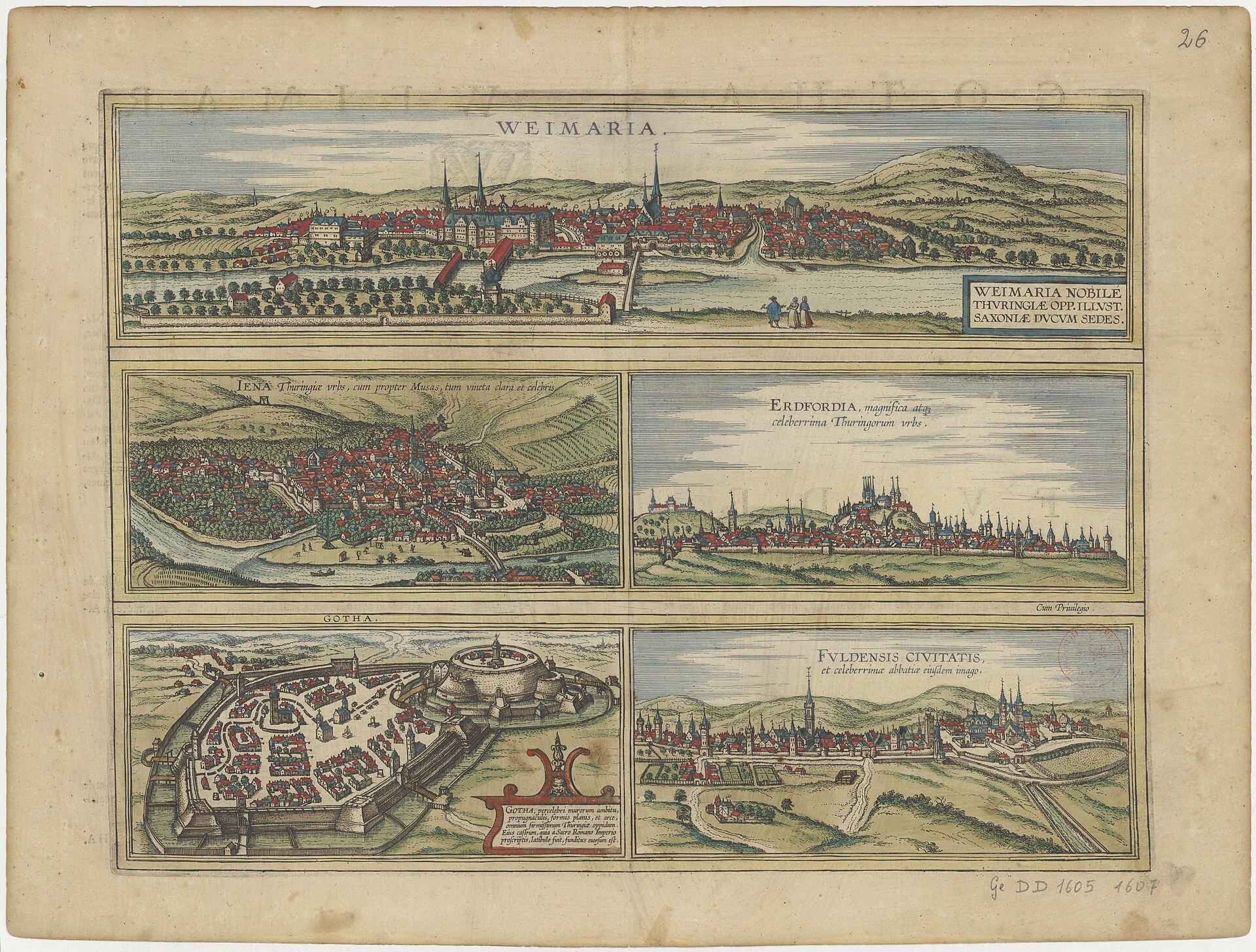
Erdfordia (Erfurt), engraved city prospect from Braun & Hogenberg's Civitates Orbis Terrarum
Panoramic prospect showing Erfurt's walled skyline with cathedral spires and numerous church steeples, towers and the river in the foreground.
Public domain (plate dated 1645)
More cities to explore
 GermanyNurembergExplore it in 1350 · 1500 · 1835
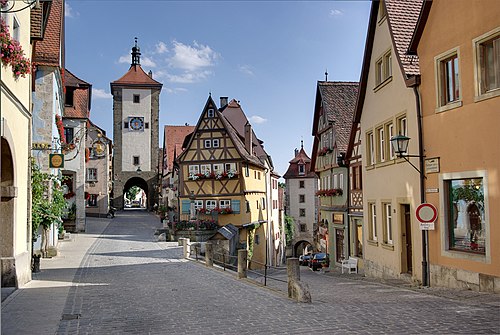 GermanyRothenburg ob der TauberExplore it in 1520
 GermanyBerlinExplore it in 1750 · 1871 · 1928
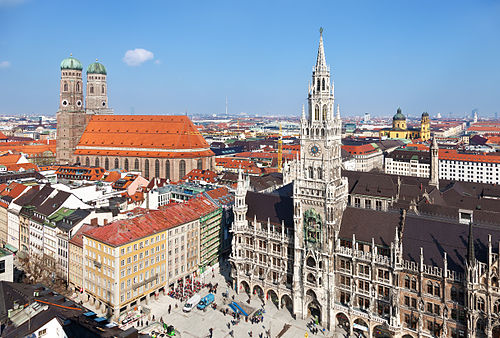 GermanyMunichExplore it in 1500 · 1700 · 1900
Castles of Europe · Landmarks of Europe · create your own reconstruction.