Historic Cities · Germany
Rothenburg ob der Tauber through the ages
Rothenburg ob der Tauber is a town in the district of Ansbach of Mittelfranken, in the Franconia region of Bavaria, Germany. It is best known for its well-preserved medieval old town, a destination for tourists from around the world. It is part of the popular Romantic Road through southern Germany.

Rothenburg ob der Tauber in 1520
The Free Imperial Town
Rothenburg in 1520 stands at the height of its life as a wealthy Free Imperial Town: church towers, guild houses and fortified walls form a compact, prosperous silhouette. The walk moves from the Tauber valley up through gates and market to St James’ twin spires, the freshly roofed gate towers, the crowded Marktplatz and the narrow timbered lanes that knit the town together.
A compact medieval skyline of stone and timber: the vertical Gothic spires of St James rise above a sea of red clay roofs and painted half-timber façades, all ringed by a continuous stone wall punctuated by round and square towers with newly tiled conical roofs. Narrow cobbled streets slope between overhanging upper storeys; market stalls cluster beneath the town hall; the Tauber river and its double bridge break the walls at the valley, and the Topplerschlösschen crouches below.
The route: 16 streets, squares and views
Tauber Valley Approach → Double Bridge → Topplerschlösschen → Rödertor → Marktplatz → Councillors' Tavern → St. Jakob → Old Town Hall → Herrngasse → Schmiedgasse → …
Step inside, 8 interiors
Toppler Tower Chamber · Marktplatz Meat Hall · Councillors' Tavern Parlour · Choir with Holy Blood Altar · Great Council Hall · Patrician Panelled Parlour · Cooper's Workshop · Heilig-Geist Hospital Ward
Planned from the Wikipedia record: Rothenburg ob der Tauber.
Its story
The story of Rothenburg ob der Tauber.
From the Staufer Castle to the Free Imperial City, 1142-1455
The counts of Comburg-Rothenburg built a castle, long since vanished, on the Essigkrug spur beside what is now the Spitalhof; the first mention of a count of Rothenburg falls in the eleventh century, and older traditions about the family are legendary. The line died out in 1116 with Count Heinrich, who left the castle to the monastery of Comburg his family had founded. In 1142 King Konrad III acquired the village of Detwang from the canons of Neumünster in Würzburg and built a castle of his own on the spur above the river, where he is recorded staying in 1150. A settlement grew beside it, and its position gave the town the tag ob der Tauber, above the Tauber. In 1172 Emperor Friedrich I Barbarossa granted the settlement town rights. It was one of a line of foundations, Dinkelsbühl among them, strung north to south along the eastern edge of his Duchy of Swabia to close the frontier against attack. Building of the first wall began at once; by 1204 the town had outgrown it and the citizens began a second circuit, which still stands and tripled the building land, and the hospital quarter to the south was taken inside the walls early in the fourteenth century. Ministerials and former garrison men of the Staufer castle formed the patriciate and alone sat on the council, while craftsmen lived in the outer districts beyond the first wall.
On 15 May 1274 King Rudolf of Habsburg raised Rothenburg to a free imperial city, a standing it held until 1803. Three fairs were established, its merchants traded as far as Italy and Prague, and the pilgrimage to the Holy Blood relic drew crowds to the town. With 5,000 to 6,000 people inside the walls and some 14,000 more across the 390 square kilometres of territory the city ruled, it was reckoned one of the twenty largest cities of the Holy Roman Empire. Wealth paid for building: the Gothic basilica of St James went up between 1311 and 1484, begun at the charge of the Teutonic Order, which had held a commandery in the town since the thirteenth century, and finished largely at the citizens' expense.
The dominant figure of the late medieval city was Heinrich Toppler (c. 1350-1408), whose land purchases and forceful policy shaped the town long after his death and who was executed in 1408, apparently after an intrigue; the archive still holds more than 300 letters of defiance from the feuds with neighbouring knights and towns that ran through the fifteenth century. In 1455 the craftsmen rose, held the councillors in the town hall dungeon and forced the creation of twelve guilds with seats on the council, though the patriciate recovered its position within a few years.
The Jewish Community: 1298, 1349 and the Expulsion of 1520
Imperial tax records of 1241 and 1242 list the names of the Jews of Rothenburg. The community produced Rabbi Meir ben Baruch of Rothenburg (c. 1220-1293), who had a great reputation across Europe as a jurist and who was buried at Worms in 1307. At its height the community numbered around 500 people, roughly a tenth of the town.
During the Rintfleisch pogrom of 1298 almost the whole community, about 450 people, was murdered. Jews settled in the town again, and the new community was destroyed by a second pogrom in the plague year of 1349. Again Jews returned, and in 1520 the town preacher Johannes Teuschlein secured their final expulsion; the community's property was confiscated and the synagogue on the Kapellenplatz was converted into a chapel, which was pulled down early in the nineteenth century. Jews were not able to settle in Rothenburg again until the nineteenth century.
The Peasants' War of 1525 and the Lutheran Settlement, 1522-1579
By 1522 there were supporters of the Reformation among the citizens and on the council, and in 1524 and 1525 the reformer Andreas Bodenstein, called Karlstadt, worked in the town. During the German Peasants' War of 1525 Rothenburg allied itself with the rebel peasants under Florian Geyer. After the peasants were beaten, Margrave Casimir of Brandenburg-Kulmbach held a blood court on the market square and had seventeen of the leaders publicly beheaded; the town was made to pay a heavy war contribution and the Mass was reinstated.
The council resolved in 1544 to reintroduce the Reformation and brought in Thomas Venatorius, who preached the first evangelical sermon in Rothenburg on 23 March that year. The Teutonic Order and the Order of St John remained Catholic and had to surrender their churches of St James and St John. In 1579 the mayor and council signed the Lutheran Formula of Concord.
Tilly's Siege, October 1631, and the Meistertrunk Legend
The Thirty Years' War caught Rothenburg between the sides: a Protestant imperial city owing loyalty to the Catholic Emperor Ferdinand II while sympathising with the Protestant cause. After Gustavus Adolphus broke the imperial army at Breitenfeld in September 1631 and took Würzburg, Tilly tried to build a new defensive line in Franconia. The imperial garrison in Rothenburg surrendered to the Swedes on 8 October without a siege, part of it mutinying and joining them, and the Swedes occupied the town. Two weeks later Tilly arrived with the main imperial army. The council refused to open surrender talks on 27 October, the town was ringed on 29 October and bombarded from the north on the 30th. The defenders inflicted about 300 casualties, but when stored gunpowder exploded in the Klingentor bastion the Swedish garrison broke off the fight and was allowed to march out.
The town was given over to plunder, probably on the night of 30-31 October, and the council was held and threatened with death until it could show that Rothenburg had had no part in the mutiny of the imperial garrison. Tilly appears to have spared the place rather than repeat Magdeburg, where his troops had massacred the population and burned the city a few months earlier. The plundering was stopped, the town paid a fine and had to quarter imperial soldiers, which brought further assaults, hunger and imported disease, until the troops left on 13 January 1632. An outbreak of bubonic plague killed many more in 1634. Poor and half empty, the town stopped growing.
The story that the old mayor Georg Nusch drained three and a quarter litres of wine at one draught on Tilly's challenge and so saved the town is a legend that first took shape around 1770. It is absent from the chronicle of Sebastian Dehner, an eyewitness who wrote about fifteen years after the siege, and appears first in the chronicle of Georg Heinrich Schaffert more than a century later. The Meistertrunk has been performed as a festival play each year since 1881, and was entered on the Bavarian list of cultural heritage in 2014 and the German list in 2016.
Bavaria, the Painters and the First Tourists, 1803-1903
By the Reichsdeputationshauptschluss of 1803 the imperial city became part of the Electorate of Bavaria, and a border treaty with Württemberg on 18 May 1810 took away the western part of its territory. Its position on the Württemberg frontier is one reason the nineteenth-century town went stiff: there were beginnings of industry, but no railway connection until 1881, and the old fabric stood largely untouched.
That decay of momentum made the town's fortune. The landscape painter Gustav Schönleber came in 1870 and Eugen Bracht in 1877, and from the 1880s later Romantics including Hans Thoma and Carl Spitzweg followed, and then the first tourists; laws were made to prevent major alterations to the town. Building outside the walls began in 1884. By the turn of the century Rothenburg was a favourite with English and French visitors, and before the First World War coach parties were putting up at the Hotel Eisenhut. Johann Friedrich von Hessing's Wildbad spa was completed in 1903.
"The Most German of German Towns" and the Expulsion of 1938
In the Weimar Republic the town and its electoral district became a stronghold of the DNVP, which several times took around 80 per cent of the vote, and then of the NSDAP, which took 83 per cent there at the elections of 5 March 1933. Antisemitic assaults followed in the town the same year. Nazi ideologists treated Rothenburg as the epitome of the German home town, and through the 1930s the Strength through Joy organisation ran regular day trips to it from across the Reich, which the townspeople supported for the trade it brought and because the town was hailed as the most German of German towns. In October 1938, shortly before the Kristallnacht, the last seventeen Jews living in Rothenburg were driven out of the town on the orders of the NSDAP district leader Karl Steinacker, the expulsion carried out by SA men and Hitler Youth. On 22 October the contents of the synagogue in the Herrngasse were plundered and destroyed, and the town held a celebration of its "liberation from the Jews".
The Raid of 31 March 1945 and the Rebuilding
On 31 March 1945 aircraft of the United States 386th Bombardment Group attacked Rothenburg. The raid had been directed at an oil depot at Ebrach in Upper Franconia, which could not be bombed because it was obscured, and the town, which had no military significance, was hit as the alternative target. Accounts give the dead as 37 or 39. Around 275 houses, roughly a third of those in the town, six public buildings, nine watchtowers and more than 2,000 feet, some 610 metres, of wall were destroyed or damaged, almost all of it in the newer eastern half of the old town; because incendiaries were used, most outer walls were left standing.
Just over a fortnight later the war ended for the town without a bombardment. The United States Assistant Secretary of War, John J. McCloy, who knew Rothenburg only from his mother's account of a pre-war visit, stated afterwards that his intervention with General Jacob L. Devers had stopped a planned artillery attack on the town. Six men of the 12th Infantry Regiment, 4th Division went in on a three-hour mission to offer terms: no shelling or bombing if the town was not defended, and destruction if they had not returned to their lines by six that evening. Private Herman Lichey, who spoke fluent German, delivered the message, and the local commander, Major Thömmes, gave up the town against Hitler's order that every town fight to the end. American troops occupied Rothenburg on 17 April 1945, and McCloy was made an honorary citizen in November 1948.
About a third of the town had to be repaired or rebuilt, and some 265 houses were put up again on their surviving walls. The work did not copy what had stood before: the new façades are plainer, matching the style of the surviving buildings rather than reproducing lost detail, while the town hall roof and stretches of the wall were restored as accurately as possible. Donations came from around the world, including from Americans, and rebuilt sections of the wall carry bricks bearing donors' names. The older western part of the old town, where the medieval city began, was not bombed. Rothenburg lost its standing as an independent district town in 1972, when town and district were absorbed into the district of Ansbach, and had 11,243 inhabitants in 2018.
From the archive
Rothenburg ob der Tauber on paper: the old town as it was mapped.
A period plan or bird's-eye view of the old town, drawn between 1500 and 1850, the streets this page's reconstructions walk. Public domain, with its source named.
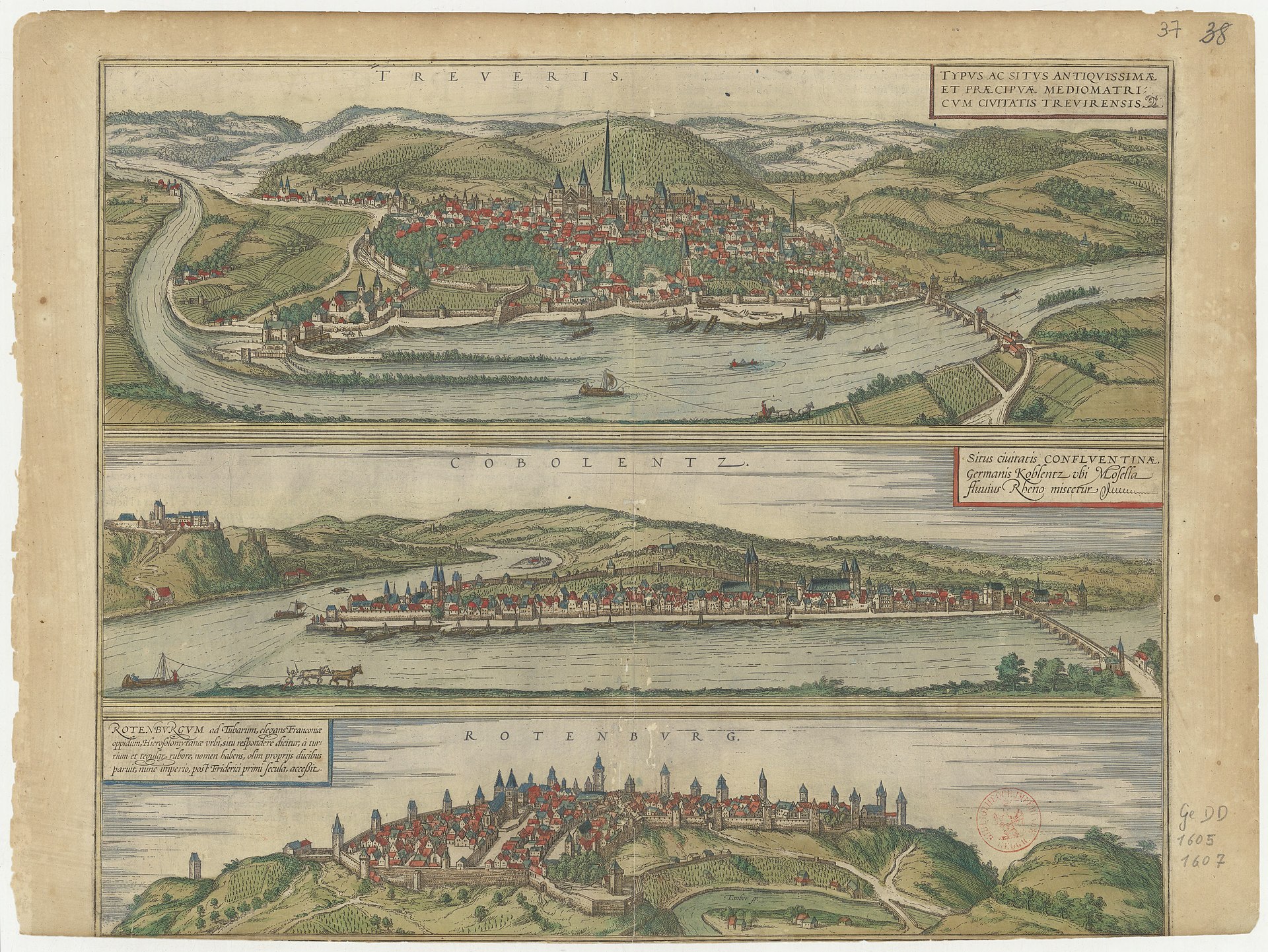
Bird's-eye view of Rothenburg ob der Tauber, from Braun & Hogenberg's Civitates Orbis Terrarum
Shows the walled old town with its continuous curtain walls, many defensive towers and gates, clustered red‑roofed houses and a prominent church tower above the Tauber valley.
Public domain (plate dated 1645)
More cities to explore
 GermanyNurembergExplore it in 1350 · 1500 · 1835
 GermanyHeidelbergExplore it in 1400 · 1615 · 1830
 GermanyBerlinExplore it in 1750 · 1871 · 1928
 GermanyMunichExplore it in 1500 · 1700 · 1900
Castles of Europe · Landmarks of Europe · create your own reconstruction.