Historic Cities · Germany
Heidelberg through the ages
Heidelberg is the fifth-largest city in the German state of Baden-Württemberg, and with a population of about 163,000, of which roughly a quarter consists of students, it is Germany's 51st-largest city. Located about 78 km (48 mi) south of Frankfurt, Heidelberg is part of the densely populated Rhine-Neckar Metropolitan Region which has its centre in Mannheim.

Heidelberg in 1400
Medieval Heidelberg
Heidelberg in 1400 is a compact riverside town whose castle and church already shape its skyline while a newly founded university begins to draw scholars into its narrow lanes. The walk moves from hilltop views across the Neckar, down through the bridge gate and market by the Heiliggeistkirche, along Hauptstraße past university houses, to the castle terraces and a final high lookout over the valley.
The skyline is a close-knit jumble: reddish clay roof tiles and dark timber-framed façades pressed under the stone bulk of the Palatine castle, round castle towers and church spire puncturing the low horizon. Narrow cobbled streets open to a single market square; the Neckar runs brown and lively with ferries and fish weirs. Walls and wooden gates ring the town; window shutters and painted signs enliven the façades. Stone, wood and clay dominate the palette.
The route: 21 streets, squares and views
Heiligenberg View → Bergheim Approach → Brückentor → Neckar Bridge → Neckar Ferry → Fish Weirs → Boatman's Inn → Neckarufer → Marktplatz → Heiliggeistkirche → …
Step inside, 12 interiors
St Michael's Chapel · Ferry Master's Boathouse · Fish Smokehouse · Boatmen's Common Hall · Butchers' Hall · Nave and Library Tribune · Council Chamber · Disputation Hall · Scribal Loft · Binder's Workshop · Elector's Great Hall · Spiral Keep Stair
Planned from the Wikipedia record: Heidelberg.
Heidelberg in 1615
Palatine Heidelberg
Heidelberg in 1615 is at the height of its role as the Elector Palatine's court, with the castle newly extended and its great terraced garden being carved into the hillside. Walkers will pass the castle terraces and Friedrichsbau, thread the Old Town markets and riverfront, cross the Neckar and finish on the Heiligenberg with the castle and Hortus Palatinus laid out below.
A compact medieval town hugged by the Neckar and a steep wooded ridge, dominated by the vast multi-winged castle of the Elector. Red-brown sandstone towers, curtain walls and round artillery towers sit above formal terraces of clipped hedges and parterres. In the valley, timber-framed houses and steep tiled roofs pack the streets; the riverfront shows wooden wharves, low barges and gardeners tending the new palace gardens on the sunlit slope.
The route: 22 streets, squares and views
Königstuhl View → Castle Outer Curtain → Hortus Palatinus Terraces → Friedrichsbau Façade → English Wing → Schlosshof and Great Tun → Dicker Turm → Schlossgasse Descent → Bastion and Rampart → Neckar Quay Landing → …
Step inside, 14 interiors
Ottheinrich Painted Chamber · Shell Grotto and Automata · Court Music Pavilion · Marble Hall · Electress's Privy Chamber · Great Court Stair · Electoral Wine Cellar · Dicker Turm Guardroom · Riverside Wine Warehouse · Riverside Tavern Taproom · Cooper's Workshop · Town Council Chamber · Nave of the Heiliggeistkirche · Academy Lecture Hall
Planned from the Wikipedia record: Heidelberg Castle.
Heidelberg in 1830
Romantic Heidelberg
Heidelberg in 1830 is the university town celebrated by poets and painters, its ruined castle looming over a compact Baroque old town beside the Neckar. The walk moves from the river approach, across the Old Bridge and through student streets to the castle terraces and the Philosophenweg, showing the city’s ruined masonry, narrow lanes and riverside houses.
In 1830 Heidelberg’s skyline is a layered silhouette of red-tiled roofs, timber-framed façades and the broken battlements of the Schloss high on the Schlossberg, all set in a green cleft of the Odenwald. The Neckar cuts a reflective ribbon beneath the Old Bridge; narrow, cobbled Hauptstraße and market squares sit under Baroque church towers. Artists and students gather where ruin, river and mountain meet in clear, often cool valley light.
The route: 20 streets, squares and views
Bergstraße Approach → Bergheim Neckar Bank → Brückentor Gate → Old Bridge Span → Neckarfront Houses → Kornmarkt Square → Heiliggeistkirche Exterior → Marktplatz → Hauptstraße Main Street → Zum Ritter Inn → …
Step inside, 14 interiors
Bridge Gate Upper Chamber · Old Bridge Guardroom · Riverside Inn Parlor · Kornmarkt Wine Cellar · Heiliggeistkirche Nave · Town Hall Council Chamber · Bookbinder's Workshop · Zum Ritter Common Room · Jesuitenkirche Baroque Nave · Studentenkarzer Cell · Steingasse Tavern Backroom · Electoral Stair Hall · Friedrichsbau Open Courtyard · Painter's Studio with View
Planned from the Wikipedia record: Heidelberg.
Its story
The story of Heidelberg.
Heiligenberg, Lopodunum and the Counts Palatine
A large fortified Celtic settlement stood on the Heiligenberg above the Neckar in the fifth and fourth centuries BC, abandoned in the third century BC for reasons that are not entirely clear. The Romans put a camp in what is now the city area and gave it a stone fort in 90 AD, though the centre of the region was neighbouring Lopodunum, now Ladenburg; after 260 they withdrew to the Rhine before the Alamanni.
The name Heidelberch is first recorded in a document of the Schönau monastery in 1196, when the site still belonged to the diocese of Worms; a castle had probably been built on the mountainside a century earlier, and the planned town below it dates from about 1220 rather than the 1170s, as was long assumed. In 1156 the Emperor Frederick Barbarossa made his half-brother Conrad Count Palatine of the Rhine; the office passed to the Wittelsbachs in 1214, and in 1225 the Count Palatine received Heidelberg from Worms as a fief. When the practice of travelling between residences was abandoned in the fourteenth century Heidelberg became the permanent one, and the Golden Bull of 1356 reserved the right to elect the emperor to the Counts Palatine, Electors Palatine thereafter.
The University of 1386 and the Expulsion of 1392
Elector Ruprecht I founded the University of Heidelberg in 1386, the third in the Holy Roman Empire after Prague and Vienna and the oldest in present-day Germany. He needed clergy, doctors, lawyers and teachers to administer his territory, and the Great Western Schism helped, since German scholars could no longer study at the Sorbonne. The town had about 5,000 inhabitants and no academic tradition, and its Hohe Schule, which had its own jurisdiction, saw repeated violent clashes between townspeople and students in the fifteenth century. Heidelberg itself remained a predominantly agricultural town, its citizens organised in ten guilds of which the winegrowers' was the largest.
In 1392 Elector Ruprecht II doubled the area of the town, pushing the western limit out to the line of today's Bismarckplatz and forcibly resettling the inhabitants of the village of Bergheim in the new suburb. At the same time the Jewish community, which had lived in Heidelberg since the thirteenth century, was expelled, and its synagogue was converted into a chapel dedicated to the Virgin Mary which also served the university as an auditorium.
Seven Changes of Confession and the Winter King, 1518–1652
Martin Luther appeared at the Heidelberg Disputation in 1518, which helped spread the ideas of the Reformation. Under Ottheinrich the Electoral Palatinate became Lutheran, and he merged the university, collegiate and palace book collections into the Bibliotheca Palatina. The territory then changed confession seven times before the eighteenth century on the principle of cuius regio, eius religio, and with each change the university was purged of professors unacceptable to the new ruler. Frederick III made it a strictly Calvinist state; the Heidelberg Catechism, written in 1563, remains a guiding document of Calvinist belief.
Frederick V, who rebuilt parts of the castle for his wife Elizabeth Stuart, daughter of James VI and I, led the Protestant Union and was elected king of Bohemia by the estates on 26 August 1619, after the Defenestration of Prague had triggered the Thirty Years' War; he held it for thirteen months, was beaten at the White Mountain on 8 November 1620 and fled into exile, remembered by the derisive name of the Winter King. Tilly's army besieged Heidelberg for nearly three months and took it on 19 September 1622. Catholicism was imposed, the university dissolved, and the Bibliotheca Palatina carried to Rome and presented to Pope Gregory XV; it is still kept in the Vatican Library. Bavarian troops held the city until autumn 1649, and the Peace of Westphalia returned a reduced Palatinate to Frederick's son Charles I Louis, who settled immigrants from Reformed lands including Switzerland and reopened the university in 1652.
Mélac's Fires, the Poor Palatines and the Move to Mannheim, 1688–1720
When Charles II died childless in 1685 the Palatinate-Simmern line died out and the electorate passed to a Catholic branch. Louis XIV claimed the inheritance through his sister-in-law Elisabeth Charlotte, known as Liselotte von der Pfalz, and in the War of the Palatinate Succession that followed, from 1688 to 1697, the French under Ezéchiel de Mélac waged a systematic campaign of destruction. The capture of October 1688 was comparatively light, though the town hall and the castle's Thick Tower were blown up; when the French returned in 1693 the whole city was reduced to rubble and ashes, only a few buildings such as the Haus zum Ritter surviving, and the castle was left a ruin.
That destruction, together with severe winters, drove thousands of Calvinist Palatines out of the country in the early eighteenth century. They fled to other European cities and above all to London, where the refugees were called the poor Palatines. In 1709–1710 Queen Anne's government arranged the transport of nearly 6,000 of them to New York, and others were carried to Pennsylvania and to South Carolina, where they worked their passage and settled in the English colonies.
Rebuilding after the Peace of Rijswijk in 1697 followed the old foundations, giving a Baroque town on a medieval plan, and under the now Catholic electors a third of the population converted. The castle was uninhabitable, and after the citizens refused to pay for the palace on the plain that Johann Wilhelm had planned, his successor Karl III Philipp quarrelled with the town's Protestants over his claim to the Heiliggeistkirche and moved the capital of the Electoral Palatinate to Mannheim in 1720. Heidelberg lost its weight as a seat of power, suffered economically from the departure of the court, and saw its university decline.
Baden, Romanticism and the Hep-Hep Riot, 1803–1933
The Electoral Palatinate ended with the Reichsdeputationshauptschluss of 1803, which assigned the lands on the right bank of the Rhine, Heidelberg among them, to Baden, and Grand Duke Karl Friedrich reorganised the university as a state institution under the name Ruprecht Karls University. The castle ruins were spared demolition through preservation efforts and drew Romantic writers and painters instead: a circle formed from 1804 around Achim von Arnim and Clemens Brentano, who published the folk-song collection Des Knaben Wunderhorn in the city between 1806 and 1808.
During the anti-Jewish Hep-Hep riots, which ran through more than eighty towns and villages of the German Confederation between August and October 1819, attackers in Heidelberg spent more than three hours on 25 August breaking into and looting the homes of three Jewish craftsmen without any intervention from the police, smashing furniture, cutting up beds and taking money from locked desks; the violence was ended by 200 Heidelberg students and the lawyer Anton Thibaut. In 1848 liberal and democratic politicians from south-western Germany met in the city on 5 March as the Heidelberg Assembly of 51, which gave the decisive impetus to the pre-parliament and so to the Frankfurt National Assembly; when that assembly failed, Prussian troops called in by the Grand Duke crushed the Baden May Uprising.
Industry never took hold as it did in neighbouring Mannheim: by the middle of the nineteenth century there were 392 industrial workers in fourteen factories in a town of about 15,000, one suggested reason being that the town already valued its landscape for tourism. Visitor numbers grew sharply once the railway reached the city from Mannheim in 1840, and after 1871 the population more than quadrupled from 20,000 to 85,000 in 1933 as neighbouring villages were incorporated from 1891 onwards.
Persecution, Deportation and a Spared City, 1925–1945
A Heidelberg branch of the NSDAP was founded in 1925 and polled well above the national average from the start, taking 30.2 per cent against 18.3 nationally in the Reichstag election of September 1930 to become the strongest party in the city, and just under 46 per cent on 5 March 1933. Organised discrimination against Jews and other 'non-Aryans' began at once: on 5 April 1933, two days before the corresponding Reich laws, Reich Commissioner Robert Wagner issued the Baden Jewish Decree, and on 7 April all 'non-Aryans' in public service were forced into retirement against their will. By 1939 the university had lost a third of its teaching staff for 'racial' or political reasons.
On the night of 9 November 1938 citizens of Heidelberg burned down the synagogues in Heidelberg and in Rohrbach, and the Orthodox prayer hall in the Plöck was destroyed. The next day the systematic deportation of the city's Jews began with 150 sent to the Dachau concentration camp. On 22 October 1940, in the Wagner-Bürckel action, more than 6,000 Jews from Baden were deported to the internment camp at Gurs in France, about 280 of them from Heidelberg. The recorded death toll at Gurs differs: as many as 1,000 dying of hunger and disease within a few months, 201 of them from Heidelberg, by one reckoning, three quarters of all those deported by another. From 1942 the survivors were deported onward to Auschwitz-Birkenau and to eastern Europe, where most of them were murdered. The poet Alfred Mombert, deported from Heidelberg, was released from Gurs in April 1941 through the efforts of the Swiss poet Hans Reinhart and died shortly afterwards of an illness contracted in captivity.
Hermann Maas, pastor at the Heiliggeistkirche from 1915, headed the church aid centre for Protestant 'non-Aryans' in 1938 and used his contacts abroad to help many people classified as Jews or half-Jews to flee before the war; he was removed from office by the Protestant Church Council of Baden in 1943 under pressure from the regime and deported to France for forced labour, and in 1950 was the first official German state guest of Israel. The city itself came through the war almost undamaged: thirteen of its 9,129 residential buildings were completely destroyed and 241 people in all were killed from the air. Why it was spared is not entirely clear: it had no heavy industry and was not a transport hub, and the Americans may already have fixed on it as a headquarters. Wehrmacht troops blew up the Neckar bridges on 29 March 1945, three arches of the Old Bridge among them, and the US 63rd Infantry Division entered the next day against no significant resistance.
The American Garrison and Its Departure, 1945–2022
An undamaged city drew Germans who had been bombed out or displaced, and the population reached 111,800 in 1946 against 85,000 before the war. Heidelberg fell in the American occupation zone and became the seat of high command posts of the US Army and NATO, and in the 1950s Mark Twain Village and Patrick Henry Village were built in the south of the city for American soldiers and their families. The university, closed by the occupying forces in April 1945, was after denazification the first West German university to resume teaching, in January 1946.
The city hosted events during the 1972 Summer Paralympics. The Red Army Faction attacked the American installations in the city twice: a bomb at the headquarters of the 7th US Army in the Campbell Barracks on 24 May 1972 killed the soldiers Clyde R. Bonner, Charles L. Peck and Ronald A. Woodward, and an attempt on the life of General Frederick J. Kroesen at the Karlstor on 15 September 1981 failed. V US Army Corps left for Wiesbaden in August 2011, the 65-year presence of USAREUR in Heidelberg ended in 2013, and by 2015 the entire military administration had gone, costing the city 45 million euros in revenue but freeing land for housing.
An application in 2004 to add the castle and old town to the UNESCO World Heritage list was rejected in 2005 and again in June 2007. The fifth-largest city in Baden-Württemberg, it has a population of about 163,000, roughly a quarter of them students, and lives on the university and on research institutions such as the European Molecular Biology Laboratory; tourism draws more than 11.9 million visitors a year. On 24 January 2022 an eighteen-year-old man opened fire in a lecture hall at the university's Centre for Organismal Studies, killing one person and injuring three before killing himself.
From the archive
Heidelberg on paper: the old town as it was mapped.
A period plan or bird's-eye view of the old town, drawn between 1500 and 1850, the streets this page's reconstructions walk. Public domain, with its source named.
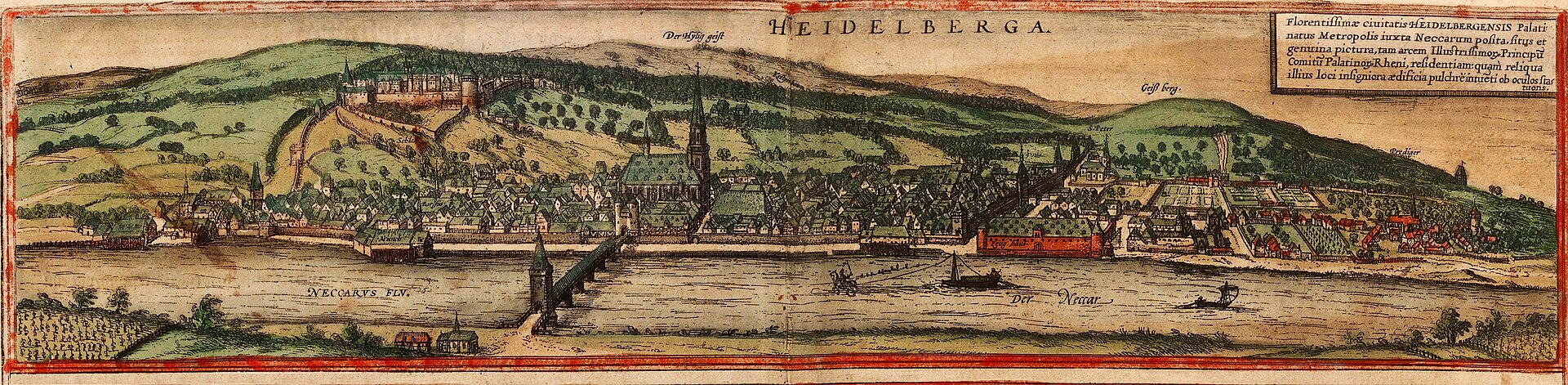
Bird's-eye view of Heidelberg (Heidelberga), from Braun & Hogenberg's Civitates Orbis Terrarum
Shows Heidelberg's castle on the hill, the Neckar river with its bridge, the town walls and the prominent church spire of the old town.
1570 · Frans Hogenberg · Wikimedia Commons
Public domain (plate dated 1570)
Castles of Heidelberg

More cities to explore
 GermanyFrankfurtExplore it in 1612 · 1900
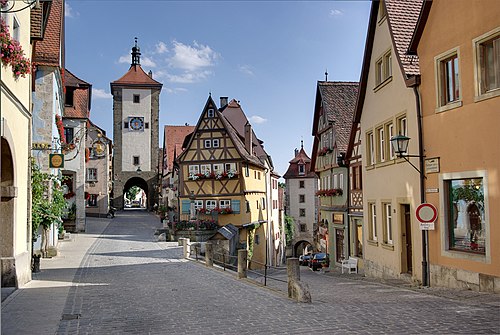 GermanyRothenburg ob der TauberExplore it in 1520
 GermanyBerlinExplore it in 1750 · 1871 · 1928
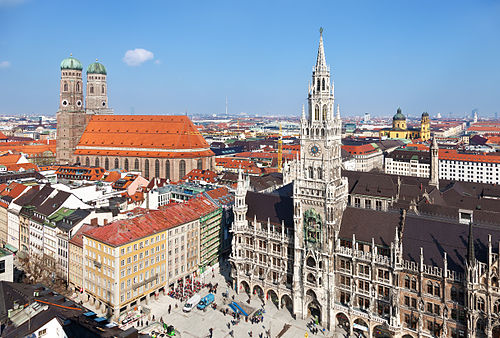 GermanyMunichExplore it in 1500 · 1700 · 1900
Castles of Europe · Landmarks of Europe · create your own reconstruction.