Historic Cities · Germany
Frankfurt through the ages
Frankfurt am Main, usually shortened to Frankfurt, is the most populous city in the German state of Hesse. Its 778,589 inhabitants as of 2025 make it the fifth-most populous city in Germany. Located in the foreland of the Taunus on its namesake river Main, the city forms a continuous conurbation with Offenbach am Main; its urban area has a population of more than 2.7 million.

Frankfurt in 1612
Coronation City
Frankfurt in 1612 is the imperial coronation city at the height of its ritual life: the electors ride into town for Matthias's crowning, the market fills with visiting princes, and the river brings the trade that feeds the festivity. This walk moves from the river approach across the Alte Brücke into the compact old town, following pageant routes, market booths and the narrow lanes of the Judengasse to the town's northern tower vantage.
In 1612 Frankfurt’s skyline is dominated by the stone spire of the Kaiserdom and the stepped gables of the Römer set among a sea of timber-framed houses with whitewashed infill and dark oak beams. Narrow cobbled streets open onto sunlit market squares; the Main cuts a ribbon through the town with low cargo barges, quayside cranes and stacked wine barrels. Roofs are red tile, façades often painted or plastered, and public life is loud with horses, banners, hawkers and cloth merchants.
The route: 16 streets, squares and views
Sachsenhausen Riverside → Alte Brücke → Fahrtor Gate → Obermainkai Quays → Römerberg → The Römer (Town Hall) → Römerberg Fountain → Saalgasse → Kaiserdom (St Bartholomäus) → Domplatz Steps → …
Step inside, 9 interiors
Bridge Gatehouse Chamber · Riverside Wine Warehouse · Kaisersaal · Patrician's Counting House · Election Chapel · Cloth and Book Hall · Bookbinder's Workshop · Great Hall · Guardroom
Planned from the Wikipedia record: Frankfurt.
Frankfurt in 1900
The Old Town's Last Decades
At the turn of the century Frankfurt's Altstadt is a dense cluster of timber-framed houses, church spires and narrow lanes gathered around the cathedral and the Römer. This walk follows trams, quay traffic and footways through the markets, gabled squares and workshops of the old town in the last decades before much of its medieval fabric was lost in the Second World War.
The skyline is a tight serration of steep red-tile roofs, stepped gables and church spires, dominated by the Kaiserdom's tall spire, while facades are chiefly dark timber beams set against pale plaster. Streets are narrow and cobbled, pierced by lanes and market squares; cast-iron footbridges and tram rails meet steam barges along the Main. Stone Gründerzeit banks and new masonry shops frame the old woodwork, giving the city a mix of black-brown timber, cream walls and the orange of clay tiles.
The route: 16 streets, squares and views
Sachsenhäuser Mainufer → Alte Brücke → Mainkai → Eiserner Steg → Römerberg → Samstagsberg Gables → Goethe-Haus → Fahrgasse → Saalgasse → Bendergasse → …
Step inside, 9 interiors
Sachsenhausen Cider Tavern · Kaisersaal · Photographer's Studio · Goethe's Parlour · Goldsmith's Workshop · Cathedral Nave · Assembly Rotunda · Banking Hall · Glasshouse Conservatory
Planned from the Wikipedia record: Frankfurt.
Its story
The story of Frankfurt.
The Ford of the Franks, to 843
The oldest part of Frankfurt is the Cathedral Hill, the Domhügel, an island made by arms of the Main in a swampy stretch of the valley. It could be reached dry-shod only from the west and it stood at a ford, which gave it both military and economic advantage. Romans are thought to have settled the hill in the last quarter of the first century, and their history there ended when the frontier fell back to the west bank of the Rhine in 259 or 260.
The hill seems to have been permanently settled again in Merovingian times. The name first appears in writing in 793, and a letter of 794 from the Emperor to the bishop of Toledo speaks of "in loco celebri, qui dicitur Franconofurd", that famous place which is called Frankfurt. Charlemagne built a royal court at the ford of the Franks and held a church council there in 794 which condemned Adoptionism. Louis the Pious made Frankfurt his seat and in 838 had it ringed with walls and ditches, and after the Treaty of Verdun in 843 it became to all intents the capital of East Francia, the principal seat of the eastern realm.
Elections, Coronations and the Imperial Fair, 1147–1792
Bernard of Clairvaux called the Hohenstaufen king Conrad III to the Second Crusade in the church at Frankfurt in 1147, and the election held there five years later chose Frederick Barbarossa. From then the city was the customary place for the election of the German kings, a role formally confirmed by the Golden Bull of 1356. Frankfurt became an imperial free city in 1372, subordinate directly to the emperor and choosing its own mayors and officials. From 1562 the emperors were crowned in the cathedral as well as elected in the city, beginning with Maximilian II; the tradition ended with the election of Francis II in 1792, whose coronation was deliberately held on 14 July, the anniversary of the storming of the Bastille.
The other half of the city's importance was the fair. The Frankfurt Trade Fair is first mentioned in 1150, and in 1240 Emperor Frederick II granted its visitors an imperial privilege placing them under the protection of the empire; in 1337 Louis IV forbade any other city to establish a market or fair that might harm it. Book trade fairs began in 1478, and from the fifteenth to the seventeenth century the most important book fair in Germany was held there. In 1585 Frankfurt traders established a system of exchange rates between the currencies in circulation, and in that lay the early roots of the Frankfurt Stock Exchange. The council kept the city neutral through the Thirty Years' War, though plague brought in by refugees ravaged it, and the Peace of Westphalia of 1648 confirmed Frankfurt as an imperial free city.
The Judengasse, 1241–1900
The first reliable information about Frankfurt's Jews dates from 24 May 1241, when 180 were killed in a riot and many fled, the first Judenschlacht. The revenue drawn from the community was pledged away piece by piece to counts, knights and, from 1297, to the Archbishop of Mainz. In the Black Death in 1349 Emperor Charles IV, fearing for his income, pledged the Jews to the city for more than 15,000 pounds of hellers on a promise of redemption he never kept; the Flagellants, on reaching Frankfurt, destroyed nearly the entire Jewish community, the Jews in their distress setting fire to their own houses, and the council confiscated their property by way of indemnity.
Jews returned only gradually. They had lived near the cathedral, where their trade was, but in 1462 they were forced to settle outside the old ramparts and moat, in a street closed by three gates that became the Judengasse. Numbers rose after emigrants arrived from Nuremberg in 1498, and Frankfurt replaced Nuremberg as the leading Jewish community in the empire, though an impending expulsion had to be averted by the council in 1525. Houses on the street were known by the signs hung in front of them, and one named from the colour of its shield, red, gave the name Rothschild.
In 1612 the council refused the guilds' demand that the city's imperial privileges be read out publicly, part of a wider demand for a share in fiscal policy and for restrictions on the rights of the Jewish community. The Fettmilch uprising followed, named for the baker Vincenz Fettmilch, and on 22 August 1614 a crowd led by men heavily indebted to Jewish lenders attacked the Jews' street and swept it clear in thirteen hours. The community sheltered in the cemetery through the night, and the following day 1,380 people left the city for Offenbach, Hanau and Höchst; the synagogue and the Torah scrolls were destroyed and the cemetery desecrated. The emperor proscribed Fettmilch, and the Jews were brought back only in February 1616, their street placed under imperial protection by a notice fixed to each of its three gates.
A fire in January 1711 destroyed the synagogue and nearly the whole Judengasse. In 1796 the Jews received permission to live among Christians, and by 1809 they were scattered across the city and had taken surnames; the prince-primate granted full civic equality in 1811. The reaction came in 1816, when the city on regaining its autonomy excluded Jews from municipal government altogether, and in 1819 there were riots to the cry of "Hep-hep". Civic rights were enlarged in 1853 and all remaining restrictions removed in 1864. The community numbered 4,309 in 1817 and about 22,000 in 1900, in a city of 288,489.
From Custine to the Paulskirche, 1792–1849
General Custine occupied Frankfurt in October 1792 during the French Revolutionary War, and the city was retaken that December. In January 1806 General Augereau occupied it with 9,000 men and extorted four million francs; in the same year its status as a free city ended when it was granted to Karl Theodor von Dalberg, whose territories were reorganised in 1810 as the Grand Duchy of Frankfurt. The duchy lasted only until 1813, when the allies gathered in the city to restore its old rights.
The Congress of Vienna made Frankfurt a sovereign city-state with a republican government and a free city of the German Confederation, and in 1816 it became the seat of the confederal Bundestag. On 18 May 1848 the National Assembly held its first meeting in the Paulskirche, making the city the centre of German political life, and riots in the Sachsenhausen quarter were suppressed by force of arms in July and September that year. The assembly drew up a constitution for a unified Germany with the Prussian king as monarch, and failed in 1849 when Frederick William IV refused what he called a crown from the gutter; its last sitting was on 31 May 1849.
Annexed by Prussia, 1863–1924
A gathering on federal reform met in Frankfurt from August 1863, but Prussia stayed away and the reform failed, leading to the Austro-Prussian War of 1866. Prussia annexed the Free City of Frankfurt and made it part of the province of Hesse-Nassau, which was widely regarded in the city as a grave injustice. Industrialisation and rapid growth followed: Frankfurt had been a Großstadt of more than 100,000 people since 1875, and the towns of Bornheim and Bockenheim were incorporated in 1890.
In 1914 the citizens founded the University of Frankfurt, later Goethe University, the only civic foundation of a university in Germany. French troops occupied the city for six weeks in 1920 after the intervention against the Ruhr uprising. Ludwig Landmann became the city's first Jewish mayor in 1924 and led a significant expansion in the years that followed.
Krebs, Kristallnacht and the Destruction of the Old City, 1933–1945
In 1933 Landmann was replaced as mayor by the NSDAP member Friedrich Krebs, and all Jewish officials were dismissed from the city administration and from city organisations. A meeting of Frankfurt traders who wanted to discuss the boycott of Jewish businesses was broken up and those attending were arrested and intimidated. The Nazis had mocked the city as Jerusalem am Main because of its large Jewish population; it now took up the propaganda title Stadt des deutschen Handwerks, city of German craft.
Most of the city's synagogues were destroyed on Kristallnacht in late 1938, and the deportation of Jewish residents to their deaths in the concentration camps quickened after it. Their property and valuables were taken by the Gestapo before deportation, and most were subjected to extreme violence during transport to the railway stations and the cattle wagons that carried them east. Most of those deported after the war began in 1939 were sent first to ghettos established by the Nazis, among them the Warsaw and Łódź ghettos, before their final transport and murder in camps such as Sobibor, Belzec and Treblinka. Frankfurt was also the site of a Nazi prison for underage girls with several forced labour camps, a camp for Sinti and Romani people, the Dulag Luft West transit camp for Allied prisoners of war, and a subcamp of the Natzweiler-Struthof concentration camp.
A British attack on 22 March 1944 destroyed the entire Old City and killed 1,001 people, and the East Port, the city's bulk-goods shipping centre, was largely destroyed as well. About 5,500 residents were killed in the raids altogether. Among the losses was the municipal library's collection of Cairo Genizah documents. The US 5th Infantry Division seized the Rhine-Main airport on 26 March 1945 and crossed the river into the city the next day, and the fighting was cleared block by block until Frankfurt was declared secured on 29 March. The population, 553,464 before the war, stood at about 358,000 at the end of 1945.
Rubble, Bonn and the Bundesbank, 1945–2025
In the autumn of 1945 the city authorities set up the Trümmerverwertungsgesellschaft to clear the rubble and recycle it; what could not yet be processed was piled into a rubble mountain, Monte Scherbelino, which had disappeared entirely by 1964. Reconstruction kept the old street system but was carried out in a plain modern style, with a few landmarks rebuilt in simplified form, St Paul's Church first among them. Frankfurt was the original choice for the provisional capital of West Germany and built a parliament building that was never used for the purpose; the vote narrowly favoured Bonn twice, some politicians opposing Frankfurt for fear that a capital there would become permanent and weaken support for reunification with the east.
The city turned instead to trade and finance: its publishing houses and its fur trade both gained from the division of Germany, and the book fair, revived in 1949, has run in the autumn since reunification while Leipzig's runs in the spring. The Allies founded the Bank deutscher Länder, forerunner of the Deutsche Bundesbank, in the city in 1948, Deutsche Bank and Dresdner Bank were re-established there, and in the 1950s the Frankfurt Stock Exchange regained its place as the country's leading exchange. Frankfurt Airport became Europe's second-busiest behind London Heathrow in 1961.
The European Central Bank was founded in Frankfurt in 1998, the European Insurance and Occupational Pensions Authority in 2011 and the Anti-Money Laundering Authority in 2024, making the city one of the four institutional seats of the European Union. Its 778,589 inhabitants in 2025 made it the fifth most populous city in Germany. As of 2015, 51.2 per cent of residents had a migration background; more than 7,200 are affiliated with a Jewish community that is the third largest in Germany after Berlin and Munich, and the Moroccan community, the largest in the country at about 8,000 people, many of whom came as guest workers in the 1970s.
From the archive
Frankfurt on paper: the old town as it was mapped.
A period plan or bird's-eye view of the old town, drawn between 1500 and 1850, the streets this page's reconstructions walk. Public domain, with its source named.
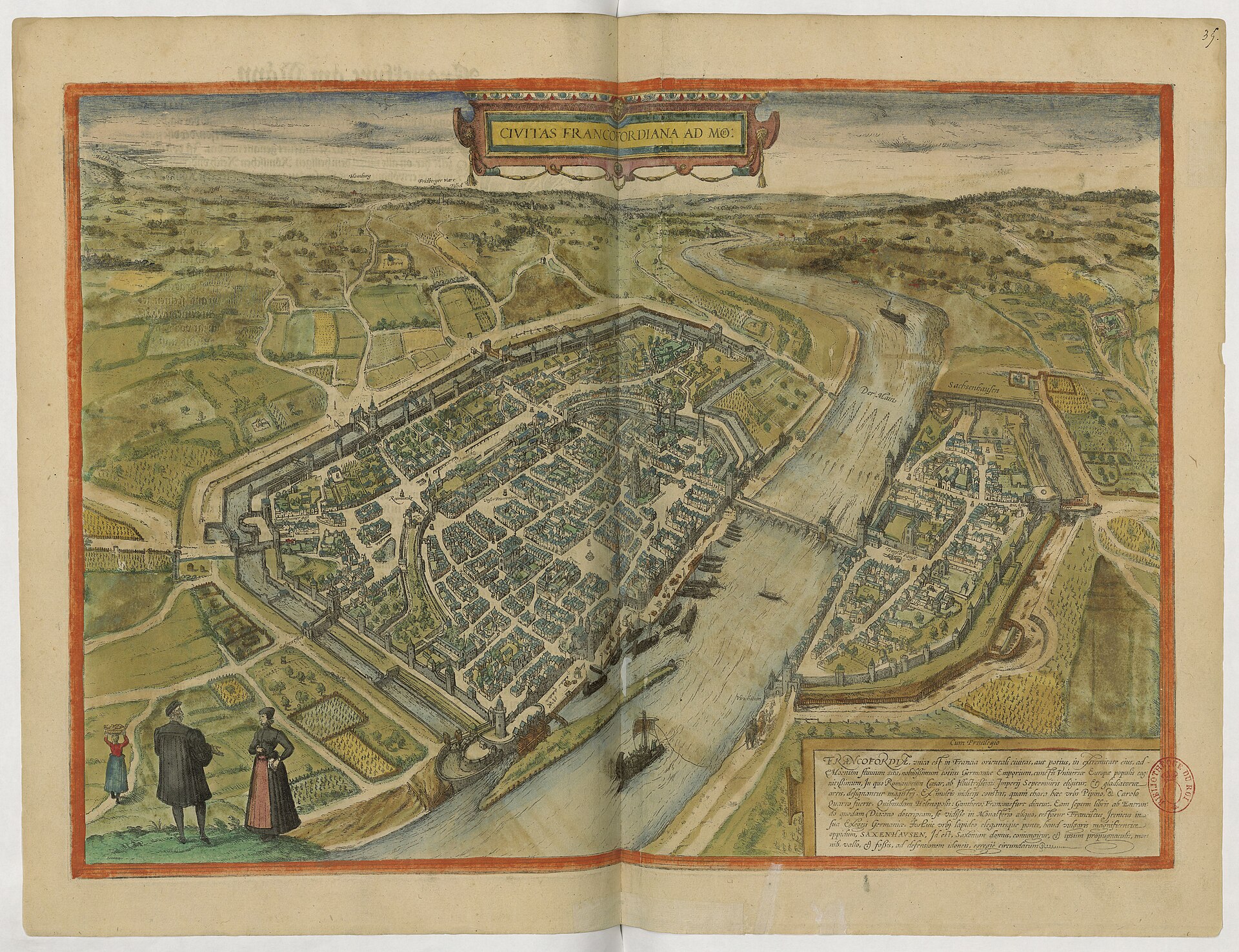
Bird's-eye view of Frankfurt am Main, from Braun & Hogenberg's Civitates Orbis Terrarum
Walled bird's‑eye plan showing the Main river and bridge, fortified walls and bastions, gates, street blocks and prominent church spires.
Public domain (plate dated 1582)


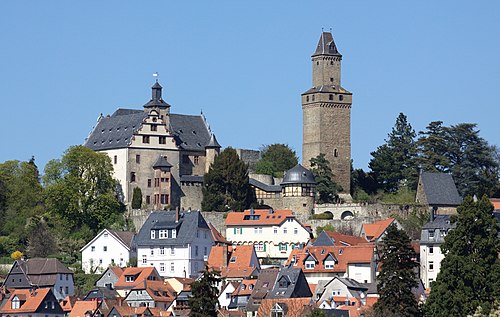
Castles of Frankfurt
More cities to explore
 GermanyHeidelbergExplore it in 1400 · 1615 · 1830
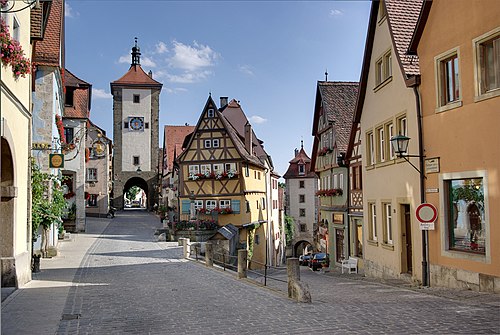 GermanyRothenburg ob der TauberExplore it in 1520
 GermanyBerlinExplore it in 1750 · 1871 · 1928
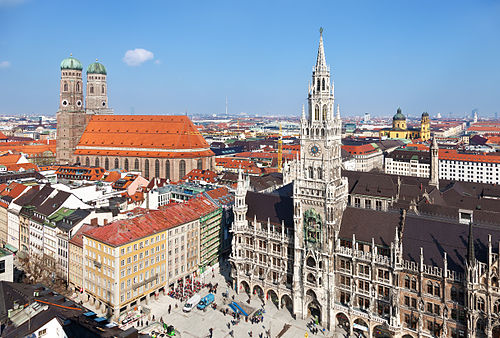 GermanyMunichExplore it in 1500 · 1700 · 1900
Castles of Europe · Landmarks of Europe · create your own reconstruction.