Historic Cities · Germany
Lübeck through the ages
Lübeck, officially the Hanseatic City of Lübeck, is a city in Northern Germany. With around 220,000 inhabitants, it is the second-largest city on the German Baltic coast and the second-largest city in the state of Schleswig-Holstein, after its capital, Kiel. It is the 36th-largest city in Germany.

Lübeck in 1500
Queen of the Hanse
Lübeck in 1500 stands at the height of its Hanseatic power: a dense island city of brick churches, merchant houses, quays stacked with salted cargo and sea-going cogs. The walk follows the Trave’s approach, passes through the Holstentor into the market and guild streets, then moves along the salt storehouses and harbor quays before rising to the ramparts for a final view of the seven towers.
The old town is a compact island of red and black bricks, steep gables and narrow alleys, ringed by mills, moats and the Trave’s quays. Sturdy merchant gables and storerooms crowd the waterline beside timbered jetties; the Town Hall shows black-glazed brick screens while Marienkirche’s twin towers and vast brick vault dominate the skyline. Market stalls, laden carts and rope-worsted sails animate the waterfront on a cool, breezy Baltic morning.
The route: 22 streets, squares and views
Trave Estuary Approach → Holstentor Gate → Holstenstraße → Koberg Square → Lübeck Cathedral → Breite Straße → St. Mary’s (Marienkirche) → Rathausmarkt → Lübeck Town Hall → Krämerstraße → …
Step inside, 14 interiors
Holstentor Gate Chamber · Cathedral Choir · Soaring Nave of St. Mary’s · Astronomical Clock Chamber · Town Hall Audience Room · Butcher's Hall · Merchant's Long Diele · Servants' Cellar · Sailmakers' Loft · Salt Storehouse Hall · Port Customs Hall · Cog Cargo Hold · Ward of Tiny Cabins · Bell Chamber of St. Petri
Planned from the Wikipedia record: Lübeck.
Lübeck in 1900
Buddenbrooks Lübeck
This is Lübeck in the long, dignified afterglow of its Hanseatic past, a compact island of brick churches, gabled merchant houses and quiet canals. The walk follows steamers and quays into the old town, past patrician doorways on Mengstraße, marzipan shops and the Holstentor settling into its marsh, ending on the tree-lined wall promenades that frame the island.
Lübeck in 1900 is a city of red-brown brick: soaring Gothic church towers and copper spires puncture a dense carpet of steep red roofs; stepped gables and tall warehouses line the Trave. Streets are narrow and paved, gas lamps glow on wet brick in the evening, and the harbour shows steamers instead of medieval cogs. Scale is human and maritime: quays, bridges and merchant façades dominate the eye, gulls wheel over the river.
The route: 21 streets, squares and views
Bay of Lübeck (Trave Mouth) → An der Untertrave → Salzspeicher Quay → Holstentor → Holstenstraße → Mengstraße → Königstraße → Hüxstraße → Breite Straße → Rathausmarkt → …
Step inside, 12 interiors
Steamship Agent's Office · Salt Warehouse Storage Hall · Holstentor Gatehouse Vault · Hospital Refectory Hall · Ratskammer Council Chamber · Ratskeller Vaulted Tavern · Organ Loft and Choir Practice · Cathedral Nave and Choir · Seamen's Guild Banquet Hall · St. Anne's Altar Hall · Panelled Family Dining Room · Marzipan Confectioner's Shop
Planned from the Wikipedia record: Lübeck.
Its story
The story of Lübeck.
Liubice, Buku and the New Town of 1143
A Slavic fortification stood at Old Lübeck, near the confluence of the Schwartau and the Trave, by 819. Founded by Polabian Slavs, it was by the tenth century the most important settlement of the Obotrites after Starigard, and is first recorded as Liubice in Adam of Bremen's history of the church of Hamburg, written in the later eleventh century. The name is Slavic, now usually derived from a personal name such as L'ub or L'ubomir.
Liubice was destroyed in 1138. In 1143 Adolf II, Count of Schauenburg and Holstein, founded a new town on the river island of Buku, the first German port on the Baltic. Fire destroyed it in 1157 and Henry the Lion rebuilt it, having acquired the site from Adolf in 1159. At Bishop Gerold's request the bishopric was moved from Oldenburg to Lübeck, and the first cathedral there was consecrated in 1163. Lübeck received the town law of Soest in 1160, and the Artlenburg Privilege of 1161 set its merchants on a legal footing with the Gotlanders who had dominated Baltic trade. When Henry was outlawed in 1181 the town passed to Emperor Frederick Barbarossa, who confirmed its privileges.
Salt, Herring and the Queen of the Hanse, 1201–1408
Lübeck came under Danish overlordship in 1201, and Valdemar II built the port's first town wall. In June 1226 Emperor Frederick II granted it imperial immediacy, making it the Free City of Lübeck, answerable directly to the emperor. Despite the Danish king's patronage, Lübeck joined the coalition of north German princes and towns that ended Danish hegemony over the southern Baltic at the Battle of Bornhöved on 22 July 1227, the first time it acted as a leading power in the region.
The city's living was salt and fish. Lüneburg salt travelled through Lübeck to Novgorod, then the largest market on the eastern Baltic; a growing twelfth-century population and the Church's requirement to eat fish on fast days made herring the other staple, and Lübeck became the central trading place for both on the east–west axis. Merchants who sold salt at Novgorod took up the furs that western Europe wanted, while Visby's position weakened once the Mongol invasion closed the overland route from the Orient. In 1249 Lübeck attacked Stralsund, a serious competitor in the herring trade, and in 1259 the Wendish towns of Lübeck, Wismar and Rostock allied for safe trade by land and water. Between 1293 and 1295 the appeal court of the Novgorod traders was moved from Visby to the Trave, and Lübeck law was eventually adopted by around a hundred towns around the Baltic.
The first general Hanseatic diet met at Lübeck in 1356, and when Valdemar IV Atterdag took Visby, the league's first chief town, in 1361, Lübeck emerged from the two Waldemar wars as the new head of the Hanseatic League. The Peace of Stralsund of 1370 marked the height of its power in the Baltic, and in the fourteenth century it was one of the largest cities in the Empire. Wealth did not buy quiet at home: the patriciate that controlled the council was closed within the exclusive Zirkelgesellschaft, and the guild craftsmen repeatedly demanded a political voice in return for the taxes they bore, in the butchers' rising of 1384, and again in 1408, when the council was deposed.
Wullenwever and the Loss of Primacy, 1524–1537
The Reformation reached Lübeck in 1524 with the first Protestant sermon, and in 1530–31 the council introduced a new church order drawn up by Johannes Bugenhagen. Anabaptists settled from 1532 and formed a Mennonite congregation of largely Dutch religious refugees; the council refused to tolerate it and forbade its burials in the city, so its dead were laid at Hamberge, outside Hanseatic ground.
Dutch merchants were meanwhile bypassing the Lübeck staple and sailing straight to the eastern Baltic, and a war against the Kalmar Union was followed by a second, costly war with Denmark. When Frederick I of Denmark refused in 1532 to hand over the Sound castles as payment for Lübeck's help in capturing Christian II, the burgomaster Jürgen Wullenwever, in office from 1533, tried to restore the old primacy by force and to swing the Count's Feud of 1534 to 1536 Lübeck's way, melting down the church treasure to pay for it. He failed, left the city in 1535, was taken prisoner by the Archbishop of Bremen and executed in 1537. It was Lübeck's last attempt to hold its earlier dominance of Baltic trade.
Neutral in the Thirty Years' War, and the Refugees Who Came After
Lübeck stayed neutral through the Thirty Years' War, and the Peace of Lübeck was concluded there in 1629 between the imperial troops and Christian IV of Denmark. As European trade shifted towards the Atlantic the Hanseatic towns met less and less often, and their last diet sat at Lübeck in 1669, after which Lübeck, Hamburg and Bremen were made trustees of the league and what was left of its assets. The league was never formally dissolved, and the three cities kept the title "Free and Hanseatic City".
The first Jewish families settled in 1656 at Moisling, a village outside the Lübeck Landwehr. They had fled Poland-Lithuania and the pogroms of the Ukrainian Cossack uprising of 1648 to 1657 under Hetman Bohdan Khmelnytsky. The owner of village and estate, the Lübeck burgomaster Gotthard von Höveln (1603–1671), settled the Ashkenazi families for economic reasons and met strong resistance from a council and citizenry who had until then kept Jews out of both the city and its rural territory. When the quarrel escalated, von Höveln placed his village under Danish royal sovereignty in 1667, and his son-in-law and heir von Wickede obtained royal concessions in 1686 and 1697 granting Jews the right of settlement at Moisling and unrestricted freedom of trade and movement within the Danish state. But the Holstein country Jews needed the Lübeck market to make a living, and it stayed largely closed to them until 1852.
Unitarians of the Polish Brethren, driven out of Poland, asked in 1664 for citizenship and freedom of worship, but the Lutheran superintendent Menno Hanneken's resistance blocked them. A Reformed congregation formed in 1666 and a French Reformed congregation of Huguenot incomers in 1689, the two merging in 1781.
From the French Occupation to the Free State, 1806–1932
When the Holy Roman Empire ended in 1806 Lübeck became a sovereign German state. After the Battle of Lübeck on 6 November 1806, ruinous for Blücher, French troops occupied the neutral city and held it until 1813, cutting into the long-distance trade it lived on. In January 1811 Lübeck was incorporated into the First French Empire as part of the Département des Bouches de l'Elbe. French rule ended in December 1813.
The Congress of Vienna recognised Lübeck in 1815 as the sovereign Free and Hanseatic City and a member of the German Confederation. The Jung-Lübeck reform movement and the Germanists' congress of 1847 made it a symbolic place of the Vormärz, but 1848 passed without serious unrest, a new constitution being already well advanced. Lübeck joined the North German Confederation in 1866 and the Customs Union in 1868, and became a constituent state of the German Empire in 1871, ending the sovereignty it had held since 1806. It remained an important Baltic trading port, well below its Hanseatic height; Thomas Mann, of a Lübeck merchant family, made the manners of its nineteenth-century bourgeoisie widely known in Buddenbrooks in 1901. The gate closure was lifted in 1864 and the suburbs spread; the Elbe-Lübeck Canal was completed in 1900 and the Herrenwyk ironworks founded in 1906.
The collapse of the Empire in 1918 brought a sailors' revolt to Lübeck, the next city after Kiel to see one, but Lübeck was the only state of the German Reich where the November Revolution caused no upheaval: Burgomaster Emil Ferdinand Fehling and all the senators stayed in office. A universal, equal and direct franchise for men and women followed the same year, and in May 1920 the elected Bürgerschaft adopted a parliamentary constitution for the city-state. The Social Democrats and several middle-class groups dominated the parliament until 1932, by which time the Nazi Party had risen to be the second-strongest group behind the Social Democrats.
Gleichschaltung, the Palm Sunday Raid and the Cap Arcona, 1933–1945
On 9 January 1933 the Bürgerschaft passed a Nazi motion of no confidence in the senate by 49 votes to 31 at first reading; on 18 January it rejected the motion 39 to 39, the Communists abstaining after having voted for it. In March 1933 the Nazi Party imposed Gleichschaltung on Lübeck, forced out the Social Democrat burgomaster Paul Löwigt and the Social Democrat senators, and suspended the city's democratic constitution. Reich Interior Minister Wilhelm Frick appointed Friedrich Völtzer Reich Commissioner on 11 March under the Reichstag Fire Decree, and on 30 May Friedrich Hildebrandt, Reichsstatthalter for Mecklenburg and Lübeck, installed his deputy Otto-Heinrich Drechsler as mayor. Julius Leber was arrested on 1 February 1933; Willy Brandt, then still Herbert Frahm, escaped persecution only by fleeing to Scandinavia. Under the Greater Hamburg Act Lübeck ceased to be a state on 1 April 1937, losing 711 years of territorial independence and becoming part of the Prussian province of Schleswig-Holstein. Drechsler, mayor from 1933 to 1937, went on to set up the Riga ghetto. Joseph Carlebach, born in Lübeck in 1883, was a rabbi and a victim of the Holocaust; he died in 1942.
Shortly after the British Area Bombing Directive was issued, on the night of 28 to 29 March 1942, the night before Palm Sunday, the Royal Air Force attacked Lübeck, aiming at the densely built medieval old town. This first area bombing of a large city caused a firestorm: 320 people were killed, between 15,000 and 30,000 made homeless, and more than 3,000 buildings destroyed or badly damaged, among them the Marienkirche, the Petrikirche and the cathedral, along with large parts of the Gründungsviertel. In 1943 four clergymen, three Catholic priests and one Lutheran, were condemned to death for "radio crimes, treasonous aid to the enemy and undermining military morale" and beheaded within three minutes of one another at the Holstenglacis prison in Hamburg on 10 November; they are remembered as the Lübeck Martyrs. Oflag X-C, a prisoner-of-war camp for Allied officers, operated in the city from 1940 to 1945.
British Second Army troops occupied Lübeck without resistance on 2 May 1945, after the German major general Kurt Lottner had the demolition charges already fixed to the bridges and quay walls taken off. The next day aircraft attacked ships in the Bay of Lübeck carrying prisoners from the Neuengamme satellite camps; the Cap Arcona and the Thielbek caught fire and capsized, killing more than 7,000 people, in an attack recorded as having been made in error.
On the Inner German Border
About 90,000 displaced people reached Lübeck between 1945 and 1948, many from East Prussia and other territories Germany had lost. The new border cut the city off from much of its eastern hinterland and disrupted its economy and transport, while giving the ferry harbour at Travemünde a favoured place in the traffic between central Europe and Sweden and Finland. Lübeck became part of the newly formed state of Schleswig-Holstein on 23 August 1946, and the Federal Constitutional Court ruled in 1956, in the Lübeck judgment, that the city had no claim to statehood of its own. Through the Cold War it was the only major West German city standing directly on the inner German border, Schlutup being the northernmost road crossing into East Germany. Since reunification it has again been the regional centre for western Mecklenburg.
Rebuilding of the old town, of which almost 20 per cent had been destroyed, began in 1949; UNESCO designated the historic centre a World Heritage Site in 1987, Germany's most extensive. On 18 January 1996 an arson attack on a hostel for asylum seekers in the Hafenstraße killed ten people and left thirty seriously and twenty slightly injured. The case was never solved.
Lübeck has around 220,000 inhabitants across 214.21 square kilometres at the mouth of the Trave, and is the second-largest city on the German Baltic coast and in Schleswig-Holstein after Kiel. Its harbour is the second-largest German Baltic port after Rostock.
From the archive
Lübeck on paper: the old town as it was mapped.
A period plan or bird's-eye view of the old town, drawn between 1500 and 1850, the streets this page's reconstructions walk. Public domain, with its source named.
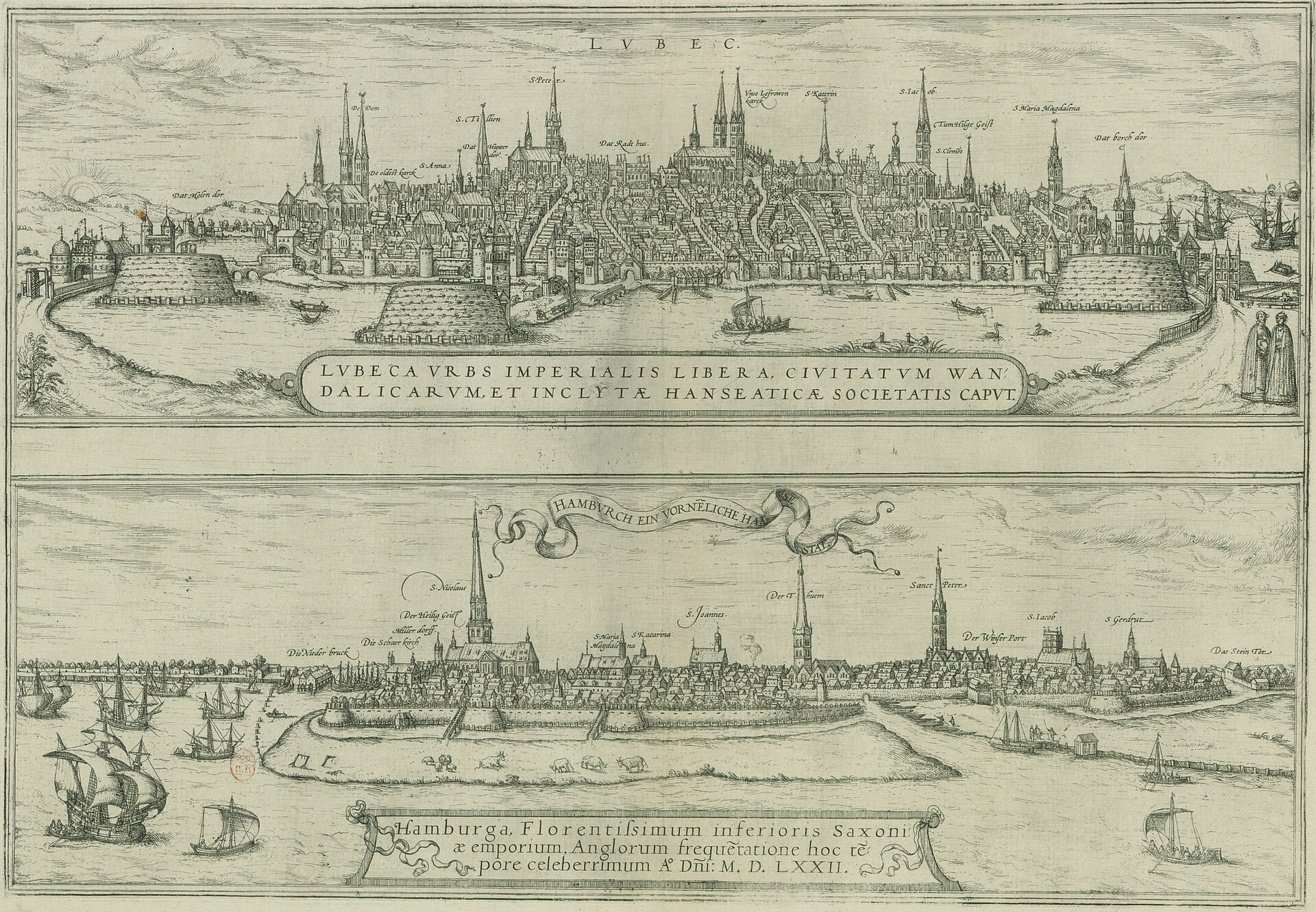
Bird's-eye view of Lübeck ('Lubeca urbs imperialis libera'), from Braun & Hogenberg's Civitates Orbis Terrarum
Depicts Lübeck's walled old town with harbourfront, defensive bulwarks and gates, dense street blocks and labelled church spires including St Mary's and St Peter.
1572 · Braun, Georg (1541-1622). Cartographe · Wikimedia Commons
Public domain (plate dated 1572)
More cities to explore
 GermanyHamburgExplore it in 1450 · 1900
 GermanyRungholtExplore it in 1361
 GermanyBerlinExplore it in 1750 · 1871 · 1928
 GermanyMunichExplore it in 1500 · 1700 · 1900
Castles of Europe · Landmarks of Europe · create your own reconstruction.