Historic Cities · Italy
Matera through the ages
Matera is a city and the capital of the Province of Matera in the region of Basilicata, in Southern Italy. With a history of continuous occupation dating back to prehistory, it is renowned for its rock-cut urban core, whose twin cliffside zones are known collectively as the Sassi.

Matera in 1750
City of the Sassi
Matera in 1750 is the lived stone city of the Sassi: two amphitheatre-like tiers of cave dwellings carved into the calcarenitic rock, with the Duomo perched on the narrow Civita spur and new baroque façades cutting the cliffline. The walk crosses the Gravina from the Murgia, moves across the Piazza del Sedile into Sasso Barisano and down through Sasso Caveoso to see rock churches, terraced gardens, hanging cisterns and the daily labour of shepherds and householders.
The city reads as honey‑coloured stone: soft calcarenite facades, carved doorways and whitewashed niches stacked roof upon roof like terraces. Two bowl‑shaped Sassi (Barisano to the north and Caveoso to the south) fall in stepped rows to the Gravina, joined by the narrow Civita spur and crowned by the Duomo’s campanile. Narrow alleys, stone stairways and vicinati open to small wells and hanging cisterns; the palette is sunburnt ochre and lime, with flashes of cloth, mule harness and smoke.
The route: 17 streets, squares and views
View from the Murgia → Castello Tramontano → Piazza del Sedile → Duomo on the Civita → Palazzo Pomarici → Chiesa del Purgatorio → Sasso Barisano → Vicinato of Barisano → San Pietro Barisano → Sasso Caveoso → …
Step inside, 9 interiors
Gilded Cathedral Nave · Tufa Wine Cellar · Stacked Cave Dwelling · Family Cave Dwelling · Parish Nave of San Pietro · Frescoed Rock Chapel · Monastic Crypt Church · Hermit's Rock Cell · Communal Bread Oven
Planned from the Wikipedia record: Sassi di Matera.
Its story
The story of Matera.
Cut Into the Gravina
Matera exists because of a gorge and a soft rock. The city stands on the right bank of the Gravina, whose canyon divides the hill country of Basilicata, historic Lucania, from the Murgia plateau of Apulia, and it began as cave dwellings excavated in the softer limestone of the gorge's western, Lucanian face. Two streams running into the ravine from near the site of the Castello Tramontano eased the angle of the drop and left a defensible narrow promontory between them: the high ground, the Civita, took the cathedral and the administrative buildings, while the districts burrowed into the rock faces below became the Sassi. The northern streambed holds Sasso Barisano, which faces Bari, the southern Sasso Caveoso, which faces Montescaglioso. The Sassi run to roughly twelve levels across a height of 380 metres, linked by paths, stairways and the shared courtyards called vicinati, and the medieval city on the canyon edge cannot be seen at all from the western approach.
How old the occupation is remains disputed. Scholars continue to argue over when the dwellings were first inhabited and whether the occupation was continuous; the area is believed to have been settled since the Palaeolithic, which would make it potentially one of the oldest continuously inhabited settlements in the world, while the architectural historian Anne Toxey has instead suggested occupation “for at least three millennia”. Palaeolithic objects left by groups of hunters have been found in the caves along the ravines; the Neolithic brought more settled life, with clear traces of entrenched villages, notably on the Murgia Timone; and the first urban nucleus, on the Civita, dates from the Metal Age.
Hiddenness cost the city its water. Getting a supply to the inhabitants was difficult, and the early dwellers put enormous labour into cisterns and channels that collected rainwater, filtered it and released it in a controlled way down to the Sassi: shallow canals feeding pools and hanging gardens, bell-shaped cisterns in the dug houses filled by seepage, and, under the Piazza Vittorio Veneto, the Palombaro Lungo of 1832, its vault more than fifteen metres high and large enough to be navigated by boat. As the population grew, many of the older cisterns were themselves turned into houses and new means of harvesting water had to be built.
Mateola: Greek Traditions and a Roman Staging Post
The town raised on the prehistoric entrenched village is likely to have Greek origins, the conclusion reached by the antiquarian Volpe in his history of Matera and by the earlier writers he cites. The argument rests largely on the city's emblem, an ox with ears of wheat, held to be a typical Magna Graecia device and read by some as the badge of Metapontum; the tradition attached to it is that Matera took in refugees from Metapontum after Hannibal destroyed their city. In the age of Magna Graecia the town kept close relations with the Greek colonies of the southern coast.
Under Rome it was a staging post rather than a place of consequence: a trade and transit route and a point of supply. Accounts of its Roman foundation differ: one has the town established in 251 BC by Lucius Caecilius Metellus, who called it Matheola; another traces the old name Mateola to Quintus Caecilius Metellus Numidicus, said to have rebuilt the town and ringed it with walls and high towers. Pliny the Elder called the inhabitants Mateolani and listed them among the Apuli, though the form of the name points to Lucanian influence: the town sat precisely on the Apulian-Lucanian border.
Lombards, the Emirate of Bari and the Byzantine Frontier, 664–1132
In 664 Matera was taken by the Lombards and annexed to the Duchy of Benevento. From the seventh and eighth centuries Benedictine and Basilian monks colonised the grottoes along the Gravina and cut them into the rupestrian churches that still line the ravines. After the Arab conquest of Bari in 840 the town came under Islamic rule and, freed from the old Lombard jurisdiction of the gastald of Acerenza in the Principality of Salerno, gained regional prominence. In the spring of 867 the imperial troops of Louis II burnt it as the first key target in the campaign against the emirate; the Chronicle of St Benedict of Monte Cassino describes it as a particularly well-defended site.
The Franks then fell out with the Lombards, and the Byzantines, exploiting the local need for protection from Arab raiding and the divisions among the Lombards, retook Apulia, which became the theme of Longobardia in 891 or 892. Byzantine authority went deep: by 887 Matera's Lombard elite bore Byzantine titles, the monastery of San Vincenzo al Volturno had to transact its business before the Byzantine judge and the town notables, and the Greeks of Matera made up the Byzantine garrison of Naples. Rule remained precarious. The town was besieged by the Lombards in 940, possibly with help from inside; on 25 January 982 the army of Otto II camped before its walls on the march from Salerno to Taranto; in 994 the Arabs took it briefly after a four-month siege; and in 1040 the Byzantine judge Romanos was murdered at Matera by local auxiliary troops during a wave of assaults on Byzantine officials across the region.
When the Apulian rebels brought in the Normans and beat the new katepano at Cannae in 1041, Matera came within reach of Norman raiding and made terms with the invaders. The next katepano, Georgios Maniakes, sent to Italy with special powers in April 1042, answered that in June with mass executions in the town, and in September launched a rebellion of his own. After he left, Matera elected William Iron Arm as its count, but the town stayed in Byzantine hands through the Norman advance. It was taken in April 1064 as a private acquisition by Robert, Count of Montescaglioso, a seditious nephew of Robert Guiscard, and on Robert's death in July 1080 accepted the rule of his brother Geoffrey of Conversano. Geoffrey's son Alexander joined the revolt against Roger II in 1132 and fled to Byzantium before the king's advance, leaving his own son in the town; the inhabitants handed the city over to avoid being massacred by the royal troops. The episcopal see, tied to the Byzantine metropolis of Otranto from 968, was reclaimed by the archbishopric of Acerenza, and a new cathedral church of St Eustace was consecrated in May 1082.
Città Regia and the Killing of Count Tramontano, 1497–1514
After a short communal phase, and through a run of pestilences and earthquakes, Matera was for long stretches a royal city, buying itself out of feudal lordship more than once; the crown above the ox on its arms was read as meaning it answered to the king and to no feudatory. In the fifteenth century it became an Aragonese possession, and on 1 October 1497 it was sold to Giancarlo Tramontano. He began the castle on the ridge above the Sassi that still carries his name and was never finished; three of its large towers were built where the design probably called for twelve. In 1514 the townspeople, ground down by his taxes and his rule, rebelled and killed him, in a popular riot dated to 29 December. The city's motto, Bos lassus firmius figit pedem, “the tired ox plants its hoof more firmly”, is thought to have been coined after the count's death.
Capital of Basilicata and the Gattini Killings, 1663–1927
In the seventeenth century Matera passed to the Orsini and belonged to the Terra d'Otranto, in Apulia. In 1663, under Spanish rule, it was separated from the Terra d'Otranto and made capital of the province of Basilicata and seat of the Regia Udienza, and the years that followed brought the town real economic, commercial and cultural growth. It held the rank until 1806, when Joseph Bonaparte transferred the functions to Potenza. The town's shape changed with its standing: from the sixteenth century public life moved outside the walls to the Piazza Sedile on the plain to the west, the Piano, and from the seventeenth century the elite followed with their houses, so that by the end of the eighteenth century a physical class boundary separated the crowded Sassi of the peasants from the quarters of their social superiors, elevation matching status so completely that the two communities no longer mixed socially.
The Risorgimento did not settle the land question. The Lucanian pro-dictatorial committee failed to keep its promises on redistributing demesne land, and the resulting discontent, stoked also by legitimists, broke out at Matera on 8 August 1860 in the killings known as the eccidio Gattini, the first sign of the rebellion that preceded the post-unification brigandage. In 1927 the town became capital of the new province of Matera.
The Rising of 21 September 1943
Matera was the first city in the Mezzogiorno to rise in arms against the Germans. On 21 September 1943 its people rose against the occupation. Eleven were killed by machine-gun fire from the retreating German troops. The reprisal that followed took a further fifteen lives, civilians and soldiers alike, blown up in the palazzo della milizia. On 1 September 1966 the city was awarded the silver medal for military valour for the sacrifices of its people during the war.
The Sassi Emptied and Reclaimed, 1945–2019
The Sassi had been declared unfit for modern habitation at the turn of the twentieth century. In 1945 Matera saw popular risings, among the first in the south, demanding the assignment of uncultivated land; they were settled by the Ponte decrees of 1946 and 1947, named after Aurelio Ponte, prefect of Matera, which anticipated the later agrarian reform. In 1948 the condition of the Sassi was raised as a national question, first by Palmiro Togliatti and then by Alcide De Gasperi, and in 1952 a national law ordered them cleared and new residential quarters built. The state relocated the inhabitants, some 15,000 people, to public housing in the Piano, by force in many cases, in a process running from 1952 into the 1970s.
The emptied districts were left to decay for more than thirty years and were still regarded as an area of poverty into the late 1980s, most of the dwellings uninhabitable; the Irpinia earthquake of 1980 and its aftershocks did further damage. A national law of 1986 financed their recovery and opened the way to reoccupation: this time, as Anne Toxey has noted, for the benefit of the wealthy middle class. On 9 December 1993, at the UNESCO assembly in Cartagena de Indias, the Sassi and the rupestrian churches across the Gravina were inscribed as a World Heritage Site, the first in southern Italy to be so recognised. On 17 October 2014 Matera was designated a European Capital of Culture for 2019, jointly with Plovdiv in Bulgaria. The comune, capital of the Province of Matera and the largest in Basilicata by area at 392.09 square kilometres, has a population of about 59,000.
From the archive
Matera on paper: the old town as it was mapped.
A period plan or bird's-eye view of the old town, drawn between 1500 and 1850, the streets this page's reconstructions walk. Public domain, with its source named.
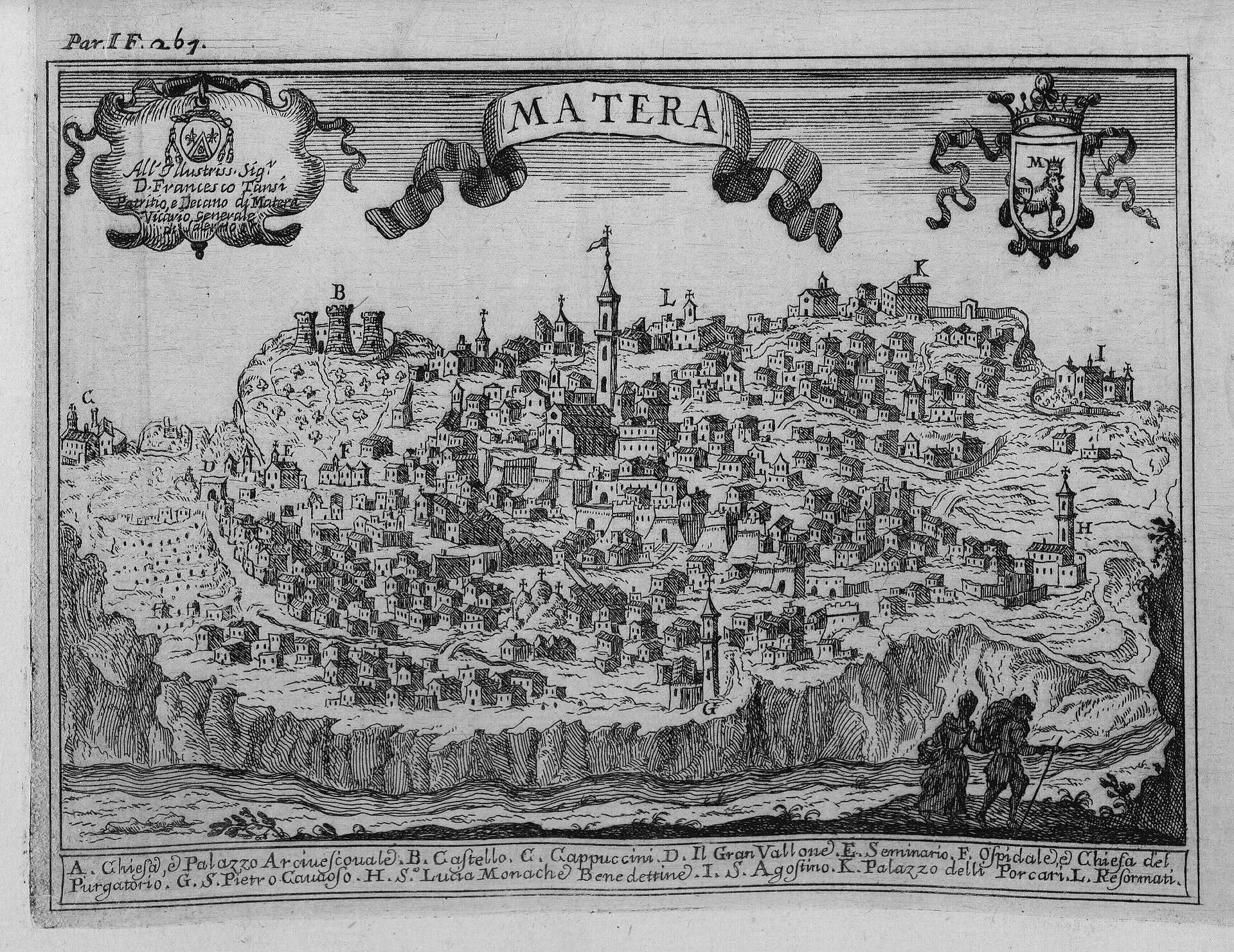
Bird's-eye view of Matera, from Pacichelli's Il regno di Napoli in prospettiva (1641)
Cliff-top town seen with dense houses and cave-dwellings, a central bell-tower, a castle on the ridge, labelled churches and surrounding ravines.
1641 · Fondo Antiguo de la Biblioteca de la Universidad de Sevilla from Sevilla, España · Wikimedia Commons
CC BY 2.0 (plate dated 1641)

More cities to explore
 ItalyPompeiiExplore it in AD 79 · 1800
 ItalyNaplesExplore it in 1350 · 1650 · 1780
 ItalyRomeExplore it in AD 320 · 1300 · 1600 · 1770
 ItalyVeniceExplore it in 1200 · 1500 · 1740
Castles of Europe · Landmarks of Europe · create your own reconstruction.