Historic Cities · Greece
Rhodes through the ages
Rhodes is the principal city and a former municipality on the island of Rhodes in the Dodecanese, Greece. Since the 2011 local government reform, it is part of the municipality Rhodes, of which it is the seat and a municipal unit. It has a population of approximately 56,000 with nearly 90,000 in its metropolitan area.

Rhodes in 1520
City of the Knights
Rhodes in 1520 is the Hospitaller capital at its polished height: fortified streets, naval trade and the eight langues of the Order arranged around the Grand Master's convent. The walk moves from the harbour and mole into the merchants' quarters and up the Street of the Knights to the palace and hospital, showing daily commerce, sea traffic and the island's mixed Greek and Latin life.
A compact medieval citadel of pale, roughly hewn stone, Rhodian roofs of red tile and flat terraces sit behind high battlemented walls and squared towers. Low-slung warehouses and arcaded façades crowd the harbour; narrow, sunlit lanes thread between Gothic inns of the langues and arcaded hospitals. The scale is human: ships at quay, windmills on the mole, olive trees and Cyprus cypresses threading the upper convent gardens.
The route: 16 streets, squares and views
Mandraki Harbour Approach → Fort of St Nicholas → Mandraki Windmills → Marine Gate (Porta Marina) → Merchants' Street → Greek Bazaars → La Juderia (Jewish Quarter) → Harbour Warehouses Quay → Street of the Knights → Auberge of France → …
Step inside, 8 interiors
Icon Painter's Workshop · Spice and Soap Warehouse · Hall of the French Tongue · Italian Auberge Refectory · Council Chamber · Palace Spiral Stair · Great Infirmary Ward · Chapter Hall of Saint John
Planned from the Wikipedia record: Rhodes (city).
Its story
The story of Rhodes.
Three Cities Into One, 408 BC
The city of Rhodes did not grow outward from a village; it was created. In 408 BC the island's three established cities, Ialysos, Kamiros and Lindos, united their territory and built a new capital at the northern tip of the island. Strabo credits the regular plan to the Athenian architect Hippodamus, and the ancient town was laid out with a well-built sewage system and a water supply network to match. The three centuries that followed were the city's golden age, kept prosperous until Roman times by sea trade, skilled shipbuilders and open-minded politicians. It struck its own coinage, drew Greek scholars to its school of rhetoric, and its coins circulated nearly everywhere in the Mediterranean.
In 305 BC Antigonus sent his son Demetrios Poliorketes to besiege the city and break its alliance with Ptolemaic Egypt. Demetrios built huge siege engines, among them a battering ram 55 metres long and a siege tower, the Helepolis. After a year he relented, signed peace in 304 BC and left his military equipment behind; the Rhodians sold it and spent the money on a statue of their sun god Helios. That statue, the Colossus of Rhodes, was made by Chares of Lindos between 304 and 293 BC, took twelve years, and is believed to have stood near the harbour entrance. A strong earthquake struck about 226 BC, badly damaging the city and toppling the Colossus.
Through the third century BC the city held its independence by keeping the Antigonids, Seleucids and Ptolemies in balance, using its economy and its navy as leverage and guarding its near-control of the eastern Mediterranean grain trade. When that balance broke, the Rhodians appealed in 201 BC to the Roman Republic, an appeal that brought Rome into the Second Macedonian War and preserved Rhodian independence.
Roman Client, Byzantine Sea Law, 164 BC–1306
In 164 BC Rhodes became a permanent ally of Rome, a status that amounted to a reduction to client state with a nominal independence. The city kept what it was good at, becoming a centre of learning for Roman noble families and particularly noted for its teachers of rhetoric; the Romans took the Rhodians' maritime law and applied it to their own shipping. Cassius invaded and sacked the city in 43 BC. Under the early emperors it became a favoured place of political exile, and Tiberius spent a brief term of exile there. Acts 21:1 records the Apostle Paul stopping at Rhodes near the end of his third missionary journey.
With the division of the Roman Empire in 395 the long Byzantine period began, and in late antiquity the island was capital of the Roman province of the Islands, its twenty cities headed by a praeses. From about 600 the city's weight in maritime matters took written form in the Rhodian Sea Law, the Nomos Rhodion Nautikos, accepted across the Mediterranean and used throughout Byzantine times. Rhodes was taken by the Sasanian navy in 622 or 623, and occupied in 654 by the Umayyad forces of Caliph Muawiyah I, who carried off the remains of the Colossus; the broken pieces were shipped to Syria and destroyed to make coins. Captured again in 673 during the first Arab attack on Constantinople, the island was evacuated in 679 or 680 under the Byzantine–Umayyad peace treaty.
From the early eighth to the twelfth century Rhodes belonged to the Cibyrrhaeot Theme and worked as a centre of shipbuilding and commerce. Seljuk forces occupied it around 1090, in the disorder following Manzikert, and Alexios I Komnenos recovered it during the First Crusade. As Byzantine central authority weakened, the island became an independent domain under Leo Gabalas and then his brother John, and was held by the Genoese between 1248 and 1250 before the Empire of Nicaea took it back.
The Knights of Rhodes, 1306–1523
The Knights Hospitaller left Cyprus after the persecution of the Knights Templar and seized Rhodes in the campaign of 1306 to 1310, making the city their headquarters; Pope Clement V confirmed their possession in 1309. Under the Knights of Rhodes the city was rebuilt on the European medieval model, and the Palace of the Grand Master dates from this period. The Knights hired Italian engineers who used their knowledge of ballistics to design the walls against gunpowder, and those walls held. A Mamluk fleet under Aynal Gecut besieged the city in 1444 and was beaten off with the help of the Burgundian naval commander Geoffroy de Thoisy.
In 1480, after the fall of Constantinople had opened a period of rapid Ottoman expansion, an invasion force under Mesih Pasha attacked from land and sea and was repelled. An earthquake on 3 May 1481 then destroyed much of the city. Grand Master Pierre d'Aubusson spent the following decades strengthening the defences, and by his death in 1521 Rhodes had among the strongest fortifications of any Christian bastion in the world.
The Knights went on raiding Muslim merchant shipping from Rhodes until 1522, when Suleiman the Magnificent came in person. The Sultan landed 100,000 men from 400 ships, a figure other accounts double; against them Grand Master Philippe Villiers de L'Isle-Adam had about 7,000 men-at-arms, the English, Spanish, French and Italian contingents each holding their own stretch of wall. The siege lasted six months and cost the besiegers heavily. Terms were agreed in December 1522: the Knights could leave with all the wealth they could carry, there would be no reprisals against the inhabitants, and they would be free to go on practising Christianity. The Knights sailed on 1 January 1523, withdrawing to the Kingdom of Sicily and later making their base on Malta and Gozo.
Ottoman Rhodes: Greeks Outside the Walls, 1523–1912
Under Ottoman rule the Greeks were forced to leave the fortified city and settle in new suburbs outside the walls. The city lost its international character and worked instead as the market for the agricultural produce of the island's interior and the small islands around it. Most churches were converted into mosques and the larger houses into private mansions or public buildings, an adaptation that kept most of the Hospitaller stonework intact. In the nineteenth century the city was capital of the Eyalet of the Archipelago, but the decline of the empire left the town and its buildings neglected and further damaged by the earthquakes that frequently strike the area. In 1856 lightning struck a gunpowder magazine beneath the old Church of Saint John (the powder possibly stored there since the siege of 1522), and the explosion killed many people, destroyed the church and wrecked much of the Grand Master's Palace.
The Jewish community of Rhodes goes back 2,300 years, and the Kahal Shalom Synagogue in the Juderia, the Jewish quarter of the old town, was established in 1557 under Ottoman rule and is the oldest synagogue in Greece. Jews generally did fairly well under that rule, though discrimination and bigotry occasionally arose. In February 1840 the Jews of Rhodes were falsely accused by the Greek Orthodox community of ritually murdering a Christian boy, an episode known as the Rhodes blood libel.
Italian Rule and the Racial Laws, 1912–1943
Italian troops took Rhodes and the rest of the Dodecanese from the Ottomans in 1912 during the Italo-Turkish War. The Treaty of Ouchy assigned the islands to Italy on terms that were to see them returned to Turkey; the First World War intervened, and Turkey ceded them formally in the 1923 Treaty of Lausanne, after which they became the core of the Italian Islands of the Aegean. Because the island was under Italian administration, its population was left out of the Greek–Turkish exchange of minorities, so its Muslim community (Turkish and Greek speaking) stayed put and became Greek citizens, some 12,000 of them, when the islands passed to Greece in 1947.
The city plan of 1923, drawn by the architect Florestano Di Fausto in agreement with governor Mario Lago, kept the walled town almost entirely and demolished only the houses built on and around the walls in the Ottoman period. The Jewish and Ottoman cemeteries were turned into a green zone around the medieval town, and a new Italian Rhodes was laid out at Mandraki as a garden city. The Italians preserved what remained of the Knights' work, reconstructed the Grand Master's Palace, destroyed the Ottoman buildings and carried out major infrastructure work. Thousands of Italian colonists settled, mostly in the capital.
Greeks arrived from the other direction. In May 1914, as persecution of the Greek population on the Anatolian coast opposite intensified, many fled to Rhodes and the neighbouring islands; some returned after the armistice of Mudros in 1918 and the Greek landing at Smyrna in 1919, but only temporarily, and after the Asia Minor catastrophe many families settled on Rhodes for good. At its height in the 1920s the Jewish community made up a third of the town's population. In 1938 the Italian government applied the Racial Laws on the island. Jews serving in government and in the military were forced to resign, Jewish schoolchildren were made to give up their studies, and all commerce involving Jews was forbidden. Nissim Soriano, a Sephardic Jew of Rhodes and father of the Congolese politician Moïse Katumbi, fled that year for Katanga in the Belgian Congo.
Occupation, Deportation and Bombing, 1943–1945
After the Italian armistice of 8 September 1943 the British tried to bring the Italian garrison over to their side. The German army anticipated it and took the island in the Battle of Rhodes, an occupation that did much to cause the British failure in the Dodecanese Campaign that followed. From September 1943 the Jews of Rhodes were sent to concentration camps.
In July 1944 the Nazi authorities ordered the deportation of over 1,700 Jews of Rhodes, men, women and children; 1,200 of them were murdered at Auschwitz. The Turkish consul Selahattin Ülkümen, at considerable risk to himself and his family, saved 42 Jewish families, about 200 people in total, who held Turkish citizenship or belonged to the families of Turkish citizens. Few Jews live on Rhodes year-round now, and services are not held regularly at Kahal Shalom, which has been renovated with the help of foreign donors; the Jewish Museum of Rhodes was established next to it in 1997.
Allied bombing raids on the old city in 1944 killed many and destroyed a significant part of it, tearing gaps in the medieval street pattern. The German garrison under Otto Wagener surrendered Rhodes and the Dodecanese to the British on 8 May 1945, and the islands were held as a military protectorate.
Union with Greece and the Protected Old Town, 1947 Onwards
The Paris Peace Treaties ended the foreign occupation; the Dodecanese passed to Greece in February 1947 and Rhodes was formally incorporated on 7 March 1948. 6,000 Italian colonists were forced to leave the island and returned to Italy. In 1949 the city was the venue for the negotiations between Israel and Egypt, Jordan, Lebanon and Syria that produced the Armistice Agreements of that year.
One of the first decrees of the Greek administration set aside the areas the bombing had cleared as ground reserved for future excavation and listed a number of buildings as safeguarded. A new city plan was approved in 1957, and in 1960 the whole medieval town was designated a protected monument by the Ministry of Culture. Decrees of 1961 and 1963 provided for widening existing streets and opening new ones, but these were never carried out in the old city because the Archaeological Service resisted them. In 1988 UNESCO designated the old town a World Heritage City.
Since the local government reform of 2011 the city has been the seat of the single municipality of Rhodes and of the Rhodes regional unit; it was capital of the former Dodecanese Prefecture and hosts offices of the South Aegean region. Its municipal unit covers 19.481 square kilometres, the smallest on the island by area and the largest by population, with about 50,000 permanent residents recorded in the 2011 census and a summer figure reaching some 100,000 as hotel beds fill and seasonal workers arrive from elsewhere in Greece. The economy is now built on tourism and services. In 2023 wildfires on the island forced nearly 19,000 people out, the largest evacuation in Greek history.
From the archive
Rhodes on paper: the old town as it was mapped.
A period plan or bird's-eye view of the old town, drawn between 1500 and 1850, the streets this page's reconstructions walk. Public domain, with its source named.
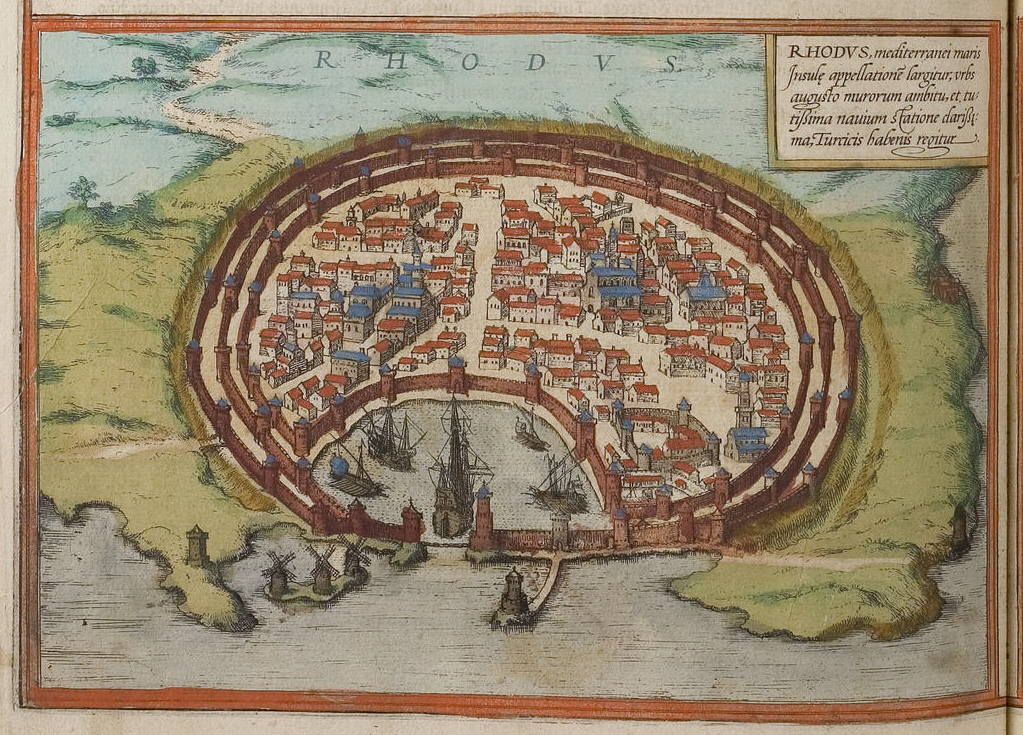
Bird's-eye view of Rhodes, from Braun & Hogenberg's Civitates Orbis Terrarum
Depicts Rhodes’ concentric fortified walls and bastioned harbour with breakwaters, harbour gate, internal street blocks, churches and windmills.
1572 · Georg Braun; Frans Hogenberg · Wikimedia Commons
Public domain (plate dated 1572)

Ships tied to Rhodes
- HMS Illustrious: Her aircraft struck the Italian seaplane base at Rhodes in 1940
Castles of Rhodes

More cities to explore
 GreeceAthensExplore it in 430 BC · AD 130 · 1835
 GreeceThessalonikiExplore it in 1200 · 1900
 GreeceAtlantisExplore it in 9600 BC
 GreeceHelikeExplore it in 373 BC
Castles of Europe · Landmarks of Europe · create your own reconstruction.